

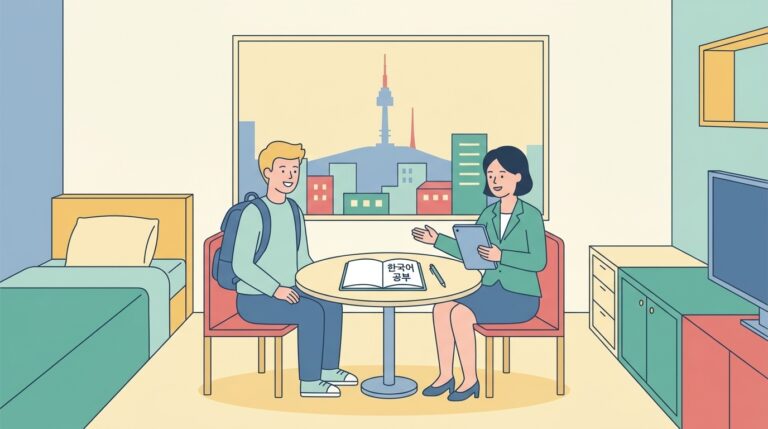
House Hunting in Korea Made Easy: Ask About Monthly Rent Like a Local!
Phase 1: Empathy & Storytelling
안녕하세요! (Annyeonghaseyo!) I’m your Daily Hangul editor and your 10-year local culture navigator in Seoul!
Imagine this: You are strolling through the vibrant streets of Sinchon or Hongdae. You spot a cozy, sunlit studio apartment (원룸, wonrum) with cute cafes just around the corner. You step into a local real estate office (부동산, budongsan) feeling excited, but suddenly your mind goes blank. “How do I ask about monthly rent without sounding like a textbook robot? What about hidden fees?”
Don’t worry at all! Renting a place in a foreign country can feel intimidating, but asking about rent in Korea is actually super straightforward once you know a few core expressions. Based on real feedback from hundreds of beginner expats and students living in Seoul, this guide will give you the exact phrases, cultural nuances, and confidence you need to navigate Korean house hunting smoothly. Let’s master this together!
Phase 2: 3 Core Expressions Deep Dive
1. 월세 얼마예요? (Wolse eolmayeyo?)
- Pronunciation: [Wol-seh eol-mah-yeh-yo?] (Rhymes softly with: “Wall-say all-mah-yay-yo?”)
- Meaning: Direct translation: “Monthly rent, how much is it?” / Real nuance: “How much is the monthly rent?”
- K-Culture Moment: You will hear young college students say this expression in Korean university lifestyle vlogs whenever they go room-touring around campus!
- Editor’s Insight: ‘월세’ (Wolse) means monthly rent. Notice how Koreans skip unnecessary prepositions. You don’t need to say “월세는 얼마입니까?”. Just short and smooth!
- Situation Spectrum: Casual 🚫 | Semi-formal ✅ | Formal ✅
- 🤔 Think About It: In your home country, do people ask about rent directly to agents, or is it considered rude to talk about money upfront?
2. 보증금은 얼마예요? (Bojeunggeumeun eolmayeyo?)
- Pronunciation: [Bo-jeung-geum-eun eol-mah-yeh-yo?] (Think: “Bow-joong-geum-oon all-mah-yay-yo?”)
- Meaning: Direct translation: “Deposit, how much is it?” / Real nuance: “How much is the security deposit?”
- K-Culture Moment: Seen in almost every Korean drama where a main character moves into a rooftop apartment (옥탑방) after signing a rental agreement.
- Editor’s Insight: Korean rentals almost always require a key money deposit (보증금). Higher deposit usually means lower monthly rent!
- Situation Spectrum: Casual 🚫 | Semi-formal ✅ | Formal ✅
- 🤔 Think About It: How does paying a large key deposit differ from rental guarantees in your own country?
3. 관리비 포함이에요? (Gwanribi poham-ieyo?)
- Pronunciation: [Gwan-ri-bi po-ham-i-e-yo?] (Think: “Gwan-ree-bee po-ham-ee-ay-yo?”)
- Meaning: Direct translation: “Maintenance fee included?” / Real nuance: “Does this include maintenance fees?”
- K-Culture Moment: Essential question when checking monthly budget during room tour videos!
- Editor’s Insight: Maintenance fees (관리비) cover cleaning, elevator operations, and sometimes water or internet. Always confirm this before signing!
- Situation Spectrum: Casual ⚠️ | Semi-formal ✅ | Formal ✅
- 🤔 Think About It: Why is it helpful to have utility management separated from base rent?
Phase 3: Textbook Korean vs Real Korean
Situation 1: Asking about rent
- 📖 Textbook Korean: 월세가 얼마입니까? (Wolse-ga eolma-imnikka?)
- 🗣️ Real Korean: 월세 얼마예요? (Wolse eolmayeyo?)
- 💡 Why the difference? Honorifics ending in ~입니까? are used in formal news broadcasts or official presentations. In a real estate office, polite informal ~예요 is standard and feels much warmer.
Situation 2: Asking if utilities/maintenance are included
- 📖 Textbook Korean: 관리비가 포함되어 있습니까? (Gwanribi-ga poham-doe-eo isseumnikka?)
- 🗣️ Real Korean: 관리비 포함이에요? (Gwanribi poham-ieyo?)
- 💡 Why the difference? Spoken Korean drops particles like ~가 and complex passive verbs, making conversation natural and effortless.
Phase 4: K-Culture Deep Dive & Non-Verbal Manners
4-1. Nunchi (눈치) & Gestures
When talking money at a Korean real estate agency, maintain polite body language. Lightly nod your head while listening. When writing down prices or looking at listings, hold your phone or pen with two hands or support your right wrist with your left hand. This demonstrates respect and good etiquette (눈치)!
4-2. Culture Code: Wolse (월세) vs Jeonse (전세)
Korea has a unique housing system. ‘Wolse’ (월세) is monthly rent paired with a security deposit. ‘Jeonse’ (전세) is a lump-sum deposit lease system where you pay a large sum upfront (no monthly rent) and get it back when your lease ends. As an international student or traveler, Wolse is the most common option you’ll encounter!
Phase 5: Real-Life Roleplay Scenario
Setting: Inside a friendly real estate agency (부동산) near Ewha Womans University.
Characters: You (Target Student) & Realtor Ms. Kim (Agent)
- Turn 1: You: 안녕하세요! 방 구하러 왔어요. (Annyeonghaseyo! Bang guhareo wasseoyo. / Hello! I came to look for a room.)
🎭 Smile politely - Turn 2: Realtor: 어서 오세요! 어떤 방 찾으세요? (Eoseo oseyo! Eotteon bang chajuseoyo? / Welcome! What kind of room are you looking for?)
- Turn 3: You: 깨끗한 원룸 구하고 있어요. (Kkaekkeut-han wonrum guhago isseoyo. / I’m looking for a clean studio.)
- Turn 4: Realtor: 이 방 어때요? 위치가 아주 좋아요. (I bang eotteoyo? Wichiga aju joa-yo. / How about this room? Location is great.)
- Turn 5: You: 예쁘네요! 월세 얼마예요? (Yeppne-yo! Wolse eolmayeyo? / It’s pretty! How much is the monthly rent?)
🎭 Point gently at listing - Turn 6: Realtor: 보증금 500만 원에 월세 50만 원이에요. (Bojeunggeum o-baek-man wone wolse o-sip-man won-ieyo. / Deposit is 5M KRW and monthly rent is 500K KRW.)
- Turn 7: You: 관리비 포함이에요? (Gwanribi poham-ieyo? / Is maintenance included?)
- Turn 8: Realtor: 네, 수도랑 인터넷 포함이에요! (Ne, sudo-rang intoneot poham-ieyo! / Yes, water and internet are included!)
🔀 Interactive Choice Point
The agent asks: “내일 방 보러 갈까요?” (Shall we go see the room tomorrow?)
* Choice A: 네, 내일 좋아요! (Ne, naeil joa-yo! / Yes, tomorrow is good!)
* Choice B: 보증금 조정돼요? (Bojeunggeum jojeong-dwaeyo? / Is the deposit negotiable?)
* Choice C: 야! 너무 비싸! (Ya! Neomu bissa! / Hey! Too expensive!)
Feedback:
* Choice A (Best): Perfect! Clear, polite, and moves the process forward naturally.
* Choice B (Risk): Acceptable, but asking to negotiate deposit immediately might require slightly more nuanced Korean.
* Choice C (Bad): Yikes! Banmal (informal speech) and aggressive phrasing will startle the realtor.
Phase 6: 10-Second Emotion Shadowing Drill
Practice these aloud with exaggerated emotion and proper pauses (/):
[😊 Curious & Polite]저기요, / 월세 / 얼마예요? (Jeogiyo, / wolse / eolmayeyo?)[🧐 Careful & Attentive]혹시 / 관리비 / 포함이에요? (Hoksi / gwanribi / poham-ieyo?)[😮 Surprised & Interested]보증금 / 500만 원이에요? (Bojeunggeum / o-baek-man won-ieyo?)
Phase 7: K-Culture Mini Dictionary
- 원룸 (Wonrum): Studio apartment / Single room layout common for young adults in Korea.
- 부동산 (Budongsan): Real estate agency / The go-to office for house hunting.
- 보증금 (Bojeunggeum): Security deposit / Key money returned at the end of the lease.
- 관리비 (Gwanribi): Building maintenance fee / Monthly fee for common maintenance and utilities.
Phase 8: Traveler’s Survival Kit
Top 3 Survival Phrases
- 월세 얼마예요? (Wolse eolmayeyo?) – How much is the monthly rent?
- 보증금 얼마예요? (Bojeunggeum eolmayeyo?) – How much is the deposit?
- 방 볼 수 있어요? (Bang bol su isseoyo?) – Can I see the room?
Editor’s Travel Note
When looking for housing in Korea, don’t rely solely on walk-ins! Use popular local house-hunting applications like Naver Real Estate or Zigbang. Before heading out, make sure to complete your Naver Map app download to easily bookmark real estate locations and calculate commuting times to your university or office.
Phase 9: One Step Deeper (Thinking Corner)
In Korean culture, housing deals are strongly built on mutual reliability and trust between tenant and landlord. Asking questions politely with standard honorifics (~요) isn’t just about language; it demonstrates that you are a respectful, responsible neighbor. When you speak politely, realtors and landlords are much more likely to help you find the best deal!
💬 Your Turn: What is the most important factor for you when choosing a house (price, location, size)? Share your thoughts in the comments below!
Phase 10: FAQ & Common Mistakes
Q: Can I negotiate monthly rent in Korea?
A: Yes! Sometimes if you offer a higher deposit (보증금), the landlord may lower the monthly rent (월세). You can ask: “보증금 높이고 월세 줄일 수 있어요?”
Q: Is utility included in 관리비 (maintenance fee)?
A: It depends on the building. Water and internet are often included, while electricity and gas are usually paid separately. Always double-check!
Q: Can I sign a contract as a foreigner?
A: Absolutely! You will need your passport or Alien Registration Card (ARC) and a local bank account.
🚨 Common Mistakes TOP 3
- Mistake: Using informal language (e.g., “월세 얼마야?”) with realtors.
- Correct Action: Always end with ~요 (e.g., “월세 얼마예요?”).
- Mistake: Assuming 관리비 includes electricity and heating.
- Correct Action: Ask specifically: “가스비랑 전기세도 포함이에요?”
- Mistake: Forgetting to convert Won accurately.
- Correct Action: Remember that 500만 원 is roughly $3,700-$4,000 USD deposit!
Phase 11: Action Mission & K-Culture Mission
🎯 Action Mission
- Bronze: Repeat “월세 얼마예요?” 5 times out loud in front of a mirror.
- Silver: Record your voice saying all 3 core expressions and listen to your pronunciation.
- Gold: Try typing “원룸 월세 얼마예요?” in a Korean learning community or mock conversation with a friend!
🎮 K-Culture Mission
Watch a clip of a Korean lifestyle vlog (자취 브이로그). Listen carefully and spot the word 원룸 or 월세 being spoken!
Phase 12: Interactive Quiz Challenge
Test your knowledge before you go house hunting!
Q1. How do you ask “How much is the monthly rent?” in polite Korean?
Click to reveal answer!
Answer: 월세 얼마예요? (Wolse eolmayeyo?)
Explanation: ‘월세’ means monthly rent and ‘얼마예요?’ means how much is it.
Q2. True or False: ‘보증금’ refers to the monthly electricity bill.
Click to reveal answer!
Answer: False!
Explanation: ‘보증금’ is the security deposit (key money), not utility bills.
Q3. Fill in the blank: Is maintenance fee included? -> ( ____ ) 포함이에요?
Click to reveal answer!
Answer: 관리비 (Gwanribi)
Explanation: ‘관리비’ means maintenance fee.







