

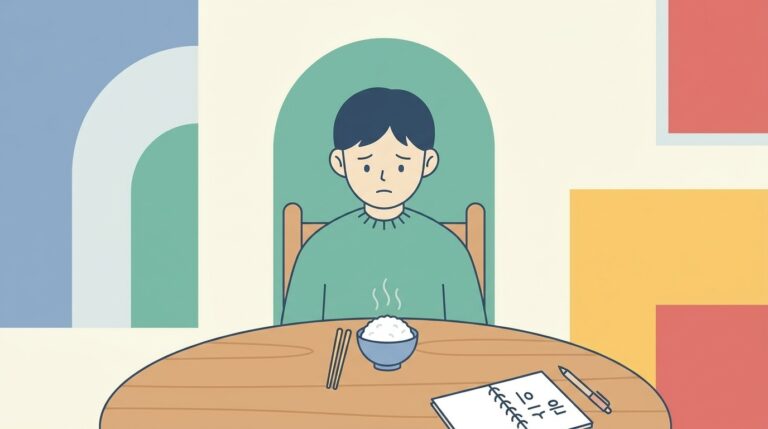
Heartbroken in Korea? Essential Korean Phrases When You Lose Your Appetite
Phase 1: Empathy (Breakup Pain Points & K-Culture Scene)
안녕하세요! Hello! Daily Hangul Editor here! Have you ever watched a emotional K-Drama scene where the main character sits alone at a dining table, staring blankly at a steaming bowl of rice while silent tears drip into the soup? That classic trope is rooted in a deeply relatable reality. Heartbreak hits hard, and in Korean culture, your emotional state is almost instantly mirrored by your eating habits. When you go through a breakup, loved ones don’t just ask “Are you okay?”—they ask, “Did you eat?” Losing your appetite after a breakup is a universally shared experience, but expressing this nuanced sorrow in Korean requires more than just dictionary translations. By mastering these expressions, you will not only articulate your raw feelings with native accuracy, but also understand how Koreans show care during tough times. Based on feedback from hundreds of intermediate learners, this guide will help you bridge the gap between robotic textbook phrases and heart-to-heart Korean conversations!
Phase 2: Deep Dive into 3 Key Expressions
1. 입맛이 없다 (Immaseui eopda)
- Pronunciation: [immaseui eopda] (Think of ‘im-mas’ sounding like ‘eem-mas’ and ‘eopda’ like ‘up-dah’)
- Meaning: Literally “Appetite does not exist” ➔ “I have no appetite.”
- K-Culture Moment: Seen frequently in K-Dramas when a friend cooks a lavish meal after a breakup, but the protagonist just pushes the spoon around.
- Editor’s Insight: ‘입맛’ combines ‘입’ (mouth) and ‘맛’ (taste). It refers specifically to your desire to eat. It is the most natural way to explain why you aren’t eating without sounding overly dramatic.
- Situation Spectrum:
- Casual: ✅ (입맛이 없어)
- Semi-formal: ✅ (입맛이 없어요)
- Formal: ✅ (입맛이 없습니다)
- 🤔 Think About It: In your culture, do people link loss of appetite directly to emotional sadness as explicitly as Koreans do?
2. 밥이 안 넘어간다 (Babi an neomeoganda)
- Pronunciation: [bab-i an neo-meo-gan-da] (Sounds like ‘bahb-ee ahn nuh-muh-gahn-dah’)
- Meaning: Literally “Food/rice does not go down (my throat)” ➔ “I’m so upset I can’t swallow food.”
- K-Culture Moment: Used in intense drama emotional climaxes when a character tries to take a bite to stay strong, but chokes up emotionally.
- Editor’s Insight: This phrase captures the physical sensation of anxiety or grief knotting up your throat. It carries deep vulnerability.
- Situation Spectrum:
- Casual: ✅ (밥이 안 넘어가)
- Semi-formal: ✅ (밥이 안 넘어간 것 같아요 / 안 넘어가요)
- Formal: ⚠️ (Used more in personal/emotional context than business)
- 🤔 Think About It: How does your native language describe the physical sensation of severe heartbreak?
3. 억지로라도 먹어야지 (Eokjirorado meogeoyaji)
- Pronunciation: [eok-ji-ro-ra-do meo-geo-ya-ji] (Sounds like ‘uck-jee-roh-rah-doh muh-gyuh-yah-jee’)
- Meaning: “You/I should eat, even if forcing it.”
- K-Culture Moment: The iconic line spoken by a best friend or mother placing a piece of side dish on top of your rice bowl.
- Editor’s Insight: ‘억지로’ means ‘by force/against one’s will’. This phrase embodies the Korean cultural belief that food provides strength (밥심) to overcome life’s obstacles.
- Situation Spectrum:
- Casual: ✅ (억지로라도 먹어)
- Semi-formal: ✅ (억지로라도 드셔야 해요)
- Formal: 🚫 (Too personal for formal corporate settings)
- 🤔 Think About It: Why is encouraging someone to force themselves to eat considered an act of love in Korea?
Phase 3: Textbook Korean vs. Real Korean
Situation 1: Declining food at lunch with close colleagues
- 📖 Textbook Korean: 저는 슬퍼서 식사를 하고 싶지 않습니다. (I do not want to eat because I am sad.)
- 🗣️ Real Korean: 마음이 안 좋아서 그런지 입맛이 전혀 없어요. (Maybe because I feel down, I really have no appetite.)
- 💡 Why different? Natives rarely state “I am sad” directly when turning down food; they attribute it to loss of appetite (‘입맛이 없다’) or a heavy mind (‘마음이 안 좋다’).
Situation 2: A friend trying to comfort you
- 📖 Textbook Korean: 당신은 음식을 먹어야 합니다. (You must eat food.)
- 🗣️ Real Korean: 기운 내려면 억지로라도 몇 숟가락 들자. (To gain energy, let’s at least take a few spoonfuls.)
- 💡 Why different? Koreans count food intake in “spoonfuls” (몇 숟가락) when someone is distressed to make eating feel less overwhelming.
Phase 4: K-Culture Deep Dive & Non-verbal Manners
4-1. Nunchi & Body Language
When a friend says they have no appetite, paying attention to 눈치 (Nunchi – social tact) is essential. It is customary to put down your chopsticks gently, sigh lightly, and lower your gaze. Do not press them aggressively with “Why aren’t you eating?” Instead, quietly pour them warm water or spoon a small amount of mild soup into their bowl.
4-2. The Culture of Care: Breakup Comfort Foods
In Korea, eating isn’t just fuel—it is emotional recovery. When someone suffers from post-breakup heartbreak, friends rarely buy them heavy meat dishes like Samgyeopsal. Instead, they send 죽 (Juk – Rice Porridge) via KakaoTalk gift coupons or take them out for warm broth like 콩나물국밥 (Bean Sprout Rice Soup). Porridge is gentle on a stomach tied in knots by grief, symbolizing gentle care and recovery.
Phase 5: Interactive Roleplay Scenario
Setting: A cozy cafe near Sinchon. Your friend Mina notices you’ve barely touched your cake after your recent breakup.
- Mina: 너 케이크 좋아하잖아. 왜 한 입도 안 먹어? 어디 아파? (You love cake. Why haven’t you eaten a single bite? Are you sick?)
- You: 아… 아니, 아픈 건 아닌데… (Ah… no, I’m not sick, but…)
- Mina: 🎭 [Looks concerned and sets down her fork] 혹시 무슨 일 있어? 얼굴이 안 좋아 보여. (Did something happen? You don’t look well.)
- You: 사실… 어제 헤어졌어. 그래서 마음이 좀 그래. (Actually… we broke up yesterday. So my mind feels heavy.)
- Mina: 🎭 [Gasps slightly and rubs your forearm] 정말? 아이구… 어떡해… 속상하겠다. (Really? Oh no… what to do… You must be so upset.)
- You: 응, 생각이 많아서 그런지 밥이 안 넘어가. (Yeah, maybe because I have so much on my mind, I can’t get any food down.)
- Mina: 🎭 [Nods with deep empathy] 그래, 그럴 때 있지. 그래도 억지로라도 조금은 먹어야 기운이 나지. (Yeah, it happens. But still, you should eat a little even if forced so you get strength.)
- You: 고마워. 그래도 마음 써줘서 속이 좀 풀린다. (Thank you. Feeling your care makes me feel a bit relieved already.)
🔀 Interactive Choice Point
How will you reply when Mina offers to get you hot porridge instead?
- Option A: 진짜 괜찮아. 나중에 먹을게. (I’m really okay. I’ll eat later.)
- Option B: 마음은 고마운데, 진짜 입맛이 없어서 죽도 안 들어갈 것 같아. (Thank you for your heart, but I really have no appetite so I don’t think porridge will go down either.)
- Option C: 그래, 그럼 딱 세 숟가락만 먹어볼게. (Okay, then I will try eating just three spoonfuls.)
Feedback:
* Option A (Bad): A bit too cold; shuts down Mina’s warm gesture abruptly.
* Option B (Risk): Honest and soft, but might leave your friend feeling helpless if you don’t express gratitude first.
* Option C (Best!): Perfect! It shows you appreciate her effort while setting a realistic boundary (“three spoonfuls”).
Phase 6: 10-Second Emotion Shadowing Drill
Practice saying these lines with authentic emotional cadence (/ indicates a natural pause):
[🥺 Downcast and soft]
생각이 많아서… / 밥이 / 전혀 안 넘어쳐요. (Saeng-gag-i man-a-seo… / bab-i / jeon-hyeo an neo-meo-ga-yo.)-
[🫂 Warm and encouraging]
힘들어도… / 억지로라도 / 몇 숟가락만 먹자. (Him-deul-eo-do… / eok-ji-ro-ra-do / Myeot sut-ga-rag-man meok-ja.)
Phase 7: K-Culture Mini Dictionary
- 이별 후유증 (Ibyeol Huyujung) | Breakup Aftermath / Aftereffects
- The physical and emotional hangover following a relationship breakup.
- 죽 (Juk) | Korean Rice Porridge
- Mild, easy-to-digest comforting food given to those sick or heartbroken.
- 밥심 (Bapsim) | Rice Energy / Power from Food
- The cultural belief that stamina and resilience come directly from eating proper meals.
- 기프티콘 (Gifticon) | Mobile Food/Goods Voucher
- Digital gift coupons sent via messaging apps like KakaoTalk to comfort friends from afar.
Phase 8: Traveler & Survival Kit
Top 3 Survival Phrases
- 소화가 안 돼요. (Sohwaga an dwaeyo) – I have indigestion.
- 부드러운 음식이 있나요? (Budeureoun eumsigi innayo?) – Do you have soft/mild food?
- 포장해 주세요. (Pojang-hae jusaeyo) – Please pack this to go.
Editor’s Travel Note
If you find yourself unwell or heartbroken while traveling in Korea, you can easily send comfort food or order warm porridge delivered to your doorstep. Check out the KakaoTalk Gifticon Service Guide or download the Naver Map Navigation App to find the nearest local porridge shop (죽집) like ‘Bon-Juk’.
Phase 9:
Frequently Asked Questions (FAQ)
Q: What does "입맛이 없다 (Immaseui eopda)" mean in Korean and how do you pronounce it?
A: In Korean, "입맛이 없다 (Immaseui eopda)" is pronounced [immaseui eopda] and means: Literally "Appetite does not exist" ➔ "I have no appetite."
Q: What does "밥이 안 넘어간다 (Babi an neomeoganda)" mean in Korean and how do you pronounce it?
A: In Korean, "밥이 안 넘어간다 (Babi an neomeoganda)" is pronounced [bab-i an neo-meo-gan-da] and means: Literally "Food/rice does not go down (my throat)" ➔ "I'm so upset I can't swallow food."
Q: What does "억지로라도 먹어야지 (Eokjirorado meogeoyaji)" mean in Korean and how do you pronounce it?
A: In Korean, "억지로라도 먹어야지 (Eokjirorado meogeoyaji)" is pronounced [eok-ji-ro-ra-do meo-geo-ya-ji] and means: "You/I should eat, even if forcing it."







