

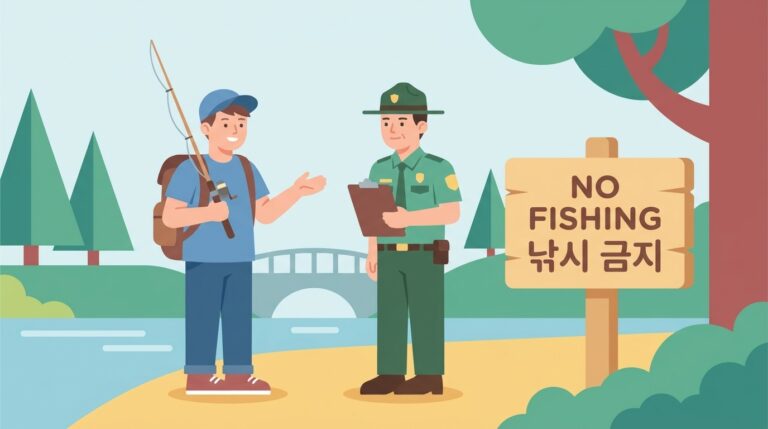
Phase 1: Empathy & Connection
안녕하세요! I’m your Daily Hangul editor and your Korean cultural bestie! Have you ever envisioned a peaceful day by a serene Korean river, fishing rod in hand, listening to the gentle flow of water? Korean fishing (낚시 – Nakshi) culture has blown up recently thanks to hit variety shows like The Fishermen and the City (나만 믿고 따라와, 도시어부). From tranquil urban spots along the Han River to ocean breakwaters, fishing is a beloved national pastime.
However, imagine this scene: You’ve set up your gear, cast your line, and are waiting for a bite. Suddenly, an official approaches you, points to a small sign, and hands you a hefty fine! The culprit? You accidentally cast your line in a 낚시 금지 구역 (No-Fishing Zone).
Many intermediate Korean learners know the basic word for ‘prohibited’ (금지), but navigating official warnings, defending your intentions respectfully, or understanding local regulations requires B2-level nuance. This guide—built on real experiences of foreign anglers in Korea—will ensure you enjoy Korea’s beautiful waters safely, confidently, and penalty-free!
Phase 2: Deep Dive into Key Expressions
1. 낚시 금지 구역입니다 (Nnak-shi geum-ji gu-yeok-im-ni-da)
- Pronunciation: [nak-shi geum-ji goo-yeok-im-ni-da] (Sounds like “knock-shee” followed by “geum” as in ‘give him’, “ji” like ‘gee’, “goo-yeok” like ‘gooey-uck’.)
- Meaning: “This is a no-fishing zone.” (Literal) / “You are not allowed to fish here.” (Nuance)
- K-Culture Moment: Seen on bright red or yellow warning banners stretched across riverbanks, breakwaters, and reservoir fences across Korea.
- Editor’s Insight: While ‘금지’ means prohibition, notice the ending ‘-입니다’. Officials use formal polite language even when issuing warnings. Responding in matching formal Korean shows respect and can de-escalate tension quickly.
- Situation Spectrum: Casual 🚫 | Semi-formal ⚠️ | Formal ✅
- 🤔 Think About It: In your home country, are prohibition signs direct or soft? How does using high-level formal speech change the tone of enforcement in Korea?
2. 과태료가 부과될 수 있습니다 (Gwa-tae-ryo-ga bu-gwa-doel su it-seum-ni-da)
- Pronunciation: [gwa-tae-ryo-ga boo-gwa-dweol soo eet-seum-ni-da]
- Meaning: “A fine may be imposed.” (Literal) / “You could be fined if you stay here.” (Nuance)
- K-Culture Moment: This phrase appears on municipal warning boards installed near environmental protection areas or drinking water sources.
- Editor’s Insight: ‘과태료’ refers specifically to administrative fines (non-criminal civil penalties), unlike ‘벌금’ which implies a criminal record fine. Knowing this distinction marks you as a sophisticated Korean speaker!
- Situation Spectrum: Casual 🚫 | Semi-formal ⚠️ | Formal ✅
- 🤔 Think About It: Notice how Korean uses passive phrasing (‘부과되다’ – to be imposed) rather than active (“We will fine you”). Why might Korean public notices prefer passive structures?
3. 몰랐어요, 바로 정리할게요 (Mol-lat-seo-yo, ba-ro jeong-ri-hal-ge-yo)
- Pronunciation: [mool-lat-seo-yo, bah-ro jung-ree-hal-geh-yo]
- Meaning: “I didn’t know, I’ll pack up right away.” (Literal/Nuance)
- K-Culture Moment: The magic phrase used by main characters in K-dramas when caught in a misunderstanding with local authorities!
- Editor’s Insight: Combining an honest admission (‘몰랐어요’) with immediate cooperative action (‘바로 정리할게요’) leverages Korean social grace. Adding the soft intention suffix ‘-ㄹ게요’ shows strong willingness to comply.
- Situation Spectrum: Casual ⚠️ | Semi-formal ✅ | Formal ✅
- 🤔 Think About It: Is apologizing immediately expected in your culture when breaking a rule unintentionally, or do people tend to argue first?
Phase 3: Textbook Korean vs. Real Native Korean
Situation 1: Spotting someone about to fish in a restricted area
- 📖 Textbook: “여기서 낚시를 하면 안 됩니다.” (You must not fish here.)
- 🗣️ Real Native: “여기 낚시 금지 구역이에요. 걸리면 벌금 나와요!” (This is a no-fishing zone. If you get caught, you’ll get fined!)
- 💡 Why the difference? Natives use ‘걸리다’ (to get caught) and ‘벌금 나오다’ (a fine comes out/is issued) in conversational contexts rather than rigid grammatical prohibitions.
Situation 2: Asking a local if fishing is allowed
- 📖 Textbook: “이곳에서 낚시가 허용됩니까?” (Is fishing permitted in this place?)
- 🗣️ Real Native: “혹시 여기 낚시해도 되는 곳인가요?” (By any chance, is this a place where fishing is allowed?)
- 💡 Why the difference? Starting questions with ‘혹시’ (by any chance) softens the inquiry, making you sound infinitely more natural and polite.
Phase 4: K-Culture Deep Dive & Non-Verbal Manners
4-1. Nunchi (눈치) & Gestures
If a park warden or police officer approaches you while fishing:
1. Stand up immediately and bow slightly (15–30 degrees). Sitting while an official talks to you can appear disrespectful.
2. Use two hands when handing over your ID or receiving a leaflet. This shows sincerity (성의).
3. Avoid waving your hand dismissively. Instead, place one hand over your chest while bowing slightly to convey “I sincerely apologize for my mistake.”
4-2. Culture Code: Korea’s Modern Fishing Craze
Fishing in Korea isn’t just sitting by a pond; it’s a massive lifestyle trend! Thanks to TV shows and YouTube culture, young Koreans actively engage in ‘Lure Fishing’ (루어 낚시) and ‘Glamping Fishing’ (글램핑 낚시). However, due to strict environmental laws protecting water quality (수질 보원) and safety on ocean breakwaters (방파제 안전), municipal enforcement using CCTV and patrols has tightened significantly. Checking local regulations via map apps before casting is now considered essential etiquette.
Phase 5: Interactive Roleplay Scenario
Setting: Han River Park (한강공원). You cast your line near a bridge. A River Patrol Officer (경찰/관리원) walks up to you.
- Officer: 저기요, 실례지만 여기서 낚시하시면 안 됩니다.
(Jeo-gi-yo, sil-lye-ji-man yeo-gi-seo nak-shi-ha-si-myeon an doem-ni-da.)
(🎭 Approachable but firm, pointing to a sign nearby) - You: 아, 정말요? 여기 낚시 금지 구역인가요?
(A, jeong-mal-yo? Yeo-gi nak-shi geum-ji gu-yeok-in-ga-yo?)
(🎭 Surprised, looking around) - Officer: 네, 표지판 보이시죠? 지정된 장소 외에는 과태료가 부과됩니다.
(Ne, pyo-ji-pan bo-i-si-jo? Ji-jeong-doen jang-so oe-e-neun gwa-tae-ryo-ga bu-gwa-doem-ni-da.)
(🎭 Pointing to the red banner on the fence) - You: 아, 표지판을 못 봤네요. 죄송합니다.
(A, pyo-ji-pan-eul mot bwat-ne-yo. Joe-song-ham-ni-da.)
(🎭 Bowing head slightly in apology) - Officer: 다음부터는 구역을 잘 확인하셔야 해요. 이번엔 경고만 드릴게요.
(Dae-um-bu-teo-neun gu-yeok-eul jal hwak-in-ha-syeo-ya hae-yo. I-beon-en gyeong-go-man deu-ril-ge-yo.)
(🎭 Relaxing posture, speaking gently) - You: 정말 몰랐어요. 지금 바로 정리하겠습니다!
(Jeong-mal mol-lat-seo-yo. Ji-geum ba-ro jeong-ri-ha-get-seum-ni-da!)
(🎭 Quickly grabbing your gear) - Officer: 근처 500미터 아래쪽에 허용 구역이 있으니 그리로 가보세요.
(Geun-cheo o-baek-mi-teo a-rae-jjok-e heo-yong gu-yeok-i it-seu-ni geu-ri-ro ga-bo-se-yo.)
(🎭 Pointing down the river path) - You: 친절하게 알려주셔서 정말 감사합니다!
(Chin-jeol-ha-ge al-ryeo-ju-syeo-seo jeong-mal gam-sa-ham-ni-da!)
(🎭 Smiling with a polite bow)
🔀 Interactive Choice Point
What would you say if the officer asks to see your ID before giving a warning?
* Choice A: “왜요? 저 그냥 몰라서 그랬는데요!” (Why? I said I didn’t know!)
* Choice B: “아, 네! 여기 있습니다. 몰라서 그랬는데 죄송합니다.” (Ah, yes! Here it is. I didn’t know, I’m sorry.)
* Choice C: “신분증 없는데요. 그냥 갈게요.” (I don’t have my ID. I’ll just leave.)
Feedback:
* Choice A (BAD): Defensive language may cause the officer to issue a fine immediately instead of a simple warning.
* Choice B (BEST): Cooperative, polite, and uses smooth B2 phrasing. The officer will likely let you off with just a friendly notice!
* Choice C (RISK): Fleeing or refusing identity verification when requested by park enforcement can escalate to police involvement.
Phase 6: 10-Second Emotion Shadowing Drill
[🥺 Apologetic & Surprised]
아… / 몰랐어요! / 표지판을 / 못 봤네요.
(Ah… / mol-lat-seo-yo! / pyo-ji-pan-eul / mot bwat-ne-yo.)-
[😊 Cooperative & Polite]
죄송합니다, / 지금 / 바로 / 정리할게요!
(Joe-song-ham-ni-da, / ji-geum / ba-ro / jeong-ri-hal-ge-yo!) -
[🙏 Inquisitive & Respectful]
혹시 / 근처에 / 낚시해도 되는 곳이 / 있나요?
(Hok-si / geun-cheo-e / nak-shi-hae-do doe-neun gos-i / it-na-yo?)
Phase 7: K-Culture Mini Dictionary
- 낚시 금지 구역 (Nakshi Geumji Guyeok) | No-Fishing Zone
- Usage: Signboards located along lakes, rivers, dams, and certain coastal zones where fishing damages ecosystems or poses safety risks.
- 과태료 (Gwataeryo) | Administrative Fine
- Usage: Civil monetary penalties for minor regulatory infractions like illegal fishing, smoking in non-smoking areas, or improper trash disposal.
- 입어료 (Ibeoryo) | Fishing Hole Entrance Fee
- Usage: Fee paid at private or managed fishing sites (유료 낚시터).
- 손맛 (Sonmat) | ‘Hand Flavor’ / The Thrill of the Catch
- Usage: A iconic Korean fishing term describing the exciting physical sensation felt in your hands when a fish bites the hook!
Phase 8: Traveler’s Survival Kit
Top 3 Survival Phrases
- 여기 낚시해도 돼요? (Yeo-gi nak-shi-hae-do dwae-yo?) – Is it okay to fish here?
- Pro Tip: Ask local convenience store owners or other anglers nearby before setting up.
- 벌금이 얼마예요? (Beol-geum-i eol-ma-ye-yo?) – How much is the fine?
- Pro Tip: Useful when reading complex rules on notice boards.
- 허용 구역이 어디예요? (Heo-yong gu-yeok-i eo-di-ye-yo?) – Where is the permitted area?
Editor’s Travel Note
Before heading out, download Naver Map App. Search for “낚시터” (Fishing Spot) or “피싱피어” (Fishing Pier). Public spots managed by local councils are tagged clearly. Always check local municipal websites (지자체 홈페이지) for seasonal prohibition periods (금어기) to protect spawning fish!
Phase 9: A Step Deeper (Cultural Reflection)
In Korea, public regulations often reflect community harmony and environmental stewardship. The rapid growth of fishing led to issues with left-behind trash (낚시 쓰레기) and water contamination, prompting local governments to strictly enforce no-fishing zones. Rather than seeing enforcement as harsh, Koreans generally view it as protecting shared public spaces for everyone’s enjoyment.
💬 Your Turn: Have you ever encountered unexpected public restrictions while traveling? How did you navigate the situation using local manners? Let us know in the comments below!
Phase 10: FAQ & Common Mistakes
Q: Can I fish anywhere along the Han River in Seoul?
A: No! Only designated areas along the Han River allow recreational fishing, and throw nets (그물) or line setups with multiple hooks are strictly forbidden.
Q: What happens if I get caught fishing in a prohibited area?
A: You may receive an administrative fine (과태료) ranging from 50,000 KRW up to 3,000,000 KRW depending on the water protection class of the site.
Q: Are foreign residents or tourists exempt if they can’t read Korean signs?
A: Ignorance of local laws is not accepted as a legal defense in Korea. However, showing polite cooperation and explaining you are a visitor will often lead officers to grant a warning rather than a fine.
🚨 Common Mistakes Warning Board
- ❌ Mistake: Arguing loudly that there were no clear signs in English.
- ✅ Correct Action: Apologize calmly using “몰랐습니다, 죄송합니다” and offer to pack up.
- ❌ Mistake: Leaving trash or fish guts on the shoreline.
- ✅ Correct Action: Always carry a trash bag (종량제 봉투) and leave zero trace (클린 낚시).
- ❌ Mistake: Using forbidden bait (e.g., toxic rice bran or excess groundbait in reservoirs).
- ✅ Correct Action: Check local restrictions on bait types to protect water quality.
Phase 11: Action Missions
- 🥉 Bronze Mission: Practice saying “몰랐어요, 바로 정리할게요!” 3 times out loud with shadowing emotions.
- 🥈 Silver Mission: Open Naver Maps, search for a river near Seoul, and look for signs saying “낚시 금지”.
- 🥇 Gold Mission: Leave a Korean comment below asking us how to say a specific fishing term you want to learn!
🎮 K-Culture Mission: Watch an episode of The Fishermen and the City (도시어부) and spot at least one native Korean expression related to fishing!
Phase 12: Interactive Quiz Challenge
1. Situation Quiz: An officer tells you “과태료가 부과될 수 있습니다.” What does this mean?
* A) Fishing is free today.
* B) You might be fined if you continue.
* C) You need to show your fishing license.
2. Blank Fill-in: Fill in the blank with the appropriate B2 expression: “표지판을 못 봤어요. 지금 _____ 정리할게요.”
* A) 내년에 (Next year)
* B) 바로 (Right away)
* C) 천천히 (Slowly)
3. True/False Culture Quiz: You can fish anywhere in Korea as long as you pay an entry fee.
* (True / False)
🔍 Click here to check your Quiz Answers & Explanations!
- Answer: B | ‘과태료’ means administrative fine, and ‘부과될 수 있습니다’ means it may be imposed.
- Answer: B (바로) | ‘바로’ means immediately/right away, showing prompt cooperation!
- Answer: FALSE | Many natural rivers, reservoirs, and coastal zones are strictly designated as 낚시 금지 구역 regardless of payment.







