

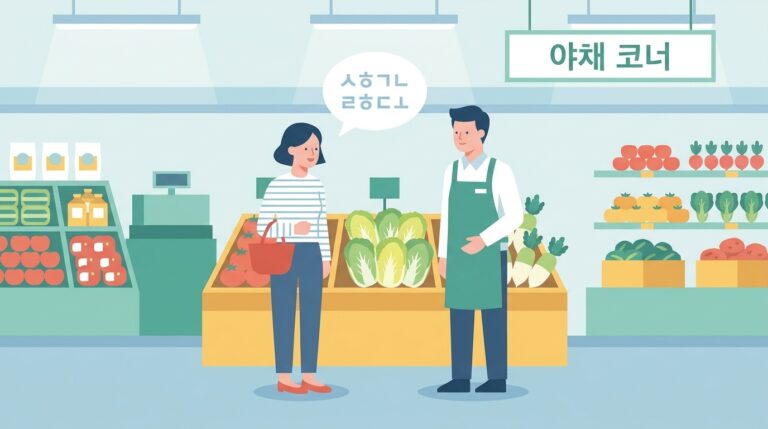
Master Korean Grocery Shopping: How to Find the Vegetable Section Effortlessly!
안녕하세요! 매일한글 에디터입니다. (Hello! This is your Daily Hangul Editor!)
Phase 1: Welcome to the K-Grocery Maze!
Have you ever walked into a massive Korean supermarket like E-Mart, Lotte Mart, or Homeplus, feeling ready to cook a delicious Korean dish, only to stand frozen in the middle of aisle 5? You hold your recipe for delicious Kimchi Stew or fresh Bibimbap, but all you see around you are rows of snacks, instant noodles, and beverages.
Finding specific sections in large Korean grocery stores can be surprisingly tricky! Many of our learners share that asking staff for help feels intimidating because textbook phrases sound too formal or stiff. Don’t worry—you don’t need complex grammar to find the fresh greens you need. Today, we’re going to unlock 3 natural, simple, A2-level Korean phrases that will get you straight to the vegetable section (채소 코너) with confidence! Based on real student experiences, learning these quick tips will transform your supermarket anxiety into a fun local adventure.
Phase 2: Core Expressions Deep Dive
1. 채소 코너가 어디예요? (Chaeso koneoga eodi-yeyo?)
- Pronunciation: Chae-so koh-neo-ga uh-dee-yay-yo? (Sounds like ‘Chae-so’ as in ‘chair-saw’ + ‘corner’ pronounced with a light K sound)
- Meaning: “Where is the vegetable section?”
- K-Culture Moment: Seen in everyday Korean vlogs or modern slice-of-life dramas when characters do weekend meal prep.
- Editor’s Insight: ‘채소’ (chaeso) is the standard Korean word for vegetables. Combining it with ‘코너’ (corner) creates the exact term used on supermarket signage.
- Situation Spectrum: Casual ⚠️ / Semi-formal ✅ / Formal ✅
- 🤔 Think About It: How does borrowing English words like ‘corner’ (코너) in Korean make store navigation easier for learners?
2. 야채는 어디에 있어요? (Yachaeneun eodie issoyo?)
- Pronunciation: Yah-chae-neun uh-dee-ae iss-uh-yo? (Sounds like ‘Yah’ + ‘Chae’ + ‘iss-oh-yo’)
- Meaning: “Where are the vegetables?”
- K-Culture Moment: Commonly used by grandmothers and home cooks asking mart staff in traditional markets or neighborhood supermarkets.
- Editor’s Insight: While ‘채소’ is pure Korean, ‘야채’ (yachae) is an extremely common everyday word for vegetables. Both are instantly understood!
- Situation Spectrum: Casual ✅ / Semi-formal ✅ / Formal ⚠️
- 🤔 Think About It: Why do native speakers often use two different words (‘채소’ vs ‘야채’) for the same concept?
3. 이쪽에 있어요? (Ijjoge issoyo?)
- Pronunciation: Ee-jjoh-gae iss-uh-yo? (‘Ee’ as in key + ‘jjok’ + ‘iss-oh-yo’)
- Meaning: “Is it over this way?”
- K-Culture Moment: Perfect when pointing in a general direction while holding a shopping basket.
- Editor’s Insight: Instead of asking long questions, simply pointing towards an aisle and asking “이쪽에 있어요?” works like magic when you’re in a hurry.
- Situation Spectrum: Casual ✅ / Semi-formal ✅ / Formal 🚫
- 🤔 Think About It: How does combining simple gestures with short phrases boost communication efficiency in Korea?
Phase 3: Textbook Korean vs. Real Korean
Scenario 1: Asking store staff
* 📖 Textbook: 실례지만, 신선한 채소가 있는 장소가 어디입니까? (Excuse me, where is the location with fresh vegetables?)
* 🗣️ Real Korean: 저기요, 채소 코너 어디예요? (Excuse me, where’s the vegetable corner?)
* 💡 Why the difference? Real Koreans use ‘저기요’ (excuse me) and short, direct questions rather than overly formal, complex sentence structures.
Scenario 2: Confirming direction
* 📖 Textbook: 야채 코너는 오른쪽으로 가면 나옵니까? (If I go to the right, does the vegetable corner appear?)
* 🗣️ Real Korean: 야채 저쪽에 있어요? (Are vegetables over there?)
* 💡 Why the difference? Conversational Korean heavily relies on context and pointing rather than full directional verbs.
Phase 4: K-Culture Deep Dive & Non-verbal Manners
4-1. Nunchi (눈치) & Supermarket Gestures
When approaching staff in a busy Korean supermarket, timing is key! Staff wearing aprons or vests are often restocking shelves quickly. Use ‘Nunchi’ (reading the room): make soft eye contact, give a polite mini head-nod (about 15 degrees), and say “저기요~” (Jeogiyo~) with a slightly rising tone. Pointing gently with an open palm—never a single index finger—towards an aisle shows high politeness!
4-2. Culture Code: The Magic of K-Mart Culture
In Korean culture, grocery shopping at large marts is a popular weekend family outing or date activity! You will often encounter ‘시식’ (sisik – food tasting stations) near the vegetable and meat sections. Knowing where the vegetable section is located often places you right next to fresh fruit displays and delicious food sampling booths!
Phase 5: Real-Life Roleplay Scenario
Setting: Inside a large Korean supermarket (Lotte Mart). You are looking for lettuce and garlic.
Characters: You (Shopping enthusiast) & Mart Employee (Wearing a green apron).
- You: 저기요! 실례합니다. (Jeogiyo! Sillyehamnida.) 🎭 Politely nodding with a warm smile
- Staff: 네, 손님! 무엇을 도와드릴까요? (Ne, sonnim! Mueoseul dowadeurilkkal-yo?) 🎭 Stopping restocking and turning friendly
- You: 채소 코너가 어디예요? (Chaeso koneoga eodi-yeyo?) 🎭 Looking around holding a basket
- Staff: 아, 채소는 직진하셔서 왼쪽으로 가시면 있어요! (A, chaesoneun jikjin-haseoso oen-jjog-euro gasimyeon issoyo!)
- You: 아, 직진해서 왼쪽이요? (A, jikjin-haeseo oen-jjog-iyo?) 🎭 Pointing gently to the left
- Staff: 네! 시식 코너 바로 옆에 있습니다. (Ne! Sisik koneo baro yeope isseumnida.)
- You: 아, 감사합니다! (A, gamsahamnida!) 🎭 Bowing head slightly
- Staff: 즐거운 쇼핑 되세요! (Jeulgeoun syoping doeseo-yo!)
🔀 Interactive Choice Point
What would you say if you didn’t hear the staff clearly?
* Option A: 죄송하지만, 다시 말씀해 주세요. (Best – Polite and clear)
* Option B: 뭐요? (Bad – Very rude/abrupt)
* Option C: 네? (Risk – Natural but can sound sharp if tone is wrong)
Phase 6: 10-Second Emotion Shadowing Drill
[😊 Friendly & Polite]저기요 / 채소 코너가 / 어디예요?[🤔 Curious & Confirming]아 / 직진해서 / 왼쪽이요?[🙏 Grateful & Bright]정말 / 감사합니다!
Phase 7: K-Culture Mini Dictionary
- 채소 (Chaeso) / 야채 (Yachae) | Vegetables | Used interchangeably on signs, menus, and market stalls.
- 신선도 (Sinseondo) | Freshness | Frequently seen on signs highlighting farm-fresh greens.
- 시식 (Sisik) | Free Food Sample | Sampling food stands inside Korean grocery marts.
- 코너 (Koneo) | Section / Aisle | Used for store sections like 과일 코너 (fruit section).
Phase 8: Traveler’s Survival Kit
Top 3 Survival Phrases
- 채소 어디예요? (Chaeso eodi-yeyo?) – Vegetables where?
- 이거 신선해요? (Igeo sinseonhaeyo?) – Is this fresh?
- 봉투 주세요. (Bongtu juseyo.) – Please give me a shopping bag.
Editor’s Travel Note
When shopping in Korea, remember that plastic bags cost around 100-500 KRW. Always carry an eco-bag! To easily locate nearby supermarkets, download and check the Naver Map App.
Phase 9: One Step Deeper
In Korean supermarkets, language reflects hospitality and speed. Korean society highly values efficiency (‘빨리빨리’ culture) alongside politeness. Asking concise questions like “채소 코너 어디예요?” respects the staff’s busy workflow while receiving quick, accurate help. It shows how language adapts to fast-paced daily life!
💬 Your Turn: What vegetable are you most excited to buy in a Korean mart? Tell us in the comments below!
Phase 10: FAQ & Common Mistakes
Q: Is there any difference between 채소 (Chaeso) and 야채 (Yachae)?
A: ‘채소’ is pure Korean and used in official settings/signs, while ‘야채’ is slightly more conversational. Both are completely fine to use!
Q: How do I ask for organic vegetables?
A: You can look for or ask for “유기농” (Yuginong) by saying: “유기농 채소 어디에 있어요?”
Q: Do supermarket staff expect tips in Korea?
A: No! Tipping is not practiced in Korea anywhere, including supermarkets.
🚨 Common Mistakes Alert
- ❌ Mistake 1: Saying “야채 어디입니까?” to a supermarket clerk. -> Too formal/stiff!
- ✅ Correct Action: Say “야채 코너 어디예요?”
- ❌ Mistake 2: Pointing directly with one finger at staff. -> Can seem impolite.
- ✅ Correct Action: Gestures with an open palm.
- ❌ Mistake 3: Waiting passively without saying “저기요”. -> Staff might think you’re just looking around.
- ✅ Correct Action: Politeness starts with a light “저기요~”.
Phase 11: Action Mission
- 🥉 Bronze Mission: Practice saying “채소 코너 어디예요?” 3 times out loud.
- 🥈 Silver Mission: Write a comment below using today’s sentence pattern with another section (e.g., 과일 코너).
- 🥇 Gold Mission: Visit a local Korean grocery store or Korean mart and ask the staff in Korean!
🎮 K-Culture Mission: Watch a scene in your favorite K-Drama where characters go grocery shopping and spot if they say ‘채소’ or ‘야채’!
Phase 12: Interactive Quiz Challenge
1. Fill in the blank: “채소 ___ 어디예요?”
* A) 마트 (Mateu)
* B) 코너 (Koneo)
* C) 식당 (Sikdang)
Click to view Answer & Explanation
Answer: B) 코너 (Koneo). ‘채소 코너’ means vegetable section!
2. True or False: Tipping grocery store clerks in Korea is expected.
Click to view Answer & Explanation
Answer: False! Korea is a strictly non-tipping culture.







