

Phase 1: 공감 (Empathy Opening)
안녕하세요! 매일한글 에디터입니다.
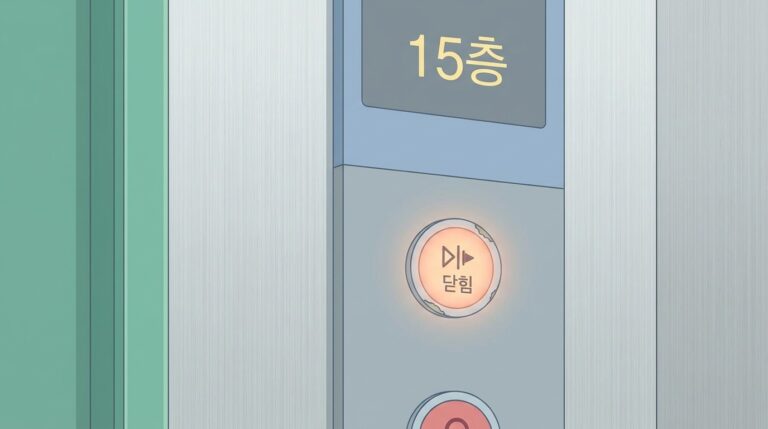
Have you ever stepped into a shiny, ultra-modern elevator in a Seoul skyscraper and noticed something intriguing? The ‘Open’ (열림) button looks untouched, shiny, and pristine. But right next to it, the ‘Close’ (닫힘) button is faded, scratched, or literally worn out from millions of impatient taps!
Before the doors even begin to slide shut, you will often see a local tapping that button three times in rapid succession like a gaming combo. Welcome to Korea’s iconic Ppalli-Ppalli (빨리빨리 – Hurry, Hurry) culture! As a 10-year local culture navigator, I have watched so many intermediate learners freeze in these fast-paced Korean service moments. You might worry about stepping on toes or sounding rude when everyone is moving at high speed.
Don’t worry! Fast culture in Korea isn’t about being mean—it is actually a unique form of consideration and efficiency. By learning a few high-frequency phrases and understanding the underlying rhythm, you will transform from an anxious onlooker into a confident, natural speaker who navigates Seoul like a true insider!
Phase 2: 핵심 표현 3선 심층 분석 (Top 3 Key Expressions)
1. 문 닫힐게요 (Mun dachil-geyo)
- Pronunciation: [Mun da-chil-geyo] (Sounds like “Moon” + “touch-ill” + “geyo”)
- Meaning: “I’m closing the door” / “The doors are closing now.”
- K-Culture Moment: Pushing the elevator close button while gently announcing it to incoming passengers in office buildings or apartments.
- Editor’s Insight: Instead of silently pressing the button, adding this short sentence shows you are conscious of others around you while keeping things moving fast.
- Situation Spectrum: Casual ⚠️ | Semi-formal ✅ | Formal ✅
- 🤔 Think About It: Why do Koreans announce an automated mechanical action out loud? How does speech bridge efficiency and politeness in your culture?
2. 잠시만요! (Jamsimanyo!)
- Pronunciation: [Jahm-shee-mahn-yo] (Sounds like “Jam” + “she” + “mahn-yo”)
- Meaning: “Just a moment!” / “Hold the door!” / “Excuse me!”
- K-Culture Moment: Shouting from down the hallway when an elevator door is starting to close, or squeezing through a crowded elevator car.
- Editor’s Insight: This is Korea’s ultimate survival phrase. It works whether you are holding a door, stepping off a crowded subway, or asking a clerk for a quick second.
- Situation Spectrum: Casual ✅ | Semi-formal ✅ | Formal ✅
- 🤔 Think About It: How can one single phrase cover both “hold on” and “get out of my way” depending on your tone of voice?
3. 먼저 가세요 (Meonjeo gaseyo)
- Pronunciation: [Muhn-juh gah-seh-yo] (Sounds like “Mun” + “jaw” + “gah-say-yo”)
- Meaning: “Please go ahead” / “After you.”
- K-Culture Moment: Yielding your spot in a tight elevator to an elderly neighbor or someone carrying heavy packages.
- Editor’s Insight: Ppalli-Ppalli speed culture is balanced by deep-rooted respect. Offering someone else the lead proves you master both speed and courtesy.
- Situation Spectrum: Casual ⚠️ | Semi-formal ✅ | Formal ✅
- 🤔 Think About It: Is speed in your culture considered antithetical to politeness, or can they go hand-in-hand like in Korea?
Phase 3: 교과서 한국어 vs 진짜 한국어 (Textbook vs Real-Life)
Situation 1: Asking someone to hold the door
- 📖 교과서 한국어: 엘리베이터 문을 열어 주시겠습니까? (Would you please open the elevator door for me?)
- 🗣️ 진짜 한국어: 잠시만요! 문 좀 잡아주세요! (Just a sec! Please hold the door!)
- 💡 왜 다를까?: In real life, elevator doors move in seconds. Real Korean relies on punchy verb structures like ~아/어 주세요 combined with the soft filler ‘좀’ (a bit) for quick, polite impact.
Situation 2: Checking if someone is getting off at the current floor
- 📖 교과서 한국어: 당신은 이번 층에서 내릴 것입니까? (Are you planning to get off at this floor?)
- 🗣️ 진짜 한국어: 내리실 건가요? / 먼저 내릴게요! (Are you getting off? / I’ll get off first!)
- 💡 왜 다를까?: Korean conversation drops subject pronouns (“당신”) completely. Using honorific verb forms (내리시다) makes the sentence concise and natural.
Phase 4: K-Culture 딥다이브 & 비언어적 매너 (Culture Deep Dive)
4-1. 눈치 (Nunchi) & Elevator Body Language
- The Sensor Wave: When shouting “잠시만요!”, extend one arm toward the door frame or sensor line. This physically signals to passengers inside that you are moving in.
- The Nod of Gratitude (목인사): When someone holds the door open for you, make brief eye contact, lower your head about 15 degrees, and say “감사합니다!” (Gamsahabnida!).
- Button Etiquette: If you are standing closest to the control panel, you are officially the designated elevator captain! Be ready to operate ‘열림’ (Open) and ‘닫힘’ (Close) for everyone.
4-2. Culture Code: The Philosophy of Service Speed
In Korea, fast service isn’t rushed work; it is viewed as high-quality service. From 30-minute food deliveries to lighting-fast fiber internet and rapid elevator buttons, speed reflects care for other people’s valuable time.
Phase 5: 실전 롤플레이 시나리오 (Interactive Roleplay)
Setting: A bustling office building in Gangnam during lunchtime. The elevator is getting full.
Characters: Minjun (Speedy Korean Office Worker) & You (Intermediate Learner).
- Minjun: (Tapping his foot lightly) 몇 층 가세요?
(Myeot cheung gaseyo? / Which floor are you going to?) - You: 7층요! 감사합니다.
(Chil-cheung-yo! Gamsahabnida. / 7th floor, please! Thank you.) - Minjun: 🎭 [Presses 7 and quickly hovers finger over close button] 7층 누르고… 문 닫힐게요.
(Chil-cheung nureogo… mun dachil-geyo. / Pressed 7… Closing doors now.) - Someone outside: 잠시만요! 같이 타요!
(Jamsimanyo! Gachi tayo! / Wait a second! Let me get on!) - You: 🎭 [Reaching hand out to door] 어, 문 열어 드릴게요!
(Eeo, mun yeoreodueril-geyo! / Oh, I’ll hold the door open for you!) - Minjun: 🎭 [Nodding with a smile] 오, 센스 있으시네요!
(O, senseu isseusineyo! / Wow, great situational awareness!) - You: 먼저 내리세요. 제가 문 잡고 있을게요.
(Meonjeo naeriseyo. Jega mun japgo isseul-geyo. / Please get off first. I’ll hold the door.) - Minjun: 고마워요! 좋은 하루 되세요!
(Gomawoyo! Joeun haru doeseyo! / Thanks! Have a great day!)
🔀 인터랙티브 분기점 (Interactive Choice)
Question: The door is closing, and you see an elderly person approaching with shopping bags. What do you say and do?
- A. Stay quiet and press ‘닫힘’ (Close) button to stay on schedule.
- B. Shout “잠시만요!” while pressing ‘열림’ (Open) and hold the door politely.
- C. Step out of the elevator completely without saying anything.
🔍 Click to see Feedback for your choice!
- Option A (Bad/Risk): 🚫 Culture faux pas! While speed is appreciated, respecting elders always comes first in Korean etiquette.
- Option B (BEST!): ✅ Perfect! You demonstrated high Nunchi, combining prompt Korean speech (“잠시만요!”) with respectful consideration.
- Option C (Awkward): ⚠️ Confusing! Stepping out silently might confuse passengers inside about where you are going.
Phase 6: 10초 감정 섀도잉 드릴 (10-Sec Emotion Shadowing)
Practice these rhythmic pauses (/) and emotions out loud!
[😊 Energetic & Polite]
잠시만요! / 문 좀 / 잡아주세요!
(Jahmsimanyo! / mun jom / jahb-ah-joo-seh-yo!)-
[⚡ Quick & Alert]
문 / 닫힐게요! / 조심하세요!
(Mun / da-chil-geyo! / jo-shim-ha-seh-yo!) -
[🤝 Warm & Considerate]
바쁘시면 / 먼저 / 가세요!
(Bah-ppeu-shim-yeon / meon-jeo / gah-seh-yo!)
Phase 7: K-Culture 미니 사전 (Mini Dictionary)
- 닫힘 (Dachim) | Close (Button) | The most used word on elevator buttons across Korea.
- 열림 (Yeollim) | Open (Button) | The opposite of Dachim; keep an eye out for these two symbols (닫힘 vs 열림).
- 빨리빨리 (Ppalli-Ppalli) | Hurry-Hurry Culture | Korea’s dynamic speed-oriented cultural mindset.
- 눈치 (Nunchi) | Social Tact / Intuition | The ability to sense surrounding feelings and act quickly in public settings.
Phase 8: 여행자를 위한 생존 키트 (Traveler’s Survival Kit)
Survival Expressions TOP 3
- 몇 층 가세요? (Myeot cheung gaseyo?) = Which floor are you heading to?
- 먼저 내릴게요! (Meonjeo naeril-geyo!) = I’ll get off first! (Useful in jammed elevators)
- 죄송합니다, 지나갈게요! (Joesonghabnida, jinagal-geyo!) = Sorry, passing through!
Editor’s Travel Note
When traveling around Seoul, speed is key! Download the Naver Map app navigation guide to check exact exit numbers and transit transfers in real time. Knowing which subway car is closest to the elevator saves you tons of walking time!
Phase 9: “한 발 더 깊이” (Deep Dive Essay)
Foreign visitors often mistake Korea’s Ppalli-Ppalli culture for impatience. However, when viewed through the lens of community dynamics, speed is actually an act of mutual respect. By doing things quickly—whether ordering food, clearing an elevator aisle, or paying at a register—you prevent taking up unnecessary time from the person behind you. Speed in Korea is simply efficiency wrapped in consideration.
💬 Your Turn: Has there been a moment during your travels where fast service blew your mind? Share your story in the comments below!
Phase 10: FAQ & Common Mistakes
Q: Is pressing the ‘Close’ button in Korea considered rude?
A: Not at all! In fact, pressing ‘닫힘’ once everyone is safely inside is expected. Sitting in an open elevator silently without pushing close can make locals wonder why you aren’t closing it!
Q: How do I distinguish between ‘열림’ (Open) and ‘닫힘’ (Close) buttons fast?
A: Look at the Hanja roots! ‘열’ (Yeol) sounds like expanding open, while ‘닫’ (Dat) sounds like shutting tight. Also remember: 닫 (Close) has the bottom consonant ‘ㄷ’ which looks like a box closing!
Q: What if I accidentally close the door on someone?
A: Immediately hit ‘열림’ (Open) and say with an apologetic tone: “아, 죄송합니다!” (Ah, joesonghabnida!).
🚨 Common Mistakes TOP 3
- Mistake: Saying “기다려요!” (Wait!) aggressively.
- Correct Action: Say politely “잠시만요~!” (Just a moment please~!).
- Mistake: Standing directly in front of elevator doors blocking people exiting.
- Correct Action: Stand to the sides of the door line until passengers step out.
- Mistake: Saying formal textbook phrases like “문을 열어 주십시오”.
- Correct Action: Keep it punchy: “문 좀 잡아주세요!”.
Phase 11: 액션 미션 & 참여 유도 (Action Missions)
- 🥉 Bronze Mission: Practice saying “문 닫힐게요” and “잠시만요!” 3 times in front of your mirror.
- 🥈 Silver Mission: Record a 5-second voice clip reciting the Shadowing Drill phrases and post it on Instagram tagging
@DailyHangul! - 🥇 Gold Mission: Use “잠시만요!” or “먼저 가세요” in real life at a local elevator, hotel, or subways during your next trip to Korea!
🎮 K-Culture Mission: Watch a modern K-Drama episode set in an office building (e.g., Misaeng or Business Proposal). Count how many times characters press the elevator button or say “잠시만요!”!
Phase 12: 인터랙티브 퀴즈 챌린지 (Quiz Challenge)
Quiz 1. Fill in the blank
When you want to ask someone politely to hold the elevator door, you say:
“잠시만요! 문 ___ 잡아주세요!”
* A) 아주 (Aju)
* B) 좀 (Jom)
* C) 너무 (Neomu)
▶ Show Answer & Explanation
Answer: B) 좀 (Jom)
Explanation: ‘좀’ is a magic modifier in Korean that softens requests, making “문 좀 잡아주세요” sound natural and polite!
Quiz 2. True or False
In Korea, standing next to the elevator buttons makes you the unofficial elevator operator for that ride.
▶ Show Answer & Explanation
Answer: TRUE!
Explanation: It’s standard Korean elevator courtesy (Nunchi) for the person closest to the control panel to press open/close buttons for fellow passengers.







