

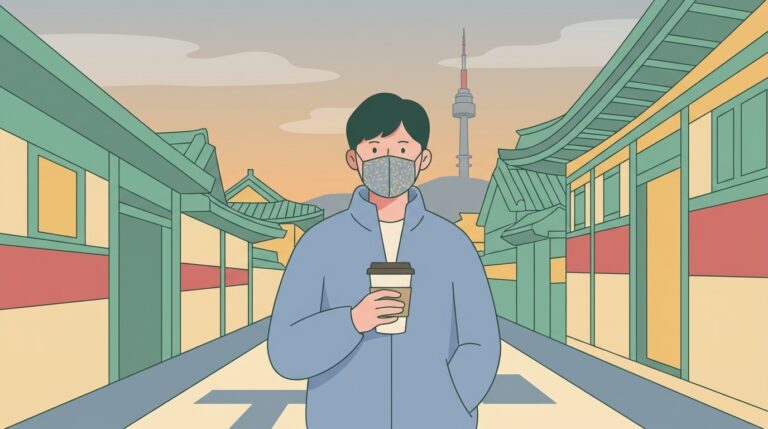
Survival Guide to Fine Dust in Korea: Essential Weather Expressions for Beginners
Phase 1: Empathy & Story Intro
안녕하세요! I’m the lead editor at Daily Hangul, your 10-year local culture navigator! Imagine this: You step outside your cozy Airbnb in Seoul, ready to explore the vibrant street food stalls of Myeongdong or grab a iced Americano at a chic Seongsu cafe. But as soon as you look up, the sky isn’t its usual bright blue—it looks foggy, grey, and hazy. Your throat feels a bit scratchy. You look around, and almost every local is wearing a crisp white or black KF94 mask. Welcome to spring in Korea, where fine dust (미세먼지) makes its annual appearance! Knowing how to talk about fine dust isn’t just about weather chit-chat; it’s a vital survival skill for staying comfortable and safe. Today, we’re unlocking simple A1-level Korean phrases so you can confidently ask about air quality, buy masks at Olive Young, or ask your host to turn on the air purifier. Let’s make sure grey skies never ruin your K-adventure!
Phase 2: 3 Core Expressions Deep Dive
1. 미세먼지가 심해요
- Pronunciation: [Mi-se-meon-ji-ga sim-hae-yo] (Sounds like Me-say-mon-gee-gah seam-hey-yo)
- Meaning: Literal: “Fine dust is severe.” | Actual Niuance: “The air quality is really bad today because of fine dust.”
- K-Culture Moment: You hear this sentence constantly on K-Dramas when characters check their weather apps before heading out for a outdoor date.
- Editor’s Insight: ‘미세’ means micro/fine, ‘먼지’ means dust, and ‘심해요’ comes from ‘심하다’ (to be severe). It’s simple, essential, and instantly understood by every local.
- Situation Spectrum: Casual (✅) / Semi-formal (✅) / Formal (✅)
- 🤔 Think About It: How does your home country talk about air pollution? In Korea, checking fine dust levels is as routine as checking the temperature!
2. 마스크 써야 돼요
- Pronunciation: [Ma-seu-keu sseo-ya dwae-yo] (Sounds like Mah-sue-keu ssuh-yah dway-yo)
- Meaning: Literal: “Must wear a mask.” | Actual Niuance: “You really should wear a mask today.”
- K-Culture Moment: Friendly convenience store clerks might point at their face and say this when you buy an iced drink on high-dust days.
- Editor’s Insight: ‘마스크’ is the loanword for mask. Combining it with ‘써야 돼요’ (must wear) creates a useful daily advice phrase.
- Situation Spectrum: Casual (✅) / Semi-formal (✅) / Formal (⚠️)
- 🤔 Think About It: In Korea, wearing a mask isn’t just self-care—it’s viewed as a polite gesture for community health!
3. 공기청정기 켜 주세요
- Pronunciation: [Gong-gi-cheong-jeong-gi kyeo ju-se-yo] (Sounds like Gong-gee-chuhng-juhng-gee kyuh joo-say-yo)
- Meaning: Literal: “Please turn on the air purifier.” | Actual Niuance: “Could you turn on the air purifier, please?”
- K-Culture Moment: Said when entering a cafe, hotel room, or Airbnb during bad dust days.
- Editor’s Insight: Almost every modern Korean indoor space has a ‘공기청정기’ (air purifier). Knowing ‘켜 주세요’ (please turn on) is super handy!
- Situation Spectrum: Casual (⚠️) / Semi-formal (✅) / Formal (✅)
- 🤔 Think About It: Koreans prioritize clean indoor environments. Turning on air purifiers is standard hospitality!
Phase 3: Textbook Korean vs. Real Korean
Situation 1: Discussing Bad Air Outside
* 📖 Textbook Korean: 오늘 대기 오염 수준이 매우 높습니다. (O-neul dae-gi o-yeom su-jun-i mae-u nop-seum-ni-da.) – “Today’s atmospheric pollution level is extremely high.”
* 🗣️ Real Korean: 오늘 미세먼지 진짜 심해요! (O-neul mi-se-meon-ji jin-jja sim-hae-yo!) – “Fine dust is super bad today!”
* 💡 Why it’s different: Textbook Korean sounds like a official news broadcast. Locals use ‘진짜 심해요’ for natural daily empathy.
Situation 2: Reminding a Friend to Wear a Mask
* 📖 Textbook Korean: 보건용 마스크를 착용하십시오. (Bo-geon-yong ma-seu-keu-reul chak-yong-ha-sip-si-o.) – “Please equip a health protection mask.”
* 🗣️ Real Korean: 마스크 꼭 쓰세요! (Ma-seu-keu kkok sseu-se-yo!) – “Make sure to wear a mask!”
* 💡 Why it’s different: ‘착용하다’ is formal jargon. Real friends use ‘쓰다’ (to wear/put on on face) with ‘꼭’ (definitely/make sure).
Phase 4: K-Culture Deep Dive & Non-verbal Manners
4-1. Nunchi & Gestures
When fine dust is high, Koreans instinctively check weather apps (like NAVER or Kakao Weather) before stepping outside. If you see people wearing masks indoors or coughing slightly into their sleeve, that’s your cue! A subtle nod while pointing slightly to your mask shows high Nunchi (social awareness).
4-2. Culture Code: Yellow Dust & KF94 Masks
Fine dust in Korea often includes ‘황사’ (Yellow Dust) coming from regional deserts in spring. To combat this, Korea developed the famous ‘KF’ (Korea Filter) mask standard. You’ll see ‘KF94’ everywhere in Olive Young or GS25 convenience stores. Wearing one isn’t seen as being sickly—it’s seen as smart self-care!
Phase 5: Interactive Roleplay Scenario
Setting: You are inside a trendy cafe in Hongdae. The door is open, and hazy air is coming in. You want to ask the friendly barista (NPC Minjun) about the dust level and if the indoor air purifier is on.
- Turn 1 (Barista Minjun): 안녕하세요! 주문하시겠어요? (Hello! Ready to order?)
- Turn 2 (You): 🎭 [Pointing outside with a worried face] 안녕하세요! 오늘 미세먼지 심해요? (Hello! Is fine dust bad today?)
- Turn 3 (Barista Minjun): 네, 오늘 미세먼지 수치가 진짜 나빠요. (Yes, the fine dust level is really bad today.)
- Turn 4 (You): 🎭 [Looking around the cafe] 아, 그래요? 마스크 써야 돼요. (Ah, really? Must wear a mask.)
- Turn 5 (Barista Minjun): 맞아요. 바깥에서는 꼭 쓰세요! (That’s right. Make sure to wear one outside!)
- Turn 6 (You): 🎭 [Politely asking] 혹시 공기청정기 켜 주세요? (By any chance, please turn on the air purifier?)
- Turn 7 (Barista Minjun): 🎭 [Smiles and presses the button] 네! 지금 바로 켜 드릴게요. (Yes! I’ll turn it on right now.)
- Turn 8 (You): 감사합니다! 따뜻한 아메리카노 주세요. (Thank you! Warm Americano please.)
🔀 Interactive Choice Point:
How would you respond if the barista asks: “목은 괜찮으세요?” (Is your throat okay?)
* Option A: 네, 괜찮아요! 공기청정기 감사합니다. (Best: Polite, clear, and acknowledges their courtesy.)
* Option B: 미세먼지 나빠요. (Bad: Ignores their polite question about your throat.)
* Option C: 마스크 주세요. (Risk: Demanding a free mask from a cafe worker might feel slightly awkward.)
Phase 6: 10-Second Emotion Shadowing Drill
[😷 Worried & Scratchy Throat]오늘 / 미세먼지 / 진짜 심해요… (O-neul / mi-se-meon-ji / jin-jja sim-hae-yo…)[💡 Helpful & Friendly]마스크 / 꼭 / 쓰세요! (Ma-seu-keu / kkok / sseu-se-yo!)[😊 Polite Request]공기청정기 / 켜 주세요! (Gong-gi-cheong-jeong-gi / kyeo ju-se-yo!)
Phase 7: K-Culture Mini Dictionary
- 미세먼지 (Mi-se-meon-ji): Fine dust / PM10 air particles.
- 초미세먼지 (Cho-mi-se-meon-ji): Ultra-fine dust / PM2.5 particles (‘초’ means super/ultra).
- 마스크 (Ma-seu-keu): Face mask (KF80, KF94 standard protection).
- 공기청정기 (Gong-gi-cheong-jeong-gi): Air purifier found in homes, cafes, and buses.
Phase 8: Travel Survival Kit
Top 3 Survival Phrases:
1. 오늘 미세먼지 어때요? (How is fine dust today?)
2. KF94 마스크 있어요? (Do you have KF94 masks?)
3. 창문 닫아 주세요. (Please close the window.)
Editor’s Travel Note:
Before heading out in Korea, download the Naver Map App Download Page to check real-time air quality indicators alongside your travel routes. Green means good, yellow means moderate, and red/purple means high dust levels!
Phase 9: A Step Deeper (Mini Essay)
In many Western cultures, wearing a mask outdoors historically meant you were sick or recovering. However, in Korea, mask culture evolved out of practical protection against seasonal dust storms. Wearing a mask is an act of shared responsibility—it keeps your lungs healthy and keeps everyone around you comfortable. It shows respect for public well-being!
💬 Your Turn: Is mask-wearing common in your city during bad weather? Let us know in the comments below!
Phase 10: FAQ & Common Mistakes
Q: What is the difference between 미세먼지 and 초미세먼지?
A: ‘미세먼지’ refers to general fine dust (PM10), while ‘초미세먼지’ means ultra-fine dust (PM2.5) which is smaller and penetrates deeper. Locals use ‘미세먼지’ as a general umbrella term.
Q: Where is the best place to buy good quality masks in Korea?
A: You can buy them at any local convenience store (CU, GS25, Seven Eleven) or pharmacy (약국). For fashionable or skin-friendly KF94 masks, visit Olive Young!
Q: Can I use ‘심해요’ for other weather conditions?
A: Yes! ‘심해요’ means severe/bad. You can say ‘비가 심해요’ (Rain is heavy/severe) or ‘추위가 심해요’ (The cold is severe).
🚨 Top 3 Common Mistakes:
1. Mistake: Saying “마스크 입으세요” (Incorrect verb for wearing mask).
Correct Action: Use ‘쓰다’ -> “마스크 쓰세요”.
2. Mistake: Confusing ‘켜 주세요’ (turn on) with ‘꺼 주세요’ (turn off).
Correct Action: Remember ‘켜다’ = turn ON, ‘끄다’ = turn OFF.
3. Mistake: Pronouncing ‘미세먼지’ as ‘미세몬지’.
Correct Action: Pronounce ‘먼’ as ‘meon’ (like ‘money’ without the ‘y’).
Phase 11: Action Mission
- 🥉 Bronze Mission: Practice saying “오늘 미세먼지 심해요” out loud 3 times in front of your mirror.
- 🥈 Silver Mission: Check your local weather app today and post a story using the Korean word #미세먼지.
- 🥇 Gold Mission: Walk into a Korean market or convenience store and ask for a “KF94 마스크” in Korean!
🎮 K-Culture Mission: Watch a clip of a Korean travel vlog and spot if the vlogger mentions ‘미세먼지’ when checking their phone in the morning!
Phase 12: Interactive Quiz Challenge
- Situational Quiz: What should you say if you want someone to turn ON the air purifier?
- A) 공기청정기 꺼 주세요.
- B) 공기청정기 켜 주세요.
- C) 공기청정기 없어요.
👉 Click to reveal Answer & Explanation
Answer: B) 공기청정기 켜 주세요.
‘켜 주세요’ means ‘please turn on’. Option A means ‘please turn off’.
- Fill-in-the-Blank: 오늘 ( _____ ) 심해요. 마스크 쓰세요! (Fine dust is severe today. Wear a mask!)
- A) 미세먼지
- B) 아메리카노
- C) 비빔밥
👉 Click to reveal Answer & Explanation
Answer: A) 미세먼지
‘미세먼지’ means fine dust!
- True / False Culture Quiz: In Korea, KF94 masks are only sold at hospitals.
- True / False
👉 Click to reveal Answer & Explanation
Answer: False
KF94 masks are conveniently sold everywhere: convenience stores, pharmacies, supermarkets, and beauty shops like Olive Young!







