

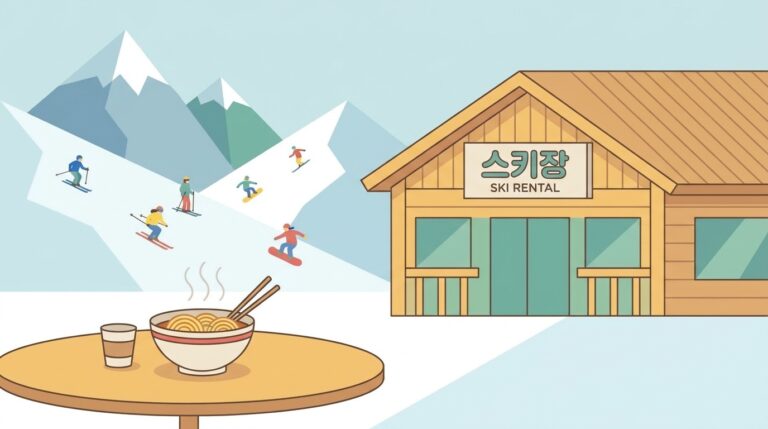
Phase 1: 공감 (스토리 몰입형 오프닝)
안녕하세요! 매일한글 에디터입니다. ❄️
winter season in Korea is truly magical, especially when the snow blankets the majestic mountains of Gangwon-do! Picture this: You and your Korean friends are standing right at the base of a bustling ski resort lodge in Pyeongchang. The icy air smells faintly of hot toasted snacks, loud K-Pop remixes echo near the ski lifts, and the mountain looks thrilling. Suddenly, your friend turns to you with a grin and asks, “오늘 스키 탈래, 보드 탈래?” (Are you going to ski or snowboard today?)
Suddenly, anxiety hits! You want to sound natural, express your experience level without feeling embarrassed, and get the right rental gear. Do you choose the speed of skis or the trendy vibe of snowboarding? Choosing gear at a Korean ski rental desk can feel overwhelming if you only know stiff classroom phrases.
Don’t worry! Based on real learning experiences and feedback from hundreds of intermediate learners, this guide is crafted specifically to give you natural, B2-level Korean confidence. By the end of this post, you’ll seamlessly navigate the slope options, banter with rental staff, and enjoy Korean winter sports culture like a local!
Phase 2: 핵심 표현 3선 심층 분석
1. 스키가 나을까요, 보드가 나을까요?
- Pronunciation: [Seu-ki-ga na-eul-kkal-yo, bo-deu-ga na-eul-kkal-yo?] (Sounds like: Ski-ga nah-ool-kka-yo, bo-deu-ga nah-ool-kka-yo?)
- Meaning: Direct: “Would skiing be better, or would snowboarding be better?” / Nuance: Gently seeking advice on which winter sport fits your current situation better.
- K-Culture Moment: Asking your Korean friend or resort guide right outside the rental window while trying to decide on your day pass ticket.
- Editor’s Insight: The grammar
-이/가 나을까요?stems from the adjective낫다(to be better). It sounds much smoother and more polite than directly asking “Which one is easy?”. - Situation Spectrum: Casual ⚠️ / Semi-formal ✅ / Formal ✅
- 🤔 Think About It: In your native culture, do people prefer asking for recommendations directly or offering their own preference first?
2. 금방 감을 잡을 수 있을까요?
- Pronunciation: [Geum-bang gam-eul jap-eul su iss-eul-kka-yo?]
- Meaning: Direct: “Can I catch the feeling quickly?” / Nuance: “Will I be able to get the hang of it quickly?”
- K-Culture Moment: Expressing slight nervous anticipation to your instructor or gear rental staff before heading up to the beginner slope.
- Editor’s Insight:
감을 잡다(to get the feeling / get the hang of) is an indispensable idiom in conversational Korean used for physical activities, driving, or new skills. - Situation Spectrum: Casual ✅ / Semi-formal ✅ / Formal ⚠️
- 🤔 Think About It: How does your language express the transition from being a complete beginner to intuitively getting used to a physical skill?
3. 제 실력에 맞는 코스로 추천해 주세요.
- Pronunciation: [Je sil-ryeok-e mat-neun ko-seu-ro chu-cheon-hae ju-se-yo.]
- Meaning: Direct: “Please recommend a course that matches my skill level.”
- K-Culture Moment: Requesting advice from resort staff when deciding between the ultra-beginner slope (초급) and intermediate slope (중급).
- Editor’s Insight: Using
-에 맞는(fitting/matching) shows polished B2 vocabulary, avoiding childish phrasing like “easy slope please”. - Situation Spectrum: Casual 🚫 / Semi-formal ✅ / Formal ✅
- 🤔 Think About It: Why is acknowledging one’s exact skill level considered an important step for safety and modesty in Korean sports culture?
Phase 3: 교과서 한국어 vs 진짜 한국어
Situation 1: Asking if a beginner can handle snowboarding
- 📖 교과서 한국어: 저는 초보자인데 스노보드를 배울 수 있습니까?
- 🗣️ 진짜 한국어: 저 완전 몸치인데, 보드 타도 괜찮을까요?
- 💡 왜 다를까? Native speakers often use humble self-deprecating humor.
몸치(someone with poor physical coordination) immediately lightens the mood and gets you friendlier advice from staff!
Situation 2: Choosing safety gear without sounding overly formal
- 📖 교과서 한국어: 안전 장비를 튼튼한 것으로 주십시오.
- 🗣️ 진짜 한국어: 저 자주 넘어질 것 같은데, 보호대 짱짱하게 챙겨주세요!
- 💡 왜 다를까?
짱짱하게is a vivid colloquial adverb meaning “sturdily / extra securely”. It sounds warm and natural when renting safety equipment.
Phase 4: K-Culture 딥다이브 & 비언어적 매너
4-1. 눈치(Nunchi) & Slope Etiquette
- Shoe Sizing Nuance: In Korea, foot sizes are strictly in millimeters (e.g., 260mm, 270mm). Know your millimeter conversion before reaching the counter!
- Polite Waiting: When receiving rental boots or snowboards, step slightly back to adjust your bindings so you don’t block the line. A polite nod (
감사합니다) to the rental technician goes a long way.
4-2. The Korean Ski Resort Ritual: Slope-Side Comfort Food
- Skiing in Korea isn’t just about speed—it’s equally about 식후경 (eating after enjoying views)! The signature highlight of Korean ski culture is hitting the mid-mountain rest house for hot cup ramyeon, piping hot eomuk-guk (fish cake broth), and spicy tteokbokki. The steam rising from hot soup in sub-zero weather is an authentic K-Travel memory you cannot miss.
Phase 5: 실전 롤플레이 시나리오
Setting: A vibrant winter gear rental shop near Vivaldi Park Resort.
Characters:
* Min-soo (김민수 대리): Energetic ski rental technician (NPC)
* You: Intermediate Korean learner excited to hit the snow
- 민수: 🎭 (밝게 웃으며 신발 사이즈를 확인한다) “안녕하세요! 오늘 스키 타시나요, 아니면 보드 타시나요?”
(Hello! Are you skiing today, or snowboarding?) - You: 🎭 (스키판과 보드를 가리키며) “사실 고민 중이에요. 스키가 나을까요, 보드가 나을까요?”
(Actually, I’m contemplating. Would skiing be better, or snowboarding?) - 민수: 🎭 (친절하게 안내판을 가리키며) “전에 겨울 스포츠 타보신 적 있으세요?”
(Have you ridden winter sports before?) - You: 🎭 (쑥스러운 듯 웃으며) “아뇨, 저 완전 몸치라서 오늘이 처음이에요!”
(No, I have terrible coordination, so today is my first time!) - 민수: 🎭 (고개를 끄덕이며 보드를 추천한다) “처음이시면 스키가 중심 잡기 편해요! 하지만 보드도 금방 배워요.”
(If it’s your first time, skiing is easier to balance! But snowboarding is also quick to learn.) - You: 🎭 (자신감을 얻으며) “그럼 스키로 할게요! 금방 감을 잡을 수 있겠죠?”
(Then I’ll go with skiing! I’ll be able to get the hang of it quickly, right?) - 민수: 🎭 (부츠를 건네며) “당연하죠! 보호대도 짱짱하게 챙겨드릴게요. 초급자 코스로 가세요!”
(Of course! I’ll secure your safety guards tight. Head to the beginner slope!) - You: 🎭 (부츠를 받으며 고맙게 인사한다) “네, 감사합니다! 재미있게 타고 올게요.”
(Yes, thank you! I’ll go have fun riding.)
🔀 인터랙티브 분기점: How will you request rental adjustments?
- Option A: “저기요, 이거 바꾸어 주십시오.” (Excuse me, change this.)
- Option B: “부츠가 약간 끼는데, 한 치수 큰 걸로 볼 수 있을까요?” (The boots are slightly tight, could I try one size bigger?)
- Option C: “이거 너무 아파요. 안 타요!” (This hurts too much. I won’t ride!)
Feedback:
* Option A (Risk): Too blunt and grammatically rigid. Sounds demanding.
* Option B (Best ✅): Polite, accurate, and uses natural B2 vocabulary (약간 끼다, 한 치수 큰 것). Staff will immediately assist you!
* Option C (Bad): Overly dramatic and impolite.
Phase 6: 10초 감정 섀도잉 드릴
Practice reading aloud with rhythm (/ = pause) and emotional investment!
[😊 설레고 기대되는 톤으로]
저 오늘 / 스키 타러 왔는데 / 처음이라 너무 설레요!
(I came to ski today / since it’s my first time / I’m so excited!)-
[😅 쑥스럽지만 밝은 톤으로]
제가 사실 / 완전 몸치거든요 / 금방 감 잡을 수 있겠죠?
(Honestly / I have zero balance / I’ll get the hang of it soon, right?) -
[👍 감격하며 감사한 톤으로]
보호대까지 / 짱짱하게 챙겨주셔서 / 정말 안심이 돼요!
(Thanks for providing safety pads / so sturdily / I feel so relieved!)
Phase 7: K-Culture 미니 사전 (핵심 키워드 4개)
- 리프트권 (Ripeuteu-gwon) | Ski Lift Pass
- Usage: Essential ticket for accessing slopes. Available as 4-hour, 6-hour, or night passes (
야간 리프트권).
- Usage: Essential ticket for accessing slopes. Available as 4-hour, 6-hour, or night passes (
- 장비 렌탈 (Jangbi rental) | Gear Rental
- Usage: Refers to renting skis, poles, boots, or snowboards directly at the resort or external shops.
- 초급자 코스 (Chogeup-ja koseu) | Beginner Slope
- Usage: The gentlest slope designed for safety and initial practice.
- 심야 스키 (Sim-ya seuki) | Night/Late-Night Skiing
- Usage: Popular young K-culture trend where slopes stay open until 2:00 AM or 4:00 AM with neon lights and music.
Phase 8: 여행자를 위한 생존 키트
Survival Expressions TOP 3
- 헬멧이랑 보호대도 포함인가요? (Hel-met-i-rang bo-ho-dae-do po-ham-in-ga-yo?)
- Pro Tip: Helmets and protective pads are often rented separately from basic ski sets!
- 초급자 리프트 승강장이 어디예요? (Cho-geup-ja ri-peu-teu seung-gang-jang-i eo-di-ye-yo?)
- Pro Tip: Ask this to ensure you don’t accidentally board an expert lift!
- 몸 좀 녹이고 올게요. (Mom jom nog-i-go ol-ge-yo.)
- Pro Tip: Perfect phrase when taking a break in the food court to warm up with hot broth.
Editor’s Travel Note
Before heading off to winter resorts in Gangwon-do or Gyeonggi-do, make sure to complete your Naver Map App Download for real-time resort shuttle bus schedules. For convenient door-to-door transportation with heavy ski gear, check your ride options via Kakao T Taxi Service.
Phase 9: “한 발 더 깊이” (생각 질문)
Winter sports in Korea reflect a unique blend of modern leisure and vibrant collective energy. Korean ski resorts are designed as all-in-one entertainment complexes—featuring saunas, indoor waterparks, karaoke rooms, and late-night food plazas under one roof. Riding down snowy slopes together and sharing hot snacks afterwards reinforces social bonding (정, Jeong). It transforms a athletic outing into a shared cultural celebration.
💬 Your Turn: If you visited a Korean ski resort this weekend, would you choose skiing or snowboarding first? What winter snack would you eat at the lodge? Share your thoughts in the comments below!
Phase 10: FAQ & 오해 방지 (FAQ Schema)
Q: Can I rent winter ski clothing directly at Korean resorts?
A: Yes! Almost all Korean ski resorts and nearby private rental shops offer full clothing rentals including waterproof jackets and pants. You only need to bring or buy personal items like thermal gloves and goggles.
Q: Is snowboarding harder to learn than skiing for complete beginners?
A: Generally, beginners find skiing easier on day one because your legs move independently. However, once you learn how to balance on a snowboard, progress can be very fast!
Q: Do I need to book ski lift passes far in advance?
A: While you can buy tickets at the window, booking online through resort apps or Korean travel platforms often grants 20% to 40% discounts!
🚨 Common Mistakes Warning Board
- Mistake 1: Asking for shoe sizes using US/UK numbers (e.g., “Size 9 please”).
- ❌ Wrong: 9 사이즈 주세요.
- ✅ Correct Action: Convert to millimeters first! Say “270(이백칠십) 밀리로 주세요.”
- Mistake 2: Using overly formal, archaic textbook phrasing.
- ❌ Wrong: 저는 스키를 타는 것을 희망합니다.
- ✅ Correct Action: Keep it natural: “저 오늘 스키 타려고요!”
- Mistake 3: Forgetting to specify helmet and knee pad rentals.
- ❌ Wrong: Assuming gear set includes guard pads.
- ✅ Correct Action: Always ask: “보호대도 같이 렌탈해 주세요.”
Phase 11: 액션 미션 & 참여 유도
Action Mission (3 Steps)
- 🥉 Bronze: Record yourself saying “스키가 나을까요, 보드가 나을까요?” three times with natural rhythm.
- 🥈 Silver: Comment below describing your winter sports skill level using the word
몸치or감! - 🥇 Gold: Use your new expressions next time you visit a Korean resort or speak with Korean friends about winter trips.
🎮 K-Culture Mission
Watch a Vlog or K-Drama winter scene (such as Goblin or Winter Sonata) featuring snowy mountains. Listen carefully to see if you can catch terms like 리프트 or 초급자!
Phase 12: 인터랙티브 퀴즈 챌린지
Quiz 1: Situation Judgment
How do you naturally tell the instructor that you lack physical coordination but want to learn?
* A) 저 완전 몸치인데 괜찮을까요?
* B) 저는 운동 기량이 전혀 없습니다.
👉 Check Answer & Explanation
Answer: A
Explanation: 몸치 is the perfect natural colloquial noun for someone who feels clumsy at physical activities. Option B sounds like a formal medical report!
Quiz 2: Fill in the Blank
When you start feeling comfortable and getting the hang of your snowboard, you say: “이제 조금 ______ 잡았어요!”
👉 Check Answer & Explanation
Answer: 감을
Explanation: The full idiom is 감을 잡다 (to get the hang of / catch the feel).
Quiz 3: True / False Culture Quiz
In Korean ski resorts, shoe sizes are measured in centimeters (e.g., 26cm).
👉 Check Answer & Explanation
Answer: False
Explanation: Korean footwear measurements always use millimeters (e.g., 260mm instead of 26cm)!







