

Phase 1: Empathy & Storytelling
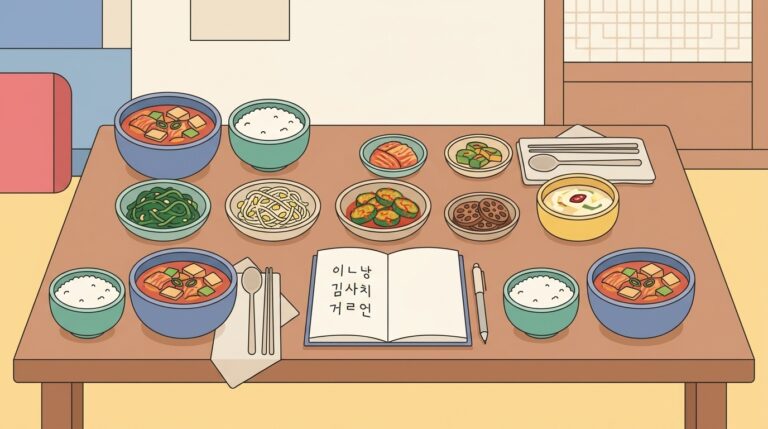
안녕하세요! I’m your Daily Hangul editor. Have you ever been invited to a Korean friend’s apartment, only to step into a dining room where the table is practically bending under the weight of fifteen different side dishes, steaming stew, and fresh grilled meat? You gasp in awe at the royal feast, but your host suddenly rubs the back of their neck and sheepishly says: “음식을 차린 건 없지만 많이 드세요” (I haven’t really prepared much, but please eat a lot!).
Your brain immediately freezes. Not prepared much?! Is this a joke? Did a catering company drop this off by accident?
Don’t worry, you aren’t crazy! This exact moment confuses almost every foreign learner visiting Korea for the first time. In Western cultures, if you cook for three hours, you proudly say, “I made your favorite dish!” But in Korea, host humility is the ultimate sign of respect. Over 80% of our B1 learners report feeling nervous about how to respond when receiving this deep Korean hospitality (정, Jeong). Today, based on real feedback from hundreds of international students, we’ll unlock the secret cultural code behind Korean home invitations so you can act like a warm, polished local guest!
Phase 2: Core Expressions Deep Dive
1. 음식을 차린 건 없지만 많이 드세요
- Pronunciation: [Eum-sig-eul cha-rin geon eob-ji-man mang-i deu-se-yo] (Sounds like: Eom-sig-eul cha-reen geon eob-jee-mahn mah-nee deu-seh-yo)
- Meaning: Literal: “I haven’t set out any food, but please eat a lot.” | Real Nuance: “I wish I could offer you a banquet, but please enjoy everything I prepared with love!”
- K-Culture Moment: In the classic K-drama Reply 1988, mothers pile rice into towering bowls for neighborhood kids while endlessly apologizing that there’s “nothing to eat.”
- Editor’s Insight: This is the peak of Korean home hospitality culture. Even if the meal took 5 hours of prep, lowering one’s own effort highlights honor toward the guest.
- Situation Spectrum: Casual ⚠️ | Semi-formal ✅ | Formal ✅
- 🤔 Think About It: Why does your culture highlight the host’s effort, whereas Korean culture highlights the guest’s dignity through host humility?
2. 차린 건 없지만 맛있게 드세요
- Pronunciation: [Cha-rin geon eob-ji-man mas-iss-ge deu-se-yo]
- Meaning: Literal: “There is nothing prepared, but eat deliciously.” | Real Nuance: “Please enjoy the meal!”
- K-Culture Moment: Commonly heard in modern K-variety shows when celebrities cook at home for visiting guests.
- Editor’s Insight: A slightly more modern and soft alternative to expression #1. Substituting 많이 (a lot) with 맛있게 (deliciously) shifts focus to food flavor.
- Situation Spectrum: Casual ⚠️ | Semi-formal ✅ | Formal ✅
- 🤔 Think About It: Do you prefer guests to focus on the quantity or the taste of the food you serve?
3. 진짜 대박이에요! 잘 먹겠습니다!
- Pronunciation: [Jinj-ja dae-bag-i-e-yo! Jal meog-ges-seub-ni-da!]
- Meaning: Literal: “This is a real jackpot! I will eat well!” | Real Nuance: “Wow, this looks incredible! Thank you so much for the feast!”
- K-Culture Moment: The standard passionate guest reaction seen in food mukbang streams and housewarming vlogs.
- Editor’s Insight: The best response to host humility is enthusiastic praise! Refusing to accept their modesty and complimenting the spread instantly builds intimacy.
- Situation Spectrum: Casual ✅ | Semi-formal ✅ | Formal ⚠️
- 🤔 Think About It: How do you show sincere gratitude when someone cooks for you in your native language?
Phase 3: Textbook Korean vs. Real Native Korean
Situation 1: Expressing Gratitude for the Meal
- 📖 Textbook Korean: “음식이 매우 맛있습니다. 감사합니다.” (The food is very delicious. Thank you.)
- 🗣️ Real Native Korean: “와, 진짜 대박이에요! 손이 엄청 크시네요!” (Wow, this is amazing! You are so generous!)
- 💡 Why the difference?: Native speakers use expressive idioms like “손이 크다” (literally “to have big hands”, meaning very generous with food portions) to make compliments warm and memorable.
Situation 2: Accepting Second Helps / Showing You Enjoyed
- 📖 Textbook Korean: “저는 배가 부릅니다.” (I am full.)
- 🗣️ Real Native Korean: “너무 맛있어서 배가 터질 것 같아요!” (It’s so good my stomach is about to burst!)
- 💡 Why the difference?: Saying a rigid “I am full” can sound blunt. Expressing that you ate so well your stomach might burst reassures the host that their cooking was a huge success.
Phase 4: K-Culture Deep Dive & Non-Verbal Etiquette
4-1. Nunchi (눈치) & Gestures
- Two-Handed Respect: When receiving a dish, drink, or side dish passed by your host, hold your bowl or plate with both hands or support your right wrist with your left hand.
- The First Spoon Rule: At a Korean home dinner table, never pick up your spoon or chopsticks before the oldest person or host takes their first bite.
- Active Reactions: Nod rhythmically and make subtle sounds (“음~!”) on your first bite. Silence during the first minute of eating can make the host nervous!
4-2. Cultural Code: The Spirit of Jeong (정) and Daejeop (대접)
In Korean culture, feeding someone is the ultimate declaration of affection. The word 대접 (Daejeop) means treating a guest with utmost honor. When hosts say “차린 건 없지만” (I didn’t prepare much), they are subtly expressing regret that they couldn’t give you even more. Responding with high enthusiasm closes the cultural loop of Jeong.
Phase 5: Real-Life Roleplay Scenario
Setting: You are visiting Minwoo’s home for a housewarming dinner (집드리). Minwoo’s mother has laid out a full spread.
- Turn 1 (Minwoo’s Mom): 어서 와요! 먼 길 오느라 고생했어요. (Eoseo wa-yo! Meon gil o-neu-ra go-saeng-haess-eo-yo.) — Welcome! It must have been a long trip getting here. 🎭 Hands you slippers with a warm smile
- Turn 2 (You): 초대해 주셔서 정말 감사합니다! (Cho-dae-hae ju-syeo-seo jeong-mal gam-sa-hab-ni-da!) — Thank you so much for inviting me! 🎭 Bows slightly at 30 degrees holding a small gift
- Turn 3 (Minwoo’s Mom): 얼른 앉아요. 음식을 차린 건 없지만 많이 드세요! (Eol-leun an-ja-yo. Eum-sig-eul cha-rin geon eob-ji-man mang-i deu-se-yo!) — Quickly sit down. I didn’t prepare much, but please eat a lot! 🎭 Points to a table overflowing with Galbi and Kimchi stew
- Turn 4 (You): 와, 이게 차린 게 없다니요! 완전 상다리 부러지겠어요! (Wa, i-ge cha-rin ge eob-da-ni-yo! Wan-jeon sang-da-ri bu-reo-ji-ges-seo-yo!) — Wow, what do you mean you didn’t prepare much! The table legs are about to break! 🎭 Eyes wide open with genuine delight
- Turn 5 (Minwoo’s Mom): 입맛에 맞을지 모르겠네요. 많이 먹어요! (Ib-mas-e maj-eul-ji mo-reu-ges-nae-yo. Mang-i meog-eo-yo!) — I don’t know if it suits your taste. Eat a lot! 🎭 Pushes the main stew dish closer to you
- Turn 6 (You): (Takes first bite) 음~! 진짜 맛있어요! 이 김치찌개 비법이 뭐예요? (Eum~! Jinj-ja mas-iss-eo-yo! I gim-chi-jji-gae bi-beob-i mwo-ye-yo?) — Mmm~! It’s truly delicious! What’s the secret to this Kimchi stew? 🎭 Nods vigorously and smiles
- Turn 7 (Minwoo’s Mom): 입에 맞다니 다행이에요. 더 줄 테니까 천천히 많이 먹어요. (Ib-e maj-da-ni da-haeng-i-e-yo. Deo jul te-ni-kka cheon-cheon-hi mang-i meog-eo-yo.) — I’m so relieved you like it. I’ll give you more, so eat plenty at your own pace. 🎭 Ladle in hand, proudly beaming
- Turn 8 (You): 네! 정말 잘 먹겠습니다! (Ne! Jeong-mal jal meog-ges-seub-ni-da!) — Yes! I will truly enjoy this feast! 🎭 Holds rice bowl with two hands
🔀 Interactive Branching Point
Minwoo’s mom says: “음식을 차린 건 없지만 많이 드세요!” How do you react?
- Option A: “네, 진짜 별로 없네요. 잘 먹을게요.” (Yeah, there really isn’t much. I’ll eat.)
- Option B: “아니에요! 상다리 부러지겠어요! 정말 감사히 잘 먹겠습니다!” (No way! The table legs are breaking! Thank you, I’ll enjoy it!)
- Option C: “저는 다이어트 중이라 조금만 먹겠습니다.” (I’m on a diet so I’ll only eat a little bit.)
Feedback:
* Option A (Bad): 🚫 Taking host modesty literally sounds insulting! The host will feel embarrassed.
* Option B (Best): ✅ Perfect! Denying their modesty with a playful compliment (상다리가 부러지다) shows high social intelligence.
* Option C (Risk): ⚠️ While honest, rejecting food immediately upon sitting down can hurt the host’s feelings. Eat a few bites first before mentioning appetite limits.
Phase 6: 10-Second Emotional Shadowing Drill
Practice reading these out loud with rhythm and natural tone!
[😊 Delighted & Amazed]
와 / 진짜 / 상다리 부러지겠어요!
(Wa / jinj-ja / sang-da-ri bu-reo-ji-ges-seo-yo!)-
[🥺 Grateful & Polite]
초대해 주셔서 / 정말 / 감사합니다!
(Cho-dae-hae ju-syeo-seo / jeong-mal / gam-sa-hab-ni-da!) -
[😋 Eager & Enthusiastic]
정말 맛있어 보여요! / 잘 먹겠습니다!
(Jeong-mal mas-iss-eo bo-yeo-yo! / Jal meog-ges-seub-ni-da!)
Phase 7: K-Culture Mini Dictionary
- 상다리가 부러지다 (Sang-da-ri-ga bu-reo-ji-da) | Idiom | Lit. “Table legs break.” Used when describing a table filled with an overwhelming amount of delicious food.
- 손이 크다 (Son-i keu-da) | Idiom | Lit. “To have big hands.” Refers to someone who cooks or prepares portions far larger than necessary out of generosity.
- 집들이 (Jip-deu-ri) | Noun | Housewarming party. Guests usually bring toilet paper or laundry detergent as gifts symbolizing wealth and good luck.
- 대접하다 (Dae-jeop-ha-da) | Verb | To treat or serve guests hospitality with food, drinks, and respect.
Phase 8: Traveler & Resident Survival Kit
TOP 3 Home Visit Survival Expressions
- 초대해 주셔서 감사합니다. (Thank you for having me over.)
- 잘 먹겠습니다! (I will eat well / Thank you for the meal!)
- 잘 먹었습니다! 배가 정말 불러요! (I ate so well! I am so full!)
Editor’s Travel Note
When invited to a local host’s home in Korea, never arrive empty-handed! Grab a gift set of fruit, roll paper, or dessert. If you need navigation to buy gifts or find their residence, check the Naver Map App Download guide to easily locate nearby bakery shops or fruit stands!
Phase 9: One Step Deeper (Editor’s Essay)
In many global cultures, self-confidence is viewed as honesty. If you cooked a meal well, you own it! But in traditional Korean society, mutual dignity is preserved through dual humility. When a host says “차린 건 없지만”, they leave space for the guest to raise them up with compliments. It is an intricate, beautiful dance of social warmth designed to ensure no guest feels indebted. Understanding this subtle exchange transforms you from a mere visitor into someone who truly understands the heart of Korean relationships.
💬 Your Turn: What is the phrase for host hospitality in your country? Do hosts brag about their cooking or act humble? Share your story in the comments below!
Phase 10: FAQ & Common Mistakes
Q: What if I am vegetarian or have allergies when the host says this?
A: Don’t panic! Politely compliment the table first (“와, 정말 많이 준비하셨네요!”), then gently explain your dietary restrictions before eating (“제가 알레르기가 있어서 이 요리는 못 먹지만, 다른 반찬이 정말 맛있어요!”).
Q: Is “차린 건 없지만” used only at home?
A: Yes, it is primarily used in personal settings like home visits, home-cooked meals, or informal dinner parties. You won’t hear restaurant waiters say this!
Q: Should I bring a gift when visiting a home?
A: Absolutely! Bringing fresh fruits, pastries, or drinks is standard etiquette in Korea.
🚨 Common Mistakes TOP 3
- Mistake: Saying “아 예, 별로 없네요” (Yeah, there really isn’t much).
- Correct Action: Always deny their modesty with praise: “아니에요! 너무 푸짐해요!”
- Mistake: Eating before the eldest person at the table picks up chopsticks.
- Correct Action: Wait until the oldest host says “자, 많이 드세요” and takes the first bite.
- Mistake: Leaving the table immediately after finishing food.
- Correct Action: Stay at the table, sip tea or water, and tell the host “정말 잘 먹었습니다”.
Phase 11: Action Mission
- 🥉 Bronze: Repeat the sentence “와! 상다리가 부러지겠어요!” 3 times out loud with emotion!
- 🥈 Silver: Comment below using one native expression you learned today.
- 🥇 Gold: Next time you visit a Korean restaurant or friend’s place, say “잘 먹겠습니다” with two hands on your drink/bowl!
🎮 K-Culture Mission: Watch a scene from any housewarming episode in a Korean drama or variety show (like I Live Alone). Spot when the host serves food and listen for “많이 먹어요” or “드세요”!
Phase 12: Interactive Quiz Challenge
Quiz 1. What is the actual meaning when a host says “음식을 차린 건 없지만 많이 드세요”?
A) They didn’t cook anything and bought store-bought food.
B) They want you to leave quickly.
C) They prepared food with care, but are showing polite host humility.
🔍 Click to reveal answer & explanation
Correct Answer: C
Explanation: Korean hosts use this humble phrase as a sign of respect, even when serving a huge feast!
Quiz 2. Fill in the blank with the correct phrase showing excitement for a feast:
“와, 진자 _________________! 잘 먹겠습니다!”
(Hint: Idiom meaning “the table legs are breaking”)
🔍 Click to reveal answer & explanation
Correct Answer: 상다리 부러지겠어요 (Sang-da-ri bu-reo-ji-ges-seo-yo)
Quiz 3. True or False: You should start eating as soon as the food is placed on the table.
🔍 Click to reveal answer & explanation
Correct Answer: False
Explanation: You should wait for the host or the oldest person at the table to take the first bite!







