

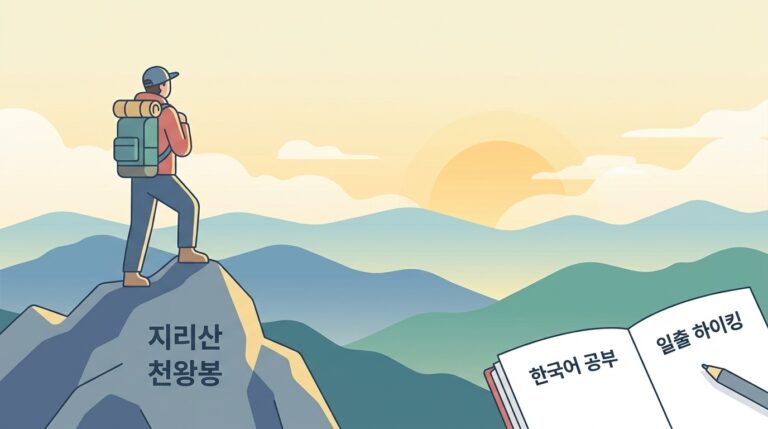
안녕하세요! 매일한글 에디터입니다. Have you ever dreamed of tackling South Korea’s ultimate alpine challenge—the grand Jirisan Traverse (지리산 종주)? Spanning over 25 kilometers along the majestic ridge of Jirisan National Park, this trail offers breathtaking views above the cloud line, pristine oxygen, and a deep sense of accomplishment. However, ask any seasoned Korean hiker about the hardest part of the traverse, and they won’t say the steep climbs up Cheonwangbong Peak (천왕봉). Instead, they’ll laugh and answer: “Securing a shelter reservation (대피소 예약)!”
Yes, booking a spot at Jangteomok or Seryeongwon shelter on the Korea National Park Service (KNPS) website feels like competing for a sold-out K-Pop concert! Many advanced language learners tell us that while they know basic travel phrases, navigating high-stakes booking culture and expressing trail nuances with fellow Korean hikers leaves them at a loss. That is why today’s guide is built on real experience and learner feedback to help you master C1-level Korean expressions, local hiking etiquette, and shelter booking lingo so you can hike like a true native trail veteran.
Phase 2: Core Expressions Deep Dive
1. 발을 맞추다 (Bal-eul mat-chuda)
- Pronunciation: [Bal-eul mat-choo-da] (Sounds like “bal” in ballad + “eul” + “match” + “oo-da”)
- Meaning: Literal: To match feet / Nuance: To sync pace, adjust speed to walk together, or cooperate closely.
- K-Culture Moment: Walking the long ridge from Nogodan to Banyabong, where group members constantly adjust their pace so nobody gets left behind in the dark.
- Editor’s Insight: Beyond physical walking, C1 speakers use this idiom in professional project management or relationships to mean “harmonizing efforts.”
- Situation Spectrum: Casual ✅ | Semi-formal ✅ | Formal ✅
- 🤔 Think About It: How does adjusting your physical walking pace reflect the Korean value of collective harmony (공동체 의식) over individual performance?
2. 취소표를 줍다 (Chwiseo-pyo-reul jup-da)
- Pronunciation: [Chwee-so-pyo-reul joop-da] (Sounds like “chwee” + “so” + “pyo” + “reul” + “joop” + “da”)
- Meaning: Literal: To pick up a canceled ticket / Nuance: To successfully grab a last-minute slot created by someone else’s cancellation.
- K-Culture Moment: Refreshing the KNPS reservation screen at 10 PM hoping a spot opens up at Jangteomok Shelter, then yelling “주웠다!” (I picked it up!).
- Editor’s Insight: Combined with the verb 줍다 (to pick up), this dynamic idiom captures the thrill of catching unexpected online vacancies in Korea’s competitive digital system.
- Situation Spectrum: Casual ✅ | Semi-formal ✅ | Formal ⚠️
- 🤔 Think About It: Why do you think Koreans use the lighthearted verb “to pick up” (줍다) for digital booking victories?
3. 산세를 살피다 (San-se-reul sal-pi-da)
- Pronunciation: [San-sse-reul sal-pi-da] (Sounds like “san” + “sse” + “reul” + “sal” + “pee” + “da”)
- Meaning: Literal: To examine the mountain’s geography/flow / Nuance: To strategically evaluate terrain, weather conditions, and trail difficulty before proceeding.
- K-Culture Moment: Experienced trail leaders checking weather alerts and ridge wind conditions at 벽소령 (Byeoksoryeong) shelter before deciding whether to push to the summit.
- Editor’s Insight: This elegant C1 phrase treats nature not as static scenery, but as an active entity with its own posture (산세).
- Situation Spectrum: Casual ⚠️ | Semi-formal ✅ | Formal ✅
- 🤔 Think About It: How does evaluating the mountain’s “posture” differ from simply checking a weather app?
Phase 3: Textbook Korean vs. Real Native Korean
Situation 1: Booking a Mountain Shelter
- 📖 교과서 (Textbook): “대피소 예약을 성공적으로 마쳤습니다.”
(I have successfully completed the shelter reservation.) - 🗣️ 진짜 (Real Native): “대피소 취소표 겨우 주웠어요!”
(I barely managed to snag a canceled shelter ticket!) - 💡 왜 다를까?: Native Korean hikers share the real struggle of mountain bookings. Using 취소표를 줍다 immediately builds camaraderie over shared digital hurdles.
Situation 2: Adjusting Pace on the Trail
- 📖 교과서 (Textbook): “천천히 걸어시길 바랍니다.”
(Please walk slowly.) - 🗣️ 진짜 (Real Native): “우리 서로 발 맞춰서 안전하게 완주해요.”
(Let’s sync up our pace and finish the whole traverse safely.) - 💡 왜 다를까?: Native hikers prefer encouraging expressions centered on mutual support (완주 – completing a full course) rather than giving mechanical instructions.
Phase 4: K-Culture Deep Dive & Non-Verbal Manners
4-1. Nunchi (눈치) & Trail Etiquette
When passing fellow hikers on narrow Jirisan ridges, bow slightly (about 15 degrees) and offer a cheerful greeting like “안산하세요!” (An-san-ha-se-yo! – Short for “Have a safe climb!”) or “수고하십니다!” (Su-go-ha-ship-ni-da!). If climbing uphill, hikers coming downhill will often step aside—always nod in gratitude and say “먼저 지나갈게요, 감사합니다!” (Meon-jeo ji-na-gal-ge-yo).
4-2. Mountain Shelter Culture (대피소 문화)
Jirisan shelters like Jangteomok are not luxury hotels; they are communal sanctuaries. Hikers cook hot Ramyeon or grilled pork belly (Samgyeopsal) at designated outdoor tables before lights-out at 9:00 PM. Sharing side dishes or trail snacks like sliced cucumber with table neighbors is the quintessential expression of mountain hospitality (산정 / Mountain Jeong).
Phase 5: Real-Life Roleplay Scenario
Setting: Jangteomok Shelter (장터목 대피소) desk at 6:00 PM. You are exhausted after walking 15km from Nogodan.
Characters:
* Minjun (민준): Pragmatic yet warm National Park Ranger.
* You (학습자): Tired but determined C1 Korean hiker.
- Minjun: “어서 오세요! 예약자 성함하고 신분증 확인 도와드리겠습니다.”
(Eoseo o-se-yo! Ye-yak-ja seong-ham-ha-go sin-bun-jeung hwag-in do-wa-deu-ri-get-seum-ni-da.)
[Welcome! Let me check your reservation name and ID.] -
You: “🎭 (신분증을 내밀며 미소를 지으며) 안녕하세요! 김민우로 예약했습니다.”
(An-nyeong-ha-se-yo! Kim Min-woo-ro ye-yak-haet-seum-ni-da.)
[Hello! I reserved under Kim Min-woo.] -
Minjun: “확인되셨습니다. 오늘 취소표 주워서 오신 분 맞죠? 운이 정말 좋으셨네요!”
(Hwag-in-doe-seot-seum-ni-da. O-neul chwi-so-pyo ju-wo-seo o-sin bun mat-jo? Un-i jeong-mal jo-eush-eon-ne-yo!)
[Confirmed. You’re the one who snagged a canceled spot today, right? You were super lucky!] -
You: “🎭 (가슴을 쓸어내리며) 맞아요! 며칠 동안 광클해서 겨우 구했습니다.”
(Ma-ja-yo! Myeo-chil dong-an gwang-kle-hae-seo gyeo-u gu-haet-seum-ni-da.)
[That’s right! I did rapid-clicking for days and barely got it.] -
Minjun: “내일 천왕봉 일출 보실 건가요? 새벽 4시에는 출발하셔야 합니다.”
(Nae-il Cheon-wang-bong il-chul bo-sil geon-ga-yo? Sae-byeok ne-si-e-neun chul-bal-ha-syeo-ya ham-ni-da.)
[Are you watching the sunrise at Cheonwangbong tomorrow? You should leave at 4 AM.] -
You: “🎭 (산세를 신경 쓰며) 네! 내일 정상 쪽 산세나 날씨는 어떤가요?”
(Ne! Nae-il jeong-sang jjok san-se-na nal-cci-neun eot-teon-ga-yo?)
[Yes! How is the terrain and weather looking toward the peak tomorrow?] -
Minjun: “새벽에는 바람이 세니 방풍재킷을 꼭 챙기세요. 다른 일행들과 발 맞춰서 올라가시고요.”
(Sae-byeok-e-neun ba-ram-i se-ni bang-pung-jae-kit-eul ckok chaeng-gi-se-yo. Da-reun il-haeng-deul-gwa bal mat-chwo-seo ol-ra-ga-si-go-yo.)
[Wind is strong at dawn so pack a windbreaker. Keep pace with other hikers as well.] -
You: “🎭 (고개를 숙이며) 조언 감사합니다! 안산하고 오겠습니다.”
(Jo-eon gam-sa-ham-ni-da! An-san-ha-go o-get-seum-ni-da.)
[Thank you for the advice! I’ll have a safe climb.]
🔀 Interactive Decision Point
Minjun asks if you brought your own sleeping bag or need to rent a blanket.
* Option A: “아무거나 주세요.” (Give me whatever.)
* Option B: “모포 대여 가능한가요? 산행 길에 짐을 줄이느라 못 챙겼습니다.” (Can I rent a blanket? I lightened my pack for the traverse.)
* Option C: “필요 없어요, 그냥 잘게요.” (No need, I’ll just sleep.)
- Feedback:
- Option A (Bad): Too vague and slightly blunt for mountain shelter logistics.
- Option B (Best ✅): Polite C1 expression explaining trail context (짐을 줄이느라).
- Option C (Risk 🚨): Jirisan nights are freezing cold even in summer; rangers will worry about hypothermia!
Phase 6: 10-Second Emotional Shadowing Drill
[😤 Phew! Exhausted but relieved]
대피소 취소표를 / 겨우 주워서 / 정말 다행이에요!
(Daepiso chwisopyoreul / gyeou juwoseo / jeongmal dahaeng-ieyo!)-
[😊 Friendly & Encouraging]
서로 발 맞춰서 / 안전하게 / 천왕봉까지 갑시다!
(Seoro bal matchwoseo / anjeonhage / Cheonwangbong-kkaji gapsida!) -
[🧐 Cautious & Strategic]
새벽 산세를 살펴보고 / 출발 시간을 / 정하는 게 좋겠어요.
(Saebyeok sansereul salpyebogo / chulbal siganeul / jeonghaneun ge jogaesseoyo.)
Phase 7: K-Culture Mini Dictionary
- 종주 (Jongju) | Longitudinal Traverse | Hiking through an entire mountain range continuously without coming down to the lowland until the end.
- 대피소 (Daepiso) | Mountain Shelter | High-altitude emergency overnight stay facility managed by National Park authorities.
- 광클 (Gwang-kle) | Light-speed Clicking | Slang for rapidly clicking a mouse button during high-demand online bookings.
- 안산 (An-san) | Safe Mountain Climbing | Short for ‘안전한 산행’ (Safe hiking); standard wish exchanged among Korean outdoor enthusiasts.
Phase 8: Traveler’s Survival Kit
Survival Phrases TOP 3
- “입실 수속 몇 시까지 해야 하나요?” (Ip-sil su-sok myeot si-kka-ji hae-ya ha-na-yo?) — What time is check-in deadline?
- “취수장에서 물 받아도 되나요?” (Chwi-su-jang-e-seo mul ba-da-do doe-na-yo?) — Can I get potable water at the water station?
- “잔여 자리가 남아있나요?” (Jan-yeo ja-ri-ga nam-a-it-na-yo?) — Are there any remaining beds?
Editor’s Travel Note
Make sure to register and practice navigation on the official 국립공원공단 예약시스템 앱 (KNPS Reservation Platform) well before your trip. For accurate trail elevation profiles and GPS tracking on dense mountain paths, download the 네이버 지도 내비게이션 (Naver Map App).
Phase 9: One Step Deeper
In Korea, mountain climbing has evolved from survival to a profound social ritual. Reaching peak summits like Cheonwangbong isn’t just about solo conquest; it’s about sharing endurance (완주) and honoring the mountain’s character (산세). When hikers share hot water or shelter space, social barriers vanish, replacing everyday hierarchy with warm mountain camaraderie (산정).
💬 Your Turn: Have you ever experienced a high-stakes booking rush or long-distance hike in your country? How did you adjust your pace? Share your story in the comments below!
Phase 10: FAQ & Common Mistakes
Q: When do Jirisan shelter reservations open?
A: Reservations open twice a month (1st and 15th) at 10:00 AM KST on the official KNPS website. Spots fill up in seconds!
Q: Can I camp anywhere on Jirisan if shelters are full?
A: No! Wild camping is strictly illegal across all Korean National Parks to protect wildlife. You must use designated shelters.
Q: What should I do if I didn’t get a shelter reservation?
A: Monitor the KNPS platform closely between 8:00 PM and 10:00 PM the night before your hike for last-minute cancellations (취소표).
🚨 Common Mistakes Alert
| Mistake | Why It Fails | Correct Action |
|---|---|---|
| Using “등산해요” for multi-day hikes | Sounds like a casual 2-hour hill walk | Use “종주 중이에요” (I’m on a traverse) |
| Saying “산이 커요” | Oversimplifies terrain analysis | Use “산세가 험해요” (The terrain is rugged) |
| Forgetting physical ID at shelter | Digital receipts are not enough | Bring physical Passport / ARC |
Phase 11: Action Mission
- Bronze: Practice saying “발 맞춰서 올라가요” 3 times out loud.
- Silver: Post a picture of your hiking gear on Instagram using the hashtag
#매일한글_안산. - Gold: Log into the KNPS booking system and navigate the Korean shelter selection menu independently!
- 🎮 K-Culture Mission: Watch a outdoor vlog or K-Drama mountain scene and spot when hikers exchange the phrase “안산하세요!”.
Phase 12: Interactive Quiz Challenge
Test your knowledge before hitting the trail!
- Which phrase describes picking up a last-minute canceled booking?
- A) 산세를 살피다
- B) 취소표를 줍다
- C) 발을 맞추다
- True or False: Wild camping anywhere along Jirisan ridge is legal as long as you leave no trace. (True / False)
Click to reveal answers & explanations!
- Answer: B (취소표를 줍다)
- Explanation: ‘취소표를 줍다’ specifically refers to snagging a spot freed up by someone else’s cancellation.
- Answer: False
- Explanation: Camping outside of designated shelters is strictly prohibited in Korean National Parks to protect nature and hiker safety!
- Explanation: Camping outside of designated shelters is strictly prohibited in Korean National Parks to protect nature and hiker safety!







