Master Korean Fashion Compliments: The Power of White Tee and Jeans!
Phase 1: Empathy (Story-driven Opening)
안녕하세요! Editor here from Daily Hangul!
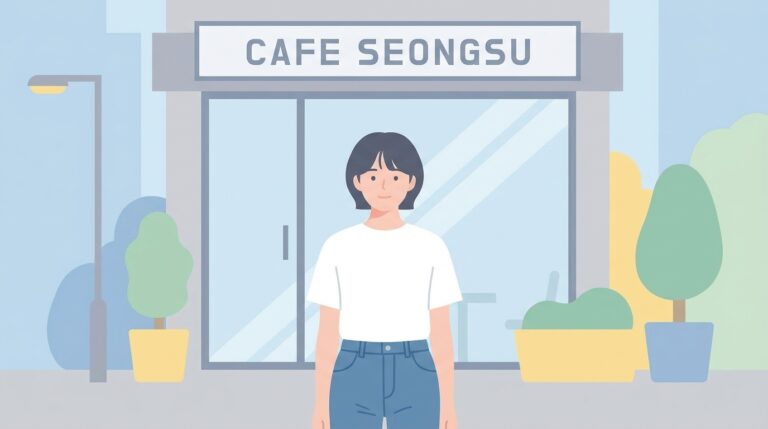
Picture this: You are sitting at a trendy minimalist cafe in Seongsu-dong, Seoul’s fashion hub. A stylish Korean friend walks in wearing the most classic combination ever—a crisp white t-shirt and perfectly fitted blue jeans. They look effortlessly cool, like a lead character from a romantic K-drama.
You want to say, “Wow, you look amazing in just a white tee and jeans!”, but your brain freezes. You search through textbook vocabulary, but phrases like “당신의 옷이 아름답습니다” sound way too formal, awkward, and robotic. Should you just stay silent and nod?
Don’t worry! Complimenting someone’s fashion—especially that beloved Korean aesthetic standard of ‘꾸안꾸’ (effortless chic)—is a secret superpower for making local friends. According to feedback from hundreds of our B1 intermediate learners, mastering fashion-related reactions boosted their conversation confidence by 80% during social meetups in Korea.
In this guide, we will unlock natural fashion compliments, break down real spoken expressions, and help you sound like a true Seoul fashion insider!
Phase 2: Core Expressions Deep Dive
1. 청바지에 흰 티셔츠가 잘 어울려요
- Pronunciation: [Cheong-ba-ji-e hin ti-sheo-tsu-ga jal eo-ul-ryeo-yo] (Think of ‘eo-ul’ as flowing smoothly like ‘uh-ool’)
- Meaning: Literal: “A white t-shirt suits your blue jeans well.” | Nuance: “You look stunning in the classic white tee and jeans combo!”
- K-Culture Moment: This is the ultimate Korean fashion aesthetic praised in K-Pop songs and K-dramas, symbolizing clean, timeless elegance.
- Editor’s Insight: The verb 어울리다 (to suit/match) is your go-to word for fashion. Adding 잘 (well) elevates it into a glowing compliment.
- Situation Spectrum: Casual ✅ | Semi-formal ✅ | Formal ⚠️
- 🤔 Think About It: Why does Korean culture value simple, clean-cut aesthetics like white tees and jeans over overly flashy outfits?
2. 완전 ‘꾸안꾸’ 스타일이에요!
- Pronunciation: [Wan-jeon kku-an-kku seu-ta-il-i-e-yo]
- Meaning: Literal: “Totally effortless chic style!” | Nuance: *”You look so stylish without looking like you tried too hard!”
- K-Culture Moment: Short for 꾸민 듯 안 꾸민 듯 (looks decorated, but not decorated). It’s the highest compliment for street fashion in Seoul.
- Editor’s Insight: 완전 means “totally” or “completely” in everyday speech and is used constantly by native speakers for emphasis.
- Situation Spectrum: Casual ✅ | Semi-formal ⚠️ | Formal 🚫
- 🤔 Think About It: How do native Korean speakers blend opposite concepts to create expressive modern slang?
3. 핏이 진짜 예술이에요!
- Pronunciation: [Pit-i jin-jja ye-sul-i-e-yo]
- Meaning: Literal: “The fit is truly art!” | Nuance: *”That outfit fits you like an absolute dream!”
- K-Culture Moment: Often heard in fashion vlog videos or while clothes shopping in Dongdaemun.
- Editor’s Insight: 예술 literally means “art,” but in natural Korean, calling something “art” means it is top-tier or perfection.
- Situation Spectrum: Casual ✅ | Semi-formal ✅ | Formal 🚫
- 🤔 Think About It: Why do Koreans use artistic metaphors to compliment body lines or silhouette fits?
Phase 3: Textbook Korean vs. Real Spoken Korean
Scenario 1: Complimenting an Outfit
- 📖 Textbook Korean: 당신은 이 옷이 예쁩니다. (Dang-sin-eun i os-i ye-ppeum-ni-da.)
- 🗣️ Real Korean: 오늘 옷 착장이 완전 착붙이에요! (O-neul ot chak-jang-i wan-jeon chak-but-i-e-yo!)
- 💡 Why the difference?: The word “당신” sounds cold and overly formal in spoken Korean. Using modern terms like 착장 (outfit setup) and 착붙 (fits perfectly/sticks nicely) creates instant friendly rapport.
Scenario 2: Praising Someone’s Sense of Style
- 📖 Textbook Korean: 당신은 패션 감각이 좋으시네요. (Dang-sin-eun pae-syeon gam-ga-gi jo-heu-si-ne-yo.)
- 🗣️ Real Korean: 센스가 보통이 아니시네요! (Sen-seu-ga bo-tong-i a-ni-si-ne-yo!)
- 💡 Why the difference?: Native speakers use 센스 (sense) and litotes like 보통이 아니다 (is not ordinary = extraordinary) to sound humorous and expressive.
Phase 4: K-Culture Deep-Dive & Non-Verbal Manners
4-1. Nunchi & Body Language
When giving fashion compliments in Korea:
* Eye Contact & Smile: Give a quick top-to-bottom scan with an appreciative smile, then make warm eye contact. Avoid staring for too long.
* Hand Gestures: A light hand wave pointing toward their outfit or a subtle double thumbs-up adds friendly energy.
* Modesty Reaction: Korean friends might shyly respond with “에이, 아니에요~” (Oh, no way~). Smile and reaffirm your compliment gently!
4-2. Culture Code: The ‘Kku-An-Kku’ Philosophy
In Korean fashion culture, simplicity is king. Legendary K-Pop airport photos and K-drama styling consistently prove that the cleanest combo—a white top and blue jeans—shows true confidence. Complimenting this basic style acknowledges that the person has great innate charm!
Phase 5: Real-Life Roleplay Scenario
Setting: Meeting your Korean friend Minji at a trendy cafe in Seongsu-dong.
- Turn 1 (Minji): 어! 오셨어요? 오래 기다렸죠? 🎭 (Waving happily while taking off her tote bag)
- Eo! O-syeos-seo-yo? O-rae gi-da-ryeot-jyo?
- “Oh! You arrived? Did you wait long?”
- Turn 2 (You): 아니에요, 방금 왔어요! 와, 오늘 스타일 진짜 깔끔하다! 🎭 (Smiling bright and gesturing toward her outfit)
- A-ni-e-yo, bang-geum was-seo-yo! Wa, o-neul seu-ta-il jin-jja kkal-kkeum-ha-da!
- “No, I just got here! Wow, your outfit today looks so clean!”
- Turn 3 (Minji): 정말요? 그냥 집에서 대충 입고 나온 건데요… 🎭 (Tucking hair behind ear bashfully)
- Jeong-mal-yo? Geu-nyang jib-e-seo dae-chung ip-go na-on geon-de-yo…
- “Really? I just threw this on quickly at home…”
- Turn 4 (You): 거짓말! 청바지에 흰 티셔츠가 너무 잘 어울려요. 🎭 (Nodding with enthusiasm)
- Geo-jit-mal! Cheong-ba-ji-e hin ti-sheo-tsu-ga neo-mu jal eo-ul-ryeo-yo.
- “No way! The white tee and jeans combo suits you so well.”
- Turn 5 (Minji): 고마워요! 완전 ‘꾸안꾸’ 룩을 노린 건데 성공했네요! 🎭 (Laughing warmly)
- Go-ma-wo-yo! Wan-jeon ‘kku-an-kku’ rug-eul no-rin geon-de seong-gong-haen-ne-yo!
- “Thank you! I was totally aiming for an effortless chic look, so I succeeded!”
- Turn 6 (You): 네, 핏이 진짜 예술이에요. 스타일리스트가 입혀준 줄 알았어요! 🎭 (Giving a thumbs up)
- Ne, pit-i jin-jja ye-sul-i-e-yo. Seu-ta-il-ri-seu-teu-ga ip-hyeo-jun jul a-ras-seo-yo!
- “Yeah, the fit is amazing. I thought a stylist dressed you!”
- Turn 7 (Minji): 칭찬해주니까 기분 너무 좋다! 오늘 커피는 제가 살게요! 🎭 (Clapping hands in joy)
- Ching-chan-hae-ju-ni-ka gi-bun neo-mu jo-tah! O-neul keo-pi-neun je-ga sal-ge-yo!
- “Hearing that compliment makes me so happy! Coffee is on me today!”
- Turn 8 (You): 아싸! 잘 먹겠습니다! 🎭 (Smiling widely)
- A-ssa! Jal meok-ges-seum-ni-da!
- “Awesome! Thanks for the treat!”
🔀 Interactive Choice Point
Minji says: “그냥 집에서 대충 입고 나온 건데요…” How do you respond?
* Choice A: “네, 대충 입은 것 같아요.” (Yeah, it looks like you threw it on.)
* Choice B: “거짓말! 청바지에 흰 티셔츠가 너무 잘 어울려요!” (No way! A white tee and jeans suit you so well!)
* Choice C: “다음에는 더 예쁘게 입고 오세요.” (Next time, wear something prettier.)
Feedback:
* Best Choice (B): Perfect! You politely dismiss their modesty and reinforce your genuine compliment.
* Bad Choice (A): Risk! Even if meant as a joke, taking their modesty literally can hurt feelings!
* Risk Choice (C): Social Hazard! Telling someone to dress better next time sounds rude.
Phase 6: 10-Second Emotion Shadowing Drill
Practice saying these aloud with natural tone markers!
[😊 Bright & Friendly]오늘 / 옷 착장이 / 완전 착붙이에요!
(O-neul / ot chak-jang-i / wan-jeon chak-but-i-e-yo!)[🤩 Exaggerated Amazement]와! / 청바지에 흰 티가 / 진짜 잘 어울려요!
(Wa! / Cheong-ba-ji-e hin ti-ga / jin-jja jal eo-ul-ryeo-yo!)[💖 Enthusiastic Praise]완전 / 꾸안꾸 스타일! / 핏이 예술이에요!
(Wan-jeon / kku-an-kku seu-ta-il! / Pit-i ye-sul-i-e-yo!)
Phase 7: K-Culture Mini Dictionary
- 꾸안꾸 (Kku-an-kku) | Effortless Chic | Short for ‘꾸민 듯 안 꾸민 듯’, describing a stylish look that appears effortless.
- 착붙 (Chak-but) | Perfect Match | Short for ‘밀착 붙다’, meaning clothing or makeup color matches someone perfectly.
- 오오티디 (O-O-Ti-Di) | Outfit Of The Day | Korean phonetic spelling of OOTD, widely used on Instagram and social media.
- 핏 (Pit) | Silhouette / Fit | Borrowed from English ‘fit’, used to describe how nicely clothing hangs on someone’s body.
Phase 8: Traveler’s Survival Kit
Top 3 Shopping Expressions
- 이거 사이즈 있어요? (I-geo sa-i-jeu is-seo-yo?) — Do you have this in my size?
- 피팅룸 어디예요? (Pi-ting-rum eo-di-ye-yo?) — Where is the fitting room?
- 다른 색상도 있나요? (Da-reun saek-sang-do in-na-yo?) — Do you have this in other colors?
Editor’s Travel Note
When shopping in fashion districts like Seongsu or Hongdae, download the Musinsa Store App to check trending items and street outfits beforehand. Use Naver Map Navigation to find boutique stores in narrow Seoul alleys effortlessly!
Phase 9: One Step Deeper
In Korean culture, complimenting someone’s appearance is not about superficial vanity; it is a warm social lubricant that builds 정 (Jeong – emotional connection). When you notice effort in simplicity—like a well-fitted white tee and jeans—and compliment it naturally, you show high 눈치 (Nunchi – social intuition) and respect for their personal style.
💬 Your Turn: What is your favorite basic fashion item? Have you ever used fashion phrases in Korean? Leave a comment below and practice with us!
Phase 10: FAQ & Common Mistakes
Q: Can I use “잘 어울려요” for accessories or hairstyles too?
A: Yes! 잘 어울려요 works for everything—hats, glasses, shoes, haircuts, and even hair colors! For example: “안경이 잘 어울려요” (The glasses suit you well).
Q: What is the difference between “예뻐요” and “잘 어울려요”?
A: 예뻐요 means “It’s pretty” (focusing on the item), while 잘 어울려요 means “It suits YOU well” (focusing on how good the item looks on that specific person).
Q: Is “꾸안꾸” appropriate in a corporate office?
A: It’s great for casual office environments among coworkers, but avoid using slang when speaking to senior directors or executives in formal meetings.
🚨 Common Mistakes Warning
- ❌ Mistake 1: Saying “당신은 옷이 아름답습니다.”
👉 Correct Action: Omit “당신”. Use “오늘 스타일 너무 좋아요!” - ❌ Mistake 2: Using “핏이 크다” to mean oversized.
👉 Correct Action: Use “오버핏이에요” (It’s an over-fit style). - ❌ Mistake 3: Calling blue jeans “파란 바지” in fashion context.
👉 Correct Action: Use 청바지 (blue jeans).
Phase 11: Action Missions
- 🥉 Bronze Mission: Say “청바지에 흰 티셔츠가 잘 어울려요” out loud 3 times in front of a mirror!
- 🥈 Silver Mission: Post your favorite outfit on social media with the hashtag
#오오티디and#꾸안꾸! - 🥇 Gold Mission: Compliment a Korean friend or online tutor on their outfit using “오늘 착장 완전 착붙이에요!”
🎮 K-Culture Mission: Watch a scene from your favorite K-drama and spot when characters compliment each other’s casual style!
Phase 12: Interactive Quiz Challenge
Question 1: Fill in the blank
“청바지에 흰 티셔츠가 잘 ______.” (suits well)
1) 있어요 2) 어울려요 3) 예뻐요 4) 맞아요
Question 2: Culture T/F
“In Korean fashion slang, ‘꾸안꾸’ means dressed up in an overly extravagant red-carpet gown.”
(True / False)
Click here for Answers & Explanations!
- Answer 1: 2) 어울려요
Explanation: 어울리다 is the correct verb meaning “to suit/match.” - Answer 2: False
Explanation: 꾸안꾸 stands for effortless chic—looking stylish without looking like you tried too hard!