

Phase 1: Empathy & K-Culture Opening
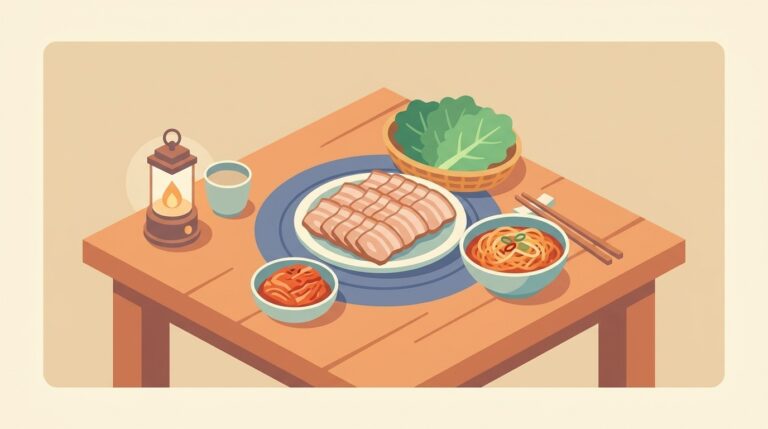
안녕하세요! I’m your tutor and friend at Daily Hangul! Have you ever watched a K-drama late at night and suddenly craved a warm, delicious feast? That is the magic of Korea’s 야식 (Yasik – Late-Night Snack) culture! Among all late-night dishes, 보쌈 (Bossam – Tender Boiled Pork Wraps) reigns as the ultimate comfort food. Imagine tender slices of pork wrapped in fresh cabbage with spicy radish kimchi at 11 PM!
However, ordering Bossam in Korea can feel intimidating for beginners. Should you order Small, Medium, or Large? How do you ask for extra lettuce politely? What if you want that spicy cold noodle dish called Makguksu on the side? Don’t worry! Based on real feedback from hundreds of Korean language learners, I have created this ultimate guide. By the end of this lesson, you will confidently order Bossam like a local Seoulite!
Phase 2: 3 Core Expressions Deep Dive
1. 보쌈 소 자 하나 주세요
- Pronunciation: [Bossam so-ja hana juseyo] (Sounds like: Boh-ssam soh-jah ha-nah joo-seh-yo)
- Meaning: “One small Bossam, please.”
- K-Culture Moment: You hear this in every Korean late-night eatery or delivery call when two friends order a late meal.
- Editor’s Insight: In Korea, dish sizes are usually categorized as 소 (So – Small), 중 (Jung – Medium), and 대 (Dae – Large). “소 자” literally means “Small Size”.
- Situation Spectrum:
- Casual: 🚫 (A bit too plain)
- Semi-formal: ✅ (Perfect for restaurants)
- Formal: ⚠️ (A bit conversational)
- 🤔 Think About It: In your home country, do you order food by portion sizes (Small/Medium/Large) or by individual plates?
2. 쌈채소 더 주실 수 있나요?
- Pronunciation: [Ssam-chaeso deo jusil su unnayo?] (Sounds like: Ssam-chae-soh duh joo-sheel soo een-nah-yo?)
- Meaning: “Could I please get more wrap vegetables?”
- K-Culture Moment: Eating Bossam requires plenty of lettuce and sesame leaves. Asking for extra side vegetables is standard practice in Korea!
- Editor’s Insight: Most Korean restaurants offer free refills on vegetable wraps (Ssam). Asking politely with “-주실 수 있나요?” makes you sound extremely respectful.
- Situation Spectrum:
- Casual: ⚠️ (Use only with friends)
- Semi-formal: ✅ (Ideal for dining out)
- Formal: ✅ (Very polite)
- 🤔 Think About It: Why do you think Korean food culture emphasizes wrapping meat with fresh greens?
3. 막국수도 같이 나와요?
- Pronunciation: [Makguksu-do gachi nawayo?] (Sounds like: Mahk-gook-soo-doh gah-chee nah-wah-yo?)
- Meaning: “Does it come with spicy cold noodles too?”
- K-Culture Moment: Bossam sets often include Makguksu (spicy buckwheat noodles) as a complimentary dish or combo item.
- Editor’s Insight: “나와요” literally means
Frequently Asked Questions (FAQ)
Q: What does "보쌈 소 자 하나 주세요" mean in Korean and how do you pronounce it?
A: In Korean, "보쌈 소 자 하나 주세요" is pronounced [Bossam so-ja hana juseyo] and means: "One small Bossam, please."
Q: What does "쌈채소 더 주실 수 있나요?" mean in Korean and how do you pronounce it?
A: In Korean, "쌈채소 더 주실 수 있나요?" is pronounced [Ssam-chaeso deo jusil su unnayo?] and means: "Could I please get more wrap vegetables?"
Q: What does "막국수도 같이 나와요?" mean in Korean and how do you pronounce it?
A: In Korean, "막국수도 같이 나와요?" is pronounced [Makguksu-do gachi nawayo?] and means: "Does it come with spicy cold noodles too?"







