

안녕하세요! 매일한글 에디터입니다.
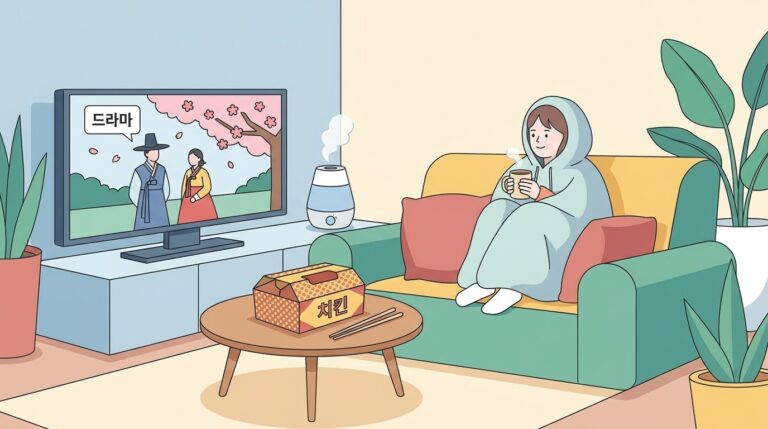
Have you ever settled onto your couch, wrapped in a cozy blanket with your favorite Korean snacks, ready to binge-watch a trending K-Drama on Netflix, only to realize you don’t know how to talk about it with your Korean friends? You press play on Squid Game or Crash Landing on You, and you want to ask your K-drama buddy if this show is good, or plead with them to watch ‘just one more episode’ without relying purely on English.
Learning Korean through media should feel like hanging out with your best friend, not sitting through a boring lecture! Many learners get stuck trying to memorize stiff dictionary phrases that no real Korean speaker uses while watching TV. That is why today, we are diving into simple, high-frequency Korean phrases tailored specifically for watching Netflix. Based on real feedback from hundreds of beginner learners at Daily Hangul, this guide gives you the exact tools to talk about shows like a native local.
Phase 2: Core Expressions Deep Dive
1. 이거 재미있어요? (I-geo jae-mi-it-seo-yo?)
- Pronunciation: [I-geo jae-mi-it-seo-yo?] (Sounds like “E-go” + “Jae-mee-eat-seoh-yo”)
- Meaning: Literal: “Is this fun?” / Actual Nuance: “Is this show good? / Are you enjoying this?”
- K-Culture Moment: Sitting on the sofa while your friend browses through the Netflix home screen thumbnail menu.
- Editor’s Insight: In Korean, the word 재미있다 (jae-mi-it-da) covers both “fun” and “interesting/entertaining.” You can use it for movies, dramas, and games!
- Situation Spectrum:
- Casual (Friends/Younger): 이거 재미있어? (✅)
- Semi-formal (Polite default): 이거 재미있어요? (✅)
- Formal (Business/Public): 이것이 재미있습니까? (🚫 – Too stiff for watching TV!)
- 🤔 Think About It: In English, you might ask “Is this movie good?”, but in Korean, emotional engagement (“is it fun/interesting?”) comes first. How does your language express enjoyment?
2. 다음 화 볼까요? (Dae-um hwa bol-kka-yo?)
- Pronunciation: [Dae-um hwa bol-kka-yo?] (Sounds like “Day-oom” + “Hwa” + “Bowl-kka-yo”)
- Meaning: Literal: “Shall we watch the next episode?” / Actual Nuance: “One more episode? (The ultimate K-drama trap!)”
- K-Culture Moment: It is 2 AM, the drama ended on a massive cliffhanger, and you look at your friend with pleading eyes.
- Editor’s Insight: ‘화 (hwa)’ means episode. For movies, you can replace it with ‘다음 영화’ (next movie). Asking ‘볼까요?’ (-l-kka-yo) is a gentle suggestion.
- Situation Spectrum:
- Casual: 다음 화 볼까? (✅)
- Semi-formal: 다음 화 볼까요? (✅)
- Formal: 다음 화를 보시겠습니까? (⚠️ – Sounds like Netflix customer support!)
- 🤔 Think About It: Notice how Korean uses soft questioning endings (-ㄹ까요) to make suggestions polite and inclusive!
3. 자막 켜 주세요 (Ja-mak kyeo ju-se-yo)
- Pronunciation: [Ja-mak kyeo ju-se-yo] (Sounds like “Jah-mak” + “Kyour” + “Joo-say-yo”)
- Meaning: Literal: “Please turn on the subtitles.”
- K-Culture Moment: The actor is speaking too fast in historical Korean (사극) or slang, and you need English or Korean subtitles quickly.
- Editor’s Insight: ‘자막 (jamak)’ = subtitles, ‘켜다 (kyeoda)’ = turn on, ‘주세요 (juseyo)’ = please give/do for me. Learn ‘주세요’ and you can survive anywhere in Korea!
- Situation Spectrum:
- Casual: 자막 켜 줘. (✅)
- Semi-formal: 자막 켜 주세요. (✅)
- Formal: 자막을 켜 주시겠습니까? (⚠️ – A bit formal for the living room!)
- 🤔 Think About It: ‘주세요’ reflects Korea’s helpful service culture. Asking for favors politely is key to friendly living.
Phase 3: Textbook Korean vs. Real Korean
Situation 1: Asking if a drama is exciting
- 📖 Textbook Korean: 이 드라마는 흥미롭습니까? (I deu-ra-ma-neun heung-mi-rop-seum-ni-kka?)
- 🗣️ Real Korean: 이 드라마 재밌어요? (I deu-ra-ma jae-mit-seo-yo?)
- 💡 Why is it different?: ‘흥미롭다’ sounds like an academic research review. Native speakers use the cozy and versatile ‘재밌어요’ (shortened form of 재미있어요) in daily conversations.
Situation 2: Pausing the video to go to the bathroom
- 📖 Textbook Korean: 비디오를 잠시 정지해 주십시오. (Bi-di-o-reul jam-si jeong-ji-hae ju-sip-si-o.)
- 🗣️ Real Korean: 잠깐만 멈춰 주세요! (Jam-kkan-man meom-chwo ju-se-yo!)
- 💡 Why is it different?: ‘잠시 정지’ is formal audio announcements (e.g., train station). In living rooms, ‘잠깐만’ (just a moment) + ‘멈춰 주세요’ (please pause/stop) is natural and natural.
Phase 4: K-Culture Deep Dive & Non-Verbal Manners
4-1. Nunchi & Gestures during Netflix Binging
- The T-Sign Gesture: If you can’t speak Korean quickly during an intense dialogue scene, make a ‘T’ sign with your hands to signal “Time out! Pause!”
- Eye Contact & Silence: When watching a big emotional scene in a K-Drama, talking over crying scenes is a slight faux pas. Hold your breath, offer a tissue, and whisper ‘잠깐만요’ if needed.
4-2. Cultural Code: 야식 (Late-Night Snack) Culture
In Korea, watching Netflix without 야식 (ya-sik) is almost impossible! The iconic combination is Chi-Maek (Chicken + Beer) or Tteokbokki. When a Korean friend asks, “야식 먹을까요?” (Shall we order late-night snacks?), the polite and culturally fluent response is an enthusiastic “좋아요!” (Sounds great!).
Phase 5: Real Roleplay Scenario
Setting: You are sitting on the couch with your Korean friend, Minji (민지), on a rainy Friday night browsing Netflix.
- Minji: 오늘 넷플릭스 볼까요? (O-neul net-feul-lik-seul bol-kka-yo? / Shall we watch Netflix today?)
🎭 Action: Minji hands you the TV remote control with a smile. - You: 네, 좋아요! 이거 재밌어요? (Ne, jo-a-yo! I-geo jae-mit-seo-yo? / Yes, great! Is this show good?)
🎭 Action: You point at a drama thumbnail on the screen. - Minji: 네! 이거 진짜 재밌어요. (Ne! I-geo jin-jja jae-mit-seo-yo. / Yes! This is super fun.)
- You: 자막 켜 주세요. (Ja-mak kyeo ju-se-yo. / Please turn on the subtitles.)
🎭 Action: You make a gentle request motion with both hands. - Minji: 알겠어요. 영어 자막 켜 줄게요. (Al-get-seo-yo. Yeong-eo ja-mak kyeo jul-ge-yo. / Got it. I’ll turn on English subtitles.)
- [1 Episode Later…]
- Minji: 벌써 끝났네요. (Beol-sseo kkeut-nat-ne-yo. / It’s already finished.)
- You: 다음 화 볼까요? (Dae-um hwa bol-kka-yo? / Shall we watch the next episode?)
🎭 Action: You lean forward excitedly with wide eyes.
🔀 Interactive Branching Choice
Minji looks at the clock—it is 1:00 AM! What do you say?
* Option A: 다음 화 볼까요? 제발요! (Dae-um hwa bol-kka-yo? Je-bal-yo! / Shall we watch the next episode? Please!)
* Option B: 이제 자야 합니다. 안녕히 계십시오. (I-je ja-ya ham-ni-da. An-nyeong-hi gye-sip-si-o. / I must sleep now. Goodbye.)
* Option C: 지금 몇 시예요? (Ji-geum myeot si-ye-yo? / What time is it now?)
Feedback:
- Best Choice (A): Perfectly matches K-drama viewing culture! Minji laughs and presses ‘Next Episode’.
- Risk Choice (B): Way too formal for a friend’s house late at night! Sounds like an army discharge message.
- Bad Choice (C): A bit abrupt and ruins the fun mood.
Phase 6: 10-Second Emotion Shadowing Drill
Practice saying these lines with realistic human emotions!
[😊 Exciting & Curious]
이거 / 진짜 / 재밌어요? (I-geo / jin-jja / jae-mit-seo-yo?)[🥺 Pleading & Cute]
다음 화 / 볼까요? / 제발요! (Dae-um hwa / bol-kka-yo? / Je-bal-yo!)[🙏 Polite & Needed]
자막 / 켜 주세요! (Ja-mak / kyeo ju-se-yo!)
Phase 7: K-Culture Mini Dictionary
- 정주행 (Jeong-ju-haeng) | Binge-watching | Watching a drama series non-stop from episode 1 to the end.
- 스포일러 (Seu-po-il-leo) | Spoiler | Ruining the plot twist! Usually shortened to ‘스포’ (Seu-po).
- 막장 (Mak-jang) | Over-the-top Drama | Dramatic plotlines with wild twists like secret twins or lost memories.
- 야식 (Ya-sik) | Late-night Snack | Essential Korean food delivered right to your home while watching TV.
Phase 8: Survival Kit for K-Media Lovers
Survival Expressions TOP 3
- 소리 좀 키워 주세요. (So-ri jom ki-wo ju-se-yo.) = Please turn up the volume.
- 잠깐만 멈춰 주세요. (Jam-kkan-man meom-chwo ju-se-yo.) = Please pause for a moment.
- 다음 화 켜 주세요. (Dae-um hwa kyeo ju-se-yo.) = Please turn on the next episode.
Editor’s Travel Note
When visiting Korea, downloading local apps makes binge-watching and snacking effortless. For ordering late night chicken while chilling at your hotel or Airbnb, check out the 요기요 앱 다운로드 guide for food delivery without native Korean phone numbers!
Phase 9: One Step Deeper (Thinking Question)
In Korean media culture, watching a show together is an active, communal bond. Asking “다음 화 볼까요?” is more than continuing a show; it is an invitation to share emotion, reaction, and late-night snacks with someone you care about.
💬 Your Turn: What is your absolute favorite K-drama to binge-watch, and who do you want to watch the next episode with? Share in the comments below!
Phase 10: FAQ & Common Mistakes
Q: Can I use ‘재미있어요’ for people?
A: No! If you say ‘이 사람 재미있어요’, it means “This person is funny/entertaining,” not physically attractive or romantic.
Q: How do I say “English Subtitles” specifically?
A: Say 영어 자막 (Yeong-eo ja-mak). For Korean subtitles, say 한국어 자막 (Han-gug-eo ja-mak).
Q: Is ‘볼까요?’ polite enough to ask an older friend?
A: Yes! Adding ‘-요’ makes it friendly yet polite for everyday situations.
🚨 Common Mistakes TOP 3
- Saying ‘영화’ (Yeong-hwa) instead of ‘드라마’ (Deu-ra-ma): Movie vs TV Drama series!
- Using stiff honorifics with friends: Avoid -습니까? while watching TV; it breaks the comfy vibe.
- Forgetting ‘주세요’: Saying just ‘자막 켜’ sounds like a command to a child. Always add ‘주세요’!
Phase 11: Action Mission & Engagement
- Bronze Mission: Say “이거 재미있어요?” out loud 3 times in front of your mirror.
- Silver Mission: Post a story of your Netflix screen on Instagram and caption it: “정주행 중! 다음 화 볼까요?”
- Gold Mission: Next time you watch a show with a friend, ask for subtitles using “자막 켜 주세요!” in real life.
🎮 K-Culture Mission: Open Netflix today, select a Korean show, and find the word 자막 in the audio/subtitle menu!
Phase 12: Interactive Quiz Challenge
Test your knowledge before you start your next Netflix session!
- Which phrase means “Shall we watch the next episode?”
a) 이거 재미있어요?
b) 다음 화 볼까요?
c) 자막 켜 주세요. -
True or False: ‘정주행’ means pausing a movie halfway through.
-
Fill in the blank: Please turn on subtitles = ____ 켜 주세요.
Click to reveal answers!
- b) 다음 화 볼까요?
- False! ‘정주행’ means binge-watching a series straight through from start to finish.
- 자막 (Ja-mak)







