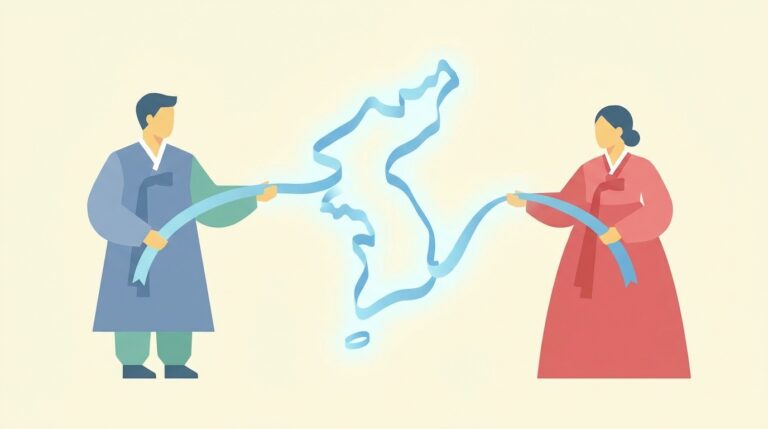
Phase 1: Why Inter-Korean Legal Talk Trips Up Even Top Learners
안녕하세요! 매일한글 에디터입니다. (Annyeonghaseyo! Maeil Hangul Editeo-imnida.) Have you ever binged Crash Landing on You or caught a heated panel on JTBC Newsroom over iced Americano, only to freeze when experts call North and South Korea “two countries, yet not foreign nations”? Even TOPIK Level 6 veterans tell us this constitutional paradox is their biggest hurdle! When one word shifts between domestic law and UN diplomacy, casual learners easily get lost. Today, using feedback from our advanced learners, I will guide you through the exact nuanced expressions Korean pundits use to navigate this dual legal reality—so you can join high-level debates with total confidence.
Phase 2: Deep Dive into 3 Core Expressions
1. 잠정적 특수관계 (Jamjeongjeok teuksu-gwangye)
- Pronunciation: [Jamjeongjeok teuksu-gwangye] — Sounds like jahm-jung-juk teuk-soo-gwan-gyeh, where teuk snaps cleanly like tapping a wooden desk.
- Meaning: Literal: “A provisional special relationship.” Nuance: The foundational legal concept from the 1991 Inter-Korean Basic Agreement, defining North and South Korea as neither ordinary foreign states nor a single unified jurisdiction, but a temporary partnership awaiting reunification.
- K-Culture Moment: Picture a tense scene in the political drama Designated Survivor: 60 Days (60일, 지정생존자), where Blue House legal counsel briefs the acting president on why an inter-Korean summit follows protocols completely distinct from standard diplomacy.
- Editor’s Insight: Native speakers rely on this phrase to explain why goods from the Kaesong Industrial Complex were treated as internal transactions rather than foreign imports. Dropping 잠정적 (provisional) alters the meaning entirely, stripping away the constitutional goal of eventual unification.
- Situation Spectrum: Casual 🚫 / Semi-formal ⚠️ / Formal ✅
- 🤔 Think About It: English jurisprudence tends to draw a sharp binary between “domestic” and “foreign.” Why do you think Korean legal discourse deliberately preserves a paradoxical middle ground?
2. 이중적 법리 구조 (Ijungjeok beomni gujo)
- Pronunciation: [Ijungjeok beomni gujo] — Sounds like ee-joong-juk bum-nee goo-joh. Notice how beop-ri glides smoothly into beom-ni (bum-nee) through natural nasal assimilation, much like saying “sub-marine” smoothly without pausing at the b.
- Meaning: Literal: “A dual legal-principle structure.” Nuance: The coexistence of two seemingly contradictory legal realities—joint UN membership as sovereign states alongside constitutional clauses claiming the entire peninsula.
- K-Culture Moment: Think of intellectual roundtables like Ssulzun (썰전) or 100-Minute Debate (100분 토론), where law professors unpack why South Korea’s Constitution and UN Charter obligations occasionally collide.
- Editor’s Insight: Using 법리 (beomni, legal reasoning/jurisprudence) instead of simple 법 (beop, law) instantly elevates your Korean to C2 mastery. It signals that you are analyzing the underlying philosophy of the law rather than just quoting statutes.
- Situation Spectrum: Casual 🚫 / Semi-formal ⚠️ / Formal ✅
- 🤔 Think About It: Does your native language frame unresolved historical divisions through rigid legal binaries or flexible transitional phrases?
3. 정전체제에서 평화체제로의 이행 (Jeongjeon-cheje-eseo pyeonghwa-cheje-ro-ui ihaeng)
- Pronunciation: [Jeongjeon-cheje-eseo pyeonghwa-cheje-ro-ui ihaeng] — Sounds like jung-jun-cheh-jeh-eh-suh pyung-hwa-cheh-jeh-roh-eh ee-haeng, where the possessive 의 (ui) softens naturally into a gentle eh.
- Meaning: Literal: “Transition from an armistice system to a peace system.” Nuance: Not merely signing a single document, but overhauling an entire military, diplomatic, and institutional architecture that has frozen the peninsula since 1953.
- K-Culture Moment: You will hear this exact cadence in investigative documentaries or military-themed dramas like The King 2 Hearts (더킹 투하츠), reminding viewers that the Korean War technically never ended with a peace treaty.
- Editor’s Insight: Pay close attention to the symmetry between 정전체제 (armistice regime) and 평화체제 (peace regime). Moreover, 이행 (ihaeng) carries a double nuance of both “transition” and “implementation/fulfillment,” emphasizing active effort rather than passive drift.
- Situation Spectrum: Casual 🚫 / Semi-formal ⚠️ / Formal ✅
- 🤔 Think About It: Because 이행 means both moving from A to B and fulfilling a promise, what does that linguistic overlap reveal about how Koreans view the road to peace?
Phase 3: Textbook Korean vs. Real Korean
Situation 1: Explaining why North and South Korea aren’t “foreign” to each other over coffee
- 📖 Textbook Korean: 남북한은 국제법상 별개의 국가이지만 통일을 지향하는 특수관계입니다. (Nambukhan-eun gukjebeopsang byeolgye-ui gukga-ijiman tongir-eul jihyanghaneun teuksu-gwangye-imnida.) — “North and South Korea are separate states under international law, yet hold a special relationship oriented toward unification.”
- 🗣️ Real Korean: 유엔엔 따로 들어갔어도, 우리끼린 남이 아니라는 애매한 포지션이지. (Yuen-en ttaro deureogasseodo, uri-kkirin nam-i aniraneun aemaehan pojisyeon-iji.) — “Even though they entered the UN separately, between us it’s that ambiguous position of not being strangers.”
- 💡 Why is it different? Outside broadcast studios, even Korean law professors soften heavy Sino-Korean nouns. Replacing 특수관계 with the emotional phrase 남이 아니다 (not strangers) and adding the loanword 포지션 (position) keeps the tone conversational and relatable.
Situation 2: Discussing replacing the 1953 armistice with lasting peace
- 📖 Textbook Korean: 정전체제를 종식하고 항구적인 평화체제를 구축해야 합니다. (Jeongjeon-chejereul jongsikhago hanggujeog-in pyeonghwa-chejereul guchukhaeya hamnida.) — “We must terminate the armistice regime and establish a permanent peace regime.”
- 🗣️ Real Korean: 임시 휴전 상태만 70년째니까 이제 진짜 종지부를 찍을 때가 됐지. (Imsi hyujeon sangtae-man chilsimnyeon-jjae-nikka ije jinjja jongjibureul jjigeul ttae-ga dwaetji.) — “It’s been a temporary ceasefire for 70 years, so it’s really time to put a period to it.”
- 💡 Why is it different? In everyday Korean debates, vivid idioms like 종지부를 찍다 (to put a final period to something) convey urgency far more naturally than stiff bureaucratic verbs like 종식하다 (terminate) or 구축하다 (construct).
Phase 4: K-Culture Deep Dive & Non-Verbal Manners
4-1. Nunchi (눈치) & Gestures
Discussing inter-Korean law in Korea requires top-tier nunchi (social awareness), because perspectives vary sharply across generations and political circles. Keep your posture balanced and relaxed; never point fingers (손가락질, songarakjil) when emphasizing an argument, as it feels confrontational. Instead, use open-palm gestures (손바닥을 펴서 설명하기) and nod steadily (고개를 끄덕이며 경청하기) while listening. Showing that you appreciate the nuance of the dual structure—rather than pushing a simplistic verdict—earns instant respect from Korean intellectuals.
4-2. Cultural Code Analysis: Crash Landing on You & JSA
Why do global audiences tear up watching border scenes in Crash Landing on You (사랑의 불시착) or the classic film Joint Security Area (공동경비구역 JSA)? Those emotional arcs are literally rooted in Korea’s dual legal identity. Under international law, crossing the 38th parallel is an unauthorized border breach; yet emotionally and constitutionally, the characters belong to 한민족 (hanminjok, one ethnic nation). That legal tug-of-war—two sovereign seats at the UN, yet one divided family—is the beating heart of modern Korean political cinema.
Phase 5: Real-Life Roleplay Scenario
Setting: A quiet, wood-scented traditional tea house (전통 찻집) in Insadong after an evening film screening. Steam rises from cups of omija tea.
NPC: Min-jun (민준), your sharp-witted Korean friend studying international law at Seoul National University.
- Min-jun: 오늘 영화 꽤 묵직했지? 난 볼 때마다 한반도의 법적 지위가 참 아이러니하게 느껴져. (Oneul yeonghwa kkwae mukjikaetji? Nan bol ttaemada hanbando-ui beopjeok jiwi-ga cham aireonihage neukkyeojyeo.) — “Today’s movie was pretty heavy, right? Every time I watch something like this, the Korean peninsula’s legal status feels so ironic.” 🎭 (Swirling his teacup thoughtfully)
- You: 맞아. 유엔에 동시 가입했다는 점만 보면 완벽한 두 국가인데 말이야. (Maja. Yuen-e dongsi gaiphaetdaneun jeom-man bomyeon wanbyeokhan du gukga-inde mariya.) — “True. Looking purely at their simultaneous UN admission, they’re clearly two separate states.” 🎭 (Leaning forward slightly on the wooden table)
- Min-jun: 그렇지. 그런데 우리 헌법과 남북기본합의서 관점에선 여전히 통일을 지향하는 잠정적 특수관계거든. (Geureochi. Geureonde uri heonbeop-gwa nambuk-gibon-hapuiseo gwanjeom-eseon yeojeonhi tongir-eul jihyanghaneun jamjeongjeok teuksu-gwangye-geodeun.) — “Exactly. Yet from our Constitution and the Basic Agreement’s perspective, it’s still a provisional special relationship aiming for unification.” 🎭 (Raising two fingers to contrast both frameworks)
- You: 그 이중적 법리 구조 때문에 국제사회에서도 해석이 엇갈리는 거구나. (Geu ijungjeok beomni gujo ttaemune gukjesahoe-eseodo haeseog-i eotgallineun geoguna.) — “So that dual legal structure is why interpretations clash even in the international community.” 🎭 (Nodding slowly as the concept clicks)
- Min-jun: 정확해! 게다가 법적으로는 아직 정전체제 아래에 있다는 게 핵심이지. (Jeonghwakhae! Gedaga beopjeog-euroneun ajik jeongjeon-cheje arae-e itdaneun ge haeksim-iji.) — “Spot on! Plus, the crux is that legally we’re still under an armistice regime.” 🎭 (Tapping the table gently to emphasize the word ‘core’)
- You: 그럼 정전체제에서 평화체제로의 이행은 단순한 종전선언 이상의 문제겠네? (Geureom jeongjeon-cheje-eseo pyeonghwa-cheje-ro-ui ihaeng-eun dansunhan jongjeonseoneon isang-ui munje-genne?) — “Then transitioning from an armistice regime to a peace regime must go far beyond a simple end-of-war declaration, right?” 🎭 (Raising an eyebrow curiously)
- Min-jun: 당연하지. 법적, 군사적 제도를 다 손봐야 하니까. 너라면 이 특수관계를 어떻게 바라볼 것 같아? (Dangyeonhaji. Beopjeok, gunsajeok jedo-reul da sonbwaya hanikka. Neoramyeon i teuksu-gwangye-reul eotteoke barabol geot gata?) — “Of course. Legal and military systems all have to be overhauled. If it were you, how would you view this special relationship?” 🎭 (Smiling warmly, genuinely curious about your outsider-insider perspective)
- You: [Choose your response below!]
🔀 Interactive Branching Point: How will you answer Min-jun?
- Option A: 분단의 현실을 인정하면서도 미래의 통일 가능성을 열어둔 유연한 장치라고 봐. (Bundan-ui hyeonsir-eul injeonghamyeonseodo mirae-ui tongil ganeungseong-eul yeoreodun yuyeonhan jangchirago bwa.) — “I see it as a flexible mechanism that acknowledges division while keeping future unification open.”
- Feedback (Best!): Brilliant C2 phrasing! Using 유연한 장치 (flexible mechanism) captures both legal pragmatism and cultural sensitivity without alienating anyone.
- Option B: 그건 그냥 법적으로 앞뒤가 안 맞는 모순이니까 당장 외국으로 선을 그어야 해. (Geugeon geunyang beopjeog-euro apdwi-ga an manneun mosun-inikka dangjang oegug-euro seon-eul geueoya hae.) — “That’s just a legal contradiction that makes no sense, so you should immediately draw the line as a foreign country.”
- Feedback (Bad!): Calling the constitutional framework 앞뒤가 안 맞는 모순 (a nonsensical contradiction) sounds dismissive of decades of painful historical context and lacks nunchi.
- Option C: 평화체제로 가려면 결국 국제법상 두 국가 현실을 더 강조할 수밖에 없지 않을까? (Pyeonghwa-cheje-ro garyeomyeon gyeolguk gukjebeopsang du gukga hyeonsir-eul deo gangjohal subakke eopji aneulkka?) — “To reach a peace regime, wouldn’t you eventually have to emphasize the two-state reality under international law?”
- Feedback (Risk!): Thought-provoking and polite! Because you used the soft ending ~지 않을까? (wouldn’t it be…?), it invites deep academic debate—though some traditionalists might push back firmly.
Phase 6: 10-Second Emotional Shadowing Drill
Practice reading these aloud with the pause markers (/) and emotional cues to sound like a seasoned Korean commentator!
- [🧐 Thoughtful & Serious]
유엔에 동시 가입했어도 / 남북관계는 여전히 / 잠정적 특수관계입니다.
(Yuen-e dongsi gaiphaesseodo / nambuk-gwangye-neun yeojeonhi / jamjeongjeok teuksu-gwangye-imnida.)
“Even with simultaneous UN admission, inter-Korean relations remain a provisional special relationship.” -
[💡 Analytical & Decisive]
이중적 법리 구조를 이해해야 / 한반도 뉴스가 / 제대로 보입니다.
(Ijungjeok beomni gujo-reul ihaehaeya / hanbando nyuseu-ga / jedaero boimnida.)
“Only by understanding the dual legal structure can you truly see Korean peninsula news clearly.” -
[🤝 Hopeful & Measured]
정전체제에서 / 평화체제로의 이행은 / 긴 호흡이 필요한 여정입니다.
(Jeongjeon-cheje-eseo / pyeonghwa-cheje-ro-ui ihaeng-eun / gin hoheub-i piryohan yeojeong-imnida.)
“Transitioning from an armistice regime to a peace regime is a journey requiring patience.”
Phase 7: K-Culture Mini Dictionary
- 남북기본합의서 (Nambuk Gibon Hapuiseo) | Inter-Korean Basic Agreement | Adopted in 1991, this landmark pact officially coined the “special provisional relationship” (특수관계) between Seoul and Pyongyang, frequently cited in university lectures and news briefs.
- 민족내부거래 (Minjok Naebu Georae) | Intra-Korean Transaction | A real economic-legal term used when South Korean companies operated in Kaesong; because of the inter-se principle, goods were legally exempt from standard foreign tariffs.
- 정전협정 (Jeongjeon Hyeopjeong) | Armistice Agreement | The 1953 ceasefire accord that paused active fighting without ending the war—often contrasted in media with 평화협정 (Pyeonghwa Hyeopjeong, Peace Treaty).
- 헌법 제3조 (Heonbeop Je-sam-jo) | Article 3 of the Constitution | The famous clause stating that the Republic of Korea’s territory consists of the entire Korean peninsula and its adjacent islands, forming the root of the dual legal dilemma.
Phase 8: Survival Kit for Travelers
Planning a visit to the DMZ, Dora Observatory, or Seoul’s War Memorial of Korea? Keep these Level 6-ready survival phrases handy:
- 이 구역에서는 사진 촬영이 가능한가요? (I guyeog-eseoneun sajin chwalyeong-i ganeunghangayo?) — “Is photography permitted in this zone?”
- Pro Tip: Restricted zones at the DMZ strictly enforce camera rules. Always ask security staff before raising your phone!
- 통일전망대 가는 셔틀은 어디서 타요? (Tongil Jeonmangdae ganeun syeoteureun eodiseo tayo?) — “Where do I catch the shuttle to the Unification Observatory?”
- Pro Tip: Shuttle departure gates around Imjingak shift seasonally, so verifying with local staff saves long walks.
- 한국어 해설 오디오 가이드 있나요? (Hangugeo haeseol odio gaideu innayo?) — “Do you have a Korean audio guide?”
- Pro Tip: At Level 6, try listening to the Korean audio track at the War Memorial of Korea—it’s packed with authentic legal and historical vocabulary!
Editor’s Travel Note: Before heading toward Paju or the DMZ, be sure to use Download Naver Map for DMZ Transit to check real-time Gyeongui-Jungang Line subway schedules, and keep Install Papago Translator for Museum Signs ready for archaic hanja placards. Most importantly, bring your physical passport (여권 지참 필수)—copies won’t get you past military checkpoints, even with a T-money card loaded for local buses!
Phase 9: One Step Deeper — The Heart Behind the Law
International law loves crisp borders, yet Korean society often filters legal definitions through 우리 (uri, collective “we”) and 정 (jeong, deep emotional attachment). That is why South Korea’s legal vocabulary refuses to sever the peninsula cleanly into two unrelated strangers, holding space for a 특수관계 even after seven decades of UN-recognized separation. Language doesn’t just describe treaties; it preserves a culture’s unresolved hopes. Even in cold legal prose, Korean reminds us that peace is as much about healing a shared identity as signing a document.
💬 Your Turn: How does your native language’s legal or political vocabulary reflect your country’s historical turning points? Share your thoughts in the comments below!
Phase 10: FAQ & Preventing Misunderstandings
Q: Why does the South Korean government treat North Korea as a special relationship if both hold UN seats?
A: Under international law, UN membership acknowledges sovereign statehood, yet South Korea’s Constitution (Article 3) and the 1991 Basic Agreement define inter-Korean ties as an inter-se (internal, provisional) relationship oriented toward peaceful reunification, creating a deliberate dual legal framework.
Q: Is an End-of-War Declaration (종전선언) the same as a Peace Treaty (평화협정)?
A: No! A 종전선언 is a political declaration signaling an intent to end hostilities, whereas a 평화협정 is a binding international legal treaty required to formally dismantle the 1953 Armistice Regime (정전체제).
Q: In everyday Korean conversation, can I casually refer to North Korea as “외국” (a foreign country)?
A: Legally and culturally, calling North Korea 외국 (oeguk) sounds awkward or inaccurate to native speakers. Koreans usually say 북한 (Bukhan) or 이북 (Ibuk) rather than categorizing it alongside ordinary foreign nations.
🚨 Common Mistakes & Correct Actions
- Calling inter-Korean trade “수출입” (import/export): Because of the special relationship doctrine, legally it is 반출·반입 (banchul/banip, bringing out/in within one nation). Correct Action: Use 반출 and 반입 or 민족내부거래 in formal essays!
- Pronouncing “법리” literally as [beop-ri]: Korean phonology never leaves p + r untouched. Correct Action: Smoothly pronounce it as [범니 / beom-ni].
- Using “체제” (regime/system) and “제도” (institution) interchangeably: 체제 covers the overarching geopolitical order (정전체제), while 제도 refers to specific policies or rules. Correct Action: Pair 정전 and 평화 with 체제.
Phase 11: Action Mission & Engagement
- 🥉 Bronze Mission (Solo Practice): Record yourself reading the 3 sentences from Phase 6 using your phone’s voice memo, focusing on the nasal assimilation in 법리 [범니].
- 🥈 Silver Mission (Share Online): Post one newly learned Level 6 keyword from Phase 7 on Instagram or X with
#DailyHanguland explain why “provisional special relationship” fascinated you. - 🥇 Gold Mission (Real-Life Use): Next time you chat with a Korean friend about news or K-dramas, drop 이중적 법리 구조 (dual legal structure) naturally—watch their jaw drop at your fluency!
🎮 K-Culture Mission: Rewatch a news clip or a dramatic briefing scene from Designated Survivor: 60 Days or Steel Rain and try to spot 정전체제, 평화협정, or 특수관계 in the subtitles!
Phase 12: Interactive Quiz Challenge
1. [Situational Judgment] During a university seminar in Seoul, a professor asks what legal term describes why Kaesong Industrial Complex goods weren’t taxed as standard foreign imports. Which phrase fits best?
A) 완전한 외국 무역 (Wanjeonhan oeguk muyeok)
B) 잠정적 특수관계에 따른 민족내부거래 (Jamjeongjeok teuksu-gwangye-e ttareun minjok naebu georae)
C) 일방적 정전체제 파기 (Ilbangjeok jeongjeon-cheje pagi)
Click to reveal Answer & Explanation
Answer: B! Under the 1991 Basic Agreement’s provisional special relationship (잠정적 특수관계), inter-Korean economic exchanges were legally categorized as intra-Korean transactions (민족내부거래). Wrong-answer feedback: Option A treats North Korea purely as a foreign trading partner, contradicting South Korean domestic legal precedent, while Option C refers to unilaterally breaking the armistice, which is unrelated to tariff law.
2. [Fill in the Blank] Complete the formal phrase for transitioning away from the 1953 ceasefire architecture:
정전체제에서 평화체제로의 _______ (Transition from an armistice regime to a peace regime)
Click to reveal Answer & Explanation
Answer: 이행 (ihaeng)! Remember that 이행 captures both “transition” and “implementation/fulfillment,” making it the signature Level 6 noun in Korean peace discourse.
3. [True / False Cultural Quiz] True or False: Saying “남북관계는 단순한 외국 간의 관계다” (Inter-Korean relations are simply relations between foreign countries) accurately reflects South Korea’s constitutional and Basic Agreement stance.
Click to reveal Answer & Explanation
Answer: False! While both Koreas hold separate UN seats, South Korea’s Constitution and the 1991 Basic Agreement maintain a dual legal structure (이중적 법리 구조) treating the relationship as a provisional special tie oriented toward peaceful reunification.
🎬 Watch Our Daily Videos! (Daily Hangul Official Instagram)
Review the expressions you learned in this article with our fun daily short videos! Check out native pronunciation and real-life nuances in action.
- Instagram @dailyhangul_en