Phase 1: Why Korean Cafes Make Beginners Freeze
안녕하세요! 매일한글 에디터입니다. (Annyeonghaseyo! Hello, I am your Daily Hangul Editor.) Imagine walking into a trendy cafe in Seongsu-dong, Seoul, just like a character in your favorite K-Drama. You successfully order your Iced Americano! Then, the smiling barista asks a fast question: “드시고 가세요? (Deusigo gaseyo?)” You freeze, point vaguely at a chair, and end up getting a takeout cup anyway because of Korea’s strict reusable cup rules. Many of my beginner students tell me this exact moment makes them nervous! Based on real feedback from hundreds of learners, this beginner-friendly guide will help you answer confidently, choose your cup size, and enjoy your coffee stress-free.
Phase 2: Top 3 Must-Know Expressions
1. 매장에서 먹고 갈게요 (Maejang-eseo meokgo galgeyo)
- Pronunciation: Mae-jang-e-seo meok-go gal-ge-yo (Sounds like: “May-jang-eh-suh muck-go gal-geh-yo” — the “eo” sounds like the relaxed “uh” in “cup”).
- Meaning: Literally “I will eat and go in the store,” but the real nuance is “I will have it for here.”
- K-Culture Moment: In hit K-Dramas like Business Proposal, characters often duck into a sunny neighborhood cafe between meetings and tell the barista this before grabbing a window seat.
- Editor’s Insight: Do not worry if you only ordered a latte and no cake! In Korean, using “eat” (
먹다, meokda) for beverages in this phrase is 100% natural and signals the barista to prepare a glass or ceramic mug. - Situation Spectrum: Casual 🚫 / Semi-formal ✅ / Formal ✅
- 🤔 Think About It: English says “for here” (focusing on the location), while Korean says “eat and go” (focusing on the full action). How does this action-first mindset change how you picture a cafe visit?
2. 가지고 갈게요 (Gajigo galgeyo)
- Pronunciation: Ga-ji-go gal-ge-yo (Sounds like: “Kah-jee-go gal-geh-yo” — keep the ending smooth and light).
- Meaning: Literally “I will take it and go,” and the real nuance is “To go, please.”
- K-Culture Moment: You can hear busy office workers in K-Dramas or K-Pop idols in behind-the-scenes vlogs rushing in before a morning broadcast and saying this to grab their iced coffee fast.
- Editor’s Insight: Yes, the Konglish word
테이크아웃 (teikeu-aut)works too, and baristas understand it! However, saying가지고 갈게요 (gajigo galgeyo)sounds much warmer, friendlier, and closer to how locals talk every day. - Situation Spectrum: Casual 🚫 / Semi-formal ✅ / Formal ✅
- 🤔 Think About It: Notice how Korean uses “go” (
가다, gada) in BOTH “for here” and “to go”! Why do you think Korean treats staying at a cafe as a temporary stop before going somewhere else?
3. 큰 사이즈로 주세요 (Keun saijeu-ro juseyo)
- Pronunciation: Keun sa-i-jeu-ro ju-se-yo (Sounds like: “Kuhn sah-ee-juh-ro joo-say-yo” — say “eu” with flat, relaxed lips).
- Meaning: Literally “Please give it to me in a big size,” meaning “Large size, please.”
- K-Culture Moment: Just like K-Pop stars holding giant iced coffees during their early-morning music show arrivals, Korea loves extra-large cups to survive long days!
- Editor’s Insight: Every Korean cafe chain uses different size names (Regular, Tall, Grande, Big). If you do not want to squint at the tiny menu board,
큰 사이즈로 주세요 (keun saijeu-ro juseyo)works at almost any cafe! - Situation Spectrum: Casual 🚫 / Semi-formal ✅ / Formal ✅
- 🤔 Think About It: In Korea, a “Regular” cup is often smaller than an American “Medium.” Knowing that sizing differs across cultures can save you from surprise caffeine shortages!
Phase 3: Textbook Korean vs. Real Korean
Situation 1: Telling the barista you are dining in
- 📖 교과서 한국어 (Textbook Korean):
여기에서 마실 것입니다. (Yeogi-eseo masil geosimnida.)— “I will drink it here.” - 🗣️ 진짜 한국어 (Real Korean):
매장에서 먹고 갈게요! (Maejang-eseo meokgo galgeyo!)— “I’ll have it here in the store!” - 💡 왜 다를까? (Why is it different?): Textbooks teach the stiff
-ㄹ 것입니다ending and the verb “to drink” (마시다, masida). In real life, Koreans use the gentle promise ending-ㄹ게요 (-lgeyo)and say “eat” (먹다, meokda) for drinks too!
Situation 2: Asking for a regular or medium cup
- 📖 교과서 한국어 (Textbook Korean):
중간 크기로 주십시오. (Junggan keugi-ro jusipsio.)— “Please give me the middle size.” - 🗣️ 진짜 한국어 (Real Korean):
기본 사이즈로 주세요. (Gibon saijeu-ro juseyo.)or레귤러로 주세요. (Regyulleo-ro juseyo.)— “Basic / regular size, please.” - 💡 왜 다를까? (Why is it different?): Korean cafe culture mixes Korean with quick English loanwords like
사이즈 (saijeu)and레귤러 (regyulleo), or uses기본 (gibon - default/standard)to keep lines moving quickly.
Phase 4: K-Culture Deep Dive & Non-Verbal Manners
4-1. Nunchi & Gestures at the Counter
When ordering in Korea, good 눈치 (nunchi - social awareness) keeps things smooth! Make brief eye contact with the barista, give a tiny, friendly head nod, and keep your voice clear. When saying 매장에서 먹고 갈게요 (Maejang-eseo meokgo galgeyo), you can gently gesture toward the tables with an open palm—never point with a single finger. Also, pay close attention to Korea’s eco-friendly cup rules: if you plan to sit inside, you must use a reusable mug or glass (머그컵, meogeukeop), not a disposable plastic cup!
4-2. Culture Code: K-Food & K-Travel Cafe Culture
South Korea has more cafes per block than almost anywhere else in the world! Beyond coffee, Korean cafes act as cozy living rooms for 카공족 (kagong-jok)—people who study or work in cafes. Saying you will eat inside (매장에서 먹고 갈게요) unlocks comfy seating, super-fast Wi-Fi, and power outlets. Just remember one golden rule before you leave: always carry your empty mug and tray to the return station (반납대, bannapdae)!
Phase 5: Real-Life Roleplay Scenario
Scene & Character
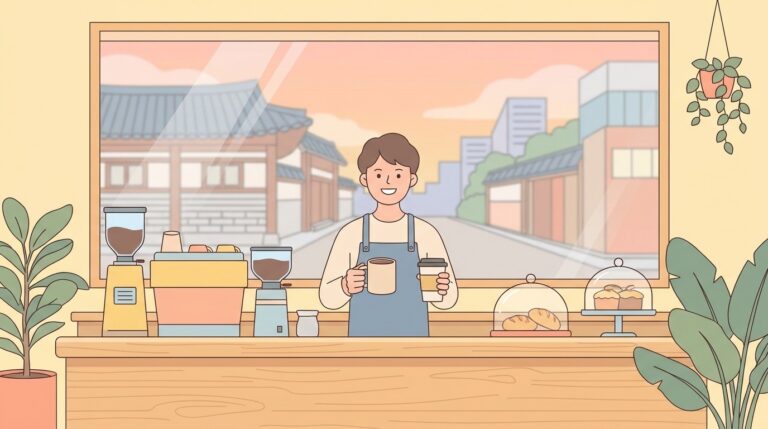
Sunlight streams through the large glass windows of a cozy indie cafe in Hongdae, smelling of freshly roasted beans while soft K-Indie music plays. Minji, a cheerful barista in a denim apron, greets you warmly at the register.
- Minji:
안녕하세요! 주문 도와드릴까요? (Annyeonghaseyo! Jumun dowadeurilkkayo?)— “Hello! May I help you with your order?” 🎭 Minji smiles brightly behind the counter. - You:
네, 아이스 아메리카노 한 잔 주세요. (Ne, aiseu amerikano han jan juseyo.)— “Yes, one iced Americano, please.” 🎭 You step up to the register and smile back. - Minji:
사이즈는 어떤 걸로 드릴까요? (Saijeu-neun eotteon geollo deurilkkayo?)— “What size would you like?” 🎭 Minji holds up two sample cups to show the sizes. - You:
큰 사이즈로 주세요. (Keun saijeu-ro juseyo.)— “Large size, please.” 🎭 You look at the larger cup and nod. - Minji:
네! 매장에서 드시고 가세요? (Ne! Maejang-eseo deusigo gaseyo?)— “Okay! Are you having it here in the store?” 🎭 Minji taps the screen and looks up at you. - You:
네, 매장에서 먹고 갈게요. (Ne, maejang-eseo meokgo galgeyo.)— “Yes, I will have it here in the store.” 🎭 You gesture politely toward the window seats. - Minji:
알겠습니다! 진동벨 울리면 가져가세요. (Algetseumnida! Jindongbel ullimyeon gajyeogaseyo.)— “Got it! Please pick it up when the buzzer vibrates.” 🎭 Minji hands you a round vibrating buzzer with both hands. - You:
감사합니다! (Gamsahamnida!)— “Thank you!” 🎭 You receive the buzzer with two hands and give a small polite bow.
🔀 Interactive Branching Point
When Minji asks 매장에서 드시고 가세요? (Maejang-eseo deusigo gaseyo?), you really want to sit down and rest your feet for an hour. Which response do you choose?
* A) 네, 매장에서 먹고 갈게요. (Ne, maejang-eseo meokgo galgeyo.)
* B) 테이크아웃 주세요! (Teikeu-aut juseyo!)
* C) 아무거나 주세요. (Amugeona juseyo.)
Feedback:
* Choice A (Best!): Spot on! Minji prepares your Iced Americano in a tall glass, and you can relax by the window stress-free.
* Choice B (Risk!): Oops! That means “to go,” so your drink will come in a plastic cup. Due to Korean eco laws, staff may politely ask you not to sit inside with a disposable cup.
* Choice C (Bad!): Saying “give me anything” will confuse the barista! Because of strict reusable cup regulations, the staff legally has to know whether you are staying or leaving.
Phase 6: 10-Second Emotion Shadowing Drill
Read each line aloud with feeling, pausing briefly at every / mark!
* [😊 Happy & Excited] 네! / 매장에서 / 먹고 갈게요! (Ne! / Maejang-eseo / meokgo galgeyo!) — “Yes! / In the store / I’ll have it here!”
* [😎 Cool & Confident] 아이스 아메리카노 / 큰 사이즈로 / 주세요. (Aiseu amerikano / keun saijeu-ro / juseyo.) — “Iced Americano / in a large size / please.”
* [🥺 Polite & Gentle] 혹시 / 가지고 갈 수 / 있을까요? (Hoksi / gajigo gal su / isseulkkayo?) — “By any chance / can I take it / to go?”
Phase 7: K-Culture Mini Dictionary
- 매장 (Maejang) | Store / Inside the shop | Used everywhere from cafes to clothing boutiques when talking about staying or shopping inside.
- 테이크아웃 (Teikeu-aut) | Takeout / To go | A very common Konglish word printed on cafe signs, menus, and kiosks.
- 진동벨 (Jindongbel) | Vibrating buzzer | The small coaster-like pager handed to you after paying; it buzzes and flashes red when your drink is ready.
- 아아 (A-a) | Iced Americano | Korea’s iconic slang abbreviation for
아이스 아메리카노—Koreans drink it even in snowstorms!
Phase 8: Traveler’s Survival Kit
Top 3 Survival Phrases
여기서 먹을게요 (Yeogiseo meogeulgeyo)— “I’ll eat here.” Pro Tip: Even shorter and super easy if you forget the word매장 (maejang)!포장해 주세요 (Pojanghae juseyo)— “Please wrap/pack it to go.” Pro Tip: Works like magic at cafes, bakeries, and street food stalls too!얼음 적게 주세요 (Eoreum jeokge juseyo)— “Less ice, please.” Pro Tip: Korean iced drinks are famous for being packed with ice, so keep this handy!
Editor’s Travel Note
Before heading out on a cafe tour in Seoul, make sure to grab the Naver Map app download or KakaoMap app download on your phone, since Google Maps does not give accurate walking directions in Korea. Almost every Korean cafe welcomes credit cards (카드 결제, kadeu gyeolje), and many popular chains have self-order kiosks (키오스크, kioseukeu) with an English language button right at the top corner!
Phase 9: One Step Deeper
In Korean, the tiny ending -게요 (-geyo) in 먹고 갈게요 (meokgo galgeyo) does something really sweet. Rather than just stating a cold fact, you are gently letting the barista know your intention so they can take good care of you. This reflects 배려 (baeryeo)—mutual consideration—which sits at the heart of everyday Korean politeness (존댓말, jondaetmal). Even a ten-second chat at a busy Seoul coffee counter becomes a warm moment of connection when you add a friendly 감사합니다 (Gamsahamnida)!
💬 Your Turn: In your native language, do you use different phrases depending on whether you stay inside or leave with your coffee? Drop your favorite cafe order in the comments below!
Phase 10: FAQ & Common Mistakes
Q: What if I said “for here” at first, but I cannot finish my drink and want to leave?
A: No worries at all! Just carry your mug back to the counter and say 이거 테이크아웃 잔에 옮겨 주세요 (Igeo teikeu-aut jan-e omgyeo juseyo) which means “Please transfer this to a takeout cup.”
Q: Why did the barista ask “드시고 가세요? (Deusigo gaseyo?)” instead of using “먹다 (meokda)”?
A: 드시다 (deusida) is the respectful honorific verb for “to eat/drink”! The barista uses 드시다 to show respect to you as a customer, while you use 먹고 갈게요 for yourself.
Q: Can I just use the touchscreen kiosk if I feel too shy to speak Korean?
A: Yes, kiosks are everywhere and super convenient! Still, trying out 매장에서 먹고 갈게요 (Maejang-eseo meokgo galgeyo) at small local cafes will almost always earn you a huge smile.
🚨 Common Mistakes TOP 3
- Mistake: Thinking
먹다 (meokda)only works for solid food and avoiding it for coffee. -> Correct Action: Use먹고 갈게요 (Meokgo galgeyo)proudly for both drinks and pastries! - Mistake: Sitting down at an indoor table with a disposable plastic takeout cup. -> Correct Action: Because of Korea’s single-use plastic rules, always say
매장에서 먹고 갈게요if you plan to sit inside. - Mistake: Dropping the polite
-요 (-yo)and saying먹고 갈게 (meokgo galge). -> Correct Action: Always keep the polite-요ending with staff:매장에서 먹고 갈게요 (Maejang-eseo meokgo galgeyo)!
Phase 11: Action Mission & Engagement
- 🥉 Bronze Mission: Look in the mirror and say
매장에서 먹고 갈게요 (Maejang-eseo meokgo galgeyo)out loud 5 times with a warm smile and a tiny nod! - 🥈 Silver Mission: Snap a photo of your favorite iced drink and post it on Instagram or TikTok with the caption:
오늘도 아아 한 잔! 매장에서 먹고 갈게요 ☕ - 🥇 Gold Mission: Next time you visit a Korean cafe (or a Korean-owned bakery in your hometown!), order your drink using
큰 사이즈로 주세요and매장에서 먹고 갈게요! - 🎮 K-Culture Mission: Watch a cafe scene in your favorite K-Drama or a K-Pop idol’s vlog and listen closely at the counter—can you catch
드시고 가세요?or포장?
Phase 12: Interactive Quiz Challenge
Quiz 1 (Situation): You want to sit by the window and enjoy your hot latte in a ceramic mug. The barista asks: 드시고 가세요? (Deusigo gaseyo?) What should you say?
* A) 가지고 갈게요. (Gajigo galgeyo.)
* B) 매장에서 먹고 갈게요. (Maejang-eseo meokgo galgeyo.)
* C) 작은 사이즈로 주세요. (Jageun saijeu-ro juseyo.)
Click to check the answer and explanation
Answer: B! “매장에서 먹고 갈게요” means “I will have it here in the store.” Choice A means “To go” (so you would get a paper cup!), and Choice C only talks about cup size.
Quiz 2 (Fill in the Blank): Complete the phrase to ask for a large size: _____ 사이즈로 주세요. (_____ saijeu-ro juseyo.)
Click to check the answer and explanation
Answer: 큰 (Keun)! “큰 사이즈로 주세요 (Keun saijeu-ro juseyo)” means “Large size, please.”
Quiz 3 (True or False): In Korea, it is natural to say 먹고 갈게요 (Meokgo galgeyo) even when you only ordered an Iced Americano and no food.
Click to check the answer and explanation
Answer: True! In Korean cafe situations, “먹다 (meokda / to eat)” is naturally used for both beverages and food.
🎬 Watch Our Daily Videos! (Daily Hangul Official Instagram)
Review the expressions you learned in this article with our fun daily short videos! Check out native pronunciation and real-life nuances in action.
- Instagram @dailyhangul_en