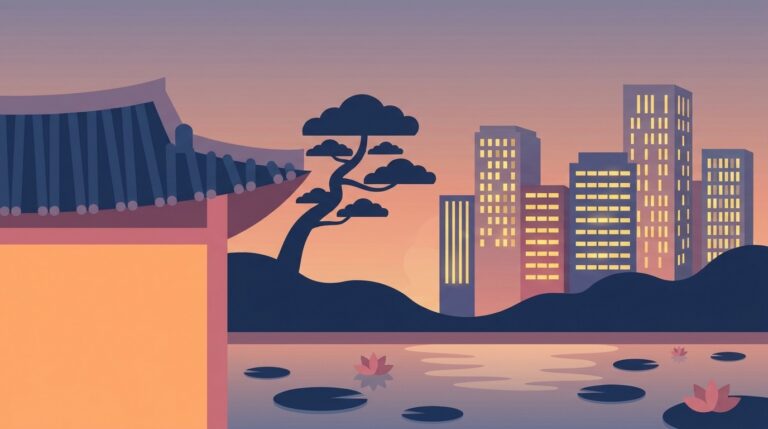
Phase 1: Why Four-Character Idioms Matter When the World Moves Fast
안녕하세요! 매일한글 에디터입니다. (Annyeonghaseyo! Maeil Hangeul editeo-imnida. — Hello! I’m your Daily Hangul Editor.)
Picture yourself sitting in a cozy Seoul cafe where a 100-year-old hanok courtyard now hosts an AI art exhibition. Across the table, your Korean colleague sighs warmly and drops a four-character idiom about how unrecognizable the city has become. You aced TOPIK grammar, yet in that split second, their poetic shorthand slips past you. Based on real feedback from our Level 5 learners navigating executive meetings and deep K-Drama dialogues, this guide unlocks the idioms Koreans use to process dizzying change while staying anchored to timeless values. Ready to sound effortlessly insightful?
Phase 2: Deep Dive Into 3 Essential Expressions
1. 상전벽해 (桑田碧海)
- Pronunciation: Sang-jeon-byeok-hae (Sounds like “sahng-juhn-byuhk-heh” — imagine saying “song” softly, “jun” as in jungle, “byuk” like buck with a quick y, and “hae” like a crisp “heh”).
- Meaning: Literally “mulberry fields becoming a blue sea.” In real life, it captures shock and awe at how completely a place, industry, or era has transformed beyond recognition—much like “a night-and-day transformation” or “the world turned upside down,” but with poetic historical weight.
- K-Culture Moment: Think of the bittersweet reunion scenes in nostalgic K-Dramas like Reply 1988 or Twenty-Five Twenty-One, when adult characters revisit their childhood alleyways only to find towering glass apartments where corner snack shops once stood.
- Editor’s Insight: Native speakers rarely use 상전벽해 (sangjeonbyeokhae) for tiny personal changes like a haircut. Reserve it for seismic shifts—like how Gangnam transformed from cabbage fields in the 1960s into a global tech-and-luxury hub, or how AI reshaped an entire career field overnight.
- Situation Spectrum: Casual ⚠️ (Used humorously among educated friends) | Semi-formal ✅ (Great in essays, podcasts, and thoughtful chats) | Formal ✅ (Classic in news editorials and speeches)
- 🤔 Think About It: English leans on mechanical or sudden metaphors (“sea change,” “overnight revolution”), while 상전벽해 paints a slow agricultural landscape swallowed by an ocean. How does your native language picture the passage of monumental time?
2. 변화무쌍하다 (變化無雙하다)
- Pronunciation: Byeon-hwa-mu-ssang-ha-da (Sounds like “byuhn-hwah-moo-ssahng-hah-dah” — give that double ss in ssang a crisp, punchy snap like the s in “sun” said with extra energy).
- Meaning: Literally “transformations without an equal.” Used as an adjective, 변화무쌍한 (byeonhwamussanghan) describes an era, market, weather, or human mood that shifts unpredictably from moment to moment—akin to “kaleidoscopic,” “volatile,” or “ever-shifting.”
- K-Culture Moment: You will hear this constantly in K-Pop industry documentaries and business news analyzing how trends on TikTok and Melon charts flip every week, forcing agencies and creators to pivot at lightning speed.
- Editor’s Insight: Unlike simple words like 자주 바뀌다 (jaju bakkwida, “changes often”), 변화무쌍하다 carries both dazzle and caution. Pairing it with 시대 (sidae, “era”) instantly elevates your Korean to editorial-grade fluency.
- Situation Spectrum: Casual ⚠️ (A bit literary for casual banter) | Semi-formal ✅ (Ideal for work discussions and reviews) | Formal ✅ (Highly natural in presentations and TOPIK writing)
- 🤔 Think About It: In Korean discourse, calling a situation 변화무쌍하다 isn’t purely negative—it implies vitality alongside uncertainty. Does “unpredictable” in your culture lean more toward fear or opportunity?
3. 법고창신 (法古創新)
- Pronunciation: Beop-go-chang-sin (Sounds like “buhp-go-chahng-shin” — stop the p softly in your throat without puffing air, then glide into a bright “chahng-sheen”).
- Meaning: Literally “modeling on the old to create the new.” Originally championed by Joseon scholar Yeonam Park Ji-won, it expresses the art of honoring timeless core values and traditional roots while boldly innovating for the present—the exact bridge between unwavering principles and agile adaptability.
- K-Culture Moment: Look at K-Pop stages where idols blend traditional gugak instruments and hanbok silhouettes with futuristic EDM beats, or modern Korean architecture that reimagines wooden hanok eaves in sleek concrete and glass.
- Editor’s Insight: Many learners default to 온고지신 (ongojisin, “reviewing the old to learn the new”), which focuses on gaining wisdom. 법고창신 (beopgochangsin) goes one step further—it demands creative action. Using this in a Korean job interview or cultural essay will genuinely impress native listeners.
- Situation Spectrum: Casual 🚫 (Too heavy for small talk) | Semi-formal ✅ (Shines in creative or cultural discussions) | Formal ✅ (Gold standard for speeches, leadership, and advanced essays)
- 🤔 Think About It: Many Western startups glorify “breaking things” to innovate, whereas 법고창신 insists innovation is strongest when anchored to heritage. Where do you stand between total disruption and respectful evolution?
Phase 3: Textbook Korean vs. Real Korean
Situation 1: Reacting to how unrecognizably fast society is changing
- 📖 Textbook Korean: 세월이 흐르면서 세상이 정말 많이 변했습니다. (Sewori heureumyeonseo sesangi jeongmal mani byeonhaetseumnida. — As time has passed, the world has changed very much.)
- 🗣️ Real Korean: 요즘 세상이 진짜 상전벽해 수준으로 급변하네요. (Yojeum sesangi jinjja sangjeonbyeokhae sujuneuro geupbyeonhaneyo. — The world is changing so fast lately it’s practically at a mulberry-fields-to-blue-sea level.)
- 💡 Why the difference? Level 5 Koreans love blending vivid sajaseong-eo with modern intensifiers like 수준으로 (sujuneuro, “to the level of”) and 급변하다 (geupbyeonhada, “change rapidly”). It sounds observant and witty rather than robotic.
Situation 2: Advising someone to keep core values while adapting flexibly
- 📖 Textbook Korean: 변하지 않는 가치를 지키면서도 변화에 유연하게 적응해야 합니다. (Byeonhaji anneun gachireul jikimyeonseodo byeonhwa-e yuyeonhage jeogeunghaeya hamnida. — You must protect unchanging values while adapting flexibly to change.)
- 🗣️ Real Korean: 중심은 단단히 잡되, 변화의 흐름에는 유연하게 발맞춰야죠. (Jungsim-eun dandanhi japdoe, byeonhwa-ui heureum-eneun yuyeonhage balmatchwoyajyo. — You should hold your center firmly, yet keep step flexibly with the flow of change.)
- 💡 Why the difference? Notice the natural connector -되 (-doe, “while/yet”) and the idiomatic pairing 중심을 잡다 (jungsim-eul japda, “keep one’s center”) with 발맞추다 (balmatchuda, “keep pace with”). It conveys calm executive maturity without sounding preachy.
Phase 4: K-Culture Deep Dive & Non-Verbal Manners
4-1. Nunchi (눈치) & Gestures
When Koreans reflect on sweeping change or cite a sajaseong-eo like 상전벽해 (sangjeonbyeokhae), their body language slows down intentionally. Instead of rapid hand-waving, you will often see a gentle downward nod paired with a soft exhale—signaling thoughtful awe rather than panic. If you are discussing strategy in a meeting and advocate for 법고창신 (beopgochangsin), keep your shoulders grounded, place one open hand subtly near your chest when referencing 본질 (bonjil, “core essence”), and sweep the other outward when mentioning innovation. Maintaining calm eye contact and leaving a half-second pause after an idiom gives your words quiet authority.
4-2. Cultural Code Analysis: K-Travel & “Newtro” Seoul
Nowhere is the tension between 상전벽해 (sangjeonbyeokhae) and 법고창신 (beopgochangsin) more visible than in Seoul’s Euljiro (을지로) and Seongsu-dong (성수동) districts. Once filled with dusty metal workshops and shoemakers, these neighborhoods faced erasure under rapid development. Instead, Korea’s younger generation embraced 뉴트로 (nyuteuro — New + Retro), preserving weathered brick facades and vintage neon signage while transforming interiors into cutting-edge cafes and design labs. Similarly, K-Dramas about family-run conglomerates or tech startups—like Reborn Rich or Start-Up—constantly pit rigid tradition against reckless disruption, ultimately rewarding protagonists who pair timeless integrity with agile strategy.
Phase 5: Real-Life Roleplay Scenario
Setting: A crisp autumn evening on a rooftop cafe in Euljiro, Seoul. Below you, glowing skyscraper billboards tower behind narrow alleyways lined with decades-old print shops. You are catching up with Min-jun (민준), a sharp Korean brand strategist.
- Min-jun: (🎭 Leaning against the railing, gazing at the skyline) 여기가 제가 대학 다닐 때만 해도 인쇄소밖에 없었는데, 정말 상전벽해가 따로 없죠? (Yeogiga jega daehak danil ttaeman haedo inswaeso-bakke eopseonneunde, jeongmal sangjeonbyeokhae-ga ttaro eopjyo? — When I was in college, there were only print shops here; it really is the definition of a complete transformation, isn’t it?)
- You: (🎭 Smiling warmly as you take a sip of your yuja tea) 그러게요. 변화무쌍한 서울을 볼 때마다 세월의 무상함까지 느껴질 정도예요. (Geureogeyo. Byeonhwamussanghan Seoureul bol ttaemada sewol-ui musangham-kkaji neukkyeojil jeongdoyeyo. — Indeed. Every time I see ever-changing Seoul, I almost feel the transience of time itself.)
- Min-jun: (🎭 Nodding appreciatively, eyes lighting up) 와, 표현이 시적이시네요! 요즘 트렌드가 너무 빨리 바뀌어서 저희 회사도 매달 전략을 수정하느라 정신이 없어요. (Wa, pyohyeoni sijeogisineyo! Yojeum teurendeuga neomu ppalli bakkwieoseo jeohui hoesado maedal jeollyageul sujeonghaneura jeongsini eopseoyo. — Wow, your phrasing is poetic! Because trends shift so fast these days, my company is swamped revising strategies every month.)
- You: (🎭 Tilting your head thoughtfully) 그럴수록 흔들리지 않는 본질적 가치가 더 중요해지지 않을까요? (Geureolsurok heundeulliji anneun bonjiljeok gachiga deo jungyohaejiji aneulkkayo? — Precisely at times like that, don’t unshakable core values become even more important?)
- Min-jun: (🎭 Tapping his cup in agreement) 맞아요. 근데 또 옛것만 고집하면 도태되기 십상이라 균형 잡기가 참 어렵죠. (Majayo. Geunde tto yetgeonman gojiphamyeon dotaedoegi sipsangira gyunhyeong japgiga cham eoryeopjyo. — Right. Yet if you stubbornly cling only to the old, it’s easy to fall behind, so finding balance is really tough.)
- You: (🎭 Smiling with calm confidence) 그래서 저는 ‘법고창신’이라는 말을 좋아해요. 뿌리는 지키되 시대에 맞게 새롭게 푸는 거죠. (Geuraeseo jeoneun ‘beopgochangsin’-iraneun mareul joahaeyo. Ppurineun jikidoe sidae-e matge saeropge puneun geojyo. — That’s why I love the expression ‘beopgochangsin.’ You guard the roots, yet reinterpret them freshly for the era.)
- Min-jun: (🎭 Laughing delightedly, clearly impressed) 오, 법고창신! 이 동네 카페들이 딱 그렇네요. 오래된 공장을 살려서 요즘 감성으로 재해석했잖아요. (O, beopgochangsin! I dongne kapedeuri ttak geureonneyo. Oraedoen gongjangeul sallyeoseo yojeum gamseongeuro jaehaeseokhaetjanayo. — Oh, beopgochangsin! That’s exactly what the cafes in this neighborhood are doing—preserving old factories and reinterpreting them with modern sensibility.)
- Min-jun: (🎭 Raising his cup playfully) 자, 그럼 오늘의 핵심 키워드네요! 당신은 일할 때 변화를 먼저 쫓는 편이에요, 아니면 원칙을 고수하는 편이에요? (Ja, geureom oneurui haeksim kiweodeuneyo! Dangsineun ilhal ttae byeonhwareul meonjeo jjonneun pyeonieyo, animyeon wonchigeul gosuhaneun pyeonieyo? — Well, that’s today’s keyword! When you work, do you tend to chase change first, or stick firmly to principles?)
🔀 Interactive Branching Point: How will you respond to Min-jun?
- Choice A: 본질은 꽉 붙잡되, 새로운 흐름에는 유연하게 올라타려고 해요. 결국 두 가지가 함께 가야 오래가더라고요. (Bonjireun kkwak butjapdoe, saeroun heureum-eneun yuyeonhage ollataryeogo haeyo. Gyeolguk du gajiga hamkke gaya oraegadeoragoyo. — I grip core essence tightly, while riding new currents flexibly. Ultimately, both have to go together to last.)
- Feedback (Best ✅): Seamless Level 5 mastery! Pairing 꽉 붙잡다 (hold tight) with 유연하게 올라타다 (ride flexibly) and the reflective ending -더라고요 (-deoragoyo) sounds deeply natural, balanced, and persuasive.
- Choice B: 세상이 변하니까 옛날 것은 다 버리고 무조건 새것만 따라가야죠. (Sesangi byeonhanikka yennal geoseun da beorigo mujogeon saegeonman ttaragayajyo. — Since the world changes, we should throw away everything old and blindly follow only the new.)
- Feedback (Bad ❌): Grammatically fine, yet tone-deaf to the conversation! Dismissing all heritage right after praising 법고창신 contradicts your own point and feels overly extreme for Korean professional rapport.
- Choice C: 음, 저는 고집이 좀 세서 그냥 제 방식대로만 밀고 나가요. (Eum, jeoneun gojibi jom seseo geunyang je bangsikdaeroman milgo nagayo. — Hmm, I’m rather stubborn, so I just push ahead strictly my own way.)
- Feedback (Risk ⚠️): Honest and conversational, especially with 고집이 세다 (to be stubborn), but it may signal inflexibility to a Korean strategist unless softened with self-deprecating humor.
Phase 6: 10-Second Emotion Shadowing Drill
Read each line aloud with natural Korean cadence. Pause briefly at / and lean into the emotion!
- [😲 Awed by rapid change]
세월이 참 빠르네요 / 몇 년 새 완전히 상전벽해예요.
(Sewori cham ppareuneyo / myeon nyeon sae wanjeonhi sangjeonbyeokhaeyeyo. — Time really flies / in just a few years, it’s a total sea change.) - [😌 Calmly reflective]
변화무쌍한 시대일수록 / 중심을 잃지 않는 게 중요하죠.
(Byeonhwamussanghan sidaeilsurok / jungsim-eul ilchi anneun ge jungyohajyo. — The more unpredictable the era / the more vital it is not to lose your center.) - [💪 Grounded & resolute]
본질은 지키되 / 변화에는 유연하게 대처해야 합니다.
(Bonjireun jikidoe / byeonhwa-eneun yuyeonhage daecheohaeya hamnida. — Guard the essence / yet respond flexibly to change.)
Phase 7: K-Culture Mini Dictionary (4 Core Keywords)
- 1. 격세지감 (Gyeok-se-ji-gam) | 2. Sense of living in a completely different era | 3. Daily/Business Usage: Used casually and professionally when a childhood memory, old technology (like flip phones), or former business model suddenly feels centuries away.
- 1. 인생무상 (In-saeng-mu-sang) | 2. Transience/ephemerality of human life | 3. Daily/Business Usage: Spoken with a philosophical sigh when watching empires rise and fall, or reflecting on fleeting fame in K-Entertainment.
- 1. 본질 (Bon-jil) | 2. Essence / Core nature | 3. Daily/Business Usage: One of the highest-frequency words in Korean business meetings, branding pitches, and essays—e.g., 문제의 본질 (the core of the issue) or 본질적 가치 (intrinsic value).
- 1. 시류 (Si-ryu) | 2. Current trend / Tide of the times | 3. Daily/Business Usage: Often paired with 편승하다 (ride the trend) or 거스르다 (go against the current) in editorial articles analyzing society.
Phase 8: Survival Kit for Travelers
Top 3 Survival Expressions for Exploring Changing Korea
- 여기가 예전과 많이 달라졌네요. (Yeogiga yejeongwa mani dallajyeonneyo. — This place has changed so much from before.)
- Pro Tip: Great icebreaker with older cafe owners or taxi drivers in historic neighborhoods like Jongno or Insadong—they love sharing stories of how the street used to look!
- 전통을 잘 살린 곳은 어디예요? (Jeontong-eul jal sallin goseun eodiyeyo? — Where is a place that preserves tradition well?)
- Pro Tip: Use this to discover hidden hanok bakeries, tea houses, and craft studios instead of generic tourist traps.
- 요즘 가장 뜨는 동네가 어디예요? (Yojeum gajang tteuneun dongnega eodiyeyo? — Which neighborhood is hottest right now?)
- Pro Tip: 뜨다 (tteuda, “to float/rise”) is everyday Korean slang for trending spots—perfect for keeping up with Seoul’s constant urban reinvention.
Editor’s Travel Note
Because Seoul’s shops and cafes reinvent themselves every few months, older paper guidebooks quickly become outdated. Before you explore, be sure to Download the Naver Map App for Real-Time Korean Navigation or Install KakaoMap for Up-to-Date Bus and Alleyway Routes—both update pop-ups and store closures far faster than overseas map apps. For seamless transit across historic palaces and futuristic districts alike, grab a Climate Card (기후동행카드) or T-money card at any convenience store, and keep an international credit card handy since nearly all trendy Seoul spots are 100% cashless.
Phase 9: “One Step Deeper” (Thought Question)
South Korea compressed centuries of industrialization into mere decades—a whirlwind often called the “Miracle on the Han River”—while preserving deeply Confucian roots of filial memory and scholarly reflection. Because daily life moves at legendary 빨리빨리 (ppalli-ppalli, “hurry-hurry”) speed, four-character idioms serve as emotional anchors in Korean conversation. Packing two thousand years of philosophy into four crisp syllables allows speakers to pause, honor the fleeting nature of time, and remind one another what must never be sacrificed to speed. Language doesn’t just describe change in Korea; it stabilizes the soul inside it.
💬 Your Turn: Think about a neighborhood or tradition from your own hometown that transformed beyond recognition. How would you describe it using today’s Korean idioms—and what core value from home do you refuse to let change? Share your thoughts in the comments below!
Phase 10: FAQ & Misunderstanding Prevention
Q: Can I use 상전벽해 (sangjeonbyeokhae) to compliment a friend who got a makeover or lost weight?
A: Not seriously! 상전벽해 refers to monumental changes in landscapes, eras, or society. Using it for a friend’s hairstyle would sound wildly exaggerated—though close friends might use it jokingly for dramatic comic effect. Stick to 완전히 달라졌네! (wanjeonhi dallajyeonne! — You look totally different!) for normal compliments.
Q: What is the exact difference between 법고창신 (beopgochangsin) and 온고지신 (ongojisin)?
A: Both respect the past, but their goals differ. 온고지신 (溫故知新) means studying old knowledge to understand new truths—it’s reflective and educational. 법고창신 (法古創新) goes further into creation: taking traditional principles as your foundation to build something boldly original.
Q: Do young Koreans in their 20s and 30s actually use these four-character idioms in daily speech?
A: Yes—selectively! While Gen Z doesn’t speak entirely in classical idioms, well-known ones like 상전벽해, 변화무쌍하다, and 인생무상 pop up frequently in YouTube essays, webtoons, news memes, and thoughtful conversations over coffee or beer.
🚨 Common Mistakes Warning Board
- Mistake: Treating every sajaseong-eo as an identical grammatical part of speech (e.g., writing 상전벽해하다 awkwardly).
- Correct Action: Check whether the idiom acts as a noun (상전벽해가 되다 / 상전벽해 같다) or an adjective/verb stem (변화무쌍하다 → 변화무쌍한 시대).
- Mistake: Overloading casual chats with multiple heavy idioms in one breath.
- Correct Action: Use the “Rule of One”—drop just one well-placed idiom per topic as a highlight, surrounded by natural spoken Korean.
- Mistake: Mixing up 무상하다 (transience, 無常) and 무쌍하다 (unrivaled/endless, 無雙).
- Correct Action: Watch the spelling and meaning! 세월이 무상하다 (time is fleeting/ephemeral) uses a single ㅅ, while 변화무쌍하다 (endlessly shifting) uses a double ㅆ.
Phase 11: Action Mission & Engagement
- 🥉 Bronze Mission (Solo Practice): Record yourself reading the 3 shadowing sentences in Phase 6 on your phone, focusing on the pause
/and emotional tone shift. - 🥈 Silver Mission (SNS Share): Post a before-and-after photo of your favorite city or personal milestone with the caption: “시간이 지나면 모든 게 상전벽해처럼 변하지만, 나의 본질은 그대로! (As time passes, everything changes like mulberry fields turning to sea, yet my core essence stays the same!)”
- 🥇 Gold Mission (Real-Life Use): In your next Korean language exchange, tutor session, or meeting, naturally weave in either 변화무쌍한 시대 (an ever-changing era) or 법고창신 (honoring roots while innovating).
🎮 K-Culture Mission: Watch one episode of a Korean documentary, architectural tour vlog, or business talk show on YouTube with Korean subtitles turned on. Spot whenever the narrator mentions 변화 (change), 본질 (essence), or a 4-character idiom—and write down the full sentence in your study notebook!
Phase 12: Interactive Quiz Challenge
1. Situational Judgment: Your Korean team leader asks how your company can stay competitive when AI tools update every week without losing customer trust. Which response fits best?
* A) AI 시장이 너무 상전벽해라서 그냥 아무것도 안 하는 게 좋겠어요.
* B) 변화무쌍한 시장일수록 브랜드의 본질은 지키면서 법고창신의 자세로 기술을 접목해야 합니다.
* C) 세월이 무상하니까 우리 회사도 곧 사라질 거예요.
👉 Click to reveal Answer & Feedback for Q1
Correct Answer: B
* Why B works: It fluidly pairs 변화무쌍한 시장 (ever-shifting market) with 본질 (core essence) and 법고창신 (innovating on solid foundations)—the exact executive-level balance!
* Why A & C miss the mark: Option A misuses 상전벽해 grammatically/contextually and suggests giving up; Option C uses 세월이 무상하다 (time is fleeting) in a gloomy, fatalistic way unsuitable for a strategy meeting.
2. Fill in the Blank: Complete this natural Korean sentence describing a neighborhood where old hanok houses were replaced by towering glass offices.
“10년 만에 와 봤는데 완전 _________네요!” (I came back after 10 years and it’s a total transformation!)
👉 Click to reveal Answer & Explanation for Q2
Correct Answer: 상전벽해 (상전벽해네요! / Sangjeonbyeokhaeneyo!)
* Explanation: When a physical place transforms beyond recognition over time, 상전벽해 is the quintessential idiom, effortlessly attaching directly to -네요 (-neyo) to express genuine surprise.
3. True / False Cultural Quiz: True or False — In Korean, 변화무상하다 (with a single ㅅ) and 변화무쌍하다 (with a double ㅆ) mean the exact same thing and can be swapped freely.
👉 Click to reveal Answer & Explanation for Q3
Correct Answer: False!
* Explanation: 변화무쌍하다 (變化無雙하다) with double ㅆ means “endlessly shifting / unpredictably varied.” Meanwhile, 무상 (無常) with single ㅅ means “fleeting/impermanent,” as in 인생무상 or 세월무상. Knowing the difference between single ㅅ and double ㅆ is a true Level 5 badge of honor!
🎬 Watch Our Daily Videos! (Daily Hangul Official Instagram)
Review the expressions you learned in this article with our fun daily short videos! Check out native pronunciation and real-life nuances in action.
- Instagram @dailyhangul_en