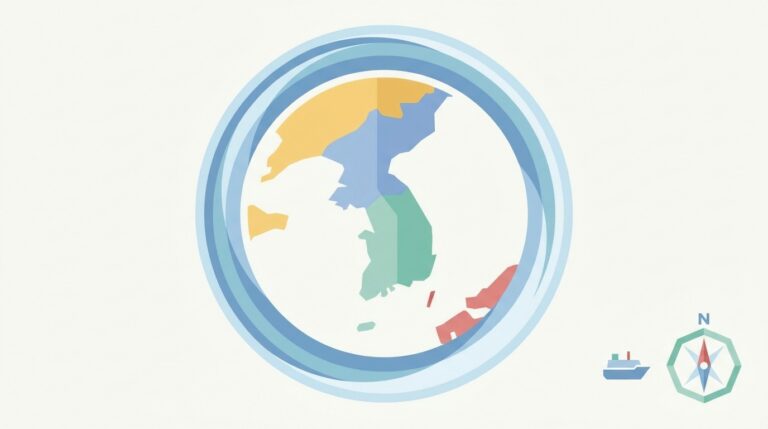
Phase 1: Why Even Level 6 Learners Freeze at Maritime Law
안녕하세요! 매일한글 에디터입니다. (Annyeonghaseyo! Maeil Hangeul Editeo-imnida. / Hello! I am your Daily Hangul Editor.)
Imagine binge-watching a gripping Korean political thriller like The Whirlwind or tuning into a late-night KBS debate, only to get blindsided by rapid-fire terms like 배타적 경제수역 (baetajeok gyeongjesuyeok) and 대륙붕 경계 획정 (daeryukbung gyeonggye hoekjeong). Even if you are a Level 6 pro who breezes through K-pop lyrics and Seoul cafe chatter, international maritime law in Korean hits like a brick wall. Based on real feedback from advanced learners aiming for diplomatic or legal roles in Korea, this guide unpacks UNCLOS—the Constitution of the Oceans—so you can command Korean policy discussions with total confidence!
Phase 2: Deep Dive into 3 Core Expressions
1. 배타적 경제수역 (Baetajeok Gyeongjesuyeok)
- Pronunciation: Baetajeok Gyeongjesuyeok (Sounds like Beh-tah-juhk Gyung-jeh-soo-yuhk, where the final k in jeok and yeok is a crisp, unreleased stop, just like stopping your breath on the k in book without puffing air.)
- Meaning: Literal: Exclusive Economic Zone (EEZ). Real Nuance: Far more than a dry coordinate on a nautical chart, in Korean discourse this term carries intense geopolitical and emotional weight tied to fishery rights, seabed energy, and national resource security.
- K-Culture Moment: Picture a high-stakes National Security Council scene in a Korean drama like Designated Survivor: 60 Days, where officials huddle around a glowing digital map of the East Sea as coastal radar alerts start blinking.
- Editor’s Insight: Break down the Sino-Korean roots: 배타적 (排他的, exclusive/excluding others) + 경제 (經濟, economy) + 수역 (水域, water zone). Unlike 영해 (yeonghae / territorial sea), a coastal state exercises sovereign rights (주권적 권리 / jukwonjeok gwolli) here rather than absolute sovereignty (주권 / jukwon).
- Situation Spectrum: Casual ⚠️ / Semi-formal ✅ / Formal ✅ (Works smoothly in a heated news chat with grad-school friends over craft beer and is indispensable in diplomatic briefings.)
- 🤔 Think About It: In English, exclusive can sound like a VIP lounge, whereas Korean 배타적 (baetajeok) carries a sharper nuance of actively shutting outsiders out. How does your native language frame maritime zones—as ownership, stewardship, or exclusion?
2. 대륙붕 경계 획정 (Daeryukbung Gyeonggye Hoekjeong)
- Pronunciation: Daeryukbung Gyeonggye Hoekjeong (Sounds like Deh-ryook-boong Gyung-gyeh Hwek-jung; keep hoek tight in a single quick syllable, blending h + we + k.)
- Meaning: Literal: Continental shelf boundary delimitation. Real Nuance: The ultimate international legal tug-of-war over underwater oil, gas, and natural prolongation (자연적 연장 / jayeonjeok yeonjang) between neighboring states.
- K-Culture Moment: Think of an investigative current affairs broadcast or a legal showdown in the spirit of Extraordinary Attorney Woo scaled up to the International Court of Justice, where attorneys pore over seabed topography charts.
- Editor’s Insight: The noun 획정 (劃定, delimitation) is legally binding and far more authoritative than everyday phrases like 선을 긋다 (seoneul geutda / to draw a line) or 결정하다 (gyeoljeonghada / to decide). Dropping 획정 instantly signals C2-level legal literacy.
- Situation Spectrum: Casual 🚫 / Semi-formal ⚠️ / Formal ✅ (Pure gold for policy papers, university seminars, and international law conferences.)
- 🤔 Think About It: Korean distinguishes everyday spatial verbs from precise Sino-Korean legal terms like 획정하다 (to delimit). Does your native language rely on Latin-derived legal jargon for maritime borders, or does it adapt everyday words?
3. 법적 지위를 규율하다 (Beopjeok Jiwirul Gyuyulhada)
- Pronunciation: Beopjeok Jiwirul Gyuyulhada (Sounds like Buhp-juhk Jee-wee-reul Gyoo-yool-ha-da; watch out for the p in beop closing cleanly before the j in jeok.)
- Meaning: Literal: To govern/regulate the legal status. Real Nuance: Describes the foundational architecture of UNCLOS—setting the exact legal rules of the road from coastal waters all the way to the deep seabed.
- K-Culture Moment: Imagine a seasoned anchor on JTBC Newsroom calmly explaining why UNCLOS is dubbed 바다의 헌법 (bada-ui heonbeop / Constitution of the Oceans) during a breaking maritime jurisdiction dispute.
- Editor’s Insight: While 규제하다 (gyujehada) means to restrict or regulate, 규율하다 (規律하다) means to establish overarching order and systematic norms. Pair it with 법적 지위 (beopjeok jiwi / legal status) whenever you want your Korean essays to sound impeccably academic.
- Situation Spectrum: Casual 🚫 / Semi-formal ⚠️ / Formal ✅ (Reserved for formal commentary, legal briefs, and scholarly debates.)
- 🤔 Think About It: Why do Korean commentators so often personify UNCLOS as a Constitution (헌법 / heonbeop) rather than just a treaty? Consider how Korean legal culture prizes clear hierarchical order.
Phase 3: Textbook Korean vs. Real Korean
Situation 1: Reacting to an EEZ fishing incursion on the evening news
- 📖 Textbook Korean: 해당 선박은 우리나라의 배타적 경제수역을 침범하여 불법 조업을 하였습니다. (Haedang seonbageun urinara-ui baetajeok gyeongjesuyeogeul chimbeomhayeo bulbeop joeobeul hayeotseumnida. / The vessel in question violated our country’s EEZ and engaged in illegal fishing.)
- 🗣️ Real Korean: 저 배가 우리 EEZ 안으로 넘어와서 싹 쓸어 가고 있다니까요! (Jeo baega uri EEZ aneuro neomeowaseo ssak sseureo gago itdanikkayo! / That boat crossed right into our EEZ and is sweeping everything clean, I tell you!)
- 💡 Why is it different? Even Korean policy experts skip the seven-syllable mouthful 배타적 경제수역 in casual conversation and say the English acronym “EEZ (이이지)” instead, pairing it with vivid native verbs like 싹 쓸어 가다 (to sweep up everything) to convey real urgency.
Situation 2: Explaining freedom of navigation on the high seas
- 📖 Textbook Korean: 공해상에서는 모든 국가가 항행의 자유를 향유할 수 있습니다. (Gonghaesang-eseoneun modeun gukgaga hanghaeng-ui jayureul hyangyuhal su itseumnida. / On the high seas, all states may enjoy the freedom of navigation.)
- 🗣️ Real Korean: 공해 쪽은 말 그대로 임자 없는 바다라 다들 자유롭게 다닐 수 있어요. (Gonghae jjogeun mal geudaero imja eomneun badara dadeul jayuropge danil su isseoyo. / The high seas are literally nobody’s ocean, so everyone can sail around freely there.)
- 💡 Why is it different? Verbs like 향유하다 (hyangyuhada / to enjoy rights) live exclusively in legal statutes. Over coffee, educated Koreans translate abstract UNCLOS principles into relatable idioms like 임자 없는 바다 (an ocean without an owner).
Phase 4: K-Culture Deep Dive & Non-Verbal Manners
4-1. Nunchi (눈치) & Diplomatic Gestures
Maritime boundary delimitation in Northeast Asia is famously sensitive, whether discussing overlapping EEZs in the West Sea (Yellow Sea) or continental shelf zones near Jeju. When discussing these topics in Korea, sharp Nunchi (눈치 / social awareness) is essential. Keep your posture relaxed yet upright, avoid jabbing a finger across a map toward a counterpart, and gesture with an open palm. Soften strong legal assertions with diplomatic cushions like ~라는 측면에서 보면 (~raneun cheukmyeon-eseo bomyeon / viewed from the perspective of…) or ~에 대한 해석의 여지가 남아 있지만 (~e daehan haeseogui yeojiga nama itjiman / while room for interpretation remains regarding…). Steady, unhurried eye contact conveys scholarly poise rather than aggression.
4-2. Cultural Code: How K-Food & Coastal K-Travel Connect to UNCLOS
Have you ever wondered why Jeju silver hairtail (갈치 / galchi) or West Sea blue crab (꽃게 / kkotge) prices make prime-time news in Korea? Because Korea is a peninsula bordered by sea on three sides (삼면이 바다 / sammyeoni bada), UNCLOS zones directly shape both the dinner table and weekend travel! From vibrant seafood auctions at Busan’s Jagalchi Market to coastal ferry routes around Ulleungdo, what happens across Korea’s territorial seas (영해) and EEZs touches everyday K-Food culture and national identity.
Phase 5: Interactive Roleplay Scenario
Setting & Characters: You are at a sleek glass-walled conference lounge overlooking Gwanghwamun in Seoul during an international maritime law symposium. Over a mid-session iced Americano (Korean office workers’ lifeblood, even in winter!), you are chatting with Min-jun (민준), a sharp, warm-hearted senior maritime policy researcher in round wire-rimmed glasses.
- Min-jun: 오늘 패널 토론 들으셨어요? 유엔해양법협약이 정말 바다의 헌법답게 모든 수역을 촘촘히 규율하고 있더라고요. (Oneul paeneol toron deureusyeosseoyo? Yuenhaeyangbeophyeobyagi jeongmal bada-ui heonbeopdapge modeun suyeogeul chomchomhi gyuyulhago itdeoragoyo. / Did you catch today’s panel? True to its name as the Constitution of the Oceans, UNCLOS really regulates every maritime zone in intricate detail.) 🎭 Adjusts his glasses and takes a sip of his iced Americano.
- You: 맞아요. 특히 영해에서 접속수역, 배타적 경제수역으로 넘어가면서 연안국의 관할권이 단계적으로 달라지는 구조가 인상적이었어요. (Majayo. Teukhi yeonghaeseo jeopsoksuyeok, baetajeok gyeongjesuyeogeuro neomeogamyeonseo yeonangugui gwanhalgwoni dandyejeogeuro dallajineun gujoga insangjeogieosseoyo. / Right. Especially the structure where a coastal state’s jurisdiction shifts step by step from the territorial sea to the contiguous zone and EEZ was really impressive.) 🎭 Nods appreciatively while holding your coffee cup.
- Min-jun: 그렇죠! 그런데 실무에서는 늘 인접국 간의 EEZ와 대륙붕 경계 획정 분쟁이 가장 골치 아프잖아요. (Geureochyo! Geunde silmueseo-neun neul injeopguk ganui EEZ-wa daeryukbung gyeonggye hoekjeong bunjaengi gajang golchi apeujanayo. / Exactly! Yet in practice, EEZ and continental shelf delimitation disputes between neighboring states are always the biggest headache.) 🎭 Lets out a wry chuckle and leans slightly forward.
- You: 아무래도 어업 자원이나 해저 석유·가스 매장량 같은 실리적인 이해관계가 얽혀 있어서 그렇겠죠? (Amuraedo eoeop jawonina haejeo seogyu-gaseu maejangnyang gateun sillijeogin ihaegwangyega eolkyeo isseoseo geureotgetjyo? / I suppose that’s because practical interests like fisheries and seabed oil and gas reserves are tangled up in it, right?) 🎭 Tilts head slightly in thoughtful agreement.
- Min-jun: 정확합니다. 게다가 등거리 원칙을 쓸지, 형평의 원칙을 적용할지를 두고도 치열하게 맞서거든요. (Jeonghwakhamnida. Gedaga deunggeori wonchigeul sseulji, hyeongpyeongui wonchigeul jeokyonghaljireul dugodo chiyeolhage matseogeodeunyo. / Spot on. Plus, states clash fiercely over whether to apply the equidistance principle or the principle of equity.) 🎭 Traces an imaginary line in the air between his two hands.
- You: 맞아요, 해안선 길이나 섬의 법적 지위 같은 관련 사정도 다 따져 봐야 하니까요. (Majayo, haeanseon girina seomui beopjeok jiwi gateun gwallyeon sajeongdo da ttajyeo bwaya hanikkayo. / True, since relevant circumstances like coastline length and the legal status of islands all have to be weighed.) 🎭 Smiles knowingly.
- Min-jun: 오, 역시 전문가시네요! 만약 두 인접국의 해안선이 아주 불규칙하게 꺾여 있다면, 어떤 논리로 경계 획정을 주장하실 건가요? (O, yeoksi jeonmungasineyo! Manyak du injeopgugui haeanseoni aju bulgyuchikhage kkeokkyeo itdamyeon, eotteon nollilo gyeonggye hoekjeongeul jujanghasil geongayo? / Oh, you really are an expert! If two adjacent states have sharply irregular coastlines, what legal reasoning would you argue for boundary delimitation?) 🎭 Raises his eyebrows playfully, inviting your take.
- You: [Choose your response below!]
🔀 Interactive Branching Point
- Option A (Best): 단순 등거리선만 고집하면 형평에 어긋날 수 있으니, 관련 사정을 고려해 중간선을 조정하자고 주장할래요. (Dansun deunggeoriseonman gojiphamyeon hyeongpyeonge eogeutnal su isseuni, gwallyeon sajeongeul goryeohae jungganseoneul jojeonghajago jujanghallaeyo. / Since insisting solely on a strict equidistance line can violate equity, I’d argue for adjusting the median line by considering relevant circumstances.) — Feedback (Best): Brilliant! You mirrored actual ICJ three-stage delimitation jurisprudence (equidistance/relevant circumstances) in flawless C2 Korean.
- Option B (Bad): 그냥 양국이 가위바위보로 바다를 반반씩 나누자고 하면 어떨까요? (Geunyang yanggugi gawibawiboro badareul banbanssik nanujago hamyeon eotteolkkayo? / What if the two countries just play rock-paper-scissors and split the sea fifty-fifty?) — Feedback (Bad): Funny icebreaker, sure, but in a serious Korean policy lounge, overly flippant humor can undermine your credibility as a senior legal thinker.
- Option C (Risk): 일단 공해로 선언한 뒤에 천천히 협상하자고 할게요. (Ildan gonghaero seoneonhan dwie cheoncheonhi hyeopsanghajago halgeyo. / I’d say let’s declare it high seas first and negotiate slowly later.) — Feedback (Risk): Bold, but legally inaccurate! Overlapping EEZs or continental shelves do not automatically revert to 공해 (high seas), so Min-jun would gently correct your UNCLOS terminology.
Phase 6: 10-Second Emotional Shadowing Drill
Read these lines aloud, pausing briefly at every / and leaning into the emotional cue:
- [🧐 Serious & Analytical] 유엔해양법협약은 / 영해와 / 배타적 경제수역의 / 법적 지위를 / 명확히 규율합니다. (Yuenhaeyangbeophyeobyageun / yeonghaewa / baetajeok gyeongjesuyeogui / beopjeok jiwirul / myeonghwakhi gyuyulhamnida. / UNCLOS clearly governs the legal status of the territorial sea and the exclusive economic zone.)
- [😤 Firm & Persuasive] 단순한 등거리 원칙만으로는 / 대륙붕 경계 획정의 / 형평성을 / 담보할 수 없습니다. (Dansunhan deunggeori wonchikmaneuroneun / daeryukbung gyeonggye hoekjeongui / hyeongpyeongseongeul / dambohal su eopseumnida. / The strict equidistance principle alone cannot guarantee equity in continental shelf delimitation.)
- [😊 Poised & Conversational] 공해에서는 / 모든 나라가 / 항행의 자유를 / 평화롭게 / 누릴 수 있어요. (Gonghaeseoneun / modeun naraga / hanghaengui jayureul / pyeonghwaropge / nuril su isseoyo. / On the high seas, every nation can peacefully enjoy the freedom of navigation.)
Phase 7: K-Culture Mini Dictionary
- 영해 (Yeonghae) | Territorial Sea | Extending up to 12 nautical miles from the baseline, this is a coastal state’s sovereign territory—though foreign ships still retain 무해통항권 (muhaetonghanggwon / right of innocent passage). Frequently heard in Korean defense and coast guard briefings.
- 접속수역 (Jeopsoksuyeok) | Contiguous Zone | The buffer zone up to 24 nautical miles where a state enforces customs, tax, immigration, and sanitary laws. Korean maritime news often mentions it when tracking smuggling or quarantine violations.
- 공해 (Gonghae) | High Seas | Open ocean beyond any state’s national jurisdiction, governed by freedom of navigation and overflight. Watch the homonym trap: in daily Seoul life, 공해 usually means air or environmental pollution!
- 등거리 원칙 (Deunggeori Wonchik) | Equidistance Principle | Drawing a median line equidistant from opposite or adjacent coasts. In Korean legal briefs, it is almost always paired in contrast with 형평의 원칙 (hyeongpyeongui wonchik / equity principle).
Phase 8: Survival Kit for Travelers
Top 3 Coastal & Maritime Museum Survival Expressions
- 이 생선은 어느 수역에서 잡힌 거예요? (I saengseoneun eoneu suyeogeseo japin geoyeyo? / Which sea zone was this fish caught in?) — Pro Tip: Ask this cheerfully at Busan’s Jagalchi Market or Jeju’s Dongmun Market to spark instant respect from vendors who pride themselves on local coastal catches.
- 해양 영토 관련 전시관은 어디에 있나요? (Haeyang yeongto gwallyeon jeonsigwaneun eodie innayo? / Where is the maritime territory exhibition hall?) — Pro Tip: Essential when visiting the National Maritime Museum in Busan or Dokdo exhibition spaces in Seoul.
- 여객선 운항 구역이 기상 때문에 제한됐나요? (Yeogaekseon unhang guyeogi gisang ttaemune jehandwaennayo? / Is the ferry operating zone restricted due to the weather?) — Pro Tip: Lifesaver when island-hopping to Ulleungdo or Jeju, where sudden wind waves often halt ferries.
Editor’s Travel Note
Heading to Korea’s coast to experience its maritime culture firsthand? First, download the Naver Map app for real-time ferry and coastal bus routes since standard overseas map apps struggle with Korean routing. Second, grab a T-money card at any convenience store to breeze onto the Busan subway straight to Yeongdo, where you can explore the Korea National Maritime Museum visitor guide for free exhibitions on Korea’s ocean heritage and UNCLOS history.
Phase 9: One Step Deeper
In Korean culture, the word 우리 (uri / we, our) binds community and territory tightly together, turning even geographic features into deeply personal spaces—우리 바다 (our sea). Yet as a trading powerhouse surrounded by neighboring maritime nations, modern Korea relies heavily on the rule-based order of UNCLOS rather than unilateral force to balance sovereign rights with peaceful coexistence. Understanding terms like 경계 획정 (delimitation) and 규율하다 (to govern) reveals how Korean legal thought transforms ancient maritime connections into structured international dialogue.
💬 Your Turn: How do people in your country talk about maritime borders or ocean resources? Drop a comment comparing your language’s ocean terminology with Korean!
Phase 10: FAQ & Myth-Busting
Q: Does a coastal state have full sovereignty over its EEZ (배타적 경제수역) just like its territorial sea (영해)?
A: No! Under UNCLOS, full sovereignty (주권 / jukwon) stops at the 12-nautical-mile territorial sea (영해). Inside the 200-nautical-mile EEZ, the coastal state holds sovereign rights (주권적 권리 / jukwonjeok gwolli) strictly for economic exploration, resource management, and environmental protection, while other nations retain freedom of navigation.
Q: Is a continental shelf (대륙붕) automatically limited to 200 nautical miles?
A: Not always. While every coastal state gets at least 200 nautical miles, under UNCLOS Article 76 a state can claim an extended continental shelf beyond 200 nautical miles if it proves geological natural prolongation (자연적 연장 / jayeonjeok yeonjang), up to specific outer limits.
Q: Why do Korean news articles call UNCLOS 바다의 헌법 (Constitution of the Oceans)?
A: Because adopted in 1982 and entered into force in 1994, UNCLOS comprehensively governs virtually every aspect of ocean use—from maritime zones and boundary delimitation to marine scientific research and seabed mining—acting as a single supreme legal framework.
🚨 Common Mistakes TOP 3
- Confusing 공해 (High Seas) with 공해 (Pollution): Saying “공해가 심해요” (Gonghaega simhaeyo) means “The pollution is severe,” not “The high seas are rough!” Correct Action: When talking about the open ocean, add context like 공해상에서 (gonghaesang-eseo / on the high seas) or 공해의 자유 (gonghae-ui jayu / freedom of the high seas).
- Using 주권 (Sovereignty) for the EEZ: Claiming a country has 영토 주권 over its EEZ sounds legally inaccurate to Korean experts. Correct Action: Use 주권적 권리 (jukwonjeok gwolli / sovereign rights) or 관할권 (gwanhalgwon / jurisdiction).
- Saying 선 긋기 instead of 경계 획정: Saying “바다에 선을 그었어요” sounds like elementary-school art class in a legal debate. Correct Action: Always elevate your register with 경계 획정 (gyeonggye hoekjeong / boundary delimitation).
Phase 11: Action Mission & Engagement
- 🥉 Bronze Mission (Solo Practice): Record a 30-second voice memo summarizing the difference between 영해 (territorial sea), 접속수역 (contiguous zone), and 배타적 경제수역 (EEZ) in Korean using at least two Phase 2 expressions.
- 🥈 Silver Mission (Social Share): Post one sentence on Instagram or X using the phrase 바다의 헌법 (Constitution of the Oceans) and tag a study buddy to quiz them on what EEZ stands for in Korean.
- 🥇 Gold Mission (Real-World Use): Find a recent Korean newspaper article (Chosun, Hankyoreh, or Yonhap) mentioning 대륙붕 or EEZ and leave a thoughtful two-sentence Korean summary in your study journal or language exchange chat.
- 🎮 K-Culture Mission: Next time you watch a Korean news broadcast or political K-drama, keep your ears peeled for the words 관할권 (jurisdiction) or 영해 (territorial sea) and note the exact context!
Phase 12: Interactive Quiz Challenge
1. Situational Judgment: Your Korean law professor asks which legal principle balances strict geometric borders with fairness when coastlines are concave or irregular. Which phrase should you answer with?
A) 무해통항권 (muhaetonghanggwon)
B) 형평의 원칙 (hyeongpyeongui wonchik)
C) 선박 등록제 (seonbak deungnokje)
Click to reveal answer & feedback for Question 1
Correct Answer: B) 형평의 원칙 (hyeongpyeongui wonchik / Principle of Equity)
* Why A is wrong: 무해통항권 refers to innocent passage of foreign vessels in territorial seas, not boundary delimitation.
* Why C is wrong: 선박 등록제 is vessel registration, unrelated to equitable maritime boundaries.
2. Fill in the Blank: 유엔해양법협약은 영해와 대륙붕을 포함한 모든 수역의 법적 지위를 체계적으로 ( _____ ).
(UNCLOS systematically _____ the legal status of all maritime zones including territorial seas and continental shelves.)
Click to reveal answer for Question 2
Answer: 규율한다 / 규율합니다 (gyuyulhanda / gyuyulhamnida / governs/regulates)
Remember: 규율하다 elevates your Korean far beyond everyday 규제하다 (to restrict) when describing foundational treaties.
3. True or False Cultural & Legal Quiz: In Korea, foreign commercial ships are completely banned from entering a coastal state’s 12-nautical-mile territorial sea (영해) under any circumstances.
Click to reveal answer for Question 3
Answer: False!
Even though a coastal state holds full sovereignty over its 영해 (territorial sea), UNCLOS guarantees foreign vessels the right of innocent passage (무해통항권 / muhaetonghanggwon) as long as it does not threaten the peace, good order, or security of the coastal state.
🎬 Watch Our Daily Videos! (Daily Hangul Official Instagram)
Review the expressions you learned in this article with our fun daily short videos! Check out native pronunciation and real-life nuances in action.
- Instagram @dailyhangul_en