Phase 1: Why Describing a Room in Korean Feels Weirdly Tricky (And How to Fix It!)
Annyeonghaseyo! This is your Daily Hangul Editor. Imagine you are scrolling through Korean room listings in Seoul, dreaming of your own cozy K-Drama apartment, or watching an episode of I Live Alone. Suddenly, you want to ask the host, “Is there a bed in the room?” or brag to your Korean friend, “There is a huge bed in my room!” Wait—why do textbooks make a simple sentence like “there is” feel like solving a math puzzle? Many beginner students tell me they freeze up mixing up locations and particles like -e and -ga. Don’t worry! Built from years of real tutoring sessions, this friendly guide turns tricky grammar into super natural, everyday Korean you can use today.
Phase 2: Top 3 Core Expressions Deep Dive
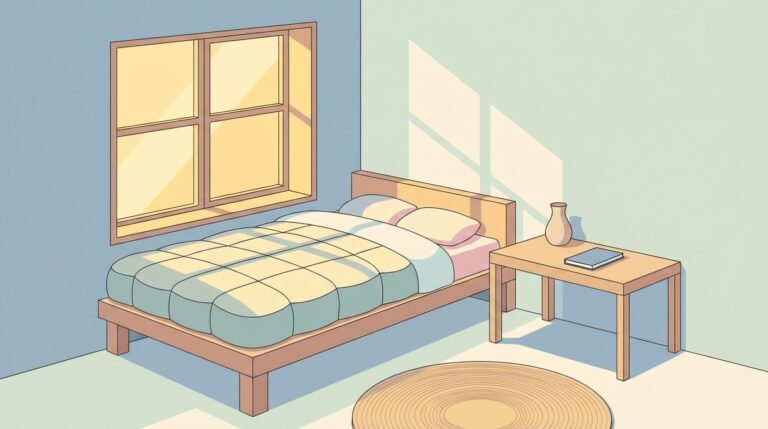
1. There is a bed in the room (방에 침대가 있어요)
- Pronunciation: Bang-e chimdaega isseoyo (Sounds like: “Bahng-eh chim-day-gah ee-ssuh-yo” — think of the “ee” in “see” and a short, soft “uh” like “uh-oh”)
- Meaning: Literal: “At the room, a bed exists.” | Actual Nuance: The standard, warm, and polite way to state that a bed is inside a room (or that you have one there).
- K-Culture Moment: In K-Dramas like Yumi’s Cells or Because This Is My First Life, when a character gives a proud mini-tour of their newly decorated studio (jachwibang), they point happily and say, “Bang-e chimdaega isseoyo!”
- Editor’s Insight: Notice the particle -e (에) stuck to bang (room). In Korean, location comes FIRST, followed by the item! Think of it like zooming in with a camera: first show the room (bang-e), then show what is inside (chimdae).
- Situation Spectrum: Casual 🚫 (Drop -yo: 있어) | Semi-formal ✅ (Perfect with friends/hosts) | Formal ⚠️ (Use 있습니다 itseumnida in business/hotels)
- 🤔 Think About It: In English, you start with the empty placeholder “There is…” and put the room at the end. In Korean, you anchor the listener in the physical space first (bang-e). How does starting with the setting change the mental picture in your head?
2. There is no air conditioner in the room (방에 에어컨이 없어요)
- Pronunciation: Bang-e eeokeoni eopseoyo (Sounds like: “Bahng-eh eh-uh-kuhn-ee uhp-ssuh-yo” — pronounce “eop” like “up” with a tiny stopped “p” at the end)
- Meaning: Literal: “At the room, air conditioner does not exist.” | Actual Nuance: Used to politely report something is missing, or gently complain when checking into a summer rental!
- K-Culture Moment: In classic Korean variety shows like Running Man or 2 Days & 1 Night, when cast members lose a game and get sent to a traditional countryside room in July, they gasp dramatically and yell, “Bang-e eeokeoni eopseoyo?!”
- Editor’s Insight: Eopseoyo (없어요) is the super-useful twin of isseoyo (있어요). It covers both “there isn’t” AND “I don’t have.” Even better, if you raise your voice at the end, it magically turns into a question: “Is there no AC?”
- Situation Spectrum: Casual 🚫 (Drop -yo: 없어) | Semi-formal ✅ (Polite & natural) | Formal ⚠️ (Use 없습니다 eopseumnida for official reports)
- 🤔 Think About It: In Korean, the exact same verb isseoyo / eopseoyo handles both existence (“there is”) and possession (“I have”). Why do you think Korean connects “existing near you” with “owning it”?
3. Is there Wi-Fi? (와이파이 있어요?)
- Pronunciation: Waipai isseoyo? (Sounds like: “Wah-ee-pah-ee ee-ssuh-yo?” — lift your pitch up at the end just like an English question!)
- Meaning: Literal: “Does Wi-Fi exist?” | Actual Nuance: The ultimate survival question! Means “Is there Wi-Fi?” or “Do you have Wi-Fi here?”
- K-Culture Moment: Picture a traveler in a Seoul travel vlog sitting down at a cozy Hanok cafe in Bukchon, smiling at the barista while holding their phone to ask, “Waipai isseoyo?”
- Editor’s Insight: Notice how ga/i (가/이) disappeared here! In real life, native Koreans often drop subject particles like ga when chatting casually or politely in cafes and guesthouses. Keeping it short makes you sound 10x more natural!
- Situation Spectrum: Casual 🚫 (Use 있어? with close friends) | Semi-formal ✅ (Your go-to everywhere in Korea) | Formal ⚠️ (Add “혹시” hoksi at the front for extra politeness)
- 🤔 Think About It: English requires changing word order (“There is” -> “Is there?”). Korean keeps the exact same words and relies purely on your intonation. Doesn’t that feel refreshing?
Phase 3: Textbook Korean vs. Real Korean
Situation 1: Checking into a Seoul Guesthouse
- 📖 Textbook Korean: 이 방에 침대가 있습니까? (I bang-e chimdaega itseumnikka?) – “Does a bed exist in this room?”
- 🗣️ Real Korean: 혹시 방에 침대 있어요? (Hoksi bang-e chimdae isseoyo?) – “By any chance, is there a bed in the room?”
- 💡 Why is it different? Using -seumnikka sounds like a strict news anchor or an army officer! Real Koreans soften questions with 혹시 (hoksi – by any chance) and drop the particle ga after chimdae to sound friendly and approachable.
Situation 2: Telling a Korean Friend About Your Room
- 📖 Textbook Korean: 제 방에는 책상이 없습니다. (Je bang-eneun chaeksangi eopseumnida.) – “In my room, there is no desk.”
- 🗣️ Real Korean: 우리 방엔 책상 없어. (Uri bang-en chaeksang eopseo.) – “There’s no desk in my room.”
- 💡 Why is it different? Close friends drop the polite -yo ending (반말 banmal) and shorten bang-eneun (방에는) to bang-en (방엔). Also, Koreans often say 우리 (uri – our) instead of je (my) because of warm communal culture!
Phase 4: K-Culture Deep Dive & Non-Verbal Manners
4-1. Nunchi (눈치) & Gestures
When you are touring a Korean room or checking out a guesthouse with a host, never point with a single index finger—that can feel a bit sharp! Instead, gesture toward the bed or furniture with an open palm facing upward, accompanied by a gentle nod. When entering any Korean bedroom or studio, taking off your shoes at the hyeongwan (현관 – entryway) is non-negotiable. Even if you just want to peek inside to see if there is a bed, keep your socks on the clean floor!
4-2. Cultural Code: Bed vs. Yo (요) in Korean Rooms
If you watch K-Dramas featuring rooftop rooms (oktapbang 옥탑방) or historic Hanok stays, you might notice something surprising: sometimes there is no bed in the room at all! Thanks to Korea’s traditional Ondol (온돌) underfloor heating system, Koreans have loved jwasik (좌식 – floor-sitting) culture for centuries. Instead of a tall bed frame, people roll out a thick, comfy floor mattress called a 요 (yo) at night and fold it up in the morning to turn their bedroom into a living room! So if a Korean host says, “침대가 없어요 (Chimdaega eopseoyo – There is no bed),” don’t panic—you might be getting a cozy heated Ondol floor experience!
Phase 5: Interactive Roleplay Scenario
Setting: A sunny afternoon in Hongdae, Seoul. You just arrived at a trendy pastel guesthouse carrying your suitcase. Min-ji, the cheerful Korean host wearing a cute apron, welcomes you at the door to show you your room.
- Min-ji: 안녕하세요! 여기가 방이에요. (Annyeonghaseyo! Yeogiga bang-ieyo.) – “Hello! Here is the room.” 🎭 (Opens the wooden door wide with an open-palm gesture and a bright smile.)
- You: 우와, 예뻐요! 그런데 방에 침대가 있어요? (Uwa, yeppeoyo! Geureonde bang-e chimdaega isseoyo?) – “Whoa, it’s pretty! By the way, is there a bed in the room?” 🎭 (Peeks inside curiously while taking off your sneakers at the entryway.)
- Min-ji: 네! 저기 창문 옆에 침대가 있어요. (Ne! Jeogi changmun yeope chimdaega isseoyo.) – “Yes! There is a bed over there next to the window.” 🎭 (Points toward a cozy white bed bathed in sunlight.)
- You: 좋아요! 혹시 와이파이도 있어요? (Joayo! Hoksi waipaido isseoyo?) – “Awesome! By any chance, is there Wi-Fi too?” 🎭 (Holds up your smartphone and tilts your head slightly.)
- Min-ji: 물론이죠! 책상 위에 비밀번호가 있어요. (Mullonijyo! Chaeksang wie bimilbeonhoga isseoyo.) – “Of course! The password is on the desk.” 🎭 (Taps a cute laminated card sitting on a small wooden desk.)
- You: 감사합니다! 아, 방에 에어컨이 있어요? (Gamsahamnida! A, bang-e eeokeoni isseoyo?) – “Thank you! Ah, is there an air conditioner in the room?” 🎭 (Fans your face playfully with your hand.)
- Min-ji: 네, 있어요. 그런데 냉장고는 없어요. (Ne, isseoyo. Geureonde naengjanggoneun eopseoyo.) – “Yes, there is. However, there is no refrigerator.” 🎭 (Makes a small apologetic smile and clasps her hands together.)
- You: 괜찮아요! 거실에 있어요? (Gwaenchanayo! Geosire isseoyo?) – “That’s okay! Is there one in the living room?” 🎭 (Nods warmly to show it’s no big deal.)
🔀 Interactive Branching Point!
Imagine Min-ji just told you there is no refrigerator in your room, and you really need cold water for your skincare masks and drinks! How should you reply?
- Option A: “괜찮아요! 혹시 공용 주방에 냉장고 있어요?” (Gwaenchanayo! Hoksi gongyong jubang-e naengjanggo isseoyo?) — “It’s okay! By any chance, is there a fridge in the shared kitchen?”
- Feedback (🏆 BEST!): Smooth, polite, and full of Korean nunchi! Using gwaenchanayo (it’s okay) keeps the mood positive, and hoksi makes your request super gentle.
- Option B: “냉장고 없어요?! 여기 안 좋아요!” (Naengjanggo eopseoyo?! Yeogi an joayo!) — “There’s no fridge?! This place isn’t good!”
- Feedback (🚫 BAD!): Ouch! Even though the grammar is simple, saying “not good” directly to a host sounds very blunt and rude in Korean culture.
- Option C: “물 없어요.” (Mul eopseoyo.) — “No water.”
- Feedback (⚠️ RISK!): A bit too telegraphic! Min-ji might think you are simply stating a fact rather than asking where to store your drinks. Add a question intonation or ask about a fridge!
Phase 6: 10-Second Emotion Shadowing Drill
Read these out loud! Pause briefly at the / marks and match the emotion tag:
- [😊 Happy and excited] 방에 / 침대가 있어요! (Bang-e / chimdaega isseoyo!) — “There is a bed in the room!”
- [🤔 Curious and polite] 혹시 / 와이파이 있어요? (Hoksi / waipai isseoyo?) — “By any chance, is there Wi-Fi?”
- [🥺 Disappointed and cute] 아~ / 방에 에어컨이 없어요… (A~ / bang-e eeokeoni eopseoyo…) — “Aww~ there’s no AC in the room…”
- [😎 Cool and confident] 제 방에 / 다 있어요! (Je bang-e / da isseoyo!) — “My room has everything!”
Phase 7: K-Culture Mini Dictionary
- 방 (Bang) | Room | Used for almost any enclosed space in Korea! Nae bang (my room), noraebang (karaoke room), PC bang (gaming cafe), and jjimjilbang (Korean sauna).
- 침대 (Chimdae) | Bed | Refers specifically to a Western-style bed with a frame/mattress. You’ll see singgeul chimdae (single bed) and deobeul chimdae (double bed) on booking apps.
- 화장실 (Hwajangsil) | Bathroom / Restroom | Literally “makeup room.” Essential whether you’re checking if your room has an en-suite bathroom (hwajangsil isseoyo?) or looking for one at a cafe.
- 온돌 (Ondol) | Traditional Korean underfloor heating | The magic behind warm Korean floors in winter! Many cozy guesthouses proudly advertise ondol bang (heated floor rooms).
Phase 8: Survival Kit for Travelers
Top 3 Survival Expressions
- 1. 엘리베이터 있어요? (Ellibeiteo isseoyo?) — “Is there an elevator?” | Pro Tip: Many trendy Hongdae buildings and villas have 4 floors with NO elevator. Ask this before dragging a 20kg suitcase up the stairs!
- 2. 콘센트 있어요? (Konsenteu isseoyo?) — “Is there a power outlet?” | Pro Tip: Lifesaver in cafes or guesthouses when your phone is at 2% battery.
- 3. 수건 더 있어요? (Sugeon deo isseoyo?) — “Are there more towels?” | Pro Tip: Korean accommodations often provide smaller face-sized towels (sugeon) instead of giant bath sheets, so don’t hesitate to ask for extras!
Editor’s Travel Note
Before you step off the plane at Incheon Airport, make sure to grab the right digital tools! Google Maps doesn’t give full walking directions in Korea, so be sure to Download Naver Map App for Korean Navigation before your trip. Also, if you want to read Korean room listings or message a host on KakaoTalk, Get Papago Korean AI Translator for super natural translations. Finally, when buying snacks or transit cards (T-money) at convenience stores, remember to carry a little cash or a travel card, and check the wall switch near your Korean room door—one switch often turns on the boiler (boilleo) for hot shower water!
Phase 9: One Step Deeper
Have you noticed how often Koreans say “우리 방” (uri bang – our room) or “우리 집” (uri jip – our house) even when they live completely alone? In Korean society, language reflects a deep-rooted sense of community called Jeong (정)—warm emotional connection. Saying “my” (na-ui) too much can sometimes feel cold or distant, as if you are drawing a wall between yourself and the listener. By saying “our,” Koreans subconsciously invite you into their space with warmth. Even a simple sentence like “There is a bed in our room” carries a tiny hug of hospitality!
💬 Your Turn: Look around the room you are sitting in right now! What is ONE thing in your room? Leave a comment using [Item] 있어요 (isseoyo)—don’t worry if you write the item in English, like “Lamp 있어요!”
Phase 10: FAQ & Common Mistakes
Q: Can I use “있어요 (isseoyo)” for people and pets, too?
A: Yes! You can use isseoyo for objects, people, and animals (e.g., “방에 친구가 있어요” Bang-e chinguga isseoyo = “My friend is in the room”). However, if you are talking about your respected grandparents, boss, or teacher, switch to the honorific verb 계세요 (gyeseyo) to show respect!
Q: What is the difference between “에 (e)” and “에서 (eseo)” for rooms?
A: Great beginner question! Think of 에 (e) as a static pin on a map—use it with isseoyo / eopseoyo to show where something exists (“방에 침대가 있어요”). Use 에서 (eseo) for action verbs like studying or sleeping (“방에서 자요” Bang-eseo jayo = “I sleep in the room”).
Q: Why do some words take “이 (i)” and others take “가 (ga)” before 있어요?
A: It all depends on the final sound of the noun! If the word ends in a vowel (like 침대 chimdae), attach 가 (ga) -> chimdaega. If the word ends in a consonant (like 책상 chaeksang), attach 이 (i) -> chaeksangi. Easy rhythm!
🚨 Common Mistakes Alert! (Top 3)
- Using “이다 (ida / 이에요)” instead of “있어요 (isseoyo)”: Saying “방에 침대예요” means “In the room, it IS a bed” (turning the room into a bed!). Correct Action: Always use 있어요 for existence/location.
- Putting the item before the room awkwardly without particles: Saying “침대 방 있어요” sounds like “There is a bed-room.” Correct Action: Keep the anchor particle -e on the location: 방에 (bang-e) + item + 있어요.
- Forgetting the “s” sound in 있어요: Saying i-eo-yo instead of i-sseo-yo changes the meaning completely! Correct Action: Hold a tiny breath before saying sseo (like “ee-SSUH-yo”).
Phase 11: Action Mission & Engagement
- 🥉 Bronze Mission (Solo Practice): Walk around your bedroom today and point to 3 items out loud: “방에 [item] 있어요!” (e.g., “Bang-e chimdaega isseoyo!”).
- 🥈 Silver Mission (Social Share): Snap an aesthetic photo of your favorite cozy corner at home and post it on Instagram Stories with the Korean caption: “우리 방에 침대가 있어요 🛏️✨ #DailyHangul”.
- 🥇 Gold Mission (Real Life): Next time you visit a Korean restaurant, cafe, or talk to a Korean language partner, ask at least ONE question using “~ 있어요?” (like “와이파이 있어요?” or “화장실 있어요?”).
🎮 K-Culture Mission: Turn on your favorite K-Drama or Korean vlog on YouTube with subtitles! Listen closely during any house tour or hotel check-in scene—every time you hear “있어요 (isseoyo)” or “없어요 (eopseoyo),” give yourself 1 point. Can you catch 5 in one episode?
Phase 12: Interactive Quiz Challenge
Test your skills! Try answering before clicking the spoiler toggle below.
Quiz 1 (Situation Judgment): You arrive at a cozy guesthouse in Busan and want to politely ask the host if there is a refrigerator in your room. What is the BEST thing to say?
A) 방에 냉장고 있어요? (Bang-e naengjanggo isseoyo?)
B) 방에서 냉장고예요? (Bang-eseo naengjanggo-yeyo?)
C) 방에 냉장고 없어요! (Bang-e naengjanggo eopseoyo!)
Click to see Quiz 1 Answer & Feedback
Answer: A) 방에 냉장고 있어요?
* Why A wins: It correctly uses -e for location and isseoyo? with a polite rising tone!
* Why B is wrong: -eseo is for action verbs, and -yeyo means “it is,” not “there is.”
* Why C is wrong: That sounds like you are complaining that there is no fridge before even asking!
Quiz 2 (Fill in the Blank): Complete the sentence: “There is no desk in the room.” -> 방에 책상___ 없어요. (Bang-e chaeksang___ eopseoyo.)
A) 가 (ga)
B) 이 (i)
C) 에서 (eseo)
Click to see Quiz 2 Answer & Explanation
Answer: B) 이 (i)
* Since 책상 (chaeksang) ends in a consonant (ng / ㅇ), it pairs with 이 (i) -> 책상이 (chaeksangi)!
Quiz 3 (True or False Cultural Quiz): True or False? If a traditional Korean room listing says “침대가 없어요 (There is no bed),” it means you have to sleep on the bare hard wooden floor with nothing.
Click to see Quiz 3 Answer & Explanation
Answer: False!
* Traditional Korean rooms with Ondol underfloor heating provide a thick, plush floor mattress called a 요 (yo) and warm blankets—it’s actually super cozy!
🎬 Watch Our Daily Videos! (Daily Hangul Official Instagram)
Review the expressions you learned in this article with our fun daily short videos! Check out native pronunciation and real-life nuances in action.
- Instagram @dailyhangul_en