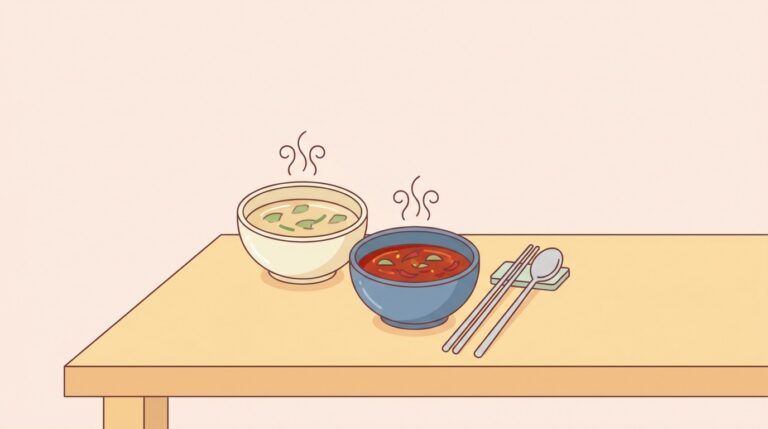
Phase 1: Why Korean Soup Menus Feel Like Roulette
안녕하세요! (Annyeonghaseyo!) Hello! This is your Daily Hangul Editor. Have you ever watched a cozy K-Drama like Hospital Playlist where friends slurp steaming bowls of soup on a rainy night, and wished you could teleport right to their table? Then you finally walk into a local Korean diner, look at the menu, and freeze. You want warm comfort food, not a surprise five-alarm chili attack! That exact moment is why so many Level 2 learners told us they play menu roulette instead of ordering what they truly crave. Based on real student feedback from Seoul, today we are fixing that for good. By the end of this guide, you will effortlessly ask about broth styles, ingredients, and recommendations like a local bestie!
Phase 2: 3 Must-Know Expressions Deep Dive
1. 국물이 맑은 편이에요, 아니면 얼큰한 편이에요? (Gungmuri malgeun pyeonieyo, animyeon eolkeunhan pyeonieyo?)
- Pronunciation: Gung-moo-ri mal-geun pyeo-ni-e-yo, a-ni-myeon eol-keun-han pyeo-ni-e-yo? (Think of gung like “goong” in lagoon, eol like “uh” in uh-oh + “l”, and pyeo like “puh” with a soft y-glide).
- Meaning: Literally “Is the broth on the clear side, or is it on the spicy-and-hearty side?” In reality, it is the smartest, most natural way to ask what flavor profile a soup has without sounding picky.
- K-Culture Moment: Picture a scene from Let’s Eat or a Seoul travel vlog on YouTube where the host spots kalguksu (knife-cut noodles) on a chalkboard menu. Because kalguksu can be either mild anchovy broth or fiery red jang-kalguksu, asking this question prevents a total flavor surprise.
- Editor’s Insight: Adding ~는/은 편이에요 (~neun/eun pyeonieyo) means “tends to be” or “on the ~ side.” Koreans love softening questions this way because taste is subjective—what is mild to a Seoul grandmother might still set your tongue on fire!
- Situation Spectrum: Casual 🚫 | Semi-formal ✅ | Formal ✅
- 🤔 Think About It: In English, we often ask directly, “Is this spicy?” Why do you think Korean speakers prefer categorizing soup by visual clarity (맑다 – makda, clear) versus warming depth (얼큰하다 – eolkeunhada, spicy and hearty)?
2. 안 매운 메뉴로 추천해 주세요. (An maeun menyuro chucheonhae juseyo.)
- Pronunciation: An mae-un me-nyu-ro chu-cheon-hae ju-se-yo. (Mae-un sounds like “meh-oon” blended smoothly, and chu-cheon sounds like “choo-chuhn”).
- Meaning: Literally “Please recommend by way of a not-spicy menu.” In real life, it means “Could you recommend something mild?”
- K-Culture Moment: Imagine walking into a bustling jjigae (stew) spot featured in a Street Food Fighter episode. Every table has bubbling red pots, and you panic a little. Dropping this phrase lets the server rescue you with a mild doenjang-jjigae (soybean paste stew) or savory bulgogi!
- Editor’s Insight: Notice the particle ~(으)로 (~(eu)ro) attached to menyu (menu). Here, it politely narrows down the category of your request—like saying “from among the non-spicy options.”
- Situation Spectrum: Casual ⚠️ | Semi-formal ✅ | Formal ✅
- 🤔 Think About It: In your native language, is asking a waiter to pick your meal seen as helpful trust or indecisiveness? In Korea, asking for a server’s recommendation is actually a warm compliment to the chef!
3. 안에 고기가 들어가요? (Ane gogiga deureogayo?)
- Pronunciation: A-ne go-gi-ga deu-reo-ga-yo? (Deu has that flat “uh” sound like pulling a funny face, while eo is an open “aw” sound).
- Meaning: Literally “Does meat go inside?” In daily conversation, it simply means “Is there meat in it?”
- K-Culture Moment: Just like in Run BTS! cooking episodes where members inspect what goes into the pot, knowing whether a broth uses beef, pork, or seafood is huge for travelers with dietary preferences or allergies.
- Editor’s Insight: Instead of using the verb “to have” (있어요 – isseoyo), Koreans naturally say ingredients “go into” (들어가요 – deureogayo) a dish. You can swap 고기 (gogi, meat) for 돼지고기 (dwaejigogi, pork), 해산물 (haesanmul, seafood), or 고수 (gosu, cilantro)!
- Situation Spectrum: Casual ⚠️ | Semi-formal ✅ | Formal ✅
- 🤔 Think About It: English says “Does it contain meat?” as if the bowl is a box. Korean says “Does meat go inside?”—focusing on the cooking process! Which perspective feels warmer to you?
Phase 3: Textbook Korean vs. Real Korean
Textbooks want you to sound ultra-proper, which is cute, but sometimes it makes busy restaurant ajummas (aunties) do a double take. Let’s upgrade your street cred!
Situation 1: Checking the spice level
* 📖 Textbook Korean: 이 음식은 매운 편입니까? (I eumsigeun maeun pyeonipnikka?) — “Does this food tend to be spicy?”
* 🗣️ Real Korean: 이거 많이 매워요? (Igeo mani maewoyo?) — “Is this really spicy?”
* 💡 Why the difference? The formal ~입니까? (-ipnikka?) ending sounds like a TV news reporter interviewing a bowl of soup! At casual eateries, pointing lightly toward the menu and using 이거 (igeo, this) with ~아/어요 (~a/eoyo) feels friendly, fast, and natural.
Situation 2: Asking for the best menu item
* 📖 Textbook Korean: 가장 맛있는 음식을 추천해 주십시오. (Gajang masinneun eumsigeul chucheonhae jusipsio.) — “Please recommend the most delicious food.”
* 🗣️ Real Korean: 여기 뭐가 제일 잘 나가요? (Yeogi mwoga jeil jal nagayo?) — “What sells best here?”
* 💡 Why the difference? Asking “what is most delicious” puts pressure on the owner because everything on their menu is supposed to be delicious! Asking 잘 나가요 (jal nagayo)—literally “goes out well”—is the insider way to discover the restaurant’s #1 bestseller.
Phase 4: K-Culture Deep Dive & Non-Verbal Manners
4-1. Nunchi & Gestures at the Table
In Korea, good 눈치 (nunchi)—social awareness—starts before you even say a word. When a restaurant is loud and lively, never snap your fingers or wave aggressively to call a server! First, check your table for a small round 호출벨 (hochulbel, call button). If there isn’t one, make friendly eye contact, lift one hand gently near shoulder height with your palm facing slightly down or forward, and say “저기요! (Jeogiyo! / Excuse me!)” with a warm smile. When asking about broth (국물이 맑은 편이에요? / Gungmuri malgeun pyeonieyo?), pointing politely with two fingers or your whole hand toward the menu line (not jabbing with one finger) shows great manners.
4-2. Cultural Code: Korea’s Obsession with Gukmul (Broth)
If you watch K-Dramas like Itaewon Class or Hospital Playlist, you will notice that Korean meals almost always feature a bubbling soup or stew in the center. Koreans divide soups into two main emotional moods: 맑은 국물 (malgeun gungmul), a clear, soothing broth made by simmering beef bones, radish, or anchovies; and 얼큰한 국물 (eolkeunhan gungmul), a rich, spicy red broth seasoned with chili flakes (gochugaru) and garlic. Fun fact: Koreans often eat eolkeunhan soup the morning after drinking—even in scorching summer—and sigh “시원하다! (Siwonhada! / It’s so refreshing!)” because sweating out the heat makes their stomach feel completely reset!
Phase 5: Interactive Roleplay Scenario
Setting: It is a drizzly Tuesday evening in Euljiro, Seoul—famous for retro alleys and steaming soup joints. You step into Euljiro Gukbap, warm rain fogging your glasses. Behind the counter stands Imo (Auntie), a cheerful owner with a floral apron and a big ladle.
- Imo: 어서 오세요! 몇 분이세요? (Eoseo oseyo! Myeot buniseyo? — Welcome! How many people?)
🎭 Imo smiles warmly while wiping down a wooden table with a towel. - You: 한 명이에요. 저기요, 여기 뭐가 제일 잘 나가요? (Han myeongieyo. Jeogiyo, yeogi mwoga jeil jal nagayo? — Just one person. Excuse me, what sells best here?)
🎭 You sit down, hang your umbrella on the chair, and glance up at the wall menu. - Imo: 우리 집은 소고기국밥이 최고예요! (Uri jibeun sogogigukbabi choegoyeyo! — Our beef rice soup is the best!)
🎭 Imo points proudly to the biggest calligraphy sign on the wall. - You: 아, 그래요? 국물이 맑은 편이에요, 아니면 얼큰한 편이에요? (A, geuraeyo? Gungmuri malgeun pyeonieyo, animyeon eolkeunhan pyeonieyo? — Oh, really? Is the broth on the clear side, or the spicy and hearty side?)
🎭 You tilt your head curiously, eager to know what you are getting into. - Imo: 조금 얼큰한 편이에요. 매운 거 잘 드세요? (Jogeum eolkeunhan pyeonieyo. Maeun geo jal deuseyo? — It is a little on the spicy and hearty side. Can you handle spicy food well?)
🎭 Imo pauses with her notepad ready, checking your expression. - You: 사실 매운 걸 잘 못 먹어요. 안 매운 메뉴로 추천해 주세요. (Sasil maeun geol jal mot meogeoyo. An maeun menyuro chucheonhae juseyo. — Actually, I cannot eat spicy food well. Please recommend a non-spicy menu item.)
🎭 You smile slightly shyly and gesture lightly toward the menu. - Imo: 그럼 설렁탕 어때요? 국물이 아주 맑고 담백해요. (Geureom seolleongtang eottaeyo? Gungmuri aju malgo dambaekhaeyo. — Then how about seolleongtang? The broth is very clear and savory.)
🎭 Imo beams like a proud mom and taps the second menu item. - You: 좋아요! 그런데 안에 파가 많이 들어가요? (Joayo! Geureonde ane paga mani deureogayo? — Sounds great! By the way, do a lot of green onions go inside?)
🎭 You lean in politely to make sure your order is just right.
🔀 Interactive Branching Point: Imo asks if you want extra chili paste (dadaegi) on the side!
Imo: 다대기는 따로 드릴까요? (Dadaegineun ttaro deurilkkayo? — Shall I give you the spicy paste separately?)
How do you reply?
- Option A: 네, 따로 주세요! 감사합니다. (Ne, ttaro juseyo! Gamsahamnida. — Yes, please give it separately! Thank you.)
- Option B: 아니요, 그냥 다 넣어 주세요! (Aniyo, geunyang da neoeo juseyo! — No, just put it all in!)
- Option C: 다대기? 몰라요. (Dadaegi? Mollayo. — Dadaegi? I don’t know.)
Feedback:
* Option A (Best! 🏆): Brilliant move! Keeping the dadaegi on the side lets you enjoy the pure, clear broth first, and you can test a tiny drop of spice at your own pace.
* Option B (Risk! 🌶️): Careful! Putting all the dadaegi inside turns your mild seolleongtang right back into a fiery red bowl. Only pick this if you suddenly feel brave!
* Option C (Bad! 😬): Simply saying “몰라요 (mollayo / I don’t know)” without polite endings sounds abrupt. Instead, try “그게 뭐예요? (Geuge mwoyeyo? / What is that?)” with a smile!
Phase 6: 10-Second Emotion Shadowing Drill
Read these aloud! Pause briefly at each / and match the emotion to sound instantly natural.
- [😊 Curious & polite]
저기요, / 국물이 맑은 편이에요, / 아니면 얼큰한 편이에요?
(Jeogiyo, / gungmuri malgeun pyeonieyo, / animyeon eolkeunhan pyeonieyo?) - [🥺 Shy & apologetic about spice tolerance]
죄송한데, / 안 매운 메뉴로 / 추천해 주세요.
(Joesonghande, / an maeun menyuro / chucheonhae juseyo.) - [🧐 Checking ingredients carefully]
혹시 / 안에 고기가 / 들어가요?
(Hoksi / ane gogiga / deureogayo?)
Phase 7: K-Culture Mini Dictionary (4 Essential Words)
- 국물 (gungmul) | 2. Broth / Soup liquid | 3. Real-life usage: Koreans rarely say “drink soup”; they say 국물을 마시다 (gungmureul masida) or 국물이 끝내주다 (gungmuri kkeutnaejuda, the broth is amazing!)—the ultimate praise for a restaurant!
- 맑다 (makda) | 2. To be clear / clean | 3. Real-life usage: Used for clear skies, clear voices, and clear, non-spicy broths (맑은 국물 / malgeun gungmul). Note that when conjugated before a vowel, it becomes 맑은 (malgeun).
- 얼큰하다 (eolkeunhada) | 2. Spicy, hearty, and invigorating | 3. Real-life usage: Unlike sharp capsaicin heat (맵다 / maepda), eolkeunhada describes a rich, comforting spicy broth that warms your chest—often paired with cold rain or hangover mornings.
- 시원하다 (siwonhada) | 2. Refreshing / Cool | 3. Real-life usage: Beginners get shocked when Koreans eat boiling hot soup and say “시원하다!” Here it means “soothing and refreshing” for your throat and stomach, not cold temperature.
Phase 8: Survival Kit for Travelers
Top 3 Survival Phrases
- 덜 맵게 해 주세요. (Deol maepge hae juseyo.) — Please make it less spicy.
- Pro Tip: Even if a dish is normally spicy, some places can reduce the chili paste if you ask before cooking starts!
- 맵찔이예요. (Maepjjiriyeyo.) — I am a spice wimp (slang, friendly & funny!).
- Pro Tip: Saying this with a laugh immediately charms young café/restaurant staff—they will protect your tastebuds like family!
- 이거 빼 주세요. (Igeo ppae juseyo.) — Please leave this out.
- Pro Tip: Point to an ingredient picture or allergy card (like peanuts or pork) and use this short rescue phrase.
Editor’s Travel Note
Before your next Seoul foodie crawl, make sure to grab Download Naver Map for Local Korean Restaurant Reviews—Google Maps struggles with walking directions in Korea, while Naver Map shows photos of every dish so you can preview whether the broth looks clear or red! Also Get the Papago AI Translator App for Instant Menu Scanning so you can snap a photo of handwritten wall menus in seconds. Finally, remember two golden diner rules: water is usually 셀프 (selpeu, self-service) from a silver fridge, and almost everywhere accepts 신용카드 (sinyongkadeu, credit cards) or T-money at the counter on your way out.
Phase 9: One Step Deeper — Why Korea Loves Soft Phrases
Have you noticed how Korean speakers rarely pin things down as 100% black or white when talking about taste? Phrases like ~는 편이에요 (on the ~ side) exist because Korean society values 정 (jeong)—warm interpersonal harmony—over blunt precision. If a server tells you a soup is “on the clear side” or “a little hearty,” they are leaving gentle room for your personal palate so neither of you feels awkward if you disagree. Learning these softeners is not just a grammar trick; it is learning how Koreans take care of each other’s feelings over a shared meal.
💬 Your Turn: Have you ever accidentally ordered a super spicy Korean dish thinking it was mild, or vice versa? Tell us your funniest K-Food surprise in the comments below!
Phase 10: FAQ & Common Mistakes
Q: What is the difference between 맵다 (maepda) and 얼큰하다 (eolkeunhada)?
A: 맵다 (maepda) simply means spicy or hot on the tongue, like chili peppers or buldak noodles. 얼큰하다 (eolkeunhada) specifically describes a warm, savory broth with a pleasant spicy kick that feels cozy and refreshing rather than painfully fiery.
Q: Can I use “맑은 편이에요?” for drinks or only for soup?
A: For broth and stews, 맑은 편이에요 is perfect! For drinks like tea or juice, people usually ask if it is sweet (단 편이에요? / dan pyeonieyo?) or strong/bold (진한 편이에요? / jinhan pyeonieyo?).
Q: How do I ask if a broth is vegetarian or made with beef bones?
A: You can politely ask, “혹시 사골 국물이에요? (Hoksi sagol gungmurieyo? / Is it beef bone broth?)” or “안에 고기나 해산물이 들어가요? (Ane gogina haesanmuri deureogayo? / Does meat or seafood go inside?)“.
🚨 Common Mistakes TOP 3
- Mistake: Saying “국물이 깨끗해요? (Gungmuri kkaekkeuthaeyo?)” to ask if broth is clear.
- Why it’s awkward: 깨끗하다 (kkaekkeutada) means “clean/hygienic”! You might accidentally sound like you are asking if the kitchen washed the bowl properly!
- Correct Action: Always use 맑다 (makda / 맑은 편이에요) for transparent, non-spicy broth.
- Mistake: Using “이거 매워요?” when you actually want to know about ingredients.
- Why it’s awkward: A clear broth like cheongyang-gochu (green chili) soup can look totally transparent and still pack a huge punch!
- Correct Action: Combine broth style with “안에 고추 들어가요? (Ane gochu deureogayo? / Are chilies inside?)“.
- Mistake: Forgetting ~주세요 (juseyo) at the end of “안 매운 메뉴로 추천해…”
- Why it’s awkward: Dropping juseyo leaves the verb unfinished or overly blunt.
- Correct Action: Always close recommendations warmly with 추천해 주세요 (chucheonhae juseyo).
Phase 11: Action Mission & K-Culture Challenge
- 🥉 Bronze Mission (Solo Practice): Stand in front of the mirror and say “국물이 맑은 편이에요, 아니면 얼큰한 편이에요? (Gungmuri malgeun pyeonieyo, animyeon eolkeunhan pyeonieyo?)” three times without looking at the romanization.
- 🥈 Silver Mission (Social Share): Post a photo of your favorite soup or ramen on Instagram/TikTok and caption it with whether it is 맑은 국물 (malgeun gungmul) or 얼큰한 국물 (eolkeunhan gungmul)—tag
#DailyHangul! - 🥇 Gold Mission (Real-World Action): Visit your local Korean restaurant this week and ask the server in Korean: “여기 뭐가 제일 잘 나가요? (Yeogi mwoga jeil jal nagayo?)” and “안 매운 메뉴로 추천해 주세요. (An maeun menyuro chucheonhae juseyo.)”
🎮 K-Culture Mission: Watch a Korean mukbang vlog or a dinner scene in Hospital Playlist / My Mister tonight. Listen closely—can you catch someone sighing “시원하다! (Siwonhada!)” or “얼큰하다! (Eolkeunhada!)” after their first spoonful of broth?
Phase 12: Interactive Quiz Challenge
Test your skills before you hit the streets of Seoul! Tap each toggle to reveal the answer.
Quiz 1 (Situational Judgment): You are at a kalguksu shop and cannot eat spicy food at all. Which question is best to ask the server?
A) 여기 국물이 깨끗한 편이에요?
B) 안 매운 메뉴로 추천해 주세요.
C) 그냥 다 넣어 주세요.
👉 Click to reveal the answer and explanation for Quiz 1
Answer: B) 안 매운 메뉴로 추천해 주세요. (An maeun menyuro chucheonhae juseyo.)
• Why A is wrong: 깨끗하다 (kkaekkeutada) means clean/sanitary, not clear broth!
• Why C is wrong: That tells the chef to put all the spicy paste inside—danger zone!
Quiz 2 (Fill in the Blank): Complete the sentence to ask if beef goes inside the stew.
“혹시 안에 소고기가 ( __________ )?” (Hoksi ane sogogiga __________?)
👉 Click to reveal the answer and explanation for Quiz 2
Answer: 들어가요 (deureogayo)
In Korean, ingredients “go into” (들어가다) a dish rather than “being inside” like a container!
Quiz 3 (True / False Culture Quiz):
True or False: When a Korean person eats piping-hot, spicy soup and says “시원하다! (Siwonhada!),” they are complaining that the soup has gone cold.
👉 Click to reveal the answer and explanation for Quiz 3
Answer: False!
They are actually paying the soup a huge compliment! Here, 시원하다 (siwonhada) means “deeply refreshing and soothing” for the body and stomach.
🎬 Watch Our Daily Videos! (Daily Hangul Official Instagram)
Review the expressions you learned in this article with our fun daily short videos! Check out native pronunciation and real-life nuances in action.
- Instagram @dailyhangul_en