

Solo Dining in Korea: How to Master Korean Delivery Apps When Minimum Order Thresholds Hit Your Wallet
Phase 1: 공감 (Storytelling Opening)
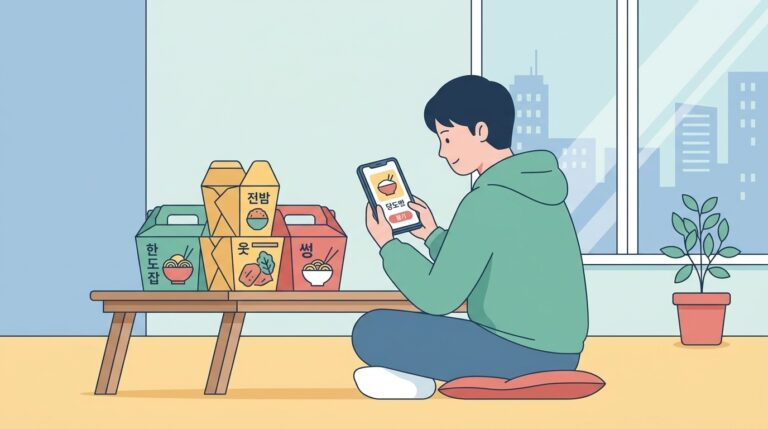
안녕하세요! 매일한글 에디터입니다. Have you ever spent twenty minutes meticulously selecting your favorite spicy tteokbokki on a Korean delivery app like Baedal Minjok or Coupang Eats, only to hit a wall at checkout? You tap the order button, and a bright red warning pops up: “Minimum order amount not met (최소 주문 금액 미달).” Your delicious 9,000 KRW meal suddenly requires you to add another 10,000 KRW worth of side dishes just to pass the threshold—not to mention a steep 4,000 KRW delivery fee!
For the growing population of honbap-jok (혼밥족, solo diners) in South Korea, this daily dilemma has sparked intense debate. As inflation and rider delivery costs rise, restaurants are continuously bumping up their minimum order requirements. What used to be a convenient midnight snack habit has turned into a strategic budgeting exercise. If you are aiming for C2-level proficiency, simply knowing how to say “I want to order food” is no longer enough. You need the linguistic finesse to express financial frustration, debate economic trade-offs, and talk about modern lifestyle adaptation in Korean with native speaker fluency. Based on real feedback from expats living in Seoul, this guide equips you with advanced nuances, cultural insights, and realistic idioms to navigate Korea’s changing delivery landscape effortlessly.
Phase 2: 핵심 표현 3선 심층 분석
1. 배달팁보다 최소 주문 금액 채우기가 더 까다롭네요
- Pronunciation: [Baedal-tip-boda choe-so ju-mun geum-aek chae-u-gi-ga deo kka-da-rom-ne-yo] (Sounds like: Bae-dal-tip-boh-dah chweh-so joo-moon goom-eck chae-oo-gee-gah duh kkah-dah-rom-nae-yo)
- Meaning: “Meeting the minimum order amount is trickier than paying the delivery fee itself.”
- K-Culture Moment: Seen frequently in lifestyle vlogs or modern Korean office lunch break conversations when co-workers discuss ordering solo deliveries.
- Editor’s Insight: The verb 채우다 (to fill/meet) paired with -기가 까다롭다 (to be tricky/picky) shows a high-level mastery of expressing subtle logistical inconveniences without sounding overly aggressive.
- Situation Spectrum: Casual ✅ | Semi-formal ✅ | Formal ⚠️
- 🤔 Think About It: How does your home country handle single-item deliveries compared to Korea’s threshold-based system?
2. 배보다 배꼽이 더 크다더니, 1인분 배달시키기가 덜덜 떨려요
- Pronunciation: [Bae-boda bae-kkob-i deo keu-da-deo-ni, il-in-bun bae-dal-si-khi-gi-ga deol-deol tteol-ryeo-yo]
- Meaning: “They say the belly button is bigger than the belly; I literally tremble at the thought of ordering a single portion.”
- K-Culture Moment: Used dramatically in YouTube commentary videos or Korean web dramas when characters react to expensive delivery totals.
- Editor’s Insight: Incorporates the classic Korean proverb 배보다 배꼽이 더 크다 (the belly button is bigger than the belly = the secondary cost exceeds the primary cost) alongside the expressive idiomatic phrase 덜덜 떨리다 (to shake/tremble from shock or stress).
- Situation Spectrum: Casual ✅ | Semi-formal ✅ | Formal 🚫
- 🤔 Think About It: Why do Koreans use physical bodily proverbs to express economic absurdity?
3. 쟁여두고 먹을 생각으로 억지로 금액 맞춰 주문했어요
- Pronunciation: [Jaeng-yeo-du-go meog-eul saeng-gag-eu-ro eog-ji-ro geum-aek mat-chwo ju-mun-haess-eo-yo]
- Meaning: “I forcibly matched the minimum amount with the intention of stockpiling the extra food for later.”
- K-Culture Moment: Common in reality TV shows like I Live Alone (나 혼자 산다), where single dwellers show off refrigerators filled with leftover delivery side dishes.
- Editor’s Insight: 쟁여두다 is an authentic, highly colloquial verb meaning to hoard or stockpile goods in small spaces. Using this instead of the plain 보관하다 (to store) instantly elevates your Korean to native-level idiomatic naturalness.
- Situation Spectrum: Casual ✅ | Semi-formal ✅ | Formal ⚠️
- 🤔 Think About It: Is stockpiling cooked delivery food a practical survival strategy or an unnecessary expense?
Phase 3: 교과서 한국어 vs 진짜 한국어
Situation 1: Expressing that minimum order amounts are too high for one person
- 📖 교과서 한국어: 최소 주문 금액이 너무 높아서 혼자 주문하기 어렵습니다.
(The minimum order threshold is too high, so it is difficult to order alone.) - 🗣️ 진짜 한국어: 1인분만 먹고 싶은데 최소 주문 금액 때문에 손이 떨려서 못 시키겠어요.
(I just want one portion, but the minimum threshold makes my hands shake—I can’t bring myself to order.) - 💡 왜 다를까? Textbook Korean uses direct, dry descriptions (높다, 어렵다). Native speakers use hyperbole and emotional physiological responses (손이 떨리다) to express economic reluctance dramatically.
Situation 2: Explaining how you ended up ordering extra food
- 📖 교과서 한국어: 금액을 맞추기 위해 음식을 추가로 구매했습니다.
(I purchased additional food to match the amount.) - 🗣️ 진짜 한국어: 금액 맞추느라 사이드를 디저트까지 싹 다 긁어모아서 겨우 주문했잖아요.
(Just to hit the minimum, I scraped together side dishes and even dessert to barely make the cut.) - 💡 왜 다를까? Advanced speakers use vivid dynamic verbs like 긁어모으다 (to scrape together) and emphatic speech enders (~잖아) to convey shared social frustration.
Phase 4: K-Culture 딥다이브 & 비언어적 매너
4-1. 눈치 (Nunchi) & Gestures
When ordering delivery food in a shared space (like an office or university dormitory), navigating minimum delivery amounts requires Nunchi. If you notice someone staring intensely at their smartphone screen while sighing deeply, they are likely stuck at the checkout threshold. It is considered polite and culturally savvy to subtly offer: “혹시 같이 시키실래요?” (Would you like to order together?). When receiving shared delivery packages, hand over any cash or transfer money via banking apps (Kakaopay/Toss) immediately without waiting to be asked.
4-2. Cultural Code Analysis: The Evolution of Honbap (혼밥)
Historically, Korean dining culture centered on communal sharing (정, Jeong), where large dishes like Gamjatang or Budaejjigae were served for groups. The rapid rise of single-person households created Honbap culture. However, delivery app economics operate on high fixed transport costs, forcing single dwellers back into a dilemma: eat out alone physically, or pay inflated bulk prices to eat at home. Understanding this socio-economic tension helps you participate in rich C2-level conversations about modern urban Korean life.
Phase 5: 실전 롤플레이 시나리오
Setting: Late evening in a Seoul apartment. Min-ho (Korean friend) and Alex (C2 Korean learner) are trying to order late-night food (Yasic).
- Min-ho: 야, 출출한데 떡볶이나 하나 시켜 먹을까? (Hey, I’m a bit peckish, shall we order some tteokbokki?)
- Alex: 🎭 [스마트폰 화면을 찡그리며 바라보며] 좋지! 근데 여기 최소 주문 금액이 18,000원으로 올랐네? (Sounds good! But wait, the minimum order amount here went up to 18,000 KRW?)
- Min-ho: 18,000원? 떡볶이 1인분에 7,000원인데 배보다 배꼽이 더 크잖아! (18,000 KRW? A single portion of tteokbokki is 7,000 KRW—that’s totally upside down!)
- Alex: 🎭 [한숨을 쉬며 고개를 저으며] 맞아. 배달팁까지 더하면 혼자 시킬 엄두가 안 나겠어. (Right. Adding the delivery fee on top, you wouldn’t even dare order alone.)
- Min-ho: 그럼 어쩌지? 다른 가게를 찾아볼까 아니면 모듬 튀김이랑 순대까지 추가할까? (What should we do then? Look for another store or add mixed fries and sundae?)
- Alex: 🎭 [자신감 있게 미소를 지으며] 억지로 금액 맞추느라 돈 더 쓰는니, 차라리 2인 세트로 시키고 남은 건 내일 쟁여두고 먹자. (Rather than wasting money just to match the limit, let’s get a 2-person set and stockpile the leftovers for tomorrow.)
- Min-ho: 오, 쟁여두고 먹기! 역시 너 한국 생활 완벽 적응했구나? (Oh, stockpiling leftovers! Man, you really have adapted perfectly to Korean life, haven’t you?)
- Alex: 🎭 [어깨를 으쓱하며] 혼밥족으로 살아남으려면 이 정도 내공은 기본이지! (To survive as a solo diner, this level of skill is absolute basic practice!)
🔀 Interactive Choice Point
How should Alex respond when Min-ho hesitates about adding more dishes?
- Option A: “그냥 주문 취소하고 편의점 가서 라면이나 먹자.” (Let’s just cancel the order and go eat convenience store ramen.)
- Option B: “최소 주문 금액 채우려고 불필요한 지출을 하는 건 합리적이지 않은 소비 패턴이야.” (Making unnecessary expenditures to meet minimum order amounts is an irrational consumption pattern.)
- Option C: “배달팁도 아낄 겸, 옆집 동호한테 연락해서 같이 묶어서 주문할까?” (To save on delivery fees too, should we message Dong-ho next door and bundle our order together?)
Feedback:
* Best (Option C): Extremely natural, culturally nuanced solution showing high community integration (Nunchi and smart consumer tactics).
* Bad (Option A): Kills the social momentum and misses an opportunity to practice C2 expressive dining language.
* Risk (Option B): Grammatically correct but overly academic/stiff for an informal friend chat. Sounds like an economics textbook.
Phase 6: 10초 감정 섀도잉 드릴
[😤 황당함과 허탈함]
배달팁보다 / 최소 주문 금액 채우기가 / 더 까다롭네요!
(Bae-dal-tip-bo-da / choe-so ju-mun geum-aek chae-u-gi-ga / deo kka-da-rom-ne-yo!)-
[😱 과장된 절망감]
배보다 배꼽이 더 크다더니, / 1인분 시키기가 / 덜덜 떨려요.
(Bae-bo-da bae-kkob-i deo keu-da-deo-ni / il-in-bun si-khi-gi-ga / deol-deol tteol-ryeo-yo.) -
[😏 뿌듯하고 능청스럽게]
어차피 내일 먹을 거니까, / 쟁여둔다고 생각하고 / 쿨하게 결제했어요!
(Eo-cha-pi nae-il meog-eul geo-ni-kka / jaeng-yeo-dun-da-go saeng-gag-ha-go / kul-ha-ge gyeol-je-haess-eo-yo!)
Phase 7: K-Culture 미니 사전
- 최소 주문 금액 (Choeso Jumun Geumaek) | Noun | The minimum order total required by a store on a delivery app before checkout is enabled.
- 배달팁 / 배달비 (Baedaltip / Baedalbi) | Noun | The delivery surcharge paid to the courier rider, which fluctuates based on weather, distance, and peak hours.
- 쟁여두다 (Jaeng-yeoduda) | Verb | To hoard or store items/food systematically in a small living space for long-term usage.
- 소분하다 (Sobunhada) | Verb | To divide bulk food or items into smaller single-serving portions before freezing or refrigerating.
Phase 8: 여행자를 위한 생존 키트
Survival Expressions TOP 3
- 1인분도 배달되나요? (Is delivery available for a single portion?)
- 최소 주문 금액이 얼마예요? (What is the minimum order requirement?)
- 포장 주문으로 하면 할인되나요? (Do I get a discount if I order for pickup/takeout?)
Editor’s Travel Note
If you want to bypass steep minimum delivery fees altogether, try using pickup options on local Korean apps! Check out the Naver Map app delivery and pickup features guide to locate nearby restaurants offering a 1,000~3,000 KRW discount when you pick up food yourself.
Phase 9: 한 발 더 깊이 (생각 질문)
The shift from traditional collective dining to app-based single delivery reflects South Korea’s fast-paced urban transformation. While delivery apps offer unprecedented convenience, high minimum order thresholds push consumers toward overconsumption or social isolation. Learning to articulate these economic ironies in Korean allows you to transition from a linguistic outsider to a culturally conscious insider.
💬 Your Turn: What strategies do you use when delivery apps in your home country enforce minimum spend limits? Share your thoughts in Korean in the comments below!
Phase 10: FAQ & 오해 방지
Q: Is it polite to ask a delivery rider to leave food outside if I haven’t met the minimum amount?
A: The minimum order threshold is enforced automatically by the app software, not the individual delivery rider. You cannot negotiate the threshold with the rider upon arrival.
Q: What does “배보다 배꼽이 더 크다” literally mean?
A: It literally translates to “the belly button is larger than the belly.” It is used whenever secondary costs (like delivery fees or add-ons) surpass the primary value of the purchase.
Q: Can I request restaurants to customize food into single portions in the order notes?
A: You can leave special requests in the 요청사항 (requests) box, but restaurants will not alter their preset menu prices or minimum order requirements based on text notes.
🚨 Common Mistakes TOP 3
- ❌ Mistake: Saying “최소 금액을 채우다” as “최소 돈을 만들다”.
- ✅ Correct Action: Always pair 금액 (amount) or 조건 (conditions) with the verb 채우다 (to fill/fulfill).
- ❌ Mistake: Confusing 배달비 (delivery fee) with 최소 주문 금액 (minimum order threshold).
- ✅ Correct Action: 배달비 goes to transport logistics; 최소 주문 금액 refers strictly to the total food price in your cart.
- ❌ Mistake: Translating “stockpiling food” literally as “음식을 모으다”.
- ✅ Correct Action: Use native colloquial verbs like 쟁여두다 or 소분해 두다 for storing meal portions.
Phase 11: 액션 미션 & 참여 유도
- 🥉 Bronze Mission: Record yourself reciting core expression #2 using the correct emotional cadence.
- 🥈 Silver Mission: Write a 3-sentence Korean social media post complaining humorously about delivery fees using 배보다 배꼽이 더 크다.
- 🥇 Gold Mission: Order food on a Korean delivery app using pickup (포장) or bulk portion freezing (소분) strategies successfully!
🎮 K-Culture Mission: Watch an episode of a Korean reality show (like * 나 혼자 산다) and spot three times a celebrity mentions *최소 주문 금액 or 쟁여두다!
Phase 12: 인터랙티브 퀴즈 챌린지
Question 1: Situation Judgment
You want to order a 10,000 KRW stew, but the delivery minimum is 15,000 KRW. What is the most natural native way to express your strategy of adding extra side dishes to freeze later?
🔍 See Answer & Explanation
- Correct Answer: “어차피 나중에 먹을 거니까 사이드 몇 개 더 추가해서 쟁여둬야겠어요.”
- Explanation: 쟁여두다 naturally captures the intent of stockpiling extra ordered items for future meals.
Question 2: Fill-in-the-blank
주문한 음식 값은 8,000원인데 배달팁이 5,000원이 나오다니, 정말 배보다 _____이/가 더 크네요!
🔍 See Answer & Explanation
- Correct Answer: 배꼽
- Explanation: The proverb 배보다 배꼽이 더 크다 uses 배꼽 (belly button) to describe disproportionate secondary expenses.
Question 3: True / False
In Korean delivery culture, 최소 주문 금액 includes the 배달팁 (delivery fee) by default.
🔍 See Answer & Explanation
- Correct Answer: False
- Explanation: 최소 주문 금액 applies strictly to food products in the shopping cart. Delivery fees are calculated separately at final payment.







