

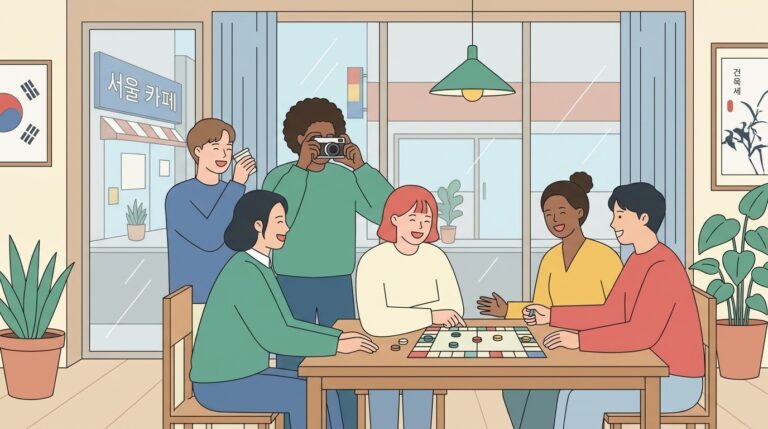
Join a Korean Club Like a Local: Easy Korean Expressions for Hobbies & Meetups!
Phase 1: Empathy & Storytelling Opening
안녕하세요! Welcome back to Daily Hangul! I’m your lead editor and culture navigator. Have you ever wished you could make real local Korean friends who share your exact passion—whether it’s bouldering in Seongsu-dong, taking aesthetic film photos along the Han River, or baking K-bakery pastries on the weekend?
Imagine this: You step into a cozy weekend meeting room in Hongdae. People are sitting around laughing, sharing delicious iced Americanos, and talking passionately about their weekend projects. You want to join in, but suddenly your mind goes blank! Should you say “제 취미는…” like a textbook, or is there a warmer, more natural way to sound friendly without feeling awkward?
Don’t worry! Talking about hobbies and joining local hobby clubs (동호회 – dong-ho-hoe) is actually one of the absolute best ways to unlock deep, meaningful connections in Korea. Based on real learner feedback and years of living in Seoul, I’ve crafted this step-by-step A2 beginner guide so you can casually talk about what you love and fit right in like a seasoned local!
Phase 2: Deep Dive into 3 Core Expressions
1. 요즘 [취미]에 빠져 있어요. (Yo-jeum [hobby]-e ppa-jyeo iss-eo-yo.)
- Pronunciation: Yo-jeum [hobby]-ae ppa-jyeo ee-sseo-yo (Sounds like “ppa” as in papa, meaning “I’m fallen into / obsessed with…”)
- Meaning: Literally “I am fallen into [hobby] these days.” Real Meaning: “I’m really into [hobby] lately!”
- K-Culture Moment: You’ll hear this expression constantly on Korean variety shows when K-Pop idols describe their newest obsession, like collecting vinyl records or camping.
- Editor’s Insight: Instead of the rigid textbook sentence “제 취미는 [취미]입니다” (My hobby is…), saying “~에 빠져 있어요” conveys genuine enthusiasm and energy!
- Situation Spectrum: Casual ✅ | Semi-formal ✅ | Formal ⚠️
- 🤔 Think About It: How do you express enthusiasm in your home country? Notice how Korean uses physical direction (“falling into”) to show passion!
2. 주말마다 동호회 모임에 가요. (Ju-mal-ma-da dong-ho-hoe mo-im-e ga-yo.)
- Pronunciation: Joo-mal-mah-dah dong-ho-hoe moh-eem-eh gah-yo
- Meaning: Literally “Every weekend I go to a club meeting.” Real Meaning: “I attend my hobby club meetings every weekend.”
- K-Culture Moment: In K-Dramas, young working adults often reboot their energy after long work weeks by gathering with their 동호회 (dong-ho-hoe).
- Editor’s Insight: The word 모임 (mo-im) comes from 모이다 (to gather). Adding ~마다 (-ma-da) emphasizes your regular routine!
- Situation Spectrum: Casual ✅ | Semi-formal ✅ | Formal ✅
- 🤔 Think About It: In Korea, hobby clubs focus strongly on shared group bonding rather than solo participation. Does your culture prefer solo or group hobbies?
3. 시간이 맞으면 같이 하실래요? (Si-gan-i maj-eu-myeon gat-i ha-sil-lae-yo?)
- Pronunciation: See-gan-ee mah-jeuh-myeon gah-tee ha-sheel-lae-yo?
- Meaning: Literally “If time fits, would you like to do it together?” Real Meaning: “If you’re free, would you like to join us?”
- K-Culture Moment: A friendly coworker invites you to a weekend hiking meetup after noticing your cool trail shoes near the office entrance.
- Editor’s Insight: Using 시간이 맞으면 (“if time aligns”) acts as a polite cushion so the listener doesn’t feel pressured to say yes immediately.
- Situation Spectrum: Casual ⚠️ | Semi-formal ✅ | Formal ✅
- 🤔 Think About It: Why do Koreans often give polite options when making plans? It shows respect for the other person’s schedule!
Phase 3: Textbook Korean vs Real Korean
Situation 1: Expressing your love for soccer or sports
- 📖 Textbook Korean: 저는 축구를 좋아합니다. (Jeo-neun chuk-gu-reeul jo-a-ham-ni-da.)
- 🗣️ Real Korean: 저 축구 완전 좋아해요! (Jeo chuk-gu wan-jeon jo-a-hae-yo!)
- 💡 Why is it different? 완전 (wan-jeon, literally “completely”) is the go-to native modifier among youth and adults for “totally” or “super.” Dropping the object particle 를 makes your Korean flow much more naturally in everyday conversation.
Situation 2: Asking someone about their weekend plans
- 📖 Textbook Korean: 주말에 무엇을 할 것입니까? (Ju-mal-e mu-eot-eul hal geos-im-ni-ka?)
- 🗣️ Real Korean: 주말에 보통 뭐 해요? (Ju-mal-e bo-tong mwo hae-yo?)
- 💡 Why is it different? The formal textbook ending ~습니까 sounds like an official survey! 보통 뭐 해요? (“What do you usually do?”) is warm, friendly, and perfectly polite for A2 learners.
Phase 4: K-Culture Deep Dive & Non-verbal Manners
4-1. Nunchi (눈치) & Gestures in Club Culture
When attending a Korean hobby gathering for the first time:
* The Two-Handed Pour/Receive: When someone hands you a drink or a name card, accept it with both hands (or support your right forearm with your left hand). This instantly marks you as respectful!
* Nunchi (Tact/Awareness): Observe the group flow before taking the lead. If everyone is taking off their shoes at the entrance or setting up communal snacks, jump in to help!
4-2. The Rise of ‘Somoim’ (소모임) Culture
In modern Korea, young adults use mobile apps to form 소모임 (so-mo-im, micro-clubs) based on specific niches—ranging from running clubs in Yeouido Park to board game nights in Gangnam. Joining these small-scale interest groups is considered the ultimate shortcut to experiencing authentic Korean social life!
Phase 5: Interactive Roleplay Scenario
Setting: You are attending a neighborhood board game club (보드게임 동호회) in Hongdae. You sit next to Min-jun (민준), an energetic local organizer.
- Turn 1 (Min-jun): 안녕하세요! 오늘 처음 오셨죠? 무슨 게임 좋아하세요? (An-nyeong-ha-se-yo! O-neul cheo-eum o-syeot-jo? Mu-seun ge-im jo-a-ha-se-yo?)
(Hello! You’re new today, right? What kind of games do you like?) - Turn 2 (You): 🎭 [Smiling warm smile] 안녕하세요! 저 전략 게임 완전 좋아해요. (An-nyeong-ha-se-yo! Jeo jeon-ryak ge-im wan-jeon jo-a-hae-yo.)
(Hello! I totally love strategy games.) - Turn 3 (Min-jun): 와, 진짜요? 그럼 혹시 ‘카탄’ 해보셨어요? (Wa, jin-jja-yo? Gerom hok-si ‘Catan’ hae-bo-syeos-eo-yo?)
(Wow, really? Then by any chance have you played ‘Catan’?) - Turn 4 (You): 🎭 [Nodding enthusiastically] 네, 해봤어요! 요즘 완전히 빠져 있어요. (Ne, hae-bwat-eo-yo! Yo-jeum wan-jeon-hi ppa-jyeo iss-eo-yo.)
(Yes, I’ve played it! I’m completely into it these days.) - Turn 5 (Min-jun): 잘됐다! 저희 지금 한 자리가 비어 있는데, 같이 하실래요? (Jal-doet-da! Jeoh-ui ji-geum han ja-ri-ga bi-eo inn-neun-de, gat-i ha-sil-lae-yo?)
(Awesome! We have one open seat right now, would you like to join us?) - Turn 6 (You): 🎭 [Clapping hands lightly] 좋아요! 같이 해요. (Jo-a-yo! Gat-i hae-yo.)
(Sounds great! Let me join.) - Turn 7 (Min-jun): 좋아요, 그럼 여기 앉으세요. 음료수 드실래요? (Jo-a-yo, geu-reom yeo-gi an-jeu-se-yo. Eum-ryo-su deu-sil-lae-yo?)
(Great, sit right here then. Would you like a drink?) - Turn 8 (You): 🎭 [Receiving politely with both hands] 아, 감사합니다! 잘 부탁드립니다. (A, gam-sa-ham-ni-da! Jal bu-tak-deu-rim-ni-da.)
(Ah, thank you! Let’s have a great game.)
🔀 Interactive Choice Point
Min-jun asks if you want to join their post-game dinner (뒷풀이 – dwit-pu-ri):
- Choice A: 네, 완전 좋아요! 같이 가요! (Ne, wan-jeon jo-a-yo! Gat-i ga-yo!)
- Choice B: 저는 바빠서 이만 가야 합니다. (Jeo-neun ba-ppa-seo i-man ga-ya ham-ni-da.)
- Choice C: 저… 안 돼요. (Jeo… an doe-yo.)
Feedback:
* Choice A (Best): 🌟 Perfect! Enthusiastic and friendly. Joining 뒷풀이 is where real friendships begin in Korean club culture!
* Choice B (Risk): ⚠️ A bit stiff and overly formal for a casual hobby club setting.
* Choice C (Bad): ❌ Too blunt! Saying “안 돼요” sounds like a harsh rejection. Use “아쉽지만 다음에 같이 가요!” (I’m sorry I can’t, but let me join next time!) instead.
Phase 6: 10-Second Emotion Shadowing Drill
Practice these lines out loud with feeling!
[😊 Excitement & Joy]저 / 사진 찍는 거 / 완전 좋아해요! (Jeo / sa-jin jjig-neun geo / wan-jeon jo-a-hae-yo!)[🥺 Polite Warmth]시간이 맞으면 / 같이 하실래요? (Si-gan-i maj-eu-myeon / gat-i ha-sil-lae-yo?)[🎉 Friendly Enthusiasm]다음 모임에도 / 꼭 나올게요! (Da-eum mo-im-e-do / kkok na-ol-ge-yo!)
Phase 7: K-Culture Mini Dictionary
- 동호회 (Dong-ho-hoe) | Hobby Club / Interest Group | Community group focused on a shared passion.
- 뒷풀이 (Dwit-pu-ri) | After-party / Social Gathering | The casual post-activity meal or drink where members chat.
- 자기소개 (Ja-gi-so-gae) | Self-introduction | A quick 2-3 sentence speech given when joining a new club.
- 정모 (Jeong-mo) | Regular Official Meetup | Short for 정기 모임 (official scheduled group meeting).
Phase 8: Traveler’s Survival Kit
Top 3 Survival Expressions
- 혹시 동호회 모임인가요? (Hok-si dong-ho-hoe mo-im-in-ga-yo?) — By any chance, is this the club meeting?
- 저도 참여해도 될까요? (Jeo-do cham-yeo-hae-do doel-kka-yo?) — May I participate too?
- 연락처 교환해요! (Yeon-rak-cheo gyo-hwan-hae-yo!) — Let me exchange contact info!
Editor’s Travel Note
Looking to explore local hobby groups during your Seoul trip? Download the Naver Map App to easily search for indoor climbing gyms, photo studios, or cozy board game cafes around subway stations!
Phase 9: “One Step Deeper” (Humanities Reflection)
In Korean culture, hobbies are rarely solo endeavors. The word 우리 (u-ri, meaning “our”) reflects how shared activities bring people into a warm community circle. Joining a 동호회 gives you an insider’s view into Korea’s collective warmth (정 – jeong).
💬 Your Turn: What is your favorite hobby? Leave a comment below using the pattern: “저는 [Hobby]에 빠져 있어요!”
Phase 10: FAQ & Common Mistakes
Q: What is the difference between 동아리 and 동호회?
A: 동아리 (dong-a-ri) is primarily used for university or school student clubs, whereas 동호회 (dong-ho-hoe) is used for adult or community hobby groups!
Q: Can beginners in Korean join real local hobby clubs?
A: Absolutely! Many activity-based clubs (like running, hiking, or drawing) welcome foreign participants enthusiastically, especially if you know basic polite phrases.
Q: Is it mandatory to stay for the after-party (뒷풀이)?
A: Not at all! You can politely say: “오늘 정말 즐거웠습니다. 저는 먼저 들어가 볼게요!” (I had so much fun today. I’ll head out first!).
🚨 Common Mistakes
- Mistake: Saying “제 취미는 축구입니다” in a casual meetup. -> Fix: Use “저 축구 완전 좋아해요!” to sound relaxed.
- Mistake: Calling an older club member by their bare name. -> Fix: Add ~님 or ask how they like to be called!
- Mistake: Refusing a drink/snack with a blunt “싫어요” (I don’t want to). -> Fix: Say “아, 괜찮습니다! 감사해요!” politely.
Phase 11: Action Mission & Engagement
- 🥉 Bronze Mission: Practice saying your favorite hobby aloud using “~에 빠져 있어요.”
- 🥈 Silver Mission: Post a picture of your hobby on Instagram and caption it in Korean!
- 🥇 Gold Mission: Visit a local Korean cafe or meetup event and introduce your hobby in Korean!
🎮 K-Culture Mission: Watch a scene in your favorite K-drama where characters meet up for a weekend activity. Listen for words like 모임 or 같이!
Phase 12: Interactive Quiz Challenge
Q1. Fill in the blank: “요즘 사진 촬영에 ______ 있어요!” (I’m really into photography lately!)
a) 빠져
b) 먹고
c) 자고
🔍 Click to view Answer & Explanation
Answer: a) 빠져
Explanation: “~에 빠져 있어요” is the natural idiom for being deep into a hobby!
Q2. True or False: “동호회” is only used for university student clubs.
🔍 Click to view Answer & Explanation
Answer: False!
Explanation: “동아리” is used for university clubs, while “동호회” is for adult/general community groups.







