

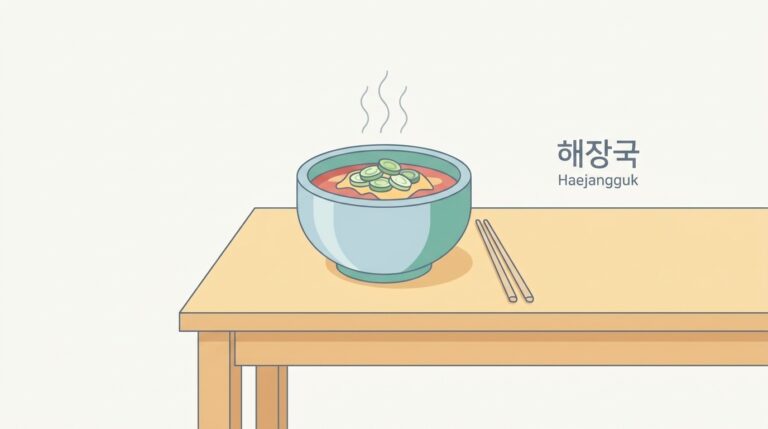
안녕하세요! 매일한글 에디터입니다. Have you ever experienced a late night in Seoul, enjoying Korean barbecue and a few glasses of somaek with Korean friends, only to wake up the next morning feeling like your stomach is turned upside down? In Korea, we don’t just endure a hangover with plain water or aspirin. We head straight to a neighborhood diner for a piping hot bowl of Haejangguk (hangover soup). But ordering Haejangguk and describing how your stomach feels after drinking can be tricky for B1 learners! Today, based on real feedback from foreign learners, we will break down the essential expressions for ‘soothing your stomach with Haejangguk’ so you can order with confidence and talk like a true local.
1. 속이 풀리다 (Sok-i pullida)
- Pronunciation: [sok-i pool-li-da] (Sounds like ‘soak-ee pool-lee-dah’)
- Meaning: Literally ‘my inside is untied/unravelled’ vs. Actually feeling your upset stomach soothe and settle down after eating warm soup.
- K-Culture Moment: In modern K-dramas, after a heavy drinking scene, characters sit at a 24-hour restaurant, take a huge sip of warm broth, and sigh with relief.
- Editor’s Insight: ‘속’ refers to your stomach or inner guts, while ‘풀리다’ means to untie a knot. Imagine your hangover as a tight knot in your belly being gently untied by warm spicy soup!
- Situation Spectrum: Casual ✅ | Semi-formal ✅ | Formal ⚠️
- 🤔 Think About It: Why does Korean culture connect warm liquid to untying physical and emotional tension?
2. 해장하다 (Haejang-hada)
- Pronunciation: [hae-jang-ha-da] (Sounds like ‘heh-jahng-hah-dah’)
- Meaning: Literally ‘to untie the guts’ vs. Eating hangover food/soup specifically to overcome the effects of alcohol.
- K-Culture Moment: A friend texting you at 11 AM on Sunday: “어제 술 많이 마셨는데 같이 해장하러 갈래?” (We drank a lot yesterday, wanna go get hangover food?)
- Editor’s Insight: You can combine this word into ‘해장국’ (hangover soup) or ‘해장술’ (hair of the dog drink, though not recommended!).
- Situation Spectrum: Casual ✅ | Semi-formal ✅ | Formal 🚫
- 🤔 Think About It: Does your native language have a single verb dedicated exclusively to eating food to cure a hangover?
3. 시원하다 (Siwon-hada)
- Pronunciation: [shi-won-ha-da] (Sounds like ‘shee-won-hah-dah’)
- Meaning: Literally ‘cool/refreshing’ vs. Contextually feeling deep relief in your throat and stomach from hot and soup-rich meals.
- K-Culture Moment: An ahjussi sipping scalding hot Kongnamul-gukbap and saying “아~ 시원하다!” leaving non-Koreans confused because the soup is burning hot.
- Editor’s Insight: Don’t take this literally as cold ice water. ‘시원하다’ describes the sensation of clarity and relief, whether it’s cold air or hot soup!
- Situation Spectrum: Casual ✅ | Semi-formal ✅ | Formal ✅
- 🤔 Think About It: How do physical sensations in your culture translate into metaphorical emotional relief?
📖 교과서 한국어: “위장이 편안해졌습니다.” (My stomach has become comfortable.)
🗣️ 진짜 한국어: “아, 이제야 속이 좀 풀리네요!” (Ah, now my stomach finally feels soothed!)
💡 왜 다를까?: Textbook expressions sound like a medical report! Real Koreans express hangover recovery dynamically using ‘속이 풀리다’ with emotional particles like ‘이제야’ (finally now).
📖 교과서 한국어: “숙취 해소용 국을 먹고 싶습니다.” (I want to eat soup for hangover relief.)
🗣️ 진짜 한국어: “뜨끈한 해장국 한 그릇 먹으러 가요.” (Let’s go grab a warm bowl of Haejangguk.)
💡 왜 다를까?: Koreans love warm sensory adjectives like ‘뜨끈하다’ (piping warm) rather than clinical terms like ‘숙취 해소용’.
4-1. Nunchi & Gestures
When eating Haejangguk, it’s customary to lean over the bowl to inhale the steam before taking your first bite. When the broth relieves your stomach, exhaling a soft “어우~” is completely acceptable and shows appreciation for the food! Also, if you are sharing side dishes like Kakdugi (radish kimchi), always use the serving tongs or your own clean chopsticks respectfully.
4-2. Culture Code: The 24-Hour Haejangguk Haven
In Korea, Haejangguk places often operate 24 hours. They are unique cultural hubs where corporate workers, night-shift drivers, and young partygoers meet under bright fluorescent lights at 4 AM to heal their stomachs together.
- Setting: A cozy, bustling 24-hour Haejangguk restaurant in Hongdae on a Sunday morning.
- Characters: You (stomach aching from last night) and Minjun (your Korean best friend).
- 민준: 어제 소맥을 너무 많이 마셨지? 속은 좀 어때? (Did you drink too much somaek yesterday? How is your stomach?)
- 유: [🥺 괴로워하며] 머리도 아프고 속이 너무 더부룩해… (My head hurts and my stomach feels bloated…)
- 민준: 그럴 줄 알고 해장국집으로 불렀지! 여기 뼈해장국 두 그릇 주세요! (I knew it, that’s why I called you to a Haejangguk place! Two pork bone soups please!)
- 유: [😳 호기심 가득히] 뼈해장국? 매운 국물이 속을 더 아프게 하지 않을까? (Pork bone soup? Won’t spicy broth hurt our stomachs more?)
- 민준: 전혀! 들깨가루 넣어서 국물 한 입 마셔봐. (Not at all! Put some perilla powder in and take a sip.)
- 유: [😋 국물을 마신 뒤] 와, 국물이 진짜 얼큰하고 시원하다! (Wow, the soup is really spicy-refreshing and satisfying!)
- 민준: 어때? 속이 좀 풀리는 것 같아? (How is it? Does your stomach feel like it’s clearing up?)
- 유: [😊 감격스러운 표정] 응, 뜨거운 국물이 들어가니까 이제야 속이 풀려! (Yeah, now that warm broth is in, my stomach finally feels soothed!)
🔀 인터랙티브 분기점:
When the waiter brings the Haejangguk, what do you say?
– Option A: “잘 먹겠습니다! 국물이 참 시원하네요!” (Best Choice! Shows great cultural understanding.)
– Option B: “이거 너무 뜨거운데 얼음 좀 주세요.” (Bad Choice! Adding ice to Haejangguk ruins the essential flavor dynamics.)
– Option C: “이거 매워서 배탈 나는 거 아니죠?” (Risk Choice! Might sound overly critical to the owner.)
Try repeating these lines aloud with deep emotion!
- [🥺 괴로워하며] 어제 술을 너무 많이 마셔서 / 속이 안 좋아요.
- [😋 입맛을 다시며] 뜨끈한 콩나물국밥 먹고 / 해장하고 싶어요.
- [😊 시원하게 탄성을 지르며] 카~ / 국물이 진짜 시원하다! / 이제야 속이 풀리네!
- 국밥 (Gukbap) | Rice soup served together or mixed in a hot bowl. The ultimate Korean comfort food.
- 깍두기 (Kakdugi) | Diced radish kimchi. Essential sweet-crunchy side dish for Haejangguk.
- 다대기 (Dadaegi) | Red pepper seasoning paste added to broth to adjust spicy flavor.
- 들깨가루 (Deulggaegaru) | Ground perilla seeds. Gives Haejangguk a rich, nutty flavor profile.
- “속이 풀리는 맛이에요.” (It’s a stomach-soothing flavor.)
- “해장하러 왔어요.” (I came here to cure my hangover.)
- “다대기 따로 주실 수 있나요?” (Can I get the spicy paste on the side?)
Pro Tip: If you are lost in Korea trying to find authentic Haejangguk, use 네이버 지도 앱 다운로드 to search for ‘해장국 맛집’ nearby!
In many Western cultures, hangover remedies are individualistic (drinking electrolyte drinks alone or resting in bed). In Korea, curing a hangover is a collective, social ritual called ‘해장’. Bringing someone to a Haejangguk restaurant is an act of warmth and caring for another person’s well-being.
💬 Your Turn: What is the traditional hangover food in your home country? Share it in the comments below in Korean!
Q: Is Haejangguk always spicy?
A: No! While Ppyeo-haejangguk (pork bone) is red and spicy, white-broth options like Kongnamul-gukbap (bean sprout) or Hwangtae-guk (pollock soup) are mild and soothing.
Q: Can I drink alcohol again while eating Haejangguk?
A: Some older Koreans drink ‘Haejang-sul’ (a hangover drink), but it’s generally considered bad for your health and not recommended!
Q: Do I put the bowl of rice into the soup directly?
A: Yes! It is very common to empty your whole bowl of rice directly into the soup broth.
🚨 Common Mistakes
1. Saying “이 국물이 차갑고 시원해요” for hot soup -> Fix: ‘시원하다’ here means ‘refreshing sensation’, not cold temperature!
2. Demanding non-spicy food in a 24-hr local spot -> Fix: Ask gracefully for “다대기 빼주세요” (Please omit the red paste).
3. Expecting Western aspirin at soup shops -> Fix: Go to a ‘약국’ (pharmacy) for medicine before heading to the restaurant.
- Bronze Mission: Read out loud ‘속이 풀려요’ 5 times in front of the mirror.
- Silver Mission: Leave a comment below using the expression ‘시원하다’.
- Gold Mission: Visit a local Haejangguk spot in Korea or your local Koreatown and order using today’s phrases!
🎮 K-Culture Mission: Watch a scene from your favorite K-drama where characters eat after drinking and spot if they say “속이 풀린다”!
Q1. What does ‘속이 풀리다’ mean when eating hot soup after drinking alcohol?
A) Your stomach hurts more.
B) Your upset stomach feels soothed and relieved.
C) You feel very cold.
Q2. Complete the sentence: “뜨거운 콩나물국을 마시니까 속이 ( ).”
A) 얼어요
B) 풀려요
C) 매워요
Q3. True or False: ‘시원하다’ can only be used when describing cold ice water.
퀴즈 정답 및 해설 보기
Q1 정답: B) Your stomach feels soothed and untied.
Q2 정답: B) 풀려요 (‘속이 풀리다’ means stomach relief).
Q3 정답: False! ‘시원하다’ is frequently used to describe warm, deeply satisfying soup relief.







