

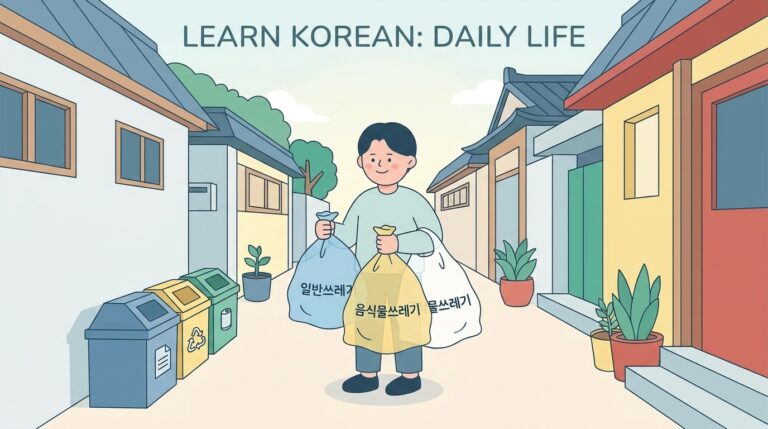
안녕하세요! 매일한글 에디터입니다. (Hello! I am your lead editor at Daily Hangul!) Welcome to your go-to guide for surviving everyday life in Korea. Have you ever stood in front of a Korean apartment complex holding a random plastic wrapper, an apple core, and an empty milk carton, feeling completely overwhelmed? You are definitely not alone! Korea has one of the world’s most meticulous waste disposal systems. From color-coded volume-based bags called jongryangje bongtu to detailed recycling sorting rules, taking out the trash can feel like a high-stakes puzzle for newcomers. But don’t worry! After surveying hundreds of foreign residents and exchange students who struggled with their very first trash day, we created this simple, stress-free guide. By mastering just a few essential A1-level Korean phrases, you will transform trash anxiety into effortless confidence!
Phase 2: Key Expressions Analysis
1. 이거 어디에 버려요? (Igeo eodie beoryeoyo?)
- Pronunciation: [ee-geo eo-dee-e beo-ryeo-yo?] (Sounds like ‘E-go’ + ‘oh-dee-air’ + ‘be-ryuh-yo’)
- Meaning: Literal: “Where do I throw this away?” / Real Nuance: A friendly, polite way to ask anyone nearby where a specific trash item goes.
- K-Culture Moment: Commonly heard in variety shows or K-Dramas when housemates clean up after a big house party or late-night chicken delivery.
- Editor’s Insight: ‘버려요’ comes from the verb ‘버리다’ (to throw away). Adding ‘요’ (yo) at the end keeps it polite and perfect for A1 learners talking to neighbors or convenience store staff.
- Situation Spectrum:
- Casual: 이거 어디에 버려? (🚫 save for close friends)
- Semi-formal: 이거 어디에 버려요? (✅ perfect for daily use)
- Formal: 이것은 어디에 버립니까? (⚠️ overly formal for taking out trash)
- 🤔 Think About It: In your home country, do you sort trash at home or at a public drop-off point? How does language reflect civic responsibilities?
2. 종량제 봉투 있어요? (Jongryangje bongtu issoyo?)
- Pronunciation: [jong-ryang-je bong-too eet-ssuh-yo?]
- Meaning: Literal: “Do you have volume-based trash bags?” / Real Nuance: The official phrase used at convenience stores or supermarkets to purchase designated general trash bags.
- K-Culture Moment: A staple phrase used by K-Drama characters moving into their new rooftop apartments or solo studios (wonroom).
- Editor’s Insight: You cannot use regular plastic grocery bags for general trash in Korea. You MUST buy these official government-regulated bags (jongryangje bongtu).
- Situation Spectrum:
- Casual: 종량제 봉투 있어? (🚫)
- Semi-formal: 종량제 봉투 있어요? (✅ recommended)
- Formal: 종량제 봉투 있습니까? (⚠️ a bit stiff)
- 🤔 Think About It: Why do you think Korea adopted pay-per-bag garbage systems instead of a flat monthly tax?
3. 분리수거 해야 돼요. (Bunrisugeo heya dwaeyo.)
- Pronunciation: [boon-ree-soo-geo hae-ya dwae-yo]
- Meaning: Literal: “We must do recycling sorting.” / Real Nuance: “We need to separate the recyclables!”
- K-Culture Moment: Often shouted cheerfully (or grumpily!) during house cleaning scenes in Korean reality TV shows like I Live Alone.
- Editor’s Insight: ‘분리’ (separation) + ‘수거’ (collection). In Korea, recycling isn’t optional—it’s a shared social ritual!
- Situation Spectrum:
- Casual: 분리수거 해야 돼. (⚠️ only with peers)
- Semi-formal: 분리수거 해야 돼요. (✅ standard polite)
- Formal: 분리수거를 해야 합니다. (⚠️ news/official context)
- 🤔 Think About It: How does collective action like bunrisugeo shape neighborly relations in dense urban cities like Seoul?
Phase 3: Textbook Korean vs. Real Korean
Situation 1: Asking where to throw food waste
- 📖 Textbook Korean: 음식물 쓰레기를 어디에 버려야 합니까? (Eumsikmul sseuregireul eodie beoryeoya hamnikka?)
- 🗣️ Real Korean: 음식물 쓰레기 어디에 버려요? (Eumsikmul sseuregi eodie beoryeoyo?)
- 💡 Why it’s different: Native speakers drop unnecessary object markers like ‘-를’ (reul) in casual conversation to sound natural and smooth.
Situation 2: Asking for a trash bag at a store
- 📖 Textbook Korean: 쓰레기 봉투를 한 장 판매하여 주십시오. (Sseuregi bongtureul han jang panmaehayeo jusipseo.)
- 🗣️ Real Korean: 일반 쓰레기 봉투 10리터짜리 하나 주세요. (Ilban sseuregi bongtu sip-liteo-jjari hana juseyo.)
- 💡 Why it’s different: In real life, specify the bag type (general/food) and size (usually 10L or 20L for single households) directly.
Phase 4: K-Culture Deep Dive & Non-Verbal Manners
4-1. Nunchi & Gestures
When asking a neighbor for help near the recycling station, maintain a mild, polite posture. Gently point with an open hand (avoid pointing with a single index finger directly at people or items) towards your trash bag and offer a slight 15-degree bow while saying “저기요…” (Jeogiyo… / Excuse me…).
4-2. Culture Code: The Art of Bunrisugeo (분리수거)
In Korea, recycling is taken very seriously. Plastic bottles must have their plastic labels peeled off and caps removed before disposal. Cardboard boxes must be flattened, and clear plastic cups must be washed clean. Showing that you care about keeping the residential trash station clean gains instant respect and warm smiles from your building manager (Gwanriin-ajusshi)!
Phase 5: Real Roleplay Scenario
Setting: You are at a neighborhood convenience store trying to buy the correct trash bag for your apartment.
Characters: You (A1 Korean Learner) & Convenience Store Clerk (Friendly NPC).
- You: 안녕하세요! (Annyeonghaseyo! / Hello!) 🎭 [Bow slightly with a smile]
- Clerk: 안녕하세요! 무엇을 도와드릴까요? (Annyeonghaseyo! Mueoseul dowadeureillkayo? / Hello! How can I help you?)
- You: 저기… 종량제 봉투 있어요? (Jeogi… jongryangje bongtu issoyo? / Excuse me… do you have general trash bags?) 🎭 [Point politely toward the counter]
- Clerk: 네, 있어요. 몇 리터 짜리 필요하세요? (Ne, issoyo. Myeot liteo jjari pil-yohaseyo? / Yes, we do. What size in liters do you need?)
- You: 10리터짜리 하나 주세요. (Sip-liteo-jjari hana juseyo. / Please give me one 10-liter bag.) 🎭 [Hold up one finger]
- Clerk: 일반 쓰레기 봉투 맞으시죠? (Ilban sseuregi bongtu majeosijyo? / General waste bag, right?)
- You: 네, 맞아요! (Ne, majayo! / Yes, that’s right!)
- Clerk: 여기 있습니다. 500원입니다. (Yeogi isseumnida. Obaerwon-imnida. / Here you go. That’s 500 KRW.) 🎭 [Hands over the bag]
🔀 Interactive Decision Point
The clerk asks: “음식물 봉투도 필요하세요?” (Eumsikmul bongtudo pil-yohaseyo? / Do you also need food waste bags?)
* Choice A: “네, 음식물 봉투도 하나 주세요.” (Ne, eumsikmul bongtudo hana juseyo.)
* Choice B: “아니요, 괜찮아요!” (Aniyo, gwaenchanayao!)
* Choice C: “무슨 소리예요?” (Museun sorieyo?)
Feedback:
* Choice A (Best): Perfect! You politely requested a food waste bag too.
* Choice B (Good): Clean and polite refusal if you don’t need one.
* Choice C (Risk): Too blunt! This sounds like “What are you talking about?” in Korean.
Phase 6: 10-Second Emotion Shadowing Drill
[😊 Friendly & Polite]저기요, / 종량제 봉투 / 있어요? (Jeogiyo, / jongryangje bongtu / issoyo?)[🥺 Confused & Asking for help]이거… / 어디에 / 버려요? (Igeo… / eodie / beoryeoyo?)[💡 Enthusiastic]분리수거 / 같이 / 해요! (Bunrisugeo / gachi / haeyo!)
Phase 7: K-Culture Mini Dictionary
- 종량제 봉투 (Jongryangje Bongtu) | General Waste Bag | Official government bag designated for non-recyclable household garbage.
- 음식물 쓰레기 (Eumsikmul Sseuregi) | Food Waste | Food scraps that must be disposed of separately in special bags or bins.
- 분리수거 (Bunrisugeo) | Recycling Sorting | The process of sorting waste into paper, plastic, glass, vinyl, and cans.
- 일반 쓰레기 (Ilban Sseuregi) | General Trash | Non-recyclable, non-food dry waste placed inside official trash bags.
Phase 8: Traveler’s Survival Kit
Top 3 Survival Phrases
- 쓰레기통 어디에 있어요? (Sseuregitong eodie issoyo?) – Where is the trash can?
- 이거 재활용돼요? (Igeo jaehwalyong-dwaeyo?) – Is this recyclable?
- 음식물 버려주세요. (Eumsikmul beoryeojuseyo.) – Please throw away the food waste.
Editor’s Travel Note
Public street trash cans are rare in Seoul! When walking outdoors, keep a small plastic bag in your backpack to store trash until you reach a subway station or convenience store. To locate nearby supermarkets or convenience stores to buy trash bags, open your 네이버 지도 앱 다운로드 (Naver Map app) and search for “편의점” (convenience store).
Phase 9: One Step Deeper
In Korea, waste disposal isn’t just about sanitation—it reflects civic courtesy (cheomdan-simin-uisik). Because neighborhoods are densely populated, proper sorting ensures that community maintenance workers can process waste safely. By taking time to separate your plastics and cardboard properly, you are communicating respect to your Korean neighbors without saying a word.
💬 Your Turn: What is the trash sorting system like in your hometown? Leave a comment below and share your experience!
Phase 10: FAQ & Common Mistakes
Q: Can I buy trash bags in one borough (Gu) and use them in another?
A: Generally, no! Jongryangje bags are specific to each district (e.g., Mapo-gu, Gangnam-gu). Make sure you buy bags sold in your specific district.
Q: Can I throw takeout coffee cups with remaining ice into general trash?
A: No. You must empty liquids and ice down the sink, rinse the cup, and throw the plastic cup into the plastic recycling bin.
Q: Where do I buy food waste bags (eumsikmul bongtu)?
A: You can buy them at any local convenience store or supermarket by asking for “음식물 봉투” (eumsikmul bongtu).
🚨 Common Mistakes TOP 3
- Throwing food scraps into general trash: Penalty risk! Always use designated food waste bags or bins.
- Leaving labels on plastic bottles: Always peel off plastic labels before putting bottles in recycling.
- Using black grocery bags for household trash: Strictly prohibited by local borough laws.
Phase 11: Action Mission
- Bronze Mission: Practice saying “종량제 봉투 있어요?” out loud 3 times in front of a mirror.
- Silver Mission: Next time you go to a local store, spot the colorful district trash bags near the register.
- Gold Mission: Successfully buy a 10L general trash bag in Korean at a convenience store!
🎮 K-Culture Mission: Watch a vlog or K-Drama episode and spot a recycling station outside a house or apartment!
Phase 12: Interactive Quiz Challenge
Question 1: Which bag must you use for dry, non-recyclable household waste in Korea?
1) Any store plastic bag
2) 종량제 봉투 (Jongryangje bongtu)
3) Paper bag
Click to reveal answer
Answer: 2) 종량제 봉투 (Jongryangje bongtu)
Explanation: In Korea, general waste must be disposed of using official volume-based bags designated by your district.
Question 2: What should you do before recycling a plastic water bottle?
Click to reveal answer
Answer: Peel off the label, rinse it out, and compress it!
Explanation: Cleanliness and label removal are key rules for plastic recycling in Korea.






