

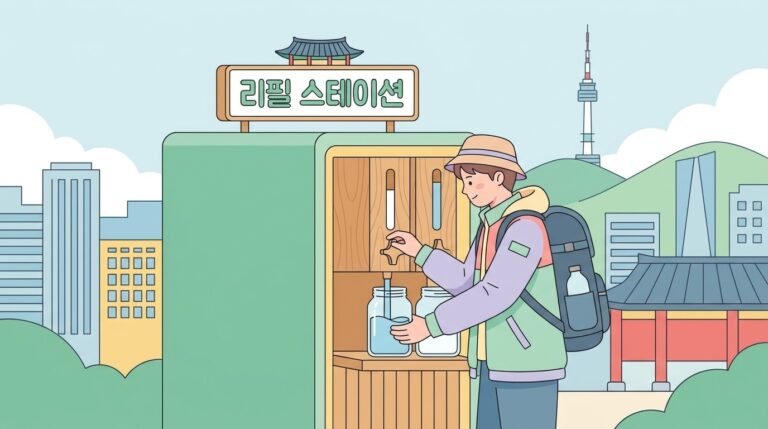
Eco-Friendly Shopping in Korea: How to Confidently Navigate a Zero Waste Shop in Seoul
Phase 1: 공감 (Empathy & K-Culture Scene)
안녕하세요! 매일한글 에디터입니다. 👋
Picture this: You’re strolling through the aesthetic backstreets of Mangwon-dong or Seongsu-dong, holding your favorite cloth bag and a couple of glass jars. You step into a cozy, minimalistic Zero Waste shop (제로 웨이스트 샵). Smells of natural lavender soap and organic tea leaves fill the air. You want to buy shampoo bars and refill your dish soap by weight, but suddenly, panic sets in!
Do you weigh the empty jar first? How do you ask the staff if your glass container is acceptable? Should you say “용기”? Wait, doesn’t 용기 mean courage?
Intermediate learners often feel stuck here. You know basic Korean words, but specialized modern routines—like tare-weighing, bulk refilling (소분), and green practices—require nuanced, B2-level conversation markers. According to feedback from our Daily Hangul community, over 70% of learners feel anxious about making conversational mistakes in eco-friendly shops. Don’t worry! By the end of this guide, you will master essential phrases and navigate Seoul’s green spaces like a seasoned local.
Phase 2: 핵심 표현 3선 심층 분석 (3 Core Expressions)
1. 용기를 가져왔는데요 (Yong-gi-reul ga-jeo-waat-neun-de-yo)
- Pronunciation: [yong-gi-reul gah-juh-waht-neh-yo] (Sounds like “yawn-geary-reul gah-juh-waht-neh-yo” with a gentle melodic tone at the end)
- Meaning: “I brought my own container…”
- K-Culture Moment: In modern K-dramas, eco-conscious characters often bring their own multi-use containers to local markets or refill stations, starting a movement called ‘용기내 챌린지’ (Container/Courage Challenge).
- Editor’s Insight: Korean uses the ending -는데요 to gently set the background context rather than making a blunt statement. It softly invites the staff to guide you to the next step.
- Situation Spectrum: Casual ⚠️ | Semi-formal ✅ | Formal ✅
- 🤔 Think About It: 용기 means both “container” (容器) and “courage” (勇氣). How does this double meaning make asking for a refill feel like a brave, positive act for the environment?
2. 필요한 만큼만 담아가도 될까요? (Pil-yo-han mang-keum-man dam-a-ga-do doel-kka-yo?)
- Pronunciation: [peel-yoh-han mahng-keum-mahn dahm-ah-gah-doh dwel-kkah-yo]
- Meaning: “May I take only as much as I need?”
- K-Culture Moment: Seen in lifestyle vlogs where shoppers purchase dry beans, spices, or liquid detergent measured precisely to the gram.
- Editor’s Insight: -만큼 expresses proportion (“as much as”), while -아/어도 될까요? is the classic polite grammar structure for seeking permission.
- Situation Spectrum: Casual 🚫 | Semi-formal ✅ | Formal ✅
- 🤔 Think About It: Why does Korean culture value asking polite permission even in self-service retail setups?
3. 무게를 먼저 재야 하나요? (Mu-ge-reul meon-jeo jae-ya ha-na-yo?)
- Pronunciation: [moo-geh-reul muhn-juh jae-yah hah-nah-yo]
- Meaning: “Should I weigh this first?”
- K-Culture Moment: Standard tare-weighing protocol at trendy refill bars in Seoul.
- Editor’s Insight: Using -해야 하나요? instead of -해야 돼요? adds a softer, more inquiring edge suitable for customer-staff interactions.
- Situation Spectrum: Casual 🚫 | Semi-formal ✅ | Formal ✅
- 🤔 Think About It: How does clarifying rules upfront reflect the Korean value of * 눈치 (Nunchi)*—being attentive and avoiding inconvenience to others?
Phase 3: 교과서 한국어 vs 진짜 한국어 (Textbook vs. Real Korean)
Situation 1: Asking if your personal jar can be filled
- 📖 교과서 한국어: “이 용기를 사용하여 상품을 살 수 있습니까?”
- 🗣️ 진짜 한국어: “저… 혹시 개인 용기에 담아가도 돼요?”
- 💡 왜 다를까? Textbook Korean sounds like an official written survey. Real native Korean utilizes conversational softeners like 저… 혹시 (Excuse me… by any chance) to open requests naturally.
Situation 2: Asking where the refill station is
- 📖 교과서 한국어: “세제 리필 장소가 어디에 위치해 있습니까?”
- 🗣️ 진짜 한국어: “세제 리필존이 어디쪽에 있어요?”
- 💡 왜 다를까? Contemporary Seoul speakers blend clear English loanwords (리필존 – refill zone) with spatial suffixes like -쪽 for casual precision.
Phase 4: K-Culture 딥다이브 & 비언어적 매너 (Culture Deep Dive & Manner)
4-1. 눈치 (Nunchi) & Body Gestures
When entering a Korean Zero Waste Shop:
* Two-Handed Gesture: When showing your empty container to the staff, lightly hold it with both hands or support your right elbow with your left hand.
* Micro-Nod: Accompany your phrase “저… 혹시” with a subtle 15-degree head bow. This instantly shows respect and local etiquette.
4-2. Cultural Code: 가치소비 (Value-Based Consumption)
In South Korea, green shopping is closely tied to 가치소비 (expressing one’s personal ethics through purchases). Young Koreans frequently participate in 플로깅 (plogging – jogging while picking up trash) and visit 보틀클럽 (bottle-sharing clubs). Knowing these terms proves you’re connected to modern Korean youth culture!
Phase 5: 실전 롤플레이 시나리오 (Roleplay Scenario)
Setting: ‘Earth Care Refill Station’ in Seongsu-dong.
Characters: Learner (지민), Eco-Shop Staff (민수).
- 지민: 안녕하세요! 저… 혹시 개인 용기에 담아가도 돼요?
(🎭 Gently holding up a clean glass jar with both hands) - 민수: 그럼요! 먼저 빈 용기 무게부터 재드릴게요. 저쪽 저울로 오시겠어요?
(🎭 Pointing politely toward the digital scale) - 지민: 아, 네! 무게를 먼저 재야 하는군요.
(🎭 Nodding understandingly) - 민수: 네, 영풍 라벨을 붙여드렸어요. 원하시는 만큼 세제를 담으신 후에 계산대로 오시면 됩니다.
(🎭 Hands back the jar with a tare weight sticker) - 지민: 감사합니다. 필요한 만큼만 담아가도 될까요?
(🎭 Smiling and moving to the refill dispenser) - 민수: 네, 10g 단위로 계산되니까 편하게 담으세요!
(🎭 Giving a reassuring thumb-up) - 지민: 다 담았어요! 이 라벨대로 계산해 주시겠어요?
(🎭 Placing the filled jar carefully on the checkout counter) - 민수: 네, 총 350g 나왔습니다. 지구를 위한 ‘용기’ 감사해요!
(🎭 Handing over the receipt with a warm smile)
🔀 Interactive Choice Branch
At Step 5, if you accidentally spill a little bit of liquid detergent on the counter, what should you say?
- Option A: “어머, 죄송해요! 제가 닦을게요. 누더기 있어요?”
- Option B: “아, 죄송합니다! 혹시 행주나 휴지 좀 쓸 수 있을까요?”
- Option C: “괜찮아요, 그냥 두세요.”
🔍 Feedback & Answer (Click to Expand)
- Option A (Risk): 누더기 means “rags/tattered clothes.” Using it sounds unintentionally bizarre!
- Option B (BEST): Courteous, accurate, and uses the proper word for dishcloth (행주). Perfect B2 response!
- Option C (BAD): Dismissive and rude in Korean service interactions.
Phase 6: 10초 감정 섀도잉 드릴 (10-Sec Shadowing Drill)
Practice saying these with natural rhythm and emotion markers!
[😊 반갑고 쑥스럽게]저… 혹시 / 개인 용기에 / 담아가도 돼요?[💡 깨달으며]아! / 무게를 / 먼저 재야 하는군요![🙏 감사하며]필요한 만큼만 / 담아갈게요 / 감사합니다!
Phase 7: K-Culture 미니 사전 (Mini Dictionary)
- 용기내다 (Yong-gi-nae-da) | Lit. To bring a container / To be brave | The famous Korean social campaign encouraging people to bring reusable containers to takeout places.
- 소분샵 (So-bun-syap) | Sub-division shop / Refill station | Stores that sell items in customized small quantities rather than bulk plastic packaging.
- 종량제 봉투 (Jong-ryang-je bong-tu) | Pay-as-you-throw trash bag | Official municipal plastic bags required for general garbage disposal in Korea.
- 보틀클럽 (Bo-teul-keul-leob) | Bottle Club | A deposit-and-return reusable cup scheme across eco-conscious Korean cafes.
Phase 8: 여행자를 위한 생존 키트 (Traveler’s Survival Kit)
Survival TOP 3 Phrases
- 소분해 주실 수 있나요? (Can you divide this into smaller portions?)
- 장바구니는 있어요. (I have my own shopping bag.)
- 영수증은 버려주세요. (Please discard the receipt.)
Editor’s Travel Note
When searching for zero-waste stores in Korea, open your favorite map application like 네이버 지도 앱 다운로드 and search for the keyword “제로웨이스트” or “리필샵”. You’ll find dozens of charming spots nearby!
Phase 9: 한 발 더 깊이 (One Step Deeper Essay)
In traditional Korean society, food and goods were shared in neighborhood communities using concept called Jung (정). When neighbors exchanged food, they never returned an empty dish (빈 그릇). Today’s Zero Waste movement in Korea reimagines this traditional communal care. By bringing your own container (용기), you aren’t just saving plastic—you are participating in a modern eco-community ritual that respects both nature and shop owners.
💬 Your Turn: Have you ever used a zero-waste shop in your home country? How would you translate your green shopping habits into Korean? Share in the comments below!
Phase 10: FAQ & 오해 방지 (FAQ & Common Mistakes)
Q: Can I bring any plastic container to a Korean refill shop?
A: Yes! As long as the container is clean and dry, Korean eco-shops welcome all reusable containers regardless of brand or material.
Q: Is the word ‘용기’ understood everywhere?
A: In eco-shops, yes! However, at standard fast-food restaurants, it’s clearer to say “개인 텀블러” (personal tumbler) or “개인 포장 용기” (personal takeout box).
Q: How do I pay for refilled liquid goods?
A: Store staff weigh the empty container first, subtract that tare weight, and charge you per gram (e.g., ₩20 per gram).
🚨 Common Mistakes Alert
| Wrong Expression | Why It’s Awkward | Correct Action (B2 Alternative) |
|---|---|---|
| “이 박스에 넣으세요.” | Imperative sound command to staff. | “여기 담아주시면 돼요.” (You can put it here.) |
| “쓰레기통 어디예요?” | Sounds like you want to throw away general trash. | “재활용 버리는 곳이 어디예요?” (Where is recycling?) |
| “무료로 주세요.” | Means “give it for free.” | “덤으로 좀 주실 수 있나요?” (Playful extra context) |
Phase 11: 액션 미션 (Action Missions)
- 🥉 Bronze Mission: Read the 3 Core Expressions aloud 3 times using the Shadowing Drill.
- 🥈 Silver Mission: Post a picture of your reusable bottle on Instagram with the Korean hashtag
#용기내챌린지and tag@DailyHangul! - 🥇 Gold Mission: Visit a local Korean grocery or eco-shop and successfully use the phrase “개인 용기에 담아가도 돼요?”
🎮 K-Culture Mission: Watch a modern Korean lifestyle vlog on YouTube and comment when you spot someone using a reusable bag (장바구니)!
Phase 12: 인터랙티브 퀴즈 챌린지 (Quiz Challenge)
Q1. What is the double meaning of the word ‘용기’ in Korean?
👉 Click to see Answer & Explanation
Answer: Container (容器) and Courage (勇氣).
Explanation: Modern eco-campaigns like ‘용기내 챌린지’ play on this homonym to mean “Have the courage to bring your own container!”
Q2. Fill in the blank: “필요한 ____만 담아가도 될까요?” (May I take only as much as I need?)
👉 Click to see Answer & Explanation
Answer: 만큼
Explanation: ‘-만큼’ is a B2 particle indicating proportion or degree (“as much as”).
Q3. True or False: In Korea, you should put general household trash in any plastic bag you find.
👉 Click to see Answer & Explanation
Answer: False!
Explanation: Korea strictly enforces the use of official municipal bags called ‘종량제 봉투’ for general non-recyclable garbage.







