

Where Is My Package? How to Track Deliveries at the Korean Post Office
Phase 1: Empathy (Story-Driven Opening)
안녕하세요! I am your Daily Hangul editor, your friendly 10-year local culture navigator! Imagine this scenario: You ordered a limited-edition K-Pop album or a box of trendy K-Beauty products. You’ve been refreshing your phone screen for two days, but the tracking status seems stuck. Feeling a little anxious, you decide to walk into a local Korean post office (우체국). You see the friendly postal staff, but suddenly your mind goes blank. How do you ask about your parcel without getting tangled in complex dictionary grammar?
Don’t worry! Tracking a package in Korea is actually fast, smooth, and surprisingly easy once you know a few key beginner-friendly phrases. This guide is crafted directly from real learner feedback and practical daily life experiences in Korea. By the end of this lesson, you will confidently walk up to any post office counter and check your delivery status like a true local!
Phase 2: Core Phrases Deep Dive
1. 배송 조회하고 싶어요. (Baesong johwe-hago sipeoyo.)
- Pronunciation: [Bae-song jo-hoe-ha-go shi-peo-yo] (Sounds like “Bae” as in bay + “Song” + “Jo-way”)
- Meaning: Literal: “I want to do a delivery check.” / Nuance: “I’d like to check my delivery status, please.”
- K-Culture Moment: You hear this at parcel service counters when checking on online orders or sent gifts.
- Editor’s Insight: The ending ‘-고 싶어요’ (I want to) combined with polite tone makes your request soft and courteous.
- Situation Spectrum: Casual ⚠️ / Semi-formal ✅ / Formal ✅
- 🤔 Think About It: How does directly stating your intention with polite verb endings help make customer service in Korea so efficient?
2. 등기번호가 어떻게 돼요? (Deunggi-beonhoga eotteohge dwaeyo?)
- Pronunciation: [Deung-gi beon-ho-ga eo-tteo-ke dwae-yo]
- Meaning: Literal: “How is the registered tracking number?” / Nuance: “What is the tracking number?”
- K-Culture Moment: Staff members ask you this while pointing politely to their screen or scanner.
- Editor’s Insight: ‘어떻게 돼요?’ is a universal polite phrase in Korea used to ask “What is [X]?” instead of using blunt questions.
- Situation Spectrum: Casual 🚫 / Semi-formal ✅ / Formal ✅
- 🤔 Think About It: Notice how Koreans use ‘어떻게’ (how) instead of ‘무엇’ (what) to sound gentler!
3. 언제쯤 도착하나요? (Eonje-jjeum dochakhanayo?)
- Pronunciation: [Eon-je-jjeum do-chak-ha-na-yo]
- Meaning: Literal: “Around when does it arrive?” / Nuance: “Around when will it arrive?”
- K-Culture Moment: Asking about estimated delivery for urgent concert tickets or travel gear.
- Editor’s Insight: Adding ‘-쯤’ (around/about) keeps your request reasonable and polite rather than demanding an exact minute.
- Situation Spectrum: Casual ⚠️ / Semi-formal ✅ / Formal ✅
- 🤔 Think About It: In a fast-paced society like Korea, asking for estimated times politely keeps everyone on the same page.
Phase 3: Textbook Korean vs. Real Korean
Situation 1: Asking staff to check your package
- 📖 Textbook Korean: 택배 위치를 알려 주십시오. (Taekbae witchireul allyeo jusipsio.)
- 🗣️ Real Native Korean: 배송 조회 좀 도와주세요. (Baesong johwe jom dowajuseyo.)
- 💡 Why the difference? Real Koreans rarely use formal command forms like ‘-주십시오’ in daily visits. Adding ‘좀’ (a little / please) makes your request natural and sweet.
Situation 2: Asking where the item currently is
- 📖 Textbook Korean: 이것은 어디에 있습니까? (Igeoseun eodie issneumnika?)
- 🗣️ Real Native Korean: 지금 어디쯤 도착했어요? (Jigeum eodijjeum dochakhaesseoyo?)
- 💡 Why the difference? Native speakers focus on the movement (“where has it arrived around now?”) rather than a static dictionary location question.
Phase 4: K-Culture Deep Dive & Non-Verbal Etiquette
4-1. Nunchi (눈치) & Post Office Gestures
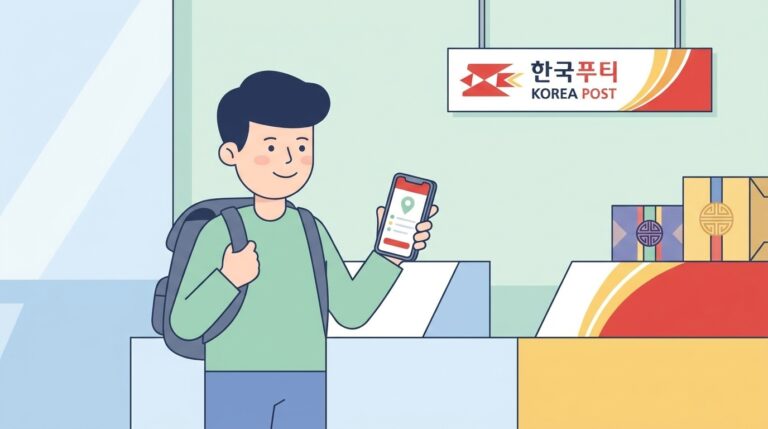
When walking up to the post office counter, hold your smartphone with your tracking code visible. A slight 15-degree head bow as you approach shows great Korean etiquette (눈치). Instead of pointing aggressively, hand over receipt barcodes or show your phone screen using both hands.
4-2. Korea’s World-Class Parcel Culture (우체국 택배)
Korea Post is renowned for its speed. The phrase “우체국 택배” (Korea Post Parcel) is synonymous with reliability. Most domestic deliveries arrive within 24 to 48 hours! Experiencing this lightning-fast delivery speed is a memorable part of modern Korean daily culture.
Phase 5: Practical Roleplay Scenario
Setting: A brightly lit, busy Korea Post office in Seoul. Alex approaches counter clerk Minsu (민수).
- Turn 1 (Alex): 안녕하세요! 배송 조회 좀 도와주세요. (Annyeonghaseyo! Baesong johwe jom dowajuseyo.) 🎭 [Bow slightly and smile politely]
- Turn 2 (Minsu): 네, 안녕하세요! 등기번호나 운송장 번호 있으세요? (Ne, annyeonghaseyo! Deunggi-beonhona unsongjang beonho isseuseyo?) 🎭 [Types on keybaord and looks up cheerfully]
- Turn 3 (Alex): 네, 여기 휴대폰에 있어요. (Ne, yeogi hyudaepone isseoyo.) 🎭 [Shows phone screen using both hands]
- Turn 4 (Minsu): 확인했습니다. 지금 배송 중이네요! (Hwaginhaessseumnida. Jigeum baesong-jung-ineyo!) 🎭 [Nods and points to the tracking status screen]
- Turn 5 (Alex): 아, 그래요? 언제쯤 도착하나요? (A, geuraeyo? Eonje-jjeum dochakhanayo?) 🎭 [Looks relieved and tilts head slightly]
- Turn 6 (Minsu): 오늘 오후 2시쯤 도착할 예정입니다. (Oneul ohu dusi-jjeum dochak-hal yejeong-imnida.) 🎭 [Gives a warm reassuring sign]
- Turn 7 (Alex): 정말요? 감사해요! 수고하세요! (Jeongmalyo? Gamsahea-yo! Sugohaseyo!) 🎭 [Smiles broadly and waves lightly]
- Turn 8 (Minsu): 네, 좋은 하루 되세요! (Ne, joheun haru dwaeseyo!) 🎭 [Bows back warmly]
🔀 Interactive Branching Point
If the staff says the address looks incomplete, how should you respond?
* Option A: 주소 다시 확인해 드릴게요! (Juso dasi hwaginhae deurilgeyo! – Best choice: Polite and proactive!)
* Option B: 왜 배송 안 돼요? (Wae baesong an dwaeyo? – Risk choice: Sounds demanding and abrupt.)
* Option C: 그냥 기다릴게요. (Geunyang gidarilgeyo. – Bad choice: Might delay your package further.)
Phase 6: 10-Second Emotion Shadowing Drill
Practice reading these out loud with natural rhythm and emotion!
[😊 Friendly & Polite]안녕하세요! / 배송 조회 좀 / 도와주세요.
(Annyeonghaseyo! / Baesong johwe jom / dowajuseyo.)[🤔 Curious & Hopeful]지금 / 어디쯤 / 도착했어요?
(Jigeum / eodijjeum / dochakhaesseoyo?)[🙏 Grateful & Bright]아, 감사합니다! / 수고하세요!
(A, gamsahamnida! / Sugohaseyo!)
Phase 7: K-Culture Mini Dictionary
- 운송장 번호 (Unsongjang Beonho) | Tracking / Waybill Number | The tracking number printed on parcel receipts or shopping app confirmation screens.
- 우체국 택배 (Ucheguk Taekbae) | Korea Post Parcel Service | Korea’s official state-run postal parcel delivery network.
- 배송중 (Baesong-jung) | Out for Delivery / In Transit | The status indicator showing your package is currently on its way to your doorstep.
- 수령인 (Suryeong-in) | Recipient | The official name listed as the package receiver.
Phase 8: Traveler’s Survival Kit
Survival TOP 3 Expressions
- 배송 조회해 주세요. (Baesong johwe-hae juseyo.) – Please check my delivery.
- 택배 왔어요? (Taekbae wasseoyo?) – Has the package arrived?
- 여기 번호 있어요. (Yeogi beonho isseoyo.) – The number is right here.
Editor’s Travel Note
Looking for the nearest post office in South Korea? Skip standard global maps that lack detailed local walking steps. Use the Naver Map App Download guide to quickly locate any nearby “우체국” (Post Office) and check real-time business hours!
Phase 9: One Step Deeper (Reflection)
In South Korea, postal efficiency is deeply tied to the community culture of trust and high customer care. The phrase “수고하세요” (Thank you for your hard work) is spoken daily to delivery personnel and post office clerks as a warm acknowledgment of their labor.
💬 Your Turn: Have you ever tracked a package in a foreign country? How was your experience compared to Korea? Share your thoughts in the comments below!
Phase 10: FAQ & Common Mistakes
Q: What information do I need to present at the post office to check delivery?
A: Having your 12 or 13-digit tracking number (운송장 번호) on your phone is usually all you need! If you don’t have it, your phone number and ID can help.
Q: What if my package tracking status says “미배달” (Undelivered)?
A: Don’t panic! “미배달” usually means a redelivery attempt will occur later today or tomorrow morning due to missing recipient presence.
Q: Can I use basic English at Korean post offices?
A: Major post offices in tourist areas or university districts often have basic English support, but using short Korean phrases will make your service much faster!
🚨 Common Mistakes TOP 3
- Mistake: Asking “어디 있어요?” without mentioning “배송 조회” (delivery tracking).
- Correct Action: Say “배송 조회 하고 싶어요” so staff know you are checking a parcel status.
- Mistake: Handing over your phone without showing the tracking barcode directly.
- Correct Action: Open the screen showing the numbers clearly before approaching.
- Mistake: Forgetting to say goodbye politeness forms.
- Correct Action: Always end your visit with a polite “감사합니다! 수고하세요!”.
Phase 11: Action Mission & Engagement
- 🥉 Bronze Level: Practice saying “배송 조회 좀 도와주세요” 3 times out loud today!
- 🥈 Silver Level: Write down your favorite Korean phrase from today’s lesson in your study notes.
- 🥇 Gold Level: Visit a post office or check a Korean shopping app tracking screen using Korean terms!
🎮 K-Culture Mission: Next time you watch a modern K-Drama, listen closely when a character receives a phone call from a delivery driver (택배 기사님)!







