

Phase 1: 공감 (Story-Driven Opening)
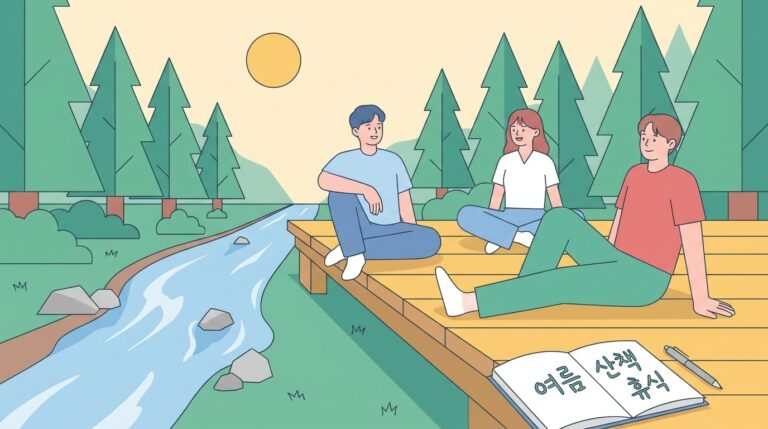
안녕하세요! 매일한글 에디터입니다! ☀️ Korean summers can be intense—sweltering humidity, sizzling concrete, and a sun that just won’t quit. While tourists flock to crowded beaches like Haeundae, savvy locals pack their water shoes and head for the lush mountains. Imagine stepping into a crystal-clear, icy mountain stream surrounded by shade, dipping your toes in the water while eating hot, savory dak-baek-suk (whole chicken soup) served right on a wooden platform over the stream.
However, visiting a Korean valley (gye-gok) comes with unique cultural nuances! How do you reserve a good spot? What do you say when you want to warn someone the water is unexpectedly freezing? Based on feedback from hundreds of intermediate learners who felt overwhelmed by local outdoor slang, this guide will give you the exact words, social cues, and cultural confidence to enjoy a Korean stream trip like a true local!
Phase 2: 핵심 표현 3선 심층 분석 (3 Key Expressions)
1. 진짜 물이 차갑네요! (Jinjja muri chagapneyeo!)
- Pronunciation: [Jeen-jja moo-ree cha-gap-nae-yo] (Sounds like “Jean-ja moo-ree cha-gap-neigh-yo”)
- Meaning: “The water is really cold!” (Literal) vs. “Wow, this water is shockingly freezing!” (Nuance)
- K-Culture Moment: You often hear this in variety shows like 1 Night 2 Days when members jump into mountain valleys for punishments.
- Editor’s Insight: In Korean, using
-네요(-ne-yo) adds an element of immediate discovery or personal reaction. It sounds much more natural and conversational than just stating a fact (차갑습니다). - Situation Spectrum:
- Casual: 진짜 물 차가워! ✅
- Semi-formal: 진짜 물이 차갑네요! ✅
- Formal: 물이 매우 차갑습니다. ⚠️ (Too stiff for a fun valley trip)
- 🤔 Think About It: In your native language, do you express sudden thermal shocks with an exclamation of surprise or a sensory descriptor?
2. 평상 하나 대여할 수 있나요? (Pyeongsang hana daeyeohal su innayo?)
- Pronunciation: [Pyeong-sang ha-na dae-yeo-hal soo een-na-yo]
- Meaning: “Can we rent one low wooden platform?”
- K-Culture Moment: Seen in summer K-Dramas where families gather outdoors on wooden platforms (pyeongsang) right beside or inside water streams.
- Editor’s Insight: Pyeongsang (평상) is a low wooden bed-like deck. Renting one is the traditional way to secure a shade spot at valley restaurants.
- Situation Spectrum:
- Casual: 평상 대여돼? ⚠️ (Only to close friends)
- Semi-formal: 평상 하나 대여할 수 있나요? ✅
- Formal: 평상 대여가 가능합니까? 🚫 (Sounds like a corporate inquiry)
- 🤔 Think About It: How does your culture handle outdoor dining space reservations—is sharing a public platform common?
3. 발만 담그고 가요! (Bal-man dam-geu-go ga-yo!)
- Pronunciation: [Bal-man dam-geu-go ga-yo]
- Meaning: “Let’s just dip our feet and go!”
- K-Culture Moment: Used by characters who don’t want to get fully soaked or change clothes, but still want to feel refreshed.
- Editor’s Insight: 담그다 (dam-geu-da) means to submerge/dip. Combining 만 (only) and 가요 (let’s go) makes it a lighthearted suggestion.
- Situation Spectrum:
- Casual: 발만 담그자! ✅
- Semi-formal: 발만 담그고 가요! ✅
- Formal: 발만 담그도록 합시다. ⚠️ (A bit overly formal)
- 🤔 Think About It: Why do Koreans love quick partial immersions over full swimming during casual hikes?
Phase 3: 교과서 한국어 vs 진짜 한국어 (Textbook vs Real Korean)
Situation 1: Expressing that the water feels great
- 📖 교과서 한국어: 물이 매우 시원합니다. (The water is very cool.)
- 🗣️ 진짜 한국어: 와, 물 진짜 미쳤다! 대박 시원해! (Wow, this water is insane! So awesome!)
- 💡 왜 다를까? Young locals use hyperbole like 미쳤다 (insane/crazy) to express extreme delight in casual settings.
Situation 2: Asking if you need to wear life jackets
- 📖 교과서 한국어: 구명조끼를 착용해야 합니까? (Must I wear a life jacket?)
- 🗣️ 진짜 한국어: 여기 깊어요? 구명조끼 빌려야 돼요? (Is it deep here? Do I need to rent a life vest?)
- 💡 왜 다를까? Conversational Korean prioritizes direct situational conditions (깊어요?) over rigid procedural rules.
Phase 4: K-Culture 딥다이브 & 비언어적 매너 (K-Culture & Manners)
4-1. Nunchi & Gestures
- The Toe-Dip Shake: Before jumping in, tap the water with your toes and shudder exaggeratingly while shouting “아, 차가워!” (Ah, cold!). It alerts people around you that you might splash accidentally.
- Trash Manners: Valleys are naturally protected eco-zones in Korea. Always clean up every single wrapper; leaving trash on a pyeongsang is considered very bad manners (Nunchi fail!).
4-2. Culture Code: Valley + Dak-baek-suk
In Korea, summer valley trips are synonymous with 보양식 (boyang-sik)—health restoration food. Eating steaming hot whole chicken soup with medicinal herbs while your feet rest in cold river water embodies the philosophy of 이열치열 (i-yeol-chi-yeol): beating heat with heat!
Phase 5: 실전 롤플레이 시나리오 (Real-Life Roleplay)
Setting: A popular valley restaurant in Gapyeong with a stream right below.
Characters: You (Learner) & Stream Restaurant Owner (사장님)
- You: 안녕하세요! 혹시 물가 쪽 평상 자리가 있나요?
(An-nyeong-ha-se-yo! Hok-si mul-ga jjok pyeong-sang ja-ri-ga in-na-yo?)
English: Hello! By any chance, do you have a platform seat by the water?
(🎭 Action: Pointing towards the stream with a polite smile) -
Owner: 어서 오세요! 마침 계단 바로 밑에 명당자리 하나 남았어요!
(Eot-seo o-se-yo! Ma-chim gye-dan ba-ro mi-te myeong-dang-ja-ri ha-na na-mass-eo-yo!)
English: Welcome! Coincidentally, we have one prime spot left right below the stairs! -
You: 다행이네요! 평상 대여료는 얼마예요?
(Da-haeng-i-ne-yo! Pyeong-sang dae-yeo-ryo-neun el-ma-ye-yo?)
English: What a relief! How much is the platform rental fee? -
Owner: 닭백숙 하나 시키시면 평상은 무료 이용이에요.
(Dak-baek-suk ha-na si-ki-si-myeon pyeong-sang-eun mu-ryo i-yong-i-e-yo.)
English: If you order one whole chicken soup, the platform is free to use. -
You: 아, 그래요? 그럼 백숙 하나랑 사이다 한 병 주세요!
(A, geu-rae-yo? Geu-reom baek-suk ha-na-rang sa-i-da han byeong ju-se-yo!)
English: Ah, really? Then please give us one chicken soup and a bottle of cider! -
Owner: 네, 음식이 나오는 동안 먼저 물놀이하고 계세요!
(Ne, eum-si-gi na-o-neun dong-an meon-jeo mul-no-ri-ha-go gye-se-yo!)
English: Sure, feel free to play in the water while the food is being prepared! -
You: 감사합니다! 수건도 혹시 대여가 되나요?
(Gam-sa-ham-ni-da! Su-geon-do hok-si dae-yeo-ga doe-na-yo?)
English: Thank you! Is towel rental available by any chance? -
Owner: 수건은 판매만 해요. 하나에 2,000원이에요.
(Su-geon-eun pan-mae-man hae-yo. Ha-na-e i-cheon-won-i-e-yo.)
English: We only sell towels. They are 2,000 won each.
🔀 Interactive Choice Point
You realize you forgot to bring water shoes and the river rocks look sharp. What do you do?
- Option A: “맨발로 그냥 들어가도 돼요?” (Can I just go in barefoot?)
- Feedback (Risk): The owner will warn you that rocks are slippery and sharp. You might cut your feet!
- Option B: “혹시 아쿠아슈즈나 슬리퍼 파나요?” (Do you happen to sell aqua shoes or slippers?)
- Feedback (Best): Polite, practical, and shows safety awareness. The owner points you to a store nearby!
- Option C: “신발 신고 들어가겠습니다.” (I will enter wearing my outdoor sneakers.)
- Feedback (Bad): Ruining street shoes in mud and polluting clear stream water is culturally discouraged.
Phase 6: 10초 감정 섀도잉 드릴 (10-Second Emotion Shadowing)
[😊 Excitement & Wonder]
와 / 물이 진짜 투명하고 / 시원해 보여요!
(Wa / mu-ri jin-jja tu-myeong-ha-go / si-won-hae beo-yeo-yo!)-
[🥶 Shivering Cold Shock]
으아 / 생각보다 / 물이 너무 차가운데요?!
(Eu-a / saeng-gak-bo-da / mu-ri neo-mu cha-ga-woun-de-yo?!) -
[😋 Satisfied Hunger]
물놀이하고 먹는 백숙은 / 진짜 꿀맛이에요!
(Mul-no-ri-ha-go meok-neun baek-suk-eun / jin-jja kkul-ma-si-e-yo!)
Phase 7: K-Culture 미니 사전 (Mini Dictionary)
- 명당자리 (Myeong-dang-ja-ri): Prime location / The best spot with great view or shade.
- 꿀맛 (Kkul-mat): Lit. “Honey taste” -> Delicious, amazing taste (especially after swimming).
- 물총 (Mul-chong): Water gun. Essential gear for adults and kids alike in streams.
- 방수팩 (Bang-su-paek): Waterproof phone pouch. Crucial for taking stream selfies.
Phase 8: 여행자를 위한 생존 키트 (Survival Kit)
Top 3 Survival Phrases
- 수심이 깊나요? (Su-si-mi gim-na-yo?) – Is the water deep here? (Pro Tip: Essential for non-swimmers!)
- 미끄러우니까 조심하세요! (Mi-kkeu-reo-u-ni-kka jo-sim-ha-se-yo!) – It’s slippery, so be careful!
- 쓰레기 봉투 어디에 버려요? (Sseu-re-gi bong-tu eo-di-e beo-ryeo-yo?) – Where do I throw away the trash bag?
Editor’s Travel Note
Before heading to valley destinations like Gapyeong, Bukhansan, or Jirisan, install the 네이버 지도 앱 다운로드 (Naver Map app) to check localized bus schedules and local stream restaurant phone numbers.
Phase 9: “한 발 더 깊이” (Deep Dive Thought)
In Western cultures, outdoor summer relaxation often revolves around private tanning or individual beach towels. In Korea, valley culture is inherently communal. Families and friends gather around shared pyeongsang platforms, passing down watermelon slices to neighboring tables and laughing together when someone gets splashed. It highlights the deeply rooted 정 (Jeong) and group bonding culture.
💬 Your Turn: What is your home country’s equivalent of escaping the heat with local comfort food? Tell us in the comments below!
Phase 10: FAQ & 오해 방지 (FAQ & Common Mistakes)
Q: Can I just jump into any stream in Korea for free?
A: Yes, public streams are free! However, areas managed by valley restaurants require ordering food to use their platform amenities and restrooms.
Q: Is it okay to wear a regular bikini at Korean valleys?
A: While allowed, locals usually wear rash guards, shorts, and caps to prevent sun damage and sharp rock scratches.
Q: How early should I arrive at popular valleys in July/August?
A: Arrive before 10:00 AM! Prime spots (명당자리) sell out fast on hot summer weekends.
🚨 Common Mistakes TOP 3
- Mistake: Wearing flip-flops in fast water currents.
- Correct Action: Wear secured aqua shoes or strap sandals.
- Mistake: Assuming all streams have lifeguards.
- Correct Action: Check depth yourself and ask locals “수심 깊나요?”
- Mistake: Leaving trash on wooden decks.
- Correct Action: Pack your trash back or ask restaurant staff where to dispose of it.
Phase 11: 액션 미션 & 참여 유도 (Action Mission)
- 🥉 Bronze Level: Practice saying “물 진짜 시원해요!” out loud 3 times.
- 🥈 Silver Level: Share this post on your social media with your favorite summer destination in Korea.
- 🥇 Gold Level: Use “혹시 명당자리 있어요?” on your next stream restaurant trip in Korea!
- 🎮 K-Culture Mission: Watch a clip of 2 Days 1 Night valley summer episode and identify when someone shouts “차갑다!”.
Phase 12: 인터랙티브 퀴즈 챌린지 (Quiz Challenge)
Question 1 (Situation Judgment)
You want to know if renting a platform (pyeongsang) is free if you order food. What do you ask?
🔍 Click to reveal answer & explanation
Answer: “음식 시키면 평상 무료인가요?”
Explanation: 음식 시키면 (If I order food) + 평상 무료인가요? (Is the platform free?) directly asks the common Korean valley business rule!
Question 2 (Fill in the Blank)
Complete the sentence: “물놀이하고 먹는 닭백숙은 진짜 ( )이에요!” (The chicken soup eaten after swimming tastes amazing!)
🔍 Click to reveal answer & explanation
Answer: 꿀맛 (Kkul-mat)
Explanation: 꿀맛 literally means honey taste, used colloquially for extremely delicious food.
Question 3 (True/False)
True or False: In Korea, most locals swim in streams wearing bikinis without rash guards.
🔍 Click to reveal answer & explanation
Answer: False!
Explanation: Most Koreans wear rash guards, shorts, and water shoes for sun protection and safety against river rocks.







