

Phase 1: 공감 (Storytelling Opening)
안녕하세요! 매일한글 에디터입니다. 🌸
Have you ever spent 45 minutes scrolling through Netflix, watching trailers for ten different K-dramas, only to give up and end up rewatching Crash Landing on You for the fifth time? Or perhaps you were standing in a bustling Seongsu-dong cafe, mesmerized by twenty different variations of matcha and espresso, while a line of impatient Seoulites formed behind you?
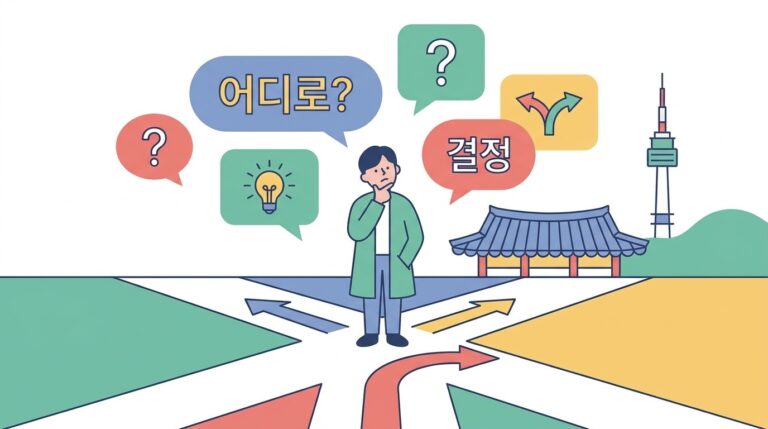
If you felt a sudden spike in cortisol during those moments, welcome to the psychological phenomenon known as Decision Paralysis—or as Koreans colloquially and dramatically call it, ‘결정 장애’ (Decision Impairment) or ‘햄릿 증후군’ (Hamlet Syndrome).
In high-context, fast-paced modern Korea, making a quick decision isn’t just about efficiency; it’s a social skill linked to Nunchi (눈치). When faced with overwhelming options, your brain hits a cognitive bottleneck. Today, drawing from real feedback from our advanced C2-level learners and sociolinguistic observations in Seoul, we will dissect the deep psychological mechanisms behind Korean decision fatigue. Mastering these nuanced expressions will elevate your conversational fluency from merely fluent to effortlessly authentic.
Phase 2: 핵심 표현 3선 심층 분석
1. 결정 장애 (한글)
- Pronunciation: [Gyeol-jeong-jang-ae] (Sounds like “Gyeol-jung-jang-eye” – picture someone rolling their eyes while trying to choose a menu item)
- Meaning: Direct: Decision Disability / Real Nuance: Severe decision paralysis due to choice overload (hyperbolic colloquialism).
- K-Culture Moment: In K-dramas, when characters enter a 24-hour convenience store during a late-night talk and stand frozen in front of 30 ramen flavors.
- Editor’s Insight: Although the word includes ‘장애’ (impairment/disability), in daily youth and internet culture, it is used self-deprecatingly to express acute indecisiveness. However, at the C2 level, be aware that formal settings prefer ‘선택의 어려움’ (difficulty in choosing).
- Situation Spectrum: Casual ✅ | Semi-formal ⚠️ | Formal 🚫
- 🤔 Think About It: Does your language use medical exaggerations to describe everyday cognitive fatigue?
2. 선택의 기로에 서다 (한글)
- Pronunciation: [Seon-taek-ui gi-ro-e seo-da]
- Meaning: Direct: Standing at the crossroads of choice / Real Nuance: Facing a critical, high-stakes decision that requires deep psychological deliberation.
- K-Culture Moment: Used by news anchors analyzing economic policies or drama protagonists caught in a love triangle between their childhood friend and a charismatic CEO.
- Editor’s Insight: This is a sophisticated, literary expression. Use this when discussing career moves, major life shifts, or psychological dilemmas in formal discussions.
- Situation Spectrum: Casual ⚠️ | Semi-formal ✅ | Formal ✅
- 🤔 Think About It: How does visualizing a choice as a “crossroads” (기로) change your emotional weight when deciding?
3. 장고 끝에 악수를 둔다 (한글)
- Pronunciation: [Jang-go kkeut-e ak-su-reul dun-da]
- Meaning: Direct: Placing a bad move after long deliberation / Real Nuance: Overthinking a decision so much that you end up making the worst possible choice.
- K-Culture Moment: Originating from Baduk (Go), this proverb is frequently quoted in Korean business news, political commentaries, and thriller series like The Glory.
- Editor’s Insight: This captures the core mechanism of Hamlet Syndrome—analysis paralysis leading to sub-optimal outcomes. C2 speakers use it with a subtle sigh of self-reflection.
- Situation Spectrum: Casual ✅ | Semi-formal ✅ | Formal ✅
- 🤔 Think About It: Is overthinking viewed as a virtue or a trap in your home culture?
Phase 3: 교과서 한국어 vs 진짜 한국어
Situation 1: Choosing a dinner menu in a group chat
- 📖 교과서 한국어: 무엇을 먹을지 결정하지 못하겠습니다. 선택지가 너무 많습니다. (I cannot decide what to eat. There are too many choices.)
- 🗣️ 진짜 한국어: 아, 나 진짜 결정 장애 왔어. 메뉴 판 볼수록 멘붕이다. (Ugh, I’m literally paralyzed by indecision. The more I look at the menu, the more my brain melts.)
- 💡 왜 다를까? Natives use figurative psychological terms like ‘멘붕’ (mental breakdown) and ‘결정 장애’ to express emotional saturation rather than stating logical facts.
Situation 2: Regretting over-analyzing an investment or career decision
- 📖 교과서 한국어: 너무 오래 고민해서 그릇된 선택을 했습니다. (Because I deliberated too long, I made a wrong choice.)
- 🗣️ 진짜 한국어: 역시 장고 끝에 악수 둔다더니, 생각만 너무 따지다 판을 망쳤네. (They say overthinking leads to a blunder, and sure enough, I ruined it by overanalyzing.)
- 💡 왜 다를까? C2 native speakers embed traditional proverbs (‘장고 끝에 악수를 둔다’) into modern idiomatic sentences to sound eloquent and deeply reflective.
Phase 4: K-Culture 딥다이브 & 비언어적 매너
4-1. 눈치(Nunchi) & non-verbal signaling in decision moments
When a Korean says “아… 어떡하지?” (Ugh… what should I do?) while tapping their chin with an index finger and exhaling lightly, they are non-verbally signalling a plea for help. In a group setting, lingering too long without choosing breaks the collective momentum (흐름). The polite counter-gesture is to offer two clear options to relieve their cognitive load: “A랑 B중에 고르라면 뭐에 더 가까워?” (If you had to pick between A and B, which one feels closer?).
4-2. Culture Code: ‘답정너’ vs. Hamlet Syndrome
Korean society balances extreme speed (Palli-Palli) with relational harmony. This creates two unique psychological archetypes in decisions:
1. 답정너 (Dap-jeong-neo): “The answer is already set, you just answer.” Someone asking for advice who already made up their mind.
2. 결정 장애 (Decision Paralysis): genuine cognitive fatigue caused by endless high-quality choices in modern Korean consumer culture.
Phase 5: 실전 롤플레이 시나리오
Setting: Late evening at a crowded Pocha in Euljiro. You are with your Korean colleague, Min-jun (민준), who is staring intently at an overwhelming menu board.
- Turn 1 (Min-jun): 아, 진짜 여기서 안주 뭐 시키지? 메뉴가 백 개는 되는 것 같아.
(Ah, seriously, what dish should we order? Feels like there are a hundred options.) - Turn 2 (You):
🎭 웃으며 메뉴판을 훑어보며아직 못 골랐어? 또 결정 장애 발동한 거야?
(Haven’t picked yet? Is your decision paralysis kicking in again?) - Turn 3 (Min-jun): 응… 닭발도 먹고 싶고, 조개탕도 당기는데… 너라면 뭐 먹을래?
(Yeah… I want spicy chicken feet, but soup is tempting too… What would you eat?) - Turn 4 (You):
🎭 고민하는 척 진지한 눈빛으로선택의 기로에 서 있네. 근데 너무 오래 고르면 장고 끝에 악수 둔다?
(Standing at a true crossroads, aren’t we? But remember, overthinking leads to bad moves.) - Turn 5 (Min-jun): 맞는데… 실패하고 싶지 않단 말이야! 네가 하나만 딱 정해줘.
(True… but I just don’t want to regret it! You make the call for me.) - Turn 6 (You):
🎭 손가락 두 개를 펴 보이며그럼 얼큰한 국물 vs 매콤한 구이, 3초 안에 고르고 털어버리자!
(Then hot broth vs spicy grilled, pick in 3 seconds and let it go!) - Turn 7 (Min-jun): 3초?! 으아… 국물! 조개탕으로 가자! 고마워, 뇌 용량 초과할 뻔했어.
(3 seconds?! Argh… broth! Let’s go with clam soup! Thanks, my brain almost overloaded.) - Turn 8 (You):
🎭 뿌듯하게 웃으며잘했어! 고민 길어봐야 스트레스만 받지, 뭐.
(Well done! Overthinking only brings stress anyway.)
🔀 인터랙티브 분기점 (Choose Your Response in Turn 4)
- Option A: “아무거나 시켜! 다 비슷하겠지.” (Order anything! They’re probably all similar.)
- Feedback (Bad): Dismisses the context and feels slightly blunt/disinterested in Korean dining atmosphere.
- Option B: “선택의 기로에 서 있네. 근데 너무 오래 고르면 장고 끝에 악수 둔다?” (You’re at a crossroads. But overthinking leads to a bad move.)
- Feedback (Best): Witty, uses C2-level idiomatic idioms, keeps the tone light and friendly!
- Option C: “선생님, 심리학적으로 당신은 햄릿 증후군입니다.” (Sir, psychologically you have Hamlet Syndrome.)
- Feedback (Risk): Too textbook-like and clinical for an informal drinking setting.
Phase 6: 10초 감정 섀도잉 드릴
[🥺 고민스럽고 징징거리는 톤으로]
아, 나 진짜 / 결정 장애 왔나 봐… / 못 고르겠어!
(Ah, na jin-jja / gyeol-jeong-jang-ae wan-na bwa… / mot go-reu-ges-seo!)-
[😏 위트 있고 조언하듯이]
너무 오래 생각하지 마! / 장고 끝에 / 악수 두는 법이야.
(Neo-mu o-rae saeng-gak-ha-ji ma! / Jang-go kkeut-e / ak-su du-neun beob-i-ya.) -
[😎 단호하고 매력 넘치게]
선택의 기로에 섰을 땐, / 첫 번째 느낌을 / 믿는 거야!
(Seon-taek-ui gi-ro-e seos-seul ttaen, / cheot beon-jae neu-kkim-eul / min-neun ggeo-ya!)
Phase 7: K-Culture 미니 사전 (핵심 키워드 4개)
- 결정 장애 (Gyeol-jeong-jang-ae) | Decision Impairment | Colloquial state of extreme hesitation when facing choices.
- 결정 피로 (Gyeol-jeong-pi-ro) | Decision Fatigue | The psychological depletion caused by making too many irrelevant decisions daily.
- 선택 절벽 (Seon-taek-jeol-byeok) | Choice Cliff | A state where consumers give up choosing altogether due to overwhelming product variations.
- 햄릿 증후군 (Ham-lit-jeung-hu-gun) | Hamlet Syndrome | Literary-psychological term for severe indecisiveness (“To be, or not to be”).
Phase 8: 여행자를 위한 생존 키트
Survival Expressions TOP 3
- “여기 제일 잘나가는 걸로 추천해 주세요.”
(Yeo-gi je-il jal-na-ga-neun geol-ro chu-cheon-hae ju-se-yo.)
➔ Pro Tip: Best way to bypass decision paralysis at restaurants. - “선택지가 너무 많아서 못 고르겠어요.”
(Seon-taek-ji-ga neo-mu ma-na-seo mot go-reu-ges-seo-yo.)
➔ Pro Tip: Polite polite way to express choice overload to staff. - “다 맛있어 보이는데, 둘 중에 뭐가 더 인기 있어요?”
(Da mas-is-seo bo-i-neun-de, dul jung-e mwo-ga deo in-ki is-seo-yo?)
➔ Pro Tip: Narrows your choices down instantly.
Editor’s Travel Note
When traveling around Seoul’s gourmet hot spots, avoid wasting time sitting paralyzed at cafe tables. Use the 네이버 지도 앱 다운로드 to check crowd-sourced ratings and highlighted representative menus before walking inside!
Phase 9:
Frequently Asked Questions (FAQ)
Q: What does "결정 장애 (한글)" mean in Korean and how do you pronounce it?
A: In Korean, "결정 장애 (한글)" is pronounced [Gyeol-jeong-jang-ae] and means: Direct: Decision Disability / Real Nuance: Severe decision paralysis due to choice overload (hyperbolic colloquialism).
Q: What does "선택의 기로에 서다 (한글)" mean in Korean and how do you pronounce it?
A: In Korean, "선택의 기로에 서다 (한글)" is pronounced [Seon-taek-ui gi-ro-e seo-da] and means: Direct: Standing at the crossroads of choice / Real Nuance: Facing a critical, high-stakes decision that requires deep psychological deliberation.
Q: What does "장고 끝에 악수를 둔다 (한글)" mean in Korean and how do you pronounce it?
A: In Korean, "장고 끝에 악수를 둔다 (한글)" is pronounced [Jang-go kkeut-e ak-su-reul dun-da] and means: Direct: Placing a bad move after long deliberation / Real Nuance: Overthinking a decision so much that you end up making the worst possible choice.







