

Send Fan Mail & Packages Like a Local! How to Write Korean Addresses Easily
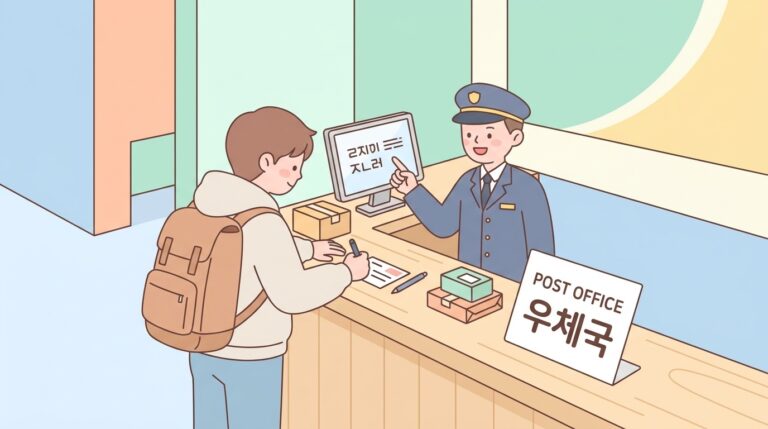
안녕하세요! Welcome back to Daily Hangul! I’m your Korean culture navigator and editor. Have you ever tried sending a sweet gift to your favorite K-Drama actor, a fan letter to a K-Pop idol, or a box of souvenirs back home from Seoul? You step into a cozy red-signed Korean Post Office (우체국 – Ucheguk), hold a pen over a shipping slip, and suddenly freeze—Wait, where do I put the city name? Do I write the apartment number first or last?
Don’t worry at all! Writing an address in Korea is like building a nested Russian Matryoshka doll—we always start from the BIGGEST area (Country/City) and zoom in step-by-step to the SMALLEST unit (Room/Apartment number). In this guide, tailored specifically for A1 beginners, you will master writing Korean addresses with confidence, learn real post office interactions, and discover how Korean address logic reflects the country’s cultural mindset!
Phase 2: Key Expressions Deep Dive
1. 여기 주소 써 주세요 (Yeogi juso sseo juseyo)
- Pronunciation: Yeo-gi ju-so sseo ju-se-yo (Sounds like “Yo-gee joo-so so ju-say-yo”)
- Meaning: “Please write the address here.”
- K-Culture Moment: You hand your package to the friendly clerk, and they point at the slip with two hands saying this phrase.
- Editor’s Insight: 여기 (yeogi) means “here”, 주소 (juso) means “address”, and 써 주세요 (sseo juseyo) means “please write”. It’s very polite and commonly used by service staff.
- Situation Spectrum: Casual 🚫 | Semi-formal ✅ | Formal ✅
- 🤔 Think About It: In English, you ask “Could you write your address?” but in Korea, stating the location (here) first keeps the context crystal clear.
2. 주소가 어떻게 돼요? (Jusoga eotteohge dwaeyo?)
- Pronunciation: Ju-so-ga eo-tteo-ke dwae-yo? (Sounds like “Joo-so-gah oh-ttoh-keh dway-yo?”)
- Meaning: “What is your address?” (Literally: “How does your address become?”)
- K-Culture Moment: Asking your Korean friend for their home address so you can ship them a birthday surprise gift via KakaoTalk Kakao Gift or postal delivery.
- Editor’s Insight: Instead of asking 주소가 뭐예요? (“What is your address?”), Koreans frequently use 어떻게 돼요? (“How is it / how does it become?”) as a much softer and more courteous phrase for personal details.
- Situation Spectrum: Casual ⚠️ | Semi-formal ✅ | Formal ✅
- 🤔 Think About It: Why do you think Korean uses “how” (어떻게) instead of “what” (무엇) when asking for personal info? It sounds gentler and less intrusive!
3. 우편번호가 몇 번이에요? (Upyeonbeonhoga myeot beonieyo?)
- Pronunciation: U-pyeon-beon-ho-ga myeot beon-i-e-yo?
- Meaning: “What is the postal code?”
- K-Culture Moment: When you fill out the 5-digit zip code box at the post office counter and need double-checking.
- Editor’s Insight: 우편번호 (upyeonbeonho) means postal code (literally mail-number). Korea uses a 5-digit postal code system.
- Situation Spectrum: Casual ⚠️ | Semi-formal ✅ | Formal ✅
- 🤔 Think About It: Korean postal codes were simplified to 5 digits nationwide in 2015 to make parcel sorting super fast!
Phase 3: Textbook Korean vs. Real Korean
Situation 1: Asking where to write the address
- 📖 Textbook Korean: 어디에 주소를 작성해야 합니까? (Eodie jusoreul jakseonghaeya hapnikka?)
- 🗣️ Real Korean: 주소 어디에 써요? (Juso eodie sseoyo?)
- 💡 Why the difference? Textbook phrasing sounds like a government official in an exam! In real life, simple verb endings like -요 (-yo) are natural, polite, and friendly.
Situation 2: Asking for help with the postal code
- 📖 Textbook Korean: 우편번호 검색을 도와주시겠습니까? (Upyeonbeonho geomsaegeul dowajusigessnikka?)
- 🗣️ Real Korean: 우편번호 좀 찾아주세요! (Upyeonbeonho jom chajajuseyo!)
- 💡 Why the difference? Adding 좀 (jom – please/a bit) instantly softens your request, making you sound fluent and polite without being overly stiff.
Phase 4: K-Culture Deep Dive & Non-Verbal Manners
4-1. Nunchi & Gesture Tip 💡
When handing your filled paper slip or money to the post office worker, hand it over using both hands or support your right elbow with your left hand. This gesture shows high respect and instantly earns you warm smiles from local post staff!
4-2. Culture Code: The Order of Korean Addresses
In Western cultures, you write: [Name] -> [House No. & Street] -> [City] -> [Zip] -> [Country].
In Korea, it is the exact opposite! You write:
[Country] -> [City/Province] -> [District/Gu] -> [Road Name] -> [Building No.] -> [Apartment/Room No.] -> [Name]
This reflects the Asian cultural worldview: Big Community / Group first, Individual last.
Phase 5: Real Roleplay Scenario
Location: Mapo Post Office in Seoul
Character: Friendly Clerk Min-soo (김민수)
- Min-soo: 안녕하세요! 무엇을 도와드릴까요?
(An-nyeong-ha-se-yo! Mu-eot-eul do-wa-deu-ril-kka-yo?)
“Hello! How can I help you?”
🎭 Smiles warmly while holding shipping forms. -
You: 이 택배 보내고 싶어요.
(I taek-bae bo-nae-go sip-eo-yo.)
“I want to send this parcel.”
🎭 Hands over the box with two hands. -
Min-soo: 네, 여기에 주소 써 주세요.
(Ne, yeo-gi-e ju-so sseo ju-se-yo.)
“Okay, please write the address here.”
🎭 Points at the red box on the shipping form. -
You: 주소 순서가 어떻게 돼요?
(Ju-so sun-seo-ga eo-tteo-ke dwae-yo?)
“What is the order of the address?”
🎭 Points to the blank line with a curious expression. -
Min-soo: 큰 도시부터 작은 동, 호수 순서로 쓰시면 돼요.
(Keun do-si-bu-teo jak-eun dong, ho-su sun-seo-ro sseu-si-myeon dwae-yo.)
“You can write from the big city down to the neighborhood and room number.”
🎭 Gestures from top to bottom. -
You: 우편번호도 써야 돼요?
(U-pyeon-beon-ho-do sseo-ya dwae-yo?)
“Do I need to write the zip code too?”
🎭 Tilts head slightly. -
Min-soo: 네! 우편번호 5자리 꼭 적어주세요.
(Ne! U-pyeon-beon-ho o-ja-ri kkok jeok-eo-ju-se-yo.)
“Yes! Please make sure to write the 5-digit zip code.” -
You: 네, 감사합니다!
(Ne, gam-sa-hap-ni-da!)
“Yes, thank you!”
🎭 Bows head politely.
🔀 Interactive Choice Point
The clerk asks you to confirm your zip code, but you forgot it. What do you say?
- Option A: “몰라요!” (Mollayo! – “I don’t know!”)
- Option B: “우편번호 좀 찾아주실 수 있어요?” (Upyeonbeonho jom chajajusil su isseoyo? – “Could you help me find the zip code?”)
- Option C: Silent bow and walk away.
Feedback:
* Option A (Bad): Too blunt and slightly impolite to service staff.
* Option B (BEST ⭐): Polite, uses 좀 (jom), and prompts the staff to quickly search it on their computer system for you!
* Option C (Risk): Your package won’t get sent!
Phase 6: 10-Second Emotion Shadowing Drill
Practice these lines out loud with the indicated rhythm (/ = brief pause) and tone!
[😊 Polite & Confident]
여기 / 주소 / 써 주세요.
(Yeo-gi / ju-so / sseo ju-se-yo.)-
[🙋 Curiously Asking]
우편번호가 / 몇 번이에요?
(U-pyeon-beon-ho-ga / myeot beon-i-e-yo?) -
[🙏 Grateful & Sweet]
도와주셔서 / 정말 감사합니다!
(Do-wa-ju-seo-seo / jeong-mal gam-sa-hap-ni-da!)
Phase 7: K-Culture Mini Dictionary
- 주소 (Juso) | Address | Essential term on all shopping, delivery, and post forms.
- 우편번호 (Upyeonbeonho) | Postal Code | 5-digit code used for sorting Korean mail.
- 도로명 주소 (Doromyeong Juso) | Road Name Address | Modern street address system introduced in South Korea.
- 택배 (Taekbae) | Parcel / Courier Delivery | Korea’s insanely fast delivery culture ecosystem!
Phase 8: Traveler’s Survival Kit
TOP 3 Survival Phrases
- 주소 써 주세요. (Juso sseo juseyo.) – Please write the address.
- 우체국 박스 어디 있어요? (Ucheguk bakseu eodi isseoyo?) – Where are the post office boxes?
- 국제우편으로 보내고 싶어요. (Gukje-upyeon-euro bonaego sipeoyo.) – I want to send this via international mail.
Editor’s Travel Note
When looking up addresses or postal codes in South Korea, Google Maps often doesn’t give precise building numbers due to local mapping regulations. We strongly recommend downloading the Naver Map App Download for fast, accurate Korean address search and road-name zip code lookup!
Phase 9: One Step Deeper (Korean Logic Essay)
Did you notice how Korean addresses go from Big to Small (Country -> City -> Road -> House)? This isn’t just about postal logistics; it reflects the traditional Korean collectivist value system where the broader group or home unit (우리 – Wuri) frames the individual. When you write a Korean address, you are literally zooming into someone’s world from the macro to the micro!
💬 Your Turn: Have you ever sent fan mail or packages to Korea? What address habit surprised you the most? Drop a comment below!
Phase 10: FAQ & Mistake Warning
Q: Can I write the recipient’s address in English letters at a Korean Post Office?
A: Yes! For international mail leaving Korea, English is standard. However, for domestic mail sent within Korea, writing the address in Hangul guarantees much faster delivery!
Q: What is the difference between “지번 주소” and “도로명 주소”?
A: 지번 주소 (Jibeon Juso) is the legacy lot-number address system, while 도로명 주소 (Doromyeong Juso) is the modern street-name address system used today. Most official post uses Road Name addresses!
Q: Do I need a Korean phone number on the shipping form?
A: Yes, local parcel services send automated KakaoTalk notifications regarding delivery status, so providing a valid phone contact is highly recommended.
🚨 Common Mistakes TOP 3
- ❌ Writing recipient’s name first on Korean domestic mail.
👉 Correct Action: Write City/Street first, and place recipient’s name at the very end with 님 (Nim) or 귀하 (Gwiha). - ❌ Using old 6-digit postal codes.
👉 Correct Action: Make sure to check the current 5-digit zip code system. - ❌ Forgetting the room/apartment number (호수).
👉 Correct Action: Always end with[Building No.]동 [Room No.]호(e.g., 101동 502호).
Phase 11: Action Mission
- 🥉 Bronze Mission: Practice saying “여기 주소 써 주세요” 3 times out loud.
- 🥈 Silver Mission: Write down your personal hotel or accommodation address in Korean format (Big to Small) in your notebook.
- 🥇 Gold Mission: Visit a local Korean post office or postal station during your trip and successfully ship a postcard using Korean address format!
🎮 K-Culture Mission: Watch a scene in a K-Drama where a character receives a parcel (택배) and spot the address slip attached to the box!
Phase 12: Interactive Quiz Challenge
Test your knowledge before you go!
Q1. What is the correct order for writing a Korean address?
A) Room No. -> Street -> City -> Country
B) Country -> City -> Street -> Room No.
🔍 Click to reveal Answer & Explanation
Answer: B!
Korean addresses always go from BIGGEST unit (Country/City) to SMALLEST unit (Room/Apartment number).
Q2. What does “우편번호” (Upyeonbeonho) mean?
A) Phone number
B) Postal / Zip code
🔍 Click to reveal Answer & Explanation
Answer: B!
우편 means mail and 번호 means number, together forming Zip/Postal Code!






