

안녕하세요! 매일한글 에디터입니다. 👋
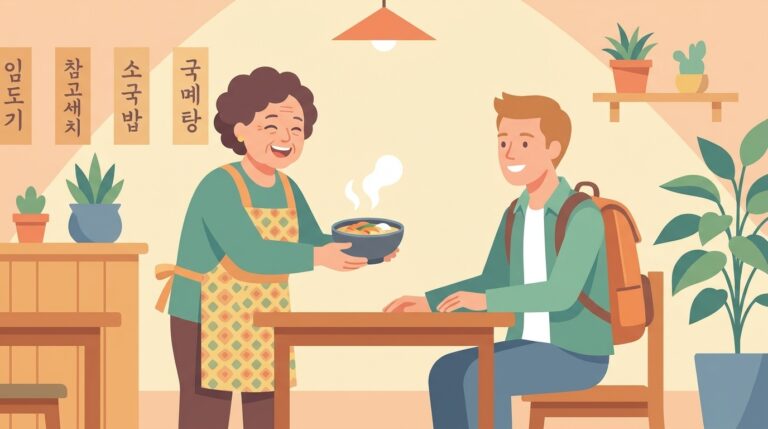
Have you ever been sitting at a cozy Korean restaurant, enjoying your meal, when the owner (affectionately called Imo or auntie) suddenly places a steaming dish of fried dumplings or soft steamed egg (gyeran-jim) on your table? You panic slightly, check your menu to see if you accidentally ordered it, or wonder if you should pull out your wallet. Then, with a warm smile, she says: “서비스예요!” (It’s service!)
If you’ve experienced this, congratulations—you have just encountered one of Korea’s most beautiful cultural dynamics: 정 (Jeong). However, many foreign learners get flustered. Should you refuse? Should you ask how much it costs? How do you accept it with maximum gratitude without sounding like a textbook robot?
Don’t worry! Based on real-life experiences and feedback from over 1,000 foreign learners living in Seoul, this guide will equip you with authentic B1-level Korean expressions, cultural context, and confidence to handle these heart-warming moments like a local.
Phase 2: 핵심 표현 3선 심층 분석 (Top 3 Key Expressions)
1. 서비스예요! (Seo-bi-seu-ye-yo!)
- Pronunciation: [seo-bi-seu-ye-yo] (Sounds like “Sir-beast-yeah-yo”)
- Meaning: Literal: “It’s service!” | Actual Niuance: “This one is on the house! Enjoy!”
- K-Culture Moment: You order two servings of Samgyeopsal (pork belly), and the owner slides a bowl of piping hot Kimchi stew onto your burner saying “서비스예요~”
- Editor’s Insight: In Korean, the loanword “서비스” (service) rarely refers to general customer service quality. Instead, it specifically means free complimentary food or items given out of goodwill or gratitude!
- Situation Spectrum: Casual ⚠️ | Semi-formal ✅ | Formal 🚫
- 🤔 Think About It: In your home culture, are free perks strictly tied to reward programs, or do business owners give free gifts based on personal affection?
2. 어머, 감사해라! 잘 먹겠습니다! (Eo-meo, gam-sa-hae-ra! Jal meok-get-seum-ni-da!)
- Pronunciation: [eo-meo, gam-sa-hae-ra! jal meok-get-seum-nee-dah] (Sounds like “Uh-mer, gahm-sah-hae-rah! Jal mock-get-seum-nee-dah”)
- Meaning: Literal: “Oh, thankfulness! I will eat well!” | Actual Niuance: “Oh wow, thank you so much! I’m going to enjoy this!”
- K-Culture Moment: Expressing slight delight and surprise when receiving an unexpected dish before taking your first bite.
- Editor’s Insight: Combining an exclamation like “어머” (Oh my!) with “잘 먹겠습니다” shows authentic joy and respect for the cook’s generosity.
- Situation Spectrum: Casual ✅ | Semi-formal ✅ | Formal ⚠️
- 🤔 Think About It: Why does showing enthusiasm before eating mean so much to Korean restaurant owners?
3. 이모, 너무 맛있어요! 또 올게요! (I-mo, neo-mu mas-is-seo-yo! Tto ol-ge-yo!)
- Pronunciation: [i-mo, neo-mu mas-ish-eo-yo! tto ol-ge-yo] (Sounds like “Ee-mo, nuh-moo mahsh-ish-uh-yo! Ttoh all-geh-yo”)
- Meaning: Literal: “Auntie, very delicious! Will come again!” | Actual Niuance: “Imo, this is amazing! I’m definitely coming back!”
- K-Culture Moment: Saying goodbye at the cash register after finishing your meal.
- Editor’s Insight: Calling a female restaurant owner “이모” (maternal aunt) breaks down formal barriers and creates an instant feeling of warmth.
- Situation Spectrum: Casual ✅ | Semi-formal ✅ | Formal 🚫
- 🤔 Think About It: How does using familial titles for strangers change the social atmosphere in Korea?
Phase 3: 교과서 한국어 vs 진짜 한국어 (Textbook vs. Real Korean)
Situation 1: Accepting free food
- 📖 교과서 한국어: 이것은 무료입니까? (I-geot-eun mu-ryo-im-ni-ka? / Is this free?)
- 🗣️ 진짜 한국어: 와, 이거 서비스예요? 감사합니다! (Wa, i-geo seo-bi-seu-ye-yo? Gam-sa-ham-ni-da!)
- 💡 왜 다를까? Asking “Is this free?” sounds overly transactional and suspicious. Expressing cheerful surprise with “서비스예요?” matches the friendly vibe instantly!
Situation 2: Expressing full satisfaction
- 📖 교과서 한국어: 정말 감사합니다. 잘 먹었습니다. (Jeong-mal gam-sa-ham-ni-da. Jal meok-eoss-seum-ni-da.)
- 🗣️ 진짜 한국어: 이모! 서비스 덕분에 완밥했어요! (I-mo! Seo-bi-seu deok-bun-e wan-bap-hae-seo-yo!)
- 💡 왜 다를까? “완밥” (wan-bap) is a trendy expression meaning “finishing every single grain of rice.” It shows the owner that their generous extra dish was thoroughly enjoyed!
Phase 4: K-Culture 딥다이브 & 비언어적 매너 (Culture Deep Dive & Non-verbal Etiquette)
4-1. 눈치 (Nunchi) & Body Gestures
When an Imo brings you service food, body language speaks louder than words:
1. The Double-Hand Bow: Place one hand on your chest or hold your hands together and bow your head slightly (~15 degrees).
2. Wide Eyes of Joy: Smile brightly with wide eyes to show sincere surprise.
3. The Empty Plate Signal: When leaving, keep the empty service dish visible near the front of the table—it proves you loved it!
4-2. Cultural Code: 정 (Jeong)
In Western business, extra food usually comes with a catch or a coupon. In Korea, 정 (Jeong) is an unspoken bond of affection, hospitality, and communal care. When an Imo gives you extra food, she isn’t trying to upsell you—she sees you enjoying her food and wants to care for you like family!
Phase 5: 실전 롤플레이 시나리오 (Real-life Roleplay Scenario)
Setting: A bustling Tteokbokki street shop near Hongdae.
Characters: Alex (B1 Korean Learner) & Imo (Warm restaurant owner).
- Imo: 손님~ 이 순대 좀 먹어봐요. 서비스예요! (Son-nim~ i sun-dae jom meok-eo-bwa-yo. Seo-bi-seu-ye-yo!)
- 🎭 Action: Places a steaming plate of blood sausage on Alex’s table with a wide smile.
- Alex: 어머, 진짜요? 이모, 감사합니다! 잘 먹겠습니다! (Eo-meo, jin-jja-yo? I-mo, gam-sa-ham-ni-da! Jal meok-get-seum-ni-da!)
- 🎭 Action: Bows head slightly and holds chopsticks with both hands.
- Imo: 맛있게 먹어요! 더 필요하면 말하고! (Mas-it-ge meok-eo-yo! Deo pil-yo-ha-myeon mal-ha-go!)
- Alex: (After taking a bite) 와, 순대가 진짜 촉촉하고 맛있어요! (Wa, sun-dae-ga jin-jja chok-chok-ha-go mas-is-seo-yo!)
- Imo: 아이구, 잘 먹으니까 내가 다 기분이 좋네! (A-i-gu, jal meok-eu-ni-kka nae-ga da gi-bun-i joh-ne!)
- Alex: 이모의 정 덕분에 배가 너무 불러요! (I-mo-ui jeong deok-bun-e bae-ga neo-mu bul-leo-yo!)
- Imo: 하하, 다음에 또 놀러 와요! (Ha-ha, da-eum-e tto nol-leo wa-yo!)
- Alex: 네! 이모, 진짜 또 올게요! 안녕히 계세요! (Ne! I-mo, jin-jja tto ol-ge-yo! An-nyeong-hi gye-se-yo!)
🔀 Interactive Choice Point
Situation: Imo offers you a dish containing ingredients you cannot eat (e.g., pork or seafood). How do you respond?
- Option A: “죄송하지만 이거 안 먹어요. 치워주세요.” (Sorry, I don’t eat this. Please take it away.)
- Option B: “우와, 이모 너무 감사해요! 그런데 제가 고기를 못 먹어서 마음만 감사히 받을게요!” (Wow Imo, thank you so much! But I can’t eat meat, so I warmly accept your kind thought!)
- Option C: Say nothing, hide it behind another bowl, and leave it untouched.
Feedback:
* Option A (BAD): Too direct and blunt. It hurts the owner’s warm intentions.
* Option B (BEST): Perfectly polite! Acknowledges the kindness (Jeong) first before gently explaining dietary restrictions.
* Option C (RISK): The owner might think the food tasted bad and feel hurt.
Phase 6: 10초 감정 섀도잉 드릴 (10-Second Emotional Shadowing Drill)
Practice repeating these lines with the indicated emotional tone and rhythm pauses (/):
[😊 Cheerful & Surprised]와~ / 이모, / 이거 서비스예요? / 감사합니당![🥺 Heartfelt & Touched]배고팠는데 / 진짜 / 너무 감사해요![😉 Bright & Friendly]이렇게 주시면 / 남는 게 있으세요? / 또 올게요!
Phase 7: K-Culture 미니 사전 (Mini Dictionary)
- 서비스 (Seo-bi-seu) | Noun | Free complimentary dish or item provided by a business as a gesture of goodwill.
- 이모 (Imo) | Noun | Literally “maternal aunt,” used as a friendly address for middle-aged female restaurant staff.
- 정 (Jeong) | Noun | Deep emotional attachment, warmth, hospitality, and affection shared between people.
- 완밥 (Wan-bap) | Slang/Noun | The act of clearing your entire bowl/plate of rice and food completely.
Phase 8: 여행자를 위한 생존 키트 (Traveler’s Survival Kit)
Survival Expressions TOP 3
- 서비스예요? (Seo-bi-seu-ye-yo?) – Is this on the house?
- 잘 먹겠습니다! (Jal meok-get-seum-ni-da!) – Thank you for the food! (Before eating)
- 계산해 주세요! (Gye-san-hae ju-se-yo!) – Check, please!
💡 Pro Tip: If you want to locate local restaurants famous for generous Jeong and huge portions, check real diner reviews before heading out. Make sure to complete your 네이버 지도 앱 다운로드 (Naver Map App Download) or perform a quick 카카오맵 애플리케이션 설치 (KakaoMap App Installation) to navigate local alleyways easily!
Phase 9: 한 발 더 깊이 (One Step Deeper: Thought Piece)
In many fast-paced modern societies, dining out is purely a financial transaction: money exchanged for food. But in Korea, food has historically been a tool for community connection. During tough historical periods, sharing food was the ultimate way to say “I care about your survival.” Today, when an Imo hands you a free side dish, she is extending that historic tradition of warmth. You aren’t just a customer; you’re a guest in her kitchen.
💬 Your Turn: Have you ever received unexpected warmth or free gifts from a stranger while traveling in Korea? Share your story in the comments below!
Phase 10: FAQ & Common Mistakes
Q: Do I need to leave a tip when I receive free service food?
A: Absolutely not! Korea is a strict no-tipping culture. Tipping can actually cause confusion. A energetic bow and a sincere “잘 먹었습니다!” is the best tip you can give.
Q: Is it rude if I can’t finish all the free service food?
A: Not at all! As long as you ate some of it and expressed gratitude, the owner will be happy. Just don’t leave it completely untouched without an explanation.
Q: Can I explicitly ask for free service food first?
A: Asking “서비스 주세요!” (Give me free service!) can sound rude unless you are a long-time regular customer teasingly asking. It’s best to let the owner offer it first!
🚨 Common Mistakes Top 3
- Mistake: Offering money for the service dish.
- Correct Action: Smile, accept it, and express sincere verbal thanks instead.
- Mistake: Calling young female waitstaff “이모” (Imo).
- Correct Action: Use “이모” for middle-aged or older female owners/cooks. For younger staff, use “저기요~” (Excuse me).
- Mistake: Leaving without saying goodbye after receiving extra care.
- Correct Action: Always make eye contact and say “잘 먹었습니다!” when walking out.
Phase 11: 액션 미션 (Action Missions)
- 🥉 Bronze Mission: Practice saying “어머, 감사해라! 잘 먹겠습니다!” out loud 3 times in front of a mirror.
- 🥈 Silver Mission: Post your favorite Korean food photo on Instagram with the caption using the slang “오늘 완밥 성공!” (Successfully finished the whole bowl today!).
- 🥇 Gold Mission: Visit a local Korean restaurant, interact warmly with the Imo, and use at least two expressions from today’s lesson!
🎮 K-Culture Mission: Watch a scene in a Korean drama (like Reply 1988) and spot a scene where neighbors exchange food bowls! Identify the Jeong moment.
Phase 12: 인터랙티브 퀴즈 챌린지 (Interactive Quiz Challenge)
Question 1: Situation Check
What does the word “서비스” (Seo-bi-seu) mean when a Korean restaurant owner hands you a dish?
* A) You need to fill out a customer service survey.
* B) The dish is complimentary and free of charge.
* C) You must pay extra service fees at checkout.
🔍 Click to view Answer & Explanation
Correct Answer: B
Explanation: In Korean dining context, “서비스” refers to free complimentary dishes provided out of hospitality and warmth (Jeong).
Question 2: Fill-in-the-blank
Fill in the blank: Before eating the free service dish, you should say: “이모, 감사해요! 잘 ____________!”
* A) 읽겠습니다 (ilk-get-seum-ni-da)
* B) 먹겠습니다 (meok-get-seum-ni-da)
* C) 가겠습니다 (ga-get-seum-ni-da)
🔍 Click to view Answer & Explanation
Correct Answer: B
Explanation: “잘 먹겠습니다” means “I will eat well / Thank you for this food.”
Question 3: True or False
Statement: You should leave a 10% cash tip on the table when you receive free service food in Seoul.
* True
* False
🔍 Click to view Answer & Explanation
Correct Answer: False
Explanation: Korea has no tipping culture. Warm verbal gratitude and a polite bow are the ultimate rewards for the owner!







