

How to Borrow a Pen in Korea Like a Native Speaker
Phase 1: 공감 (Empathy Opening)
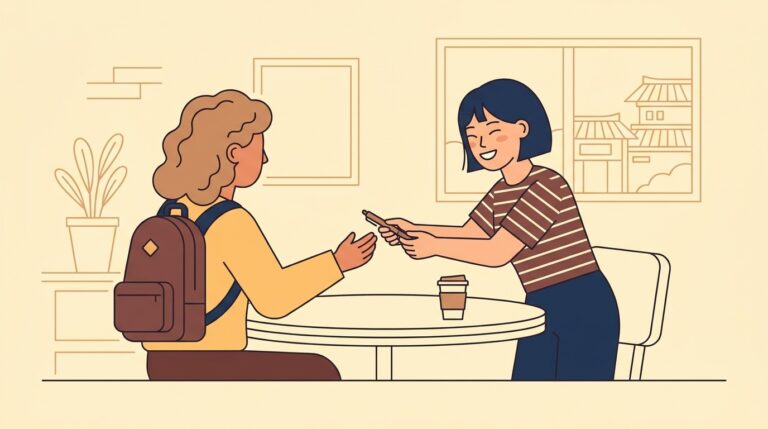
안녕하세요! I’m your Daily Hangul editor. Imagine this scene: You’re sitting in a beautiful cafe in Seongsu-dong, filling out a visitor log or writing a cute postcard. Suddenly, your ink runs dry! You spot a friendly university student at the next table with a pencil case full of colorful stationery. You know the Korean word for pen is 펜 (pen), but how do you ask to borrow one without sounding awkward, demanding, or overly stiff?
Asking for small favors in a foreign language can make your heart race. Many learners panic and say “펜 주세요!” (Give me a pen!), which actually sounds like you want to keep their pen forever! Based on real feedback from hundreds of elementary Korean learners, knowing just a couple of soft, polite expressions will transform these mini-awkward moments into memorable connections with locals. Let’s master the art of asking favors naturally!
Phase 2: 핵심 표현 3선 심층 분석 (3 Key Expressions)
1. 펜 좀 빌려주세요 (Pen jom bil-ryeo-ju-se-yo)
- Pronunciation: [pen jom beel-ryuh-joo-seh-yo] (Sounds like “pen” + “chom” + “beel-ryuh-joo-say-yo”)
- Meaning: Literal: “Please lend me a pen.” / Nuance: Soft, polite, and perfect for daily situations.
- K-Culture Moment: A classic library scene in a K-drama where two university students start talking after sharing stationery.
- Editor’s Insight: The secret ingredient here is 좀 (jom)! It literally means “a little bit”, but in Korean, it acts as a magical word that instantly softens your request from a command to a gentle ask.
- Situation Spectrum: Casual ⚠️ | Semi-formal ✅ | Formal ✅
- 🤔 Think About It: Why does adding a small word like “a little bit” make requests sound much friendlier in your culture?
2. 혹시 펜 있어요? (Hok-si pen is-seo-yo?)
- Pronunciation: [hok-shee pen ees-seh-yo?]
- Meaning: Literal: “By any chance, do you have a pen?” / Nuance: Indirect and super polite way to open a favor.
- K-Culture Moment: Asking a cafe barista or a neighbor at a communal table in Seoul.
- Editor’s Insight: 혹시 (hok-si) means “by any chance”. Koreans love indirect questions because they give the other person an easy out if they don’t have what you need!
- Situation Spectrum: Casual ✅ | Semi-formal ✅ | Formal ⚠️
- 🤔 Think About It: In English, we say “Do you happen to have…”. Isn’t it fascinating how both languages use indirectness to show politeness?
3. 죄송하지만 펜 좀 빌릴 수 있을까요? (Jwe-song-ha-ji-man pen jom bil-ril su is-seul-kka-yo?)
- Pronunciation: [chwe-song-ha-jee-man pen jom beel-reel soo ees-seul-kka-yo?]
- Meaning: Literal: “I am sorry, but could I borrow a pen?” / Nuance: Very respectful and formal.
- K-Culture Moment: Filling out forms at the airport immigration office or bank counter.
- Editor’s Insight: High politeness level! Ideal for elderly people, official staff, or total strangers in formal settings.
- Situation Spectrum: Casual 🚫 | Semi-formal ✅ | Formal ✅
- 🤔 Think About It: Korean speech levels change depending on age and social distance. How do you show social respect in your native language?
Phase 3: 교과서 한국어 vs 진짜 한국어 (Textbook vs. Real Korean)
Situation 1: Asking to borrow
- 📖 교과서 한국어: 펜을 빌려주십시오. (Pen-eul bil-ryeo-ju-sip-si-o.)
- 🗣️ 진짜 한국어: 저기요, 혹시 펜 좀 빌려주세요~ (Jeo-gi-yo, hok-si pen jom bil-ryeo-ju-se-yo~)
- 💡 왜 다를까?: “주십시오” is extremely formal—usually used in public announcements or military contexts! Real native speakers use “-주세요” combined with “혹시” (by any chance) and “저기요” (excuse me) to feel warm and natural.
Situation 2: Refusing polite request
- 📖 교과서 한국어: 아니오, 펜이 없습니다. (A-ni-o, pen-i eop-seum-ni-da.)
- 🗣️ 진짜 한국어: 아, 죄송해요! 지금 펜이 없어요. (A, jwe-song-hae-yo! Ji-geum pen-i eop-seo-yo.)
- 💡 왜 다를까?: Saying a direct “아니오” (No) sounds harsh in Korea. Koreans soften refusals by starting with “아, 죄송해요” (Ah, I’m sorry).
Phase 4: K-Culture 딥다이브 & 비언어적 매너 (Culture & Manner)
4-1. 눈치 (Nunchi) & Two-Handed Manner
In Korea, non-verbal gestures carry huge meaning! When you borrow or return a pen, always hand it over using both hands (or support your right wrist with your left hand). Also, use Nunchi (cultural awareness): if the person looks super busy or stressed, try asking someone else!
4-2. Korean Study & Stationery Culture
Korea has a vibrant study cafe and stationery culture (like Olive Young for school supplies!). Asking to borrow cute pens is a very normal, friendly interaction among students in places like Sinchon or Hongdae.
Phase 5: 실전 롤플레이 시나리오 (Real-Life Roleplay)
Setting: A cozy study cafe in Hongdae. You are writing notes, and Minjun is sitting nearby.
- You: 저기요, 혹시 펜 있으세요? (Jeo-gi-yo, hok-si pen is-seu-se-yo? / Excuse me, by any chance do you have a pen?) 🎭 [Lightly waving hand and bowing head slightly]
- Minjun: 아, 네! 펜 있어요. (A, ne! Pen is-seo-yo. / Ah, yes! I have a pen.) 🎭 [Smiling and pulling out a pen]
- You: 혹시 펜 좀 빌려주실 수 있어요? (Hok-si pen jom bil-ryeo-ju-sil su is-seo-yo? / Could you lend me a pen?) 🎭 [Holding out two hands ready to receive]
- Minjun: 그럼요. 여기 있어요. (Geu-reom-yo. Yeo-gi is-seo-yo. / Sure, here you go.) 🎭 [Handing the pen with both hands]
- You: 정말 감사합니다! 금방 쓰고 드릴게요. (Jeong-mal gam-sa-ham-ni-da! Geum-bang sseu-go deu-ril-ge-yo. / Thank you so much! I’ll use it quickly and return it.) 🎭 [Bowing head deeply]
- Minjun: 천천히 쓰셔도 돼요! (Cheon-cheon-hi sseu-syeo-do dwae-yo! / Take your time!) 🎭 [Waving hand gently with a friendly smile]
- You: 다 썼어요. 여기 있습니다. 감사합니다! (Da sseoss-eo-yo. Yeo-gi is-seum-ni-da. Gam-sa-ham-ni-da! / Finished! Here it is. Thank you!) 🎭 [Handing back pen with both hands]
- Minjun: 네, 좋은 하루 되세요! (Ne, jo-eun ha-ru dwae-se-yo! / Yes, have a nice day!) 🎭 [Nodding warmly]
🔀 Interactive Branching Point!
What if Minjun says: “아, 죄송해요. 지금 펜이 하나밖에 없어서요…” (Sorry, I only have one pen…)? How should you reply?
* Option A: “아, 괜찮아요! 감사합니다.” (Ah, it’s okay! Thank you.) ➡️ Best Choice! (Polite and respects their situation)
* Option B: [Say nothing and turn away] ➡️ Bad Choice! (Makes the moment awkward)
* Option C: “왜 없어요?” (Why don’t you have more?) ➡️ Risk Choice! (Sounds rude and demanding)
Phase 6: 10초 감정 섀도잉 드릴 (10-Sec Shadowing Drill)
[🥺 Soft & Polite]저기요 / 혹시 / 펜 좀 / 빌려주세요? (Jeo-gi-yo / hok-si / pen jom / bil-ryeo-ju-se-yo?)[😊 Grateful & Friendly]아 / 정말 / 감사합니다! (A / jeong-mal / gam-sa-ham-ni-da!)[🙏 Apologetic Refusal]아 / 죄송해요 / 지금 / 펜이 없어요. (A / jwe-song-hae-yo / ji-geum / pen-i eop-seo-yo.)
Phase 7: K-Culture 미니 사전 (Mini Dictionary)
- 빌리다 (Bil-li-da) | To borrow | Essential verb for requesting items like pens, umbrellas, or phone chargers.
- 혹시 (Hok-si) | By any chance | The magic buffer word to open polite questions.
- 좀 (Jom) | A bit / Please | A softening word inserted before requests.
- 죄송해요 (Jwe-song-hae-yo) | I’m sorry | Used before refusing or asking favors to show respect.
Phase 8: 여행자를 위한 생존 키트 (Survival Kit for Travelers)
Survival TOP 3
- 펜 빌려주세요 (Pen bil-ryeo-ju-se-yo) – Please lend me a pen.
- 여기 있어요 (Yeo-gi is-seo-yo) – Here it is.
- 감사합니다 (Gam-sa-ham-ni-da) – Thank you.
Editor’s Travel Note
Need to buy your own adorable Korean pen or stationery? Open your Naver Map App Download and search for 문구점 (stationery shop) or visit the nearest Daiso (다이소) in Seoul for ultra-affordable supplies!
Phase 9: 한 발 더 깊이 (A Step Deeper)
In Korean culture, asking for small favors like borrowing a pen isn’t seen as a burden—it’s a small spark of human connection called 정 (Jeong). Korean society values mutual help in daily community spaces. Don’t be afraid to ask politely; locals are usually more than happy to help visitors!
💬 Your Turn: Have you ever had to ask a stranger for help while traveling? What happened? Share your story in the comments below!
Phase 10: FAQ & 흔한 실수 (FAQ & Common Mistakes)
Q: Can I say “펜 좀 주세요” (Pen jom ju-se-yo) instead?
A: “주세요” means “give me”. While understood, it sounds like you are asking to keep the pen! Always use “빌려주세요” (lend me) so they know you will return it.
Q: What should I say when returning the pen?
A: Hold it with both hands and say: “다 썼어요. 감사합니다!” (I finished using it. Thank you!)
Q: How do I refuse if someone asks to borrow my pen?
A: Smile softly and say: “아, 죄송해요. 지금 펜이 없어요.” (Ah, I’m sorry. I don’t have a pen right now.)
🚨 Common Mistakes TOP 3
- Mistake: Saying “펜 주세요!” (Give me a pen!) ➡️ Fix: Add “빌려” to make it “펜 빌려주세요!”
- Mistake: Handing items with only one hand. ➡️ Fix: Always use two hands when giving or receiving.
- Mistake: Saying a cold “아니요” when refusing. ➡️ Fix: Always start with “아, 죄송해요…”
Phase 11: 액션 미션 & 참여 유도 (Action Mission)
- 🥉 Bronze Mission: Repeat “펜 좀 빌려주세요” 3 times out loud right now!
- 🥈 Silver Mission: Record your voice saying “저기요, 혹시 펜 있으세요?” and save it as a voice note.
- 🥇 Gold Mission: Use this expression at a Korean cafe or language exchange meeting this week!
- 🎮 K-Culture Mission: Watch a scene in your favorite K-drama and spot how characters use the magic word 혹시!
Phase 12: 인터랙티브 퀴즈 챌린지 (Quiz Challenge)
Q1. What is the magical Korean word that means “by any chance”?
Click to reveal answer
Answer: 혹시 (Hok-si)! It helps soften any question in Korean.
Q2. Fill in the blank: “펜 ___ 빌려주세요.” (Please lend me a pen)
Click to reveal answer
Answer: 좀 (jom)! “펜 좀 빌려주세요” is natural and polite.
Q3. True or False: Handing back a borrowed pen with two hands shows good etiquette in Korea.
Click to reveal answer
Answer: True! Using two hands shows respect and warm manners.







