

Phase 1: Empathy – Story-Driven Opening
안녕하세요! This is your Daily Hangul editor! Have you ever felt the overwhelming urge to hit the ‘pause’ button on modern life, put away your smartphone, and step into a centuries-old wooden temple tucked away in the misty Korean mountains? If so, you are definitely not alone! Templestay (템플스테이) has evolved from a niche spiritual retreat into one of South Korea’s premier global tourism resources and modern ‘healing’ (힐링) phenomena.
As a C2-level learner, you likely already know basic temple vocabulary like 절 (temple) or 스님 (monk). However, when you actually step onto the wooden floorboards of a quiet temple like Jikjisa or Haeinsa, you realize that true fluency requires an understanding of the subtle emotional depth, non-verbal respect, and refined vocabulary that turns a simple tourist visit into a soul-restoring experience. Advanced learners often struggle to bridge the gap between dictionary-definition spiritual terms and the nuanced, poetic expressions used by Koreans seeking mental rejuvenation. Based on feedback from our advanced learners at Daily Hangul, this guide will arm you with the precise linguistic tools and cultural sensitivity needed to master Templestay conversations naturally and deeply.
Phase 2: Core Expression Deep Dive
1. 마음을 비우다 (Maeumeul biuda)
- Pronunciation: [Mae-um-eul bi-u-da] (Sounds like: May-oom-ool bee-oo-da — think of emptying a glass of water)
- Meaning: Literal: To empty one’s mind/heart | Nuance: To let go of anxieties, attachments, and worldly stress to achieve mental clarity.
- K-Culture Moment: In modern K-dramas and lifestyle shows, characters often head to a temple or a quiet getaway saying, “요즘 머리가 너무 복잡해서 마음 좀 비우고 오려고요” (My mind has been so chaotic lately, I’m going to go empty my heart/mind).
- Editor’s Insight: While ‘비우다’ means ‘to empty’, in Korean spiritual culture, emptying your mind is not an act of loss; it is creating room for inner stillness and new insights. At a C2 level, use this instead of simplistic words like ‘쉬다’ (to rest).
- Situation Spectrum:
- Casual: ✅ (머리 좀 비우고 올게!)
- Semi-formal: ✅ (마음을 비우는 시간을 가지려고 합니다.)
- Formal: ✅ (마음을 비우고 온전한 자신을 마주하는 계기가 됩니다.)
- 🤔 Think About It: Does your native language view “emptying the mind” positively, or is it seen as lacking focus? How does the Korean concept of ‘비움’ (emptying) redefine your view of relaxation?
2. 차담을 나누다 (Chadameul nanuda)
- Pronunciation: [Cha-dam-eul na-nu-da] (Sounds like: Cha-dahm-ool nah-noo-da — ‘Cha’ like tea, ‘dam’ like conversation)
- Meaning: Literal: To share tea-talk | Nuance: To engage in an intimate, deep, and mindful conversation over traditional tea, typically with a Buddhist monk.
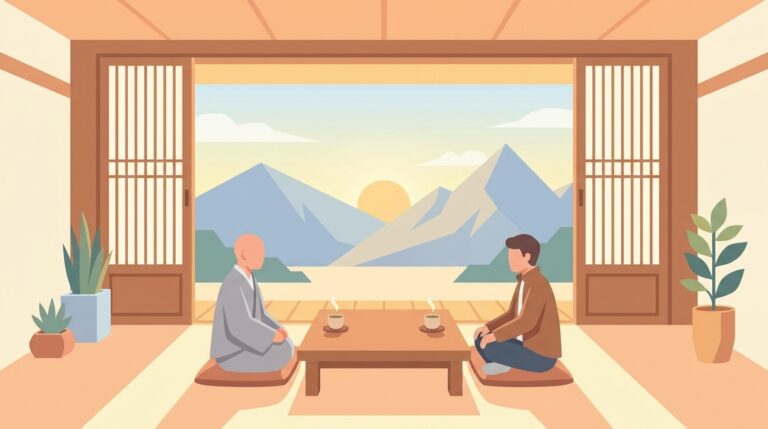
- K-Culture Moment: During a Templestay, the highlight for many travelers is the ‘차담’ session, where guests sit cross-legged with the monk, sipping green tea and discussing life’s heavy questions.
- Editor’s Insight: Notice the verb ‘나누다’ (to share) instead of ‘하다’ (to do). Tea conversation in Korean culture is seen as a reciprocal gift of wisdom and listening, rather than mere small talk.
- Situation Spectrum:
- Casual: ⚠️ (Used mostly in formal/spiritual contexts, though casual tea talk exists)
- Semi-formal: ✅ (스님과 차담을 나누며 고민을 털어놓았습니다.)
- Formal: ✅ (차담을 나누는 시간 동안 깊은 영적 위로를 받았습니다.)
- 🤔 Think About It: Why do you think Korean culture links tea consumption with deep emotional exchange rather than just a quick beverage break?
3. 온전한 휴식 (Onjeonhan hyusik)
- Pronunciation: [On-jeon-han hyu-sik] (Sounds like: Own-jeon-hahn hyoo-sheek)
- Meaning: Literal: Complete/unbroken rest | Nuance: Holistic, undisturbed rest that restores both body and mind away from digital clutter.
- K-Culture Moment: Tourism promotions for Korean wellness travels frequently highlight: “바쁜 일상에서 벗어나 온전한 휴식을 누려보세요” (Escape your busy daily life and enjoy complete, undivided rest).
- Editor’s Insight: C2 speakers distinguish between ‘그냥 쉬는 것’ (just taking a break) and ‘온전한 휴식’ (an immersive, uninterrupted state of healing). It signifies quality over duration.
- Situation Spectrum:
- Casual: ⚠️ (Slightly poetic for everyday casual chatter)
- Semi-formal: ✅ (주말 동안 온전한 휴식을 취했어요.)
- Formal: ✅ (현대인들에게는 온전한 휴식이 절실히 필요합니다.)
- 🤔 Think About It: What does ‘complete rest’ mean in your culture? Is it doing nothing, or actively engaging in spiritual practices?
Phase 3: Textbook Korean vs. Real Native Korean
Scenario 1: Expressing the need to relieve stress and reset
- 📖 Textbook Korean: 스님, 저는 요즘 스트레스가 많아서 마음의 평화를 얻고 싶습니다. (Monk, I have a lot of stress lately, so I want to gain peace of mind.)
- 🗣️ Real Native Korean: 요즘 번아웃이 와서 머릿속이 산만한데, 여기서 마음을 좀 가라앉히고 정리하고 싶어요. (I’ve been feeling burnt out lately and my head is cluttered, so I want to settle my mind and organize my thoughts here.)
- 💡 Why the difference? C2 natives rarely express psychological states in flat terms like ‘스트레스가 많다’. Instead, they use evocative verbs like ‘머릿속이 산만하다’ (cluttered mind) and ‘마음을 가라앉히다’ (settle the mind), reflecting a deeper emotional vocabulary.
Scenario 2: Describing the tranquil atmosphere of the temple
- 📖 Textbook Korean: 이 절은 매우 조용하고 풍경이 아름답습니다. (This temple is very quiet and the scenery is beautiful.)
- 🗣️ Real Native Korean: 고즈넉한 사찰 분위기 덕분에 절로 마음이 평온해지는 것 같아요. (Thanks to the quiet and serene atmosphere of the temple, my heart naturally feels at peace.)
- 💡 Why the difference? Native Koreans use ‘고즈넉하다’ to capture the unique, peaceful quietness of traditional Korean heritage sites. Adding ‘절로’ (naturally/spontaneously) emphasizes an effortless inner state.
Phase 4: K-Culture Deep Dive & Non-Verbal Manners
4-1. Nunchi & Temple Etiquette Gestures
When participating in Templestay, your physical posture speaks louder than your words.
* Hapjang (합장): Pressing both palms together in front of your chest while slightly lowering your head. This gesture signifies respect, unity, and non-duality. Do this whenever greeting a monk or entering a temple hall.
* Chagwan (차관) & Voice Modulation: Inside temple grounds, practice Nunchi by lowering your speaking tone by two levels. Loud laughter or energetic arm movements disrupt the communal ‘적막’ (tranquil silence).
4-2. Culture Code: From Sacred Tradition to Tourism Healing
In modern Korea, Templestay is no longer strictly religious—it is recognized as a psychological sanctuary. As urban burnout rises, Korean youth and international travelers alike embrace ‘디지털 디톡스’ (Digital Detox) through temple programs. The Korean government and Buddhist associations have modernized these stays, offering minimalist design, vegan temple cuisine (Baru Gongyang), and mindfulness walks without pushing dogmatic beliefs. Understanding this allows you to speak about Templestay not just as an ancient ritual, but as an active wellness movement.
Phase 5: Real-life Roleplay Scenario
Setting: A sunlit tea room at Golgulsa Temple. Sunim (a Buddhist monk) is pouring warm mugwort tea for Alex, an advanced Korean language learner.
Characters:
* 스님 (Sunim): Gentle, perceptive, speaks with calm formal grace.
* 알렉스 (Alex – You): C2 learner seeking mental clarity after months of intense work.
Dialogue:
1. 스님: 🎭 (차를 따르며 따뜻한 미소를 짓는다) 차 한잔 드시지요. 산사까지 오시느라 고생 많으셨습니다. (Please have some tea. You must have worked hard to come all the way to this mountain temple.)
2. 알렉스: 🎭 (두 손으로 차잔을 받으며 고개를 숙인다) 감사합니다, 스님. 들어오는 길에 들리는 풍경소리 덕분에 벌써 마음이 가벼워집니다. (Thank you, Sunim. Thanks to the sound of the wind chimes on the way in, my heart already feels lighter.)
3. 스님: 🎭 (차향을 음미하며) 다행이군요. 요즘 어떤 마음의 짐을 안고 이곳을 찾으셨습니까? (That is a relief. What kind of burden in your heart brought you here today?)
4. 알렉스: 🎭 (시선을 차잔에 두었다가 스님을 바라보며) 사실 치열한 일상에 쫓기다 보니 온전한 제 자신을 잃어버린 기분이 들었습니다. (To be honest, being chased by intense daily routine made me feel like I lost my authentic self.)
5. 스님: 🎭 (고개를 천천히 끄덕인다) 비우지 않으면 새것을 채울 수 없는 법이지요. 이곳에 계신 동안은 무엇을 하려고 애쓰지 마세요. (If you don’t empty, you cannot fill anew. While you are here, do not strive to do anything.)
6. 알렉스: 🎭 (깊은 숨을 내쉬며) 무엇을 하지 않을 권리를 잊고 살았던 것 같아요. 머릿속 비우기가 생각보다 쉽지 않네요. (I think I forgot the right to do nothing. Emptying my head isn’t as easy as I thought.)
7. 스님: 🎭 (찻잔을 가볍게 내려놓으며) 그 마음마저 내려놓는 것이 참선입니다. 흐르는 물처럼 그대로 두어 보세요. (Putting down even that thought is true Zen practice. Let it be like flowing water.)
8. 알렉스: 🎭 (합장하며) 네, 스님. 이번 템플스테이를 통해 제 안의 소리에 귀 기울여 보겠습니다. (Yes, Sunim. Through this Templestay, I will try to listen to the voice within me.)
🔀 Interactive Choice Point
After the monk tells you to let your thoughts flow like water, how do you respond?
- Option A: “스님 말씀이 맞아요! 오늘부터 스마트폰 완전히 끄고 아무 생각도 안 해볼게요!” (You are right! Starting today I’ll turn off my phone and think about nothing!)
- Option B: “내려놓는다는 게 말처럼 쉽지 않지만, 애쓰지 않고 자연스럽게 머물러 보겠습니다.” (Putting it down isn’t as easy as it sounds, but I will try to stay naturally without forcing it.)
- Option C: “스님, 참선을 잘하려면 하루에 몇 시간씩 앉아 있어야 하나요?” (Sunim, how many hours a day should I sit to be good at Zen meditation?)
Feedback:
* Option A (Risk): Too enthusiastic and energetic for the tranquil tea room setting. While turning off your phone is good, exclaiming it loudly breaks the ‘차담’ atmosphere.
* Option B (BEST ⭐): Demonstrates high-level native emotional intelligence. Uses nuanced language (‘말처럼 쉽지 않지만’, ‘애쓰지 않고’) that reflects true comprehension of monk’s advice.
* Option C (Bad): Focuses on achievement and performance (“how many hours to be good”), which contradicts the Buddhist spiritual concept of releasing goals.
Phase 6: 10-Second Emotion Shadowing Drill
Practice these high-level emotional sentences with natural pauses (/) and feeling markers:
- [😊 온화하고 평온하게 – Gentle & Serene]
복잡한 도시에서 벗어나 / 고즈넉한 산사에 오니 / 비로소 숨이 쉬어지는 것 같아요.
(Bok-jap-han do-si-e-seo beot-eo-na / go-jeu-neok-han san-sa-e o-ni / bi-ro-so sum-i swi-eo-ji-neun geot gata-yo.) -
[🥺 차분하고 솔직하게 – Calm & Candid]
앞만 보고 달리느라 / 정작 제 마음을 / 돌아볼 여유가 없었습니다.
(Amp-man bo-go dal-li-neu-ra / jeong-jak je mae-um-eul / do-ra-bol yeo-yu-ga eop-seot-seum-ni-da.) -
[🧘♂️ 깊이 있고 정갈하게 – Deep & Receptive]
스님과의 차담을 통해 / 마음의 짐을 / 한결 내려놓을 수 있었습니다.
(Seu-nim-gwa-ui cha-dam-eul tong-hae / mae-um-ui jim-eul / han-gyeol nae-ryeo-noh-eul su it-seot-seum-ni-da.)
Phase 7: K-Culture Mini Dictionary
- 발우공양 (Baru Gongyang) | Traditional Temple Dining
- The ritualistic, zero-waste meal eaten in wooden bowls (baru). It teaches gratitude for every grain of rice and nature’s labor.
- 참선 (Chamseon) | Zen Meditation
- Seated meditation practice aimed at gaining insight into one’s true nature by quiet mind observation.
- 포행 (Pohaeng) | Mindful Walking Meditation
- Slow, conscious walking through nature or temple grounds, aligning breath with every footprint.
- 적막 (Jeongmak) | Profound Tranquil Silence
- A rich, therapeutic silence free from artificial noise, highly prized by urban retreatants.
Phase 8: Traveler’s Survival Kit
Top 3 Spiritual Wellness Phrases
- 템플스테이 예약 확인하고 싶은데요. (I’d like to confirm my Templestay reservation.)
- 공양 시간은 몇 시인가요? (What time is the temple meal served?)
- 스님과 차담 시간을 가질 수 있을까요? (Is it possible to have a tea conversation session with a monk?)
Editor’s Travel Note
Before embarking on your spiritual trip, check program options on the Templestay Official Reservation Portal. Choose between ‘체험형’ (Experiential – includes lantern making, martial arts) and ‘휴식형’ (Restful – maximum free time, meditation, quiet walks). Also, download the Naver Map Navigation App to check rural bus routes, as ancient temples are often located deep within national parks!
Phase 9:
Frequently Asked Questions (FAQ)
Q: What does "마음을 비우다 (Maeumeul biuda)" mean in Korean and how do you pronounce it?
A: In Korean, "마음을 비우다 (Maeumeul biuda)" is pronounced [Mae-um-eul bi-u-da] and means: Literal: To empty one's mind/heart | Nuance: To let go of anxieties, attachments, and worldly stress to achieve mental clarity.
Q: What does "차담을 나누다 (Chadameul nanuda)" mean in Korean and how do you pronounce it?
A: In Korean, "차담을 나누다 (Chadameul nanuda)" is pronounced [Cha-dam-eul na-nu-da] and means: Literal: To share tea-talk | Nuance: To engage in an intimate, deep, and mindful conversation over traditional tea, typically with a Buddhist monk.
Q: What does "온전한 휴식 (Onjeonhan hyusik)" mean in Korean and how do you pronounce it?
A: In Korean, "온전한 휴식 (Onjeonhan hyusik)" is pronounced [On-jeon-han hyu-sik] and means: Literal: Complete/unbroken rest | Nuance: Holistic, undisturbed rest that restores both body and mind away from digital clutter.







