

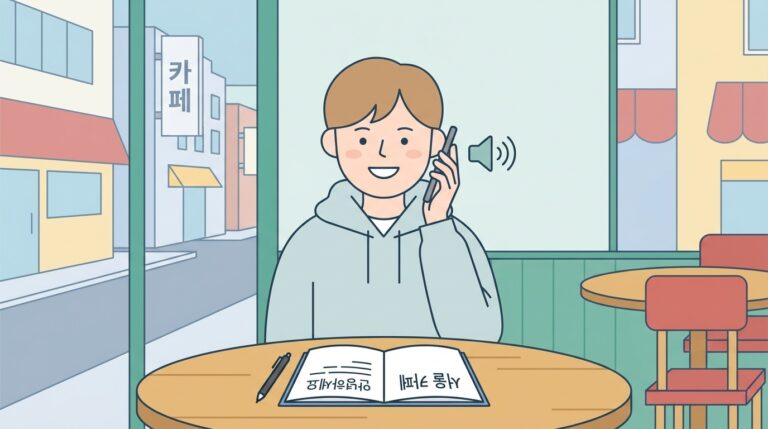
Phase 1: Welcome! (안녕하세요! 매일한글 에디터입니다.)
Have you ever been on a phone call in Korea, walking down a noisy street in Hongdae or trying to show a recipe to a friend while holding your phone, only to realize you desperately need your hands free? You press the speaker button, but suddenly you panic—How do I tell the person on the other end that they are on speakerphone so they don’t say something super private in front of everyone?
Or picture this classic K-Drama scene: someone answers a call on speakerphone while surrounded by friends, and the caller instantly blurts out a secret crush! Awkward, right?
In Korean culture, putting someone on speakerphone without telling them can lead to major social slip-ups. As your Korean language buddy and local navigator, I’m here to make sure you navigate these moments with confidence and style. Based on real learner feedback and everyday situations in Korea, this guide will give you the exact A2-level phrases you need to switch to speakerphone smoothly and politely!
Phase 2: Top 3 Core Expressions
1. 스피커폰으로 바꿀게요 (Seupeikeoponeuro bakkulgeyo)
- Pronunciation: [seu-pee-keo-pon-eu-ro ba-kkul-ge-yo] (Sounds like “speaker-phone” + “eu-ro” as in ‘towards’, and “ba-kkul-ge-yo” like ‘bah-kwool-geh-yo’)
- Meaning: “I’ll switch to speakerphone.” (Literal: “I will change to speakerphone.”)
- K-Culture Moment: You are carrying bags of fried chicken (Chimaek!) in both hands, and your friend calls to check where you are. You answer and say this right away!
- Editor’s Insight: Using the ending
~ㄹ게요 (~lgeyo)shows your clear intention to do something right at that moment. It sounds proactive and polite! - Situation Spectrum:
- Casual: 스피커폰으로 바꿀게! ✅
- Semi-formal: 스피커폰으로 바꿀게요! ✅
- Formal: 스피커폰으로 변경하겠습니다. 🚫 (Too stiff for daily calls!)
- 🤔 Think About It: In your culture, do people warn the other caller before putting them on speakerphone? Why is transparency so important in conversational etiquette?
2. 스피커폰 켜져 있어요 (Seupeikeopon kyeojyeo isseoyo)
- Pronunciation: [seu-pee-keo-pon kyeo-jyeo is-seo-yo] (Think of “kyeo” like ‘kyaw’ as in ‘yawn’)
- Meaning: “The speakerphone is on.” / “You are on speakerphone.”
- K-Culture Moment: When your roommate enters the room while you are talking to your mom on the phone, you say this to let both sides know they aren’t alone!
- Editor’s Insight:
켜져 있다 (kyeojyeo itda)means a state of being turned on. It serves as a polite heads-up to avoid unintentional gossip exposure. - Situation Spectrum:
- Casual: 스피커폰 켜져 있어! ✅
- Semi-formal: 스피커폰 켜져 있어요. ✅
- Formal: 현재 스피커폰 상태입니다. ⚠️ (Sounds like an automated system!)
- 🤔 Think About It: How does saying this sentence protect both you and the person on the other end of the line?
3. 잘 안 들려요 (Jal an deullyeoyo)
- Pronunciation: [jal an deul-lyeo-yo] (Sounds like ‘jahl ahn deol-lyaw-yo’)
- Meaning: “I can’t hear you well.” (Literal: “It isn’t heard well.”)
- K-Culture Moment: You are inside a loud subway train on Seoul Subway Line 2. You need to switch to speakerphone or ask them to speak up!
- Editor’s Insight:
안 (an)means ‘not’, and들려요 (deullyeoyo)means ‘is heard’. It’s much softer and more natural than saying “You are speaking too softly.” - Situation Spectrum:
- Casual: 잘 안 들려! ✅
- Semi-formal: 잘 안 들려요. ✅
- Formal: 잘 들리지 않습니다. ⚠️ (Used in formal business settings)
- 🤔 Think About It: Notice how Korean uses passive verbs like “it isn’t heard” rather than blaming the speaker (“You aren’t speaking loud”)? How does this reflect Korean politeness?
Phase 3: Textbook Korean vs. Real Korean
Situation 1: Letting someone know you are turning on the speaker
- 📖 Textbook Korean: 스피커폰을 사용하겠습니다. (Seupeikeoponeul sayonghagessseumnida. – “I will utilize the speakerphone.”)
- 🗣️ Real Korean: 스피커폰 켤게요! (Seupeikeopon kyeolgyeyo! – “I’m turning on speakerphone!”)
- 💡 Why is it different? The textbook phrase sounds like a formal public announcement. Real Koreans use the light and friendly action verb
켜다 (kyeoda - to turn on)in daily phone calls.
Situation 2: Explaining why you can’t hear well
- 📖 Textbook Korean: 음성이 명확하지 않습니다. (Eumseongi myeonghwakhaji anseumnida. – “The audio is not clear.”)
- 🗣️ Real Korean: 소리가 잘 안 들려요. (Soriga jal an deullyeoyo. – “The sound isn’t heard well.”)
- 💡 Why is it different? Real conversation relies on simple words like
소리 (sori - sound)and잘 안 들려요 (jal an deullyeoyo)to keep things friendly and natural.
Phase 4: K-Culture Deep Dive & Non-verbal Manners
4-1. Nunchi (눈치) & Speakerphone Etiquette
In Korea, Nunchi (tact/social awareness) is everything! Putting someone on speakerphone in a crowded cafe, bus, or quiet public space is considered a major faux pas. If you must switch to speakerphone because your hands are busy, immediately give a quick head nod to people nearby (if any) and inform the caller: “지금 스피커폰이에요!” (Jigeum seupeikeoponieyo! – It’s on speakerphone right now!) This lets the caller adjust their tone and topic.
4-2. Culture Code: Multitasking & Delivery Calls
When ordering food via apps or waiting for a delivery driver (택배 아저씨), Koreans often put calls on speakerphone while checking door codes or organizing items. Showing quick courtesy while multitasking makes your everyday interactions in Korea super smooth!
Phase 5: Interactive Roleplay Scenario
Setting: You are cooking Korean street food (Tteokbokki!) at home. Your Korean friend Min-jun (민준) calls you on your phone.
- Turn 1 (Min-jun): 여보세요? 지금 뭐 해요? (Yeoboseyo? Jigeum mwo haeyo? / Hello? What are you doing right now?)
- Turn 2 (You): 🎭 Holding a ladle, pressing speaker button / 여보세요! 나 지금 떡볶이 만들고 있어. (Yeoboseyo! Na jigeum tteokbokki mandeulgo isseo. / Hello! I’m making Tteokbokki right now.)
- Turn 3 (Min-jun): 진짜요? 우와, 맛있겠다! 그런데 왜 목소리가 울려요? (Jinjja-yo? Uwa, masitgetda! Geureonde wae moksoriga ullyeoyo? / Really? Wow, must be delicious! But why does your voice echo?)
- Turn 4 (You): 🎭 Explaining naturally / 아, 손이 바빠서 스피커폰 켰어요! (A, son-i bappaseo seupeikeopon kyeosseoyo! / Ah, my hands are busy so I turned on speakerphone!)
- Turn 5 (Min-jun): 아하! 그렇구나. 옆에 다른 사람도 있어? (Aha! Geureokguna. Yeope dareun saramdo isseo? / Aha! I see. Is anyone else next to you?)
- Turn 6 (You): 🎭 Reassuring him / 아니요, 혼자 있어요. 편하게 말해요! (Aniyo, honja isseoyo. Pyeonhage malhaeyo! / No, I’m alone. Speak comfortably!)
- Turn 7 (Min-jun): 다행이다! 그럼 떡볶이 다 만들고 다시 통화할까요? (Dahaeng-ida! Geureom tteokbokki da mandeulgo dasi tonghwahalkkayo? / What a relief! Then shall we talk again after you finish making Tteokbokki?)
- Turn 8 (You): 🎭 Smiling / 그래요, 금방 다시 전화할게요! (Guraeyo, geumbang dasi jeonhwahalgeyo! / Okay, I’ll call you back shortly!)
🔀 Interactive Choice Point
Min-jun asks: “왜 목소리가 울려요?” (Why does your voice echo?) What do you respond?
- Choice A: 스피커폰 켰어요! (I turned on speakerphone!)
- Choice B: 몰라요, 전화 끄세요. (I don’t know, hang up the phone.)
- Choice C: 스피커폰을 사용하고 있는 중입니다. (I am in the middle of utilizing the speakerphone.)
👉 Click to see feedback on your choice!
- Choice A (BEST! 🏆): Perfect! It’s natural, friendly, and perfectly suited for A2 level.
- Choice B (BAD! ❌): Ouch! “전화 끄세요” sounds very blunt and rude to a friend.
- Choice C (RISK! ⚠️): Grammatically correct, but sounds like a robot or a customer service center!
Phase 6: 10-Second Emotion Shadowing Drill
Practice these lines with rhythm and realistic facial expressions!
[😅 Apologetic & Busy]손이 바빠서 / 스피커폰 켰어요! (Son-i bappaseo / seupeikeopon kyeosseoyo!)[😊 Cheerful & Friendly]잘 안 들려요 / 스피커폰으로 바꿀게요! (Jal an deullyeoyo / seupeikeoponeuro bakkulgeyo!)[🤫 Cautionary & Gentle]지금 / 스피커폰 켜져 있어요! (Jigeum / seupeikeopon kyeojyeo isseoyo!)
Phase 7: K-Culture Mini Dictionary
- 스피커폰 (Seupeikeopon) | Speakerphone | Used when switching audio to public speaker during calls.
- 음소거 (Eumsogeo) | Mute | The button you hit when coughing or in a noisy room (
음소거 할게요= I’ll mute). - 통화 (Tonghwa) | Phone call/conversation | The noun for talking on the phone (
통화 중= On another call). - 진동 (Jindong) | Vibrate mode | Setting your phone to vibrate in public places in Korea (
진동으로 바꿨어요= Switched to vibrate).
Phase 8: Traveler’s Survival Kit
TOP 3 Phone Survival Expressions
- 스피커폰으로 해 주세요. (Seupeikeoponeuro hae juseyo.) – Please put it on speakerphone (e.g., when asking a friend to share the call audio with someone next to them).
- 소리 조금만 키워 주세요. (Sori jogeumman kiwoo juseyo.) – Please turn up the volume a little bit.
- 나중에 다시 걸게요. (Najunge dasi geolgeyo.) – I’ll call you back later.
💡 Editor’s Travel Note
When navigating Korea, phone calls with taxi drivers or delivery hosts are common. Make sure you get the 네이버 지도 앱 다운로드 (Naver Map App Download) to track your route in real-time while talking on speakerphone!
Phase 9: One Step Deeper
In Korean culture, telephone etiquette revolves around consideration for others’ personal boundaries (배려, Baeryeo). Because voice sounds carry easily in Korea’s densely populated urban spaces, keeping phone conversations private—or giving immediate notice when putting someone on speakerphone—is a fundamental sign of respect. It reflects the harmony between personal respect and community manners.
💬 Your Turn: Have you ever accidentally kept someone on speakerphone in an awkward situation? Share your fun story in the comments below!
Phase 10: FAQ & Common Mistakes
Q: Can I use “스피커” instead of “스피커폰”?
A: Yes! Saying “스피커 켰어요” (Seupeikeo kyeosseoyo) is very common in casual speech among friends.
Q: How do I tell someone I’m putting them on speaker politely to an elder?
A: Use honorifics! Say: “어르신, 잘 안 들려서 스피커폰으로 바꾸겠습니다.” (Eoresin, jal an deullyeoseo seupeikeoponeuro bakkkugessseumnida.)
Q: What is the difference between “전화를 켜다” and “스피커폰을 켜다”?
A: You don’t say “전화를 켜다” for answering a call; you say “전화를 받다” (answer a call). But for speakerphone, you use “켜다” (turn on).
🚨 Common Mistakes TOP 3
- ❌ 스피커폰 열었어요 (Opened speakerphone) ➡️ ✅ 스피커폰 켰어요 (Turned on speakerphone)
- ❌ 너 스피커폰이야! (You are a speakerphone!) ➡️ ✅ 스피커폰 켜져 있어! (The speakerphone is turned on!)
- ❌ 소리 없어요 (There is no sound – wrong context) ➡️ ✅ 잘 안 들려요 (I can’t hear you well)
Phase 11: Action Mission
- 🥉 Bronze: Say “스피커폰 켰어요!” out loud 3 times in front of your mirror.
- 🥈 Silver: Record your voice shadowing Phase 6 phrases and post it on your Instagram story tagging
@DailyHangul! - 🥇 Gold: Use “스피커폰으로 바꿀게요” on your next actual Korean call or practice with a language exchange partner!
🎮 K-Culture Mission: Watch a K-Drama episode today and spot the exact moment a character switches to speakerphone! What word did they use?
Phase 12: Interactive Quiz Challenge
Q1. Fill in the blank:
“손이 바빠서 스피커폰 ______.”
(Because my hands are busy, I turned on the speakerphone.)
* A) 껐어요
* B) 켰어요
* C) 먹었어요
Q2. True or False:
It is totally fine to put your friend on speakerphone in a crowded Korean quiet cafe without telling them.
* (True / False)
🎁 Click here to check Answer & Explanations!
- Q1 Answer: B) 켰어요 (켜다 = to turn on. 껐어요 = turned off).
- Q2 Answer: False! In Korea, it is polite to inform the caller and mind your environment before using speakerphone in public.







