

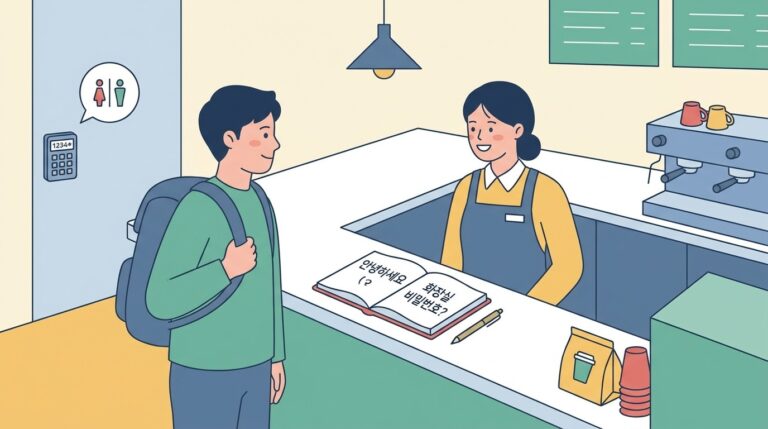
Phase 1: Empathy – The Unexpected Cafe Dilemma
안녕하세요! I’m your Daily Hangul tutor! Have you ever settled into a cozy cafe in Seoul, enjoyed a delicious iced Americano, and suddenly realized you need to use the restroom? You walk up to the restroom door, but wait… there’s a digital keypad lock! You rush back to the counter, but your mind goes completely blank. Don’t panic! This is one of the most common right-of-passage experiences for anyone living in or visiting Korea. In Korea, most cafes, restaurants, and shops keep their restrooms locked with a door code (비밀번호) or attach a key to a giant doll to keep it private for customers. Master this simple 1-minute lesson based on real student experiences, and you’ll never face a restroom emergency in Korea again!
Phase 2: Top 3 Essential Expressions
1. 화장실 비밀번호가 뭐예요? (Hwajangsil bimilbeonhoga mwoyeyo?)
- Pronunciation: Hwa-jang-sil bee-meel-beon-ho-ga mwo-ye-yo? (Sounds like: Hwa-jang-seel be-meal-burn-ho-ga mwo-yeh-yo?)
- Meaning: Literal: “What is the restroom password?” | Nuance: A polite and direct way to ask for the door code.
- K-Culture Moment: You’ll see this scene constantly in K-Dramas where a character looks at a receipt frantically searching for four digits!
- Editor’s Insight: ‘비밀번호’ means ‘password’ or ‘PIN’. Koreans shorten it to ‘비번’ (Bibeon) in casual speech, but asking ‘비밀번호가 뭐예요?’ is perfect for A2 learners.
- Situation Spectrum: Casual ⚠️ | Semi-formal ✅ | Formal ✅
- 🤔 Think About It: In your home country, do restrooms usually have digital keypad locks? Why do you think Korean cafes use pin codes instead of physical keys?
2. 화장실 어디에 있어요? (Hwajangsil eodie issoyeo?)
- Pronunciation: Hwa-jang-sil eo-di-e iss-eo-yo? (Sounds like: Hwa-jang-seel oh-dee-eh eess-oh-yo?)
- Meaning: Literal: “Where is the restroom?” | Nuance: Asking for the physical location of the bathroom.
- K-Culture Moment: Asking this at a busy K-BBQ restaurant when the restroom is actually outside the building!
- Editor’s Insight: If the staff points outside, they will usually give you a key or tell you a passcode right after.
- Situation Spectrum: Casual ⚠️ | Semi-formal ✅ | Formal ✅
- 🤔 Think About It: How does asking for directions directly reflect the fast-paced ‘Pali-pali’ (hurry-hurry) culture of modern Korea?
3. 영수증에 적혀 있어요? (Yeongsujeunge jeokhyeo issoyeo?)
- Pronunciation: Yeong-su-jeung-e jeok-hyeo iss-eo-yo? (Sounds like: Yung-soo-jung-eh jug-hyeo eess-oh-yo?)
- Meaning: Literal: “Is it written on the receipt?” | Nuance: Checking if the passcode is printed at the bottom of your receipt.
- K-Culture Moment: When ordering at a self-service kiosk, the passcode is almost always automatically printed at the very bottom of the receipt!
- Editor’s Insight: Don’t throw away your receipt immediately! Cafe staff often print the code, Wi-Fi password, and restroom code together at the bottom.
- Situation Spectrum: Casual ⚠️ | Semi-formal ✅ | Formal ✅
- 🤔 Think About It: Why do you think Korean businesses prefer printing information on receipts rather than shouting it out?
Phase 3: Textbook Korean vs. Real-Life Korean
Situation 1: Asking for the code quickly
* 📖 Textbook Korean: 화장실 비밀번호를 가르쳐 주시겠습니까? (Hwajangsil bimilbeonhoreul gareuchyeo jusigessneumnika?)
* 🗣️ Real-Life Korean: 저기요, 화장실 비번 뭐예요? (Jeogiyo, hwajangsil bibeon mwoyeyo?)
* 💡 Why is it different? Native speakers shorten ‘비밀번호’ to ‘비번’ (bi-beon) in daily life to save time, and use ‘저기요’ (Excuse me) to politely grab attention.
Situation 2: Finding out if you need a key or passcode
* 📖 Textbook Korean: 화장실 열쇠는 어디에 있습니까? (Hwajangsil yeolsoeneun eodie issneumnika?)
* 🗣️ Real-Life Korean: 화장실 키 갖고 가야 돼요? (Hwajangsil ki gatgo gaya dwaeyo?)
* 💡 Why is it different? Koreans frequently use the English loanword ‘키’ (key) instead of ‘열쇠’ (yeolsoe) in modern casual conversations.
Phase 4: K-Culture Deep Dive & Mannerisms
4-1. Nunchi (눈치) & Gestures
When asking staff for the bathroom code, make gentle eye contact and tap your receipt lightly if you hold one. If the staff points a thumb behind their back toward an exit door, it means the restroom is located outside in the building hallway. Don’t forget to give a slight nod (about 15 degrees) when saying “감사합니다” (Thank you).
4-2. K-Culture Code: Receipts & Building Layouts
In Korea’s urban spaces, many small cafes share a common building restroom located in the stairwell. To prevent non-customers from using it, cafes install door locks. Always check the very bottom of your receipt first! You’ll often see terms like ‘화장실 암호’ or ‘W.C. 비밀번호: 1234*’. Note the star (*) or hashtag (#) key at the end—you often need to press it on the keypad!
Phase 5: Real-Life Roleplay Scenario
Setting: A trendy cafe in Hongdae. You just finished your coffee and need to use the bathroom.
Characters: You (Learner) & Barista (Friendly NPC)
- You: 저기요, 화장실이 어디에 있어요? (Jeogiyo, hwajangsil-i eo-di-e iss-eo-yo?)
🎭 [Politely waving hand slightly] - Barista: 카페 밖으로 나가셔서 오른쪽 계단 옆에 있어요. (Kape baggeuro nagasyaseo oreunjjok gyaedan yeope issoyeo.)
🎭 [Pointing toward the front door] - You: 아, 그래요? 혹시 비밀번호 있어요? (A, geuraeyo? Hoksi bimilbeonho issoyeo?)
🎭 [Looking curious and pointing to your receipt] - Barista: 네, 비밀번호 눌러야 돼요. (Ne, bimilbeonho nulleoya dwaeyo.)
🎭 [Nodding warmly] - You: 영수증에 적혀 있어요? (Yeongsujeunge jeokhyeo issoyeo?)
🎭 [Holding up your receipt] - Barista: 네! 맨 밑에 ‘1234‘라고 적혀 있어요. (Ne! Maen mite ‘1234‘rago jeokhyeo issoyeo.)
🎭 [Pointing to the bottom of the paper] - You: 아, 확인했어요! 휴지는 가져가야 돼요? (A, hwaginhaess-eoyo! Hyujineun gajeogaya dwaeyo?)
🎭 [Looking around for tissue paper] - Barista: 아니요, 화장실 안에 있어요~ (Aniyo, hwajangsil ane issoyeo~)
🎭 [Smiling reassuringly]
🔀 Interactive Choice Point
The door keypad is beep-booping red! What do you do?
* Choice A: Press the 4-digit number and walk away when it doesn’t open.
* Choice B: Press the 4-digit number and then press the ‘*’ (star) or ‘#’ (pound) button.
* Choice C: Yell at the door in English.
Feedback:
* Choice A (Bad): Korean door locks usually require pressing ‘*’ or ‘#’ at the end! You’ll remain stuck outside.
* Choice B (BEST!): Perfect! Almost all digital keypads in Korea require pressing the star or pound key after entering digits.
* Choice C (Risk): People nearby might get confused! Just walk back to the cafe counter and ask politely again.
Phase 6: 10-Second Emotion Shadowing Drill
Practice saying these lines with real human feeling! / indicates a short pause.
[🥺 Urgent & Polite]저기요 / 화장실 / 어디에 있어요? (Jeogiyo / hwajangsil / eodie issoyeo?)[💡 Realization]아! / 영수증 밑에 / 있네요! (A! / yeongsujeung mite / itneyeo!)[😊 Relieved & Grateful]감사합니다! / 금방 다녀올게요! (Gamsahamnida! / geumbang danyeoolgeyo!)
Phase 7: K-Culture Mini Dictionary
- 비번 (Bibeon) | Short for 비밀번호 | Used constantly in daily conversation for door locks, Wi-Fi, and phones.
- 영수증 (Yeongsujeung) | Receipt | Crucial paper in Korea where Wi-Fi passwords and bathroom codes are printed.
- 휴지 (Hyuji) | Toilet paper / Tissue | Some older places require you to grab tissue from the counter before heading out!
- 도어락 (Do-eo-rak) | Digital Door Lock | Keypad locks installed on almost all Korean home and commercial doors.
Phase 8: Traveler’s Survival Kit
Survival Top 3
- 화장실 비밀번호 뭐예요? (Restroom password, please?)
- 휴지 있어요? (Is there toilet paper?)
- 밖으로 나가야 돼요? (Do I have to go outside?)
Editor’s Travel Note
When traveling in Korea, download the Naver Map App Download to easily locate open public restrooms near subway stations if cafes are closed! Subway stations always offer clean, passcode-free restrooms.
Phase 9: A Step Deeper (Thinking Point)
In many Western cultures, restrooms in commercial spaces are open or require a physical key attached to a heavy object. In high-tech Korea, electronic keypads (도어락) are the norm even for public-adjacent facilities. This blend of security, digital convenience, and trust reflects Korea’s unique urban infrastructure. Next time you see a door code on a receipt, you’re experiencing a mini slice of modern Korean digital lifestyle!
💬 Your Turn: Have you ever been surprised by a password-locked bathroom in Korea or another country? Share your experience in the comments below!
Phase 10: FAQ & Common Mistakes
Q: What if I didn’t get a receipt at the cafe?
A: Simply ask the staff: “저기요, 화장실 비밀번호 알려주세요!” (Jeogiyo, hwajangsil bimilbeonho allyeojuseyo – Excuse me, please tell me the restroom code!).
Q: Why isn’t the restroom door opening even after entering the code?
A: Check if you need to press ‘*’ (star) or ‘#’ (pound) after the digits, or check if the lock requires you to touch the screen first to light up the numbers.
Q: Is toilet paper inside the stall?
A: Most modern cafes have paper inside, but older building restrooms might have a single roll mounted on the hallway wall outside the stall!
🚨 Common Mistakes TOP 3
- Wrong: Entering digits without pressing
*at the end.- Correct Action: Always press
[Code] + *on electronic locks.
- Correct Action: Always press
- Wrong: Throwing away the receipt before going to the restroom.
- Correct Action: Hold onto your receipt until you’ve successfully used the facilities!
- Wrong: Searching inside the cafe for a restroom that is actually out in the hallway.
- Correct Action: If you see no door inside, ask “밖으로 나가야 돼요?” (Do I go outside?).
Phase 11: Action Mission
- 🥉 Bronze Level: Practice saying “화장실 비밀번호가 뭐예요?” out loud 3 times in front of a mirror.
- 🥈 Silver Level: Next time you get a store receipt, find where the numbers are printed!
- 🥇 Gold Level: Visit a local Korean cafe or restaurant and ask the staff for the restroom location in Korean!
🎮 K-Culture Mission: Watch a scene in a K-drama set in a cafe and spot if the characters check their receipt or carry a key attached to a plushie!
Phase 12: Interactive Quiz Challenge
Q1. What is the shortened word for ‘비밀번호’ (password)?
* A) 비번 (Bibeon)
* B) 비비 (Bibi)
* C) 번호 (Beonho)
👉 Click to see the answer!
Answer: A) 비번 (Bibeon)
Explanation: Native speakers frequently shorten ‘비밀번호’ to ‘비번’ in daily speech.
Q2. True or False: In Korea, you usually need to press ‘*’ or ‘#’ after typing the 4-digit bathroom code.
👉 Click to see the answer!
Answer: True!
Explanation: Most digital door locks (도어락) in Korea require pressing the star or pound key to finalize the passcode.







