

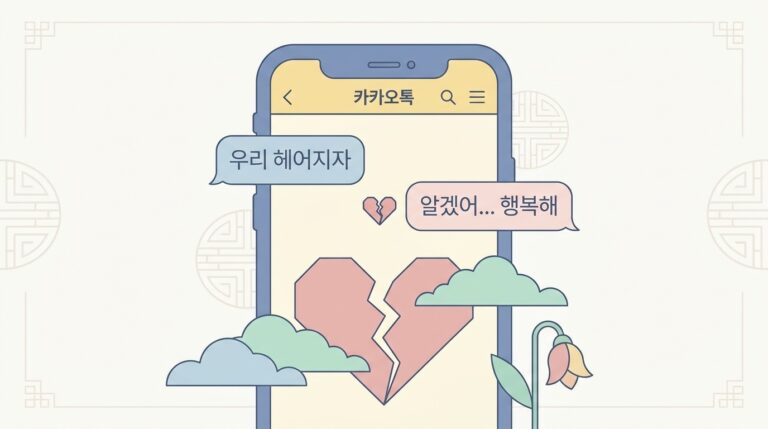
Phase 1: Empathy & Storytelling
안녕하세요! I’m your Daily Hangul lead editor and local culture navigator! Have you ever watched a K-Drama where the main characters break up through a cold KakaoTalk message, leaving one person staring at the screen in utter disbelief? Breaking up via text is a delicate topic in Korea. While sending a text like “우리 헤어지자” (Let’s break up) might feel abrupt, sometimes it’s the only way to draw a clear line when conflict reaches its peak.
Many intermediate Korean learners know how to say simple breakup phrases, but they struggle with nuance—ending things politely without causing unnecessary drama, or understanding how heavy a single text message can feel in modern Korean dating culture. In this guide based on real learner experiences and cultural insights, you’ll master how to express breakups, navigate text-based conflicts, and read between the lines like a true native. Let’s dive in together!
Phase 2: Core Expressions Deep Dive
1. 우리 헤어지자 (Uri he-eo-ji-ja)
- Pronunciation: [Uri he-eo-ji-ja] (Sounds like: Oo-ree hay-aw-jee-jah)
- Meaning: Literal: “Let’s separate.” / Nuance: “Let’s break up.”
- K-Culture Moment: The classic text message line right before a dramatic K-Drama soundtrack drops.
- Editor’s Insight: This is the most direct way to initiate a breakup in informal language (반말). Using “우리” (we) softens the impact slightly by framing it as a mutual decision, but the tone remains decisive.
- Situation Spectrum: Casual ✅ | Semi-formal ⚠️ | Formal 🚫
- 🤔 Think About It: Why do Koreans often use “우리” (we) even when unilaterally deciding to break up?
2. 더 이상은 힘들 것 같아 (Deo i-sang-eun him-deul geot gat-a)
- Pronunciation: [Deo i-sang-eun him-deul geot gat-a] (Sounds like: Duh ee-sang-eun heem-deul guht gah-tah)
- Meaning: Literal: “I think it will be hard beyond this.” / Nuance: “I don’t think I can do this anymore.”
- K-Culture Moment: Sent after a long series of arguments when one person decides to finally give up.
- Editor’s Insight: Koreans frequently use indirect phrasing like “것 같아” (it seems like) to soften hard truths. It clearly communicates emotional exhaustion without launching a personal attack.
- Situation Spectrum: Casual ✅ | Semi-formal ✅ | Formal ⚠️
- 🤔 Think About It: How does softening a harsh statement with “~ 것 같아” reflect Korean interpersonal harmony?
3. 좋은 사람 만나 (Joeun sa-ram man-na)
- Pronunciation: [Joeun sa-ram man-na] (Sounds like: Joh-eun sah-ram mahn-nah)
- Meaning: Literal: “Meet a good person.” / Nuance: “I hope you find someone better than me / Wish you the best.”
- K-Culture Moment: The final closing text that marks a complete, bittersweet farewell.
- Editor’s Insight: It’s a bittersweet farewell phrase. While polite on the surface, sending this over text can sometimes feel cold or dismissive depending on the context.
- Situation Spectrum: Casual ✅ | Semi-formal ⚠️ | Formal 🚫
- 🤔 Think About It: Does saying “meet a good person” offer true comfort, or is it just a polite exit strategy?
Phase 3: Textbook vs Real Korean
Situation 1: Saying “Let’s end this relationship”
- 📖 Textbook Korean: 우리는 이별해야 합니다. (We must part ways.)
- 🗣️ Real Korean: 우리 그만하자. (Let’s stop seeing each other.)
- 💡 Why the difference?: Written textbook expressions sound overly theatrical or archaic. “그만하자” (Let’s stop) is natural, direct, and widely used in real-life texts.
Situation 2: Expressing emotional exhaustion
- 📖 Textbook Korean: 저는 매우 피곤합니다. (I am very tired.)
- 🗣️ Real Korean: 나 진짜 지쳤어. (I’m honestly so exhausted/burnt out.)
- 💡 Why the difference?: “피곤하다” refers to physical tiredness. When talking about relationship fatigue, native speakers always use “지치다” (to be emotionally drained).
Phase 4: K-Culture Deep Dive & Non-Verbal Etiquette
4-1. Nunchi & Texting Etiquette
In Korea, breaking up over text (문자 통보) is generally considered lacking in Nunchi (눈치 – tact/situational awareness) and etiquette if you’ve been dating for a long time. However, it is accepted if the relationship was brief or toxic. Sending a long block of text (장문) signifies you’ve given it deep thought, whereas a short one-liner like “헤어지자” without explanation is viewed as extremely harsh.
4-2. Culture Code: The KakaoTalk Read Status (‘1’)
In Korean dating culture, the number ‘1’ next to a KakaoTalk message represents an unread text. Leaving someone on “1” during a fight (읽씹) or reading it and ignoring it is a huge non-verbal signal of conflict. Sending a breakup text and immediately blocking (차단) the person is considered the ultimate bridge-burning move.
Phase 5: Interactive Roleplay Scenario
Setting: You (Min-jun) have decided to end a month-long strained relationship with Yu-na over text due to constant misunderstandings.
- Character: Yu-na (NPC – Hurt & Confused)
Dialogue:
1. Min-jun: 유나야, 할 말이 있어. (Yu-na, I have something to say.) 🎭 [Grave and hesitant]
2. Yu-na: 뭔데? 또 싸우자는 거야? (What is it? Are you trying to fight again?) 🎭 [Slightly annoyed]
3. Min-jun: 아니, 우리 더 이상은 힘들 것 같아. (No, I don’t think I can do this anymore.) 🎭 [Firm but quiet]
4. Yu-na: 갑자기 무슨 소리야? 문자로 이러는 게 어딨어? (What are you talking about all of a sudden? How can you do this over text?) 🎭 [Shocked and emotional]
5. Min-jun: 생각 많이 했어. 우리 여기서 그만하자. (I thought about it a lot. Let me stop here.) 🎭 [Decisive]
6. Yu-na: 진짜 이렇게 끝내는 거야? 후회 안 해? (Are we really ending it like this? Won’t you regret it?) 🎭 [Holding back tears]
7. Min-jun: 응. 그동안 고마웠어. 좋은 사람 만나. (Yeah. Thank you for everything. Wish you the best.) 🎭 [Polite finality]
8. Yu-na: 그래, 잘 살아. (Fine. Have a good life.) 🎭 [Cold acceptance]
🔀 Interactive Branching Choice
How will you respond if Yu-na asks to meet in person to talk? (“만나서 얘기해.”)
* Option A: “미안해, 만나면 더 힘들 것 같아. 문자로 끝내자.” (Best – Clear, polite, avoids dragging things out)
* Option B: “어차피 할 말 없는데 왜 만나?” (Bad – Aggressive and provoking unnecessary anger)
* Option C: “그럼 내일 잠깐 볼까…?” (Risk – Mixed signals; might reopen the conflict without resolution)
Phase 6: 10-Second Emotion Shadowing Drill
[🥺 Weary & Drained]우리 / 이제 그만하는 게 / 맞을 것 같아.[💔 Calm Finality]그동안 고마웠어. / 건강하게 잘 지내.[😤 Firm Boundary]더 이상 / 연락하지 않았으면 좋겠어.
Phase 7: K-Culture Mini Dictionary
- 읽씹 (Ilg-ssip) | Leaving on Read | Reading a text message (removing the ‘1’) but deliberately ignoring it.
- 안씹 (An-ssip) | Leaving on Unread | Intentionally not opening the text so the ‘1’ stays, avoiding confrontation.
- 환승이별 (Hwan-seung-i-byeol) | Transit Breakup | Breaking up with someone and immediately dating someone else (like transferring buses).
- 잠수이별 (Jam-su-i-byeol) | Ghosting Breakup | Disappearing completely without any final text or explanation.
Phase 8: Traveler’s Survival Kit
Survival Expressions TOP 3
- 연락하지 마세요. (Yeon-rak-ha-ji ma-se-yo.) – Please do not contact me. (Pro Tip: Essential if someone won’t leave you alone).
- 생각할 시간이 필요해요. (Saeng-gak-hal si-gan-i pil-yo-hae-yo.) – I need time to think.
- 차단할게요. (Cha-dan-hal-ge-yo.) – I’m going to block you.
Editor’s Travel Note
If you ever need to navigate around Korea while dealing with emotional stress or meeting someone in public to return belongings, download the Naver Map App for precise subway and walking routes. Unlike Google Maps, it gives real-time updates across South Korea.
Phase 9: A Step Deeper (Reflective Thought)
In Korean culture, how you end a relationship often reflects your personal character (Inseong – 인성). Because Korea is a tightly connected society, word about bad breakups—like ghosting (Jam-su-i-byeol)—can spread quickly within social circles. Ending things with clear, respectful language over text, even when difficult, shows social maturity.
💬 Your Turn: What is considered the most respectful way to break up in your culture? Is breaking up via text ever acceptable? Share your thoughts in the comments below!
Phase 10: FAQ & Common Mistakes
Q: Is it rude to break up over KakaoTalk in Korea?
A: Generally yes, especially for long-term relationships. However, if the relationship was short or had severe conflict, sending a sincere, long text message (Jang-mun) is acceptable.
Q: What does “그만하자” actually imply?
A: It literally means “Let me stop,” but in dating, it definitively means “Let’s break up.” It carries a strong nuance of emotional depletion.
Q: What is the difference between 읽씹 and 잠수이별?
A: Ilg-ssip is ignoring a single message, while Jam-su-i-byeol is complete ghosting where the person cuts off all communication permanently.
🚨 Common Mistakes TOP 3
- Saying “헤어지자” during a minor argument 🚫 → In Korea, saying this implies a permanent breakup. Don’t use it lightly unless you mean it.
- Overusing formal ending (~습니다) 🚫 → Saying “헤어집니다” sounds like a news broadcast. Stick to standard informal/polite phrasing.
- Forgetting to return belongings 🚫 → Leaving personal items creates lingering ties. Clear agreements on belongings should follow a breakup.
Phase 11: Action Mission & Engagement
- Bronze: Practice saying “우리 그만하자” aloud 3 times with a calm tone.
- Silver: Write a mock text in Korean politely asking for space: “생각할 시간이 필요해.”
- Gold: Watch a K-Drama scene involving a breakup text and spot 2 expressions covered today!
🎮 K-Culture Mission: Next time you listen to a K-Pop ballad, listen carefully for the words “지쳤어” or “헤어지자”!







