

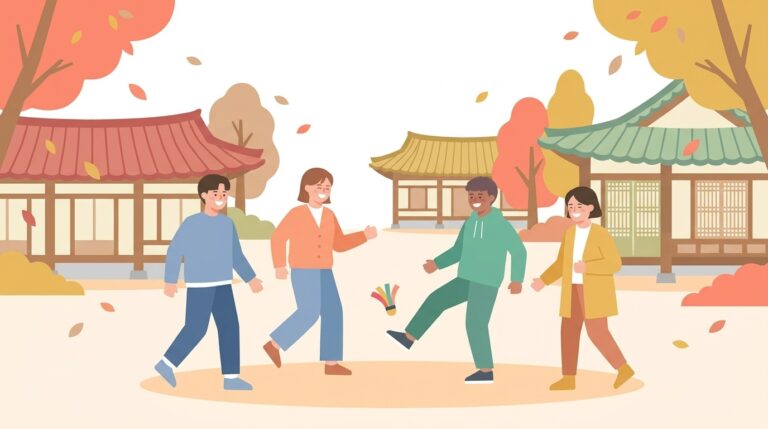
안녕하세요! 매일한글 에디터입니다. 😊 Have you ever watched a Korean variety show like Running Man or a K-drama like Squid Game and seen people kicking a strange, shuttlecock-like object with their feet? That’s Jegichagi (제기차기), one of Korea’s most beloved traditional street games!
I remember teaching my foreign friends how to play Jegichagi during the Chuseok holiday last year. At first, everyone was swinging their feet wildly, missing the Jegi completely, and bursting into laughter. But the moment someone hit it three times in a row? The whole room erupted in cheers! Playing traditional games is the single best way to break the ice with Koreans. Today, we’re going to learn real, friendly Korean expressions you can use right away while trying out Jegichagi with your Korean friends!
1. 같이 해요! (Gachi haeyo!)
- Pronunciation: [Ga-chi hae-yo] (Sounds like “Got-chee hey-yo”)
- Meaning: “Let’s do it together!”
- K-Culture Moment: Seen when cast members in variety shows invite guest stars to join a fun traditional game challenge.
- Editor’s Insight: ‘같이’ (together) is pronounced as ‘가치’ (gachi). It sounds warm and inviting, perfect for asking friends to play games!
- Situation Spectrum: Casual ✅ | Semi-formal ✅ | Formal ⚠️
- 🤔 Think About It: How do you invite someone to play a casual game in your country? Is it direct or indirect?
2. 몇 개 할 수 있어요? (Myeot gae hal su iss-eoyo?)
- Pronunciation: [Myeot gae hal soo ee-seoy-yo] (Sounds like “Mutt-gae hal soo is-seoy-yo”)
- Meaning: “How many can you do?”
- K-Culture Moment: Asking your opponent before starting a game of Jegichagi to set up a friendly bet (like buying ice cream!).
- Editor’s Insight: ‘개’ (gae) is the general counting unit for items in Korean. Use this to ask for counts in games or when shopping.
- Situation Spectrum: Casual ✅ | Semi-formal ✅ | Formal ⚠️
- 🤔 Think About It: Why do you think counting units (counters) are so important in Asian languages compared to English?
3. 한 번 더! (Han beon deo!)
- Pronunciation: [Han beon deo] (Sounds like “Hahn burn duh”)
- Meaning: “One more time!”
- K-Culture Moment: Cheering for a friend who dropped the Jegi after just one kick so they can try again.
- Editor’s Insight: This short 3-word magic phrase works at karaoke (Noraebang), game arcades, and street game challenges!
- Situation Spectrum: Casual ✅ | Semi-formal ✅ | Formal 🚫
- 🤔 Think About It: In Korean games, giving second chances is very common. Does your culture have a similar ‘retry’ spirit?
📖 Textbook Korean: 제기차기를 합시다. (Jegichagireul habsida. / Let us play Jegichagi.)
🗣️ Real Korean: 제기차기 같이 해요! (Jegichagi gachi haeyo! / Let’s play Jegichagi together!)
💡 Why is it different? Textbook phrases like ‘~합시다’ can sound like a formal business announcement. Real Koreans use ‘~같이 해요’ to sound warm, playful, and friendly.
📖 Textbook Korean: 다시 시도하십시오. (Dasi sido-hasibsio. / Please try again.)
🗣️ Real Korean: 한 번 더 해봐요! (Han beon deo haebwayo! / Give it one more try!)
💡 Why is it different? Command forms sound stiff like a video game system prompt. ‘해봐요’ softens the suggestion, showing encouragement.
4-1. Nunchi & Gestures
When playing Jegichagi, bend your knees slightly and keep your eyes focused on the Jegi. When cheering for a friend, raise both hands in the air and yell, “아깝다!” (Akkapda! – So close!) with a big smile!
4-2. Cultural Deep-Dive
In Korea, traditional games like Jegichagi, Yutnori, and Ttakkji-chigi bring people together during holidays like Chuseok and Seollal. Nowadays, K-pop idols often play these games on live broadcasts or show contents (like RUN BTS) to win snacks or avoid penalties. Learning these games gives you instant access to Korean banter!
Setting: Park bench on a sunny autumn afternoon. You see your Korean friend Minjun (민준) holding a colorful Jegi.
- Minjun: 이거 본 적 있어요? 제기예요! (Igeo bon jeok iss-eoyo? Jegi-yeyo! / Have you seen this before? It’s a Jegi!)
🎭 Shows the Jegi with a smile - You: 와, 색깔이 예뻐요! 같이 해요! (Wa, saekkkal-i yeoppeoyo! Gachi haeyo! / Wow, the colors are pretty! Let’s do it together!)
🎭 Pointing at the Jegi enthusiastically - Minjun: 좋아요! 민수 씨는 몇 개 할 수 있어요? (Joh-ayo! Minsu-ssi-neun myeot gae hal su iss-eoyo? / Great! How many can you do, Minsu?)
🎭 Tosses the Jegi up and down - You: 글쎄요… 세 개 할 수 있어요! (Geulsseyo… se gae hal su iss-eoyo! / Well… I can do three!)
🎭 Holding up three fingers confidently - Minjun: 哇! 그럼 먼저 해보세요! (Wa! Geureom meonjeo haeboseyo! / Wow! Then try first!)
🎭 Hands over the Jegi - You: (Kicks once and drops it) 아! 떨어뜨렸어요! (A! Tteoroeotteuryeosseoyo! / Ah! I dropped it!)
🎭 Laughing awkwardly - Minjun: 괜찮아요! 한 번 더 해봐요! (Gwaenchana-yo! Han beon deo haebwayo! / It’s okay! Try one more time!)
🎭 Clapping hands to cheer - You: 네! 이번에는 다섯 개 할게요! (Ne! Ibeon-eneun daseot gae halgeyo! / Yes! I’ll do five this time!)
🎭 Taking a deep breath
🔀 Interactive Choice:
What will you say after kicking 5 times successfully?
* A) 완벽해요! 제가 이겼어요! (Best choice! Confident and fun)
* B) 저는 매우 잘합니다. (Bad choice: Sounds too robotic and arrogant)
* C) 또 하고 싶지 않아요. (Risk choice: Sounds rude like you gave up)
- [😊 excited] 제기차기 / 같이 해요! (Je-gi-cha-gi / ga-chi hae-yo!)
- [🤔 curious] 몇 개 / 할 수 있어요? (Myeot gae / hal soo ee-seoy-yo?)
- [🔥 cheering] 한 번 더! / 파이팅! (Han beon deo! / Pa-i-ting!)
- 제기 (Jegi) | A Korean traditional shuttlecock made of paper/vinyl wrapped around a coin.
- 제기차기 (Jegichagi) | The game of kicking a Jegi into the air continuously using your inner foot.
- 아깝다 (Akkapda) | “So close!” or “What a waste!” Used when someone almost succeeds.
- 파이팅 (Fighting) | A classic Korean cheer meaning “You can do it!” or “Good luck!”
- Top 1: 제기차기 같이 해요! (Let’s play Jegichagi together!) — Pro Tip: Smile brightly when asking!
- Top 2: 한 번 더 해봐요! (Try one more time!) — Pro Tip: Use this when a friend fails on their first kick.
- Top 3: 몇 개 했어요? (How many did you do?) — Pro Tip: Great for checking scores during games.
-
Editor’s Travel Note: Heading to Seoul? Visit Namsangol Hanok Village or Bukchon Hanok Village during Korean holidays. You can play Jegichagi for free! Make sure to install the Naver Map App Download to find traditional cultural parks easily.
Traditional Korean games aren’t just about winning; they are about Jeong (정)—sharing warmth, encouragement, and laughter together. When someone fails at Jegichagi, Koreans immediately chant “한 번 더!” (One more time!). It reflects a culture that loves lifting each other up.
💬 Your Turn: Have you ever played a traditional game from another country? What was it? Tell us in the comments below!
Q: Is Jegichagi hard for beginners?
A: It can be tricky at first! But even kicking it once or twice brings lots of laughs, which is the main point of the game.
Q: What footwear is best for playing Jegichagi?
A: Flat sneakers are the best! Avoid heavy boots or sandals so your ankles can move freely.
Q: Can I play Jegichagi indoors?
A: Yes, as long as you have enough open space away from fragile items.
🚨 Common Mistakes
- ❌ Mistake: Yelling “다시 하세요!” (Dasi haseyo!) loudly like a strict command.
- ⭕ Correct Action: Say gently with a smile, “한 번 더 해봐요!” (Han beon deo haebwayo!).
- Bronze Mission: Practice saying “같이 해요!” (Gachi haeyo!) 3 times in front of the mirror.
- Silver Mission: Post a video/story on Instagram playing any foot game and tag
#DailyHangul! - Gold Mission: Find a Korean friend or conversation partner and invite them: “제기차기 같이 해요!”
🎮 K-Culture Mission: Watch an episode of Run BTS or Running Man and count how many times you hear the phrase “한 번 더!”.
Q1. What is the friendly way to say “Let’s do it together!” in Korean?
a) 혼자 해요 b) 같이 해요 c) 하지 마요
Click to view Answer & Explanation
Answer: b) 같이 해요
Explanation: ‘같이’ (together) + ‘해요’ (do it) means ‘Let’s do it together!’.
Q2. Fill in the blank: “One more time!” = (____) 번 더!
a) 한 b) 두 c) 세
Click to view Answer & Explanation
Answer: a) 한
Explanation: ‘한 번 더’ means ‘one time more’.
Q3. True or False: Jegichagi is played by hitting the Jegi with your hands.
Click to view Answer & Explanation
Answer: False
Explanation: Jegichagi is played by kicking the Jegi using your feet!







