

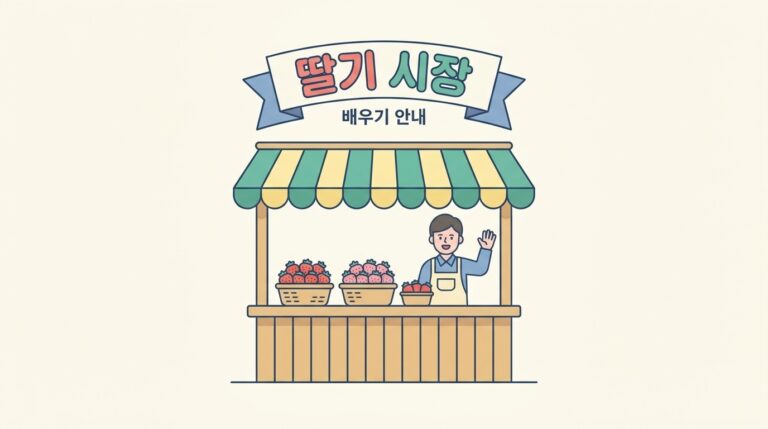
Phase 1: Empathy – Welcome to the Market!
안녕하세요! I’m your Daily Hangul editor, your favorite Korean bestie! Have you ever walked through a bustling Korean traditional market, overwhelmed by the vibrant smells of street food, colorful vegetables, and friendly vendors shouting? You point at a basket of glossy strawberries, but your mind goes blank. You want to ask, “Are these fresh?” or compliments the vendor, but all you can manage is a nervous smile.
Don’t worry! Every beginner feels intimidated by the lively energy of traditional markets. This guide is crafted from real student experiences to give you instant confidence. By learning just one key phrase—싱싱해요 (Singsinghaeyo / It’s fresh)—you won’t just buy fruit; you’ll unlock genuine smiles, extra free samples (called ‘덤’ – Deom!), and a memorable cultural connection!
Phase 2: Core Expressions Deep Dive
1. 싱싱해요! (Singsinghaeyo)
- Pronunciation: [Sing-sing-hae-yo] (Sounds like singing twice! Imagine fresh vegetables singing with joy!)
- Meaning: “It’s fresh!” (Used specifically for raw food like fish, fruits, and vegetables).
- K-Culture Moment: You’ll hear this constantly in street market scenes in K-Dramas like Reply 1988 or food shows featuring street markets.
- Editor’s Insight: Saying “싱싱해요!” to a vendor acts like magic. It shows you appreciate their produce, often leading to bigger portions!
- Situation Spectrum: Casual ✅ | Semi-formal ✅ | Formal ⚠️
- 🤔 Think About It: How does complimenting a vendor’s produce change your shopping experience compared to a quiet supermarket checkout?
2. 이거 얼마예요? (Igeo eolmayeyo?)
- Pronunciation: [Ee-geo eol-ma-ye-yo?]
- Meaning: “How much is this?”
- K-Culture Moment: The absolute essential phrase whenever characters shop at traditional markets in K-Travel vlogs.
- Editor’s Insight: Keep it simple! Point at what you want, smile, and ask this.
- Situation Spectrum: Casual ✅ | Semi-formal ✅ | Formal ✅
- 🤔 Think About It: In English, we say “How much is this?” Notice how Korean puts “this” (이거) right at the front!
3. 조금만 주세요. (Jogeumman juseyo.)
- Pronunciation: [Jo-geum-man joo-seh-yo]
- Meaning: “Just a little bit, please.”
- K-Culture Moment: Perfect when food stall portions are too big for a solo traveler!
- Editor’s Insight: ‘조금’ means ‘a little’, and ‘만’ means ‘only’. Super useful for beginners!
- Situation Spectrum: Casual ✅ | Semi-formal ✅ | Formal ✅
- 🤔 Think About It: Asking for smaller portions politely shows respect for food waste in Korean culture.
Phase 3: Textbook vs. Real Korean
Situation 1: Asking if produce is good
* 📖 Textbook Korean: 이 과일은 신선합니까? (Is this fruit fresh? – Very formal/robotic)
* 🗣️ Real Korean: 이 딸기 진짜 싱싱해요! (These strawberries are really fresh!)
* 💡 Why it’s different: Native speakers prefer casual, warm compliments over formal questions when shopping at traditional stalls.
Situation 2: Asking for price
* 📖 Textbook Korean: 이것은 얼마입니까? (How much is this? – Written style)
* 🗣️ Real Korean: 이거 얼마예요? (How much is this? – Natural spoken style)
* 💡 Why it’s different: Spoken Korean drops heavy honorific endings in daily conversations.
Phase 4: K-Culture Deep Dive & Non-Verbal Etiquette
4-1. Nunchi & Gestures
When visiting a market, use two hands when handing over cash or receiving your bag. A slight nod of the head along with “싱싱해요!” shows respect and creates instant warmth (정 / Jeong).
4-2. Culture Code: The Magic of ‘Deom’ (덤)
In traditional markets, vendors love giving ‘덤’ (Deom)—free extra items or extra scoops! Complimenting their food with “싱싱해요!” is the best trigger to get some free Deom!
Phase 5: Roleplay Scenario
Setting: Mangwon Market, Seoul. You are standing in front of a colorful fruit stall run by a cheerful vendor (Imo / Auntie).
- Turn 1 (Vendor): 어서 오세요! 딸기 사세요! (Welcome! Buy some strawberries!)
- Turn 2 (You): 🎭 Pointing at strawberries with a bright smile / 안녕하세요! 이 딸기 진짜 싱싱해요! (Hello! These strawberries are really fresh!)
- Turn 3 (Vendor): 🎭 Laughs happily / 그럼요! 오늘 아침에 왔어요. (Of course! They arrived this morning.)
- Turn 4 (You): 🎭 Nodding / 이거 얼마예요? (How much is this?)
- Turn 5 (Vendor): 한 상자에 오천 원이에요! (It’s 5,000 won for one box!)
- Turn 6 (You): 🎭 Handing cash with two hands / 한 상자 주세요. (Please give me one box.)
- Turn 7 (Vendor): 🎭 Adding extra strawberries to the bag / 학생이 말을 예쁘게 하니까 덤 더 줄게요! (You talk so nicely, I’ll give you extra!)
- Turn 8 (You): 🎭 Bowing slightly / 감사합니다! 많이 파세요! (Thank you! Sell a lot!)
🔀 Interactive Choice:
What do you say after receiving your fruit?
* A: 그냥 가기 (Leave silently)
* B: 감사합니다! (Thank you!)
* C: 맛없으면 환불해주세요! (If it tastes bad, give me a refund!)
Feedback:
* Choice A (Bad): A bit cold for traditional market vibe.
* Choice B (Best): Perfect! Simple, polite, and warm.
* Choice C (Risk): Very rude in a friendly market setting!
Phase 6: 10-Second Emotion Shadowing Drill
- [😊 Bright & Enthusiastic] 와! / 과일이 / 진짜 / 싱싱해요!
(Wa! / Gwait-i / jinjja / singsinghaeyo!) - [🥺 Polite & Curious] 저기요, / 이거 / 얼마예요?
(Jeogiyo, / igeo / eolmayeyo?) - [🥰 Grateful & Happy] 와, / 덤 감사해요! / 많이 파세요!
(Wa, / deom gamsahaeyo! / mani pasaeyo!)
Phase 7: K-Culture Mini Dictionary
- 시장 (Sijang) | Traditional Market | A open-air or covered neighborhood market selling fresh food and street snacks.
- 이모 (Imo) | Auntie / Female Vendor | Friendly term used to address middle-aged female stall owners.
- 덤 (Deom) | Free Bonus / Extra | Small extra portion given out of generosity.
- 싱싱하다 (Singsinghada) | To be fresh | Root adjective used for raw food items like fish, veggies, and fruits.
Phase 8: Traveler’s Survival Kit
Top 3 Survival Phrases
- 이거 주세요. (Igeo juseyo.) – Please give me this.
- 카드 돼요? (Kadeu dwaeyo?) – Do you accept cards?
- 많이 파세요! (Mani pasaeyo!) – Sell a lot! (Friendly market goodbye).
Editor’s Travel Note
Before heading out, download the Naver Map App to easily find top-rated markets like Mangwon Market or Gwangjang Market. Keep cash handy, as small market vendors love cash transactions!
Phase 9: A Step Deeper
Korean markets are defined by Jeong (정)—an emotional bond of warmth and affection between people. Shopping here isn’t just a transaction; it’s a mini social connection. Saying a simple compliment like “싱싱해요” bridges the gap between tourist and local.
💬 Your Turn: What is your favorite market food experience when traveling? Let us know in the comments below!
Phase 10: FAQ & Common Mistakes
Q: Can I use 싱싱해요 for cooked street food like Tteokbokki?
A: No! Use 맛있어요 (Masisseoyo / It’s delicious) for cooked food. Use 싱싱해요 only for raw, fresh ingredients like fruits, vegetables, or seafood.
Q: Is it okay to negotiate prices at Korean traditional markets?
A: Haggling isn’t as common today, especially for cheap items. Instead of asking for a discount, saying friendly words usually yields free Deom (extras)!
Q: Can I use cash and cards?
A: Most vendors accept cards now, but cash is appreciated for small snacks!
🚨 Common Mistakes TOP 3
- Mistake: Calling cooked food “싱싱해요”.
Correct Action: Use “맛있어요!” instead. - Mistake: Handing cash with one hand.
Correct Action: Hand money over with both hands. - Mistake: Saying formal academic phrases to friendly vendors.
Correct Action: Keep it warm with conversational Korean!
Phase 11: Action Mission
- Bronze Level: Practice saying “이거 진짜 싱싱해요!” out loud 3 times.
- Silver Level: Share this expression on your Instagram story and tag @DailyHangul!
- Gold Level: Visit a local Korean market or grocery store and use “이거 얼마예요?” with a worker!
🎮 K-Culture Mission: Watch a street food vlog set in Seoul and spot how many times people say “맛있어요” or “싱싱해요”!
Phase 12: Interactive Quiz Challenge
Q1. Situation Quiz
You see beautiful, fresh fish at Mangwon Market. What should you say?
A) 이거 맛있어요!
B) 이거 진짜 싱싱해요!
C) 이거 너무 매워요!
Click for Answer & Explanation
B is correct! ‘싱싱해요’ means ‘It’s fresh’, perfect for raw fish or produce!
Q2. Fill in the Blank
“이거 ________?” (How much is this?)
Click for Answer & Explanation
얼마예요 (eolmayeyo)
Q3. Culture True/False
Giving cash with both hands in Korea shows polite respect.
(True / False)
Click for Answer & Explanation
True! Using two hands shows respect in Korean etiquette.







