

Phase 1: Empathy & Storytelling
안녕하세요! I’m your chief editor at Daily Hangul. Have you ever stepped into an elevator in Seoul, only to see someone frantically tapping the ‘Close Door’ (닫힘) button like they are playing an arcade game? Or maybe you’ve caught yourself doing it after living here for a few weeks? Don’t worry, you’re not alone! This is the legendary Pbali-Pali (빨리빨리 – Hurry, Hurry) culture in action.
Understanding this habit isn’t just about learning elevator etiquette; it’s your gateway to understanding the fast-paced flow of modern Korean society. Today, we’re going to break down the exact phrases, cultural nuances, and natural reactions you need when navigating these speedy everyday moments!
Phase 2: Top 3 Core Expressions
1. 잠시만요! (Jam-si-man-yo!)
- Pronunciation: [Jahm-shee-mahn-yo] (Sounds like ‘Jahm-she-man-yoh’)
- Meaning: “Just a moment!” or “Excuse me for a second.”
- K-Culture Moment: You hear this all the time in K-dramas when a character jumps into an elevator right before the doors close.
- Editor’s Insight: This is the most versatile phrase in Korea. You can use it to hold the door, walk through a crowd, or ask for a brief moment.
- Situation Spectrum: Casual ✅ | Semi-formal ✅ | Formal ✅
- 🤔 Think About It: Does your country have a universal phrase that works for both ‘Excuse me’ and ‘Wait a second’?
2. 먼저 타세요. (Meon-jeo ta-se-yo.)
- Pronunciation: [Meon-juh tah-seh-yoh] (Sounds like ‘Muhn-juh tah-say-yoh’)
- Meaning: “Please get in first.”
- K-Culture Moment: A polite gesture often shown in office dramas when showing respect to colleagues or elders.
- Editor’s Insight: Combining efficiency with politeness! Adding a small tilt of your head makes it sound 100% natural.
- Situation Spectrum: Casual ⚠️ | Semi-formal ✅ | Formal ✅
- 🤔 Think About It: How do people in your culture balance speed and politeness in crowded spaces?
3. 닫힘 버튼 누르셨어요? (Dat-him beoteun nureusyeosseoyo?)
- Pronunciation: [Dat-heem buh-teun noo-reu-syuhs-seo-yoh]
- Meaning: “Did you press the close button?”
- K-Culture Moment: Used playfully between friends when an elevator door takes longer than 2 seconds to close.
- Editor’s Insight: Expresses that typical Korean impatience in a lighthearted, conversational way.
- Situation Spectrum: Casual ✅ | Semi-formal ✅ | Formal 🚫
- 🤔 Think About It: Why do you think speed is considered a form of consideration in modern Korean culture?
Phase 3: Textbook Korean vs. Real Native Korean
- Textbook: 문이 닫힙니다. 조심하십시오. (The door is closing. Be careful.)
- 🗣️ Real Native: 문 닫혀요! 얼른 오세요! (Door’s closing! Hurry over!)
- 💡 Why the difference? Natives favor action-oriented, quick phrases over formal automated announcements in real life.
- Textbook: 천천히 오셔도 괜찮습니다. (It is okay even if you come slowly.)
- 🗣️ Real Native: 천천히 오세요! (눌렀어요!) (Take your time! (I held the button!))
- 💡 Why the difference? Reassuring the other person by reassuring them that you are pressing the ‘Open’ button prevents them from running frantically.
Phase 4: K-Culture Deep Dive & Non-Verbal Etiquette
4-1. Nunchi (눈치) & Gestures
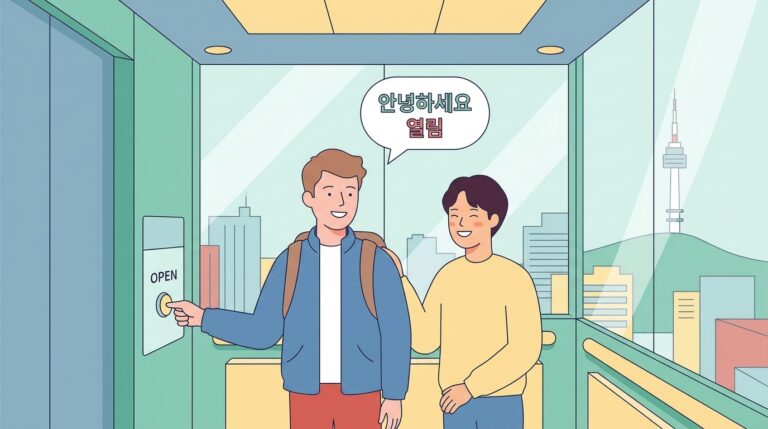
When pressing the ‘Open’ (열림) button for someone, hold the button with one hand and make a welcoming palm-up gesture with the other. A light bow of the head is the ultimate display of Nunchi (social tact).
4-2. Culture Code: The Root of Ppalli-Ppalli
Korea’s compressed economic growth transformed time into the ultimate commodity. Fast internet, 1-day deliveries, and tapping the elevator ‘Close’ button are all symptoms of a culture that deeply respects speed and efficiency.
Phase 5: Real-Life Roleplay Scenario
- Setting: An office building elevator in Gangnam during lunchtime.
- Character: Min-woo (a fast-moving Korean co-worker).
- Min-woo: 어, OO씨! 닫힘 버튼 좀 누르셨어요? (Oh, [Name]! Did you press the close button?)
- You: 아, 네! 눌렀어요. (Ah, yes! I pressed it.)
- Min-woo: 휴, 점심시간이라 엘리베이터가 너무 늦게 와요. (Phew, it’s lunch hour so the elevator is taking forever.)
- You: 맞아요. 한국은 엘리베이터도 정말 빠르네요. (True. Elevators in Korea are really fast too.)
- Min-woo: 🎭 [Laughs and nods] 닫힘 버튼 연타는 한국인 필수 기술이죠! (Tapping the close button is a mandatory skill for Koreans!)
- You: 🎭 [Smile] 저도 이제 한국인 다 됐나 봐요. (I guess I’m becoming a true Korean now too.)
- Min-woo: 아, 저기 누가 오네요! 잠시만요! (Oh, someone’s coming! Just a moment!)
- You: 제가 열림 버튼 누를게요! (I’ll press the open button!)
🔀 Interactive Choice:
Someone is running toward the closing elevator. What do you do?
* A. Rapidly press the 닫힘 (Close) button while avoiding eye contact.
* B. Press and hold the 열림 (Open) button and say “천천히 오세요!”
* C. Yell “빨리 오세요!” while standing still.
- Feedback:
- A (Risk): Very impolite! You might catch some side-eyes.
- B (BEST): Perfect! Demonstrates warmth and social awareness (Nunchi).
- C (Bad): Sounds bossy and unhelpful!
Phase 6: 10-Second Emotion Shadowing Drill
[😊 Welcoming & Bright]천천히 / 오세요! / 눌렀어요! (Cheon-cheon-hi / o-se-yo! / nul-leoss-eo-yo!)[💨 Slightly Impatient]아, / 문이 / 왜 이렇게 / 안 닫히죠? (Ah, / mun-i / wae i-reoh-ke / an dat-hi-jyo?)
Phase 7: K-Culture Mini Dictionary
- 빨리빨리 (Ppalli-ppalli): Hurry-hurry; the fast-paced mindset of Korean everyday life.
- 연타 (Yeon-ta): Rapid tapping/button-mashing (derived from gaming terms).
- 눈치 (Nunchi): The art of reading the room and acting appropriately.
- 퇴근길 (Toe-geun-gil): The evening commute home, where Ppalli-ppalli peaks!
Phase 8: Traveler’s Survival Kit
- Top 3 Survival Phrases:
- 잠시만요! (Jam-si-man-yo!) – Hold the door / Passing through.
- 먼저 타세요. (Meon-jeo ta-se-yo.) – Go ahead and get in.
- 몇 층 가세요? (Myeot cheung ga-se-yo?) – Which floor are you going to?
- Editor’s Travel Note: When traveling around Seoul, make sure to download the Naver Map App for real-time subway and elevator location guides!
Phase 9: A Step Deeper (Reflection)
While pressing the close button repeatedly might seem impatient at first glance, it often comes from a shared desire not to waste anyone’s time. In Korean culture, efficiency can be a form of caring for others’ convenience.
💬 Your Turn: Have you ever caught yourself repeatedly pressing a button in Korea? Share your story in the comments below!
Phase 10: FAQ & Common Mistakes
Q: Is pressing the close button considered rude in Korea?
A: Not at all! In fact, most Koreans naturally press it as soon as they step inside. However, closing it when someone is running toward the elevator is considered rude.
Q: Which button is which? I get confused!
A: 열림 (Open) usually has arrows pointing outwards |< >|, and 닫힘 (Close) has arrows pointing inwards |> <|.
Q: What should I say if I accidentally close the door on someone?
A: A quick “죄송합니다!” (Joe-song-ham-ni-da – I’m sorry) with an apologetic smile is perfect.
🚨 Common Mistakes TOP 3:
- Mistake: Confusing 열림 (Open) and 닫힘 (Close) under pressure.
- Correct Action: Remember 열 (Open – like ‘open sky’) vs 닫 (Close).
- Mistake: Standing right in front of the control panel without pressing buttons for others.
- Correct Action: If you stand near the panel, it’s polite to help press the floor or hold the open button.
- Mistake: Shouting too loudly in a quiet elevator.
- Correct Action: Keep your voice lowered inside elevators.
Phase 11: Action Mission
- Bronze: Practice saying “잠시만요!” 3 times out loud.
- Silver: Try using “먼저 타세요” next time you take an elevator with a local.
- Gold: Notice how many people press the ‘Close’ button within 1 second in Korea!
🎮 K-Culture Mission: Watch a modern Korean urban drama and spot how many times characters tap elevator buttons!
Phase 12: Interactive Quiz Challenge
-
Situational Quiz: What is the most polite thing to say when holding the elevator open for an elderly person?
Click to view answer
천천히 오세요, 먼저 타세요! (Take your time, please get in first!)
-
Fill in the Blank: “Just a second!” in Korean is “________!”
Click to view answer
잠시만요 (Jam-si-man-yo)
-
True/False: Pressing the ‘Close’ button in a Korean elevator is considered illegal.
Click to view answer
False! It’s an everyday habit driven by the Ppalli-Ppalli culture.







