

Uh-Oh, ‘Incomplete Transfer’! How to Survive a Low Balance on Your Korean Transit Card
Phase 1: Empathy (스토리 몰입형 오프닝)
안녕하세요! (Annyeonghaseyo!) Your friendly neighborhood editor from Daily Hangul is back! 👋
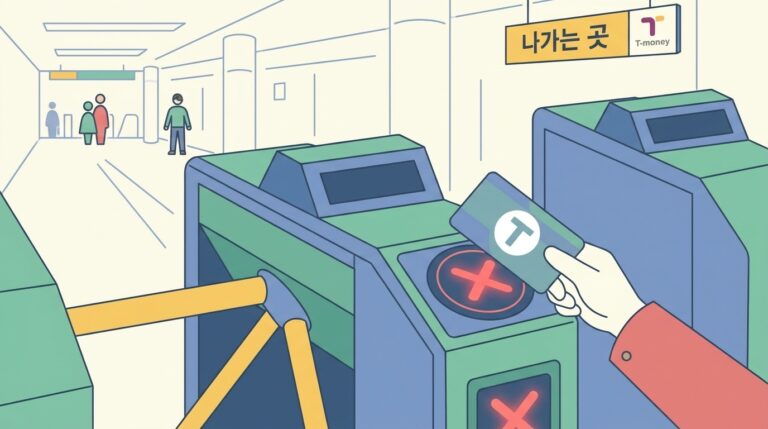
Imagine this: You are in Seoul, rushing down the stairs of a bustling subway station during rush hour. You are listening to your favorite K-Pop track, feeling like the main character of a K-drama. You confidently tap your T-money card on the turnstile. But instead of a satisfying beep, a loud, shrill buzzer goes off: “BEEP-BEEP! 잔액이 부족합니다 (Janaegi bujokhamnida – Insufficient balance)!”
The turnstile locks. The crowd of busy commuters behind you suddenly halts. Your face turns bright red. What do you do? Where do you go? How do you ask for help without looking completely lost?
Don’t panic! Almost every Korean has experienced this exact moment. Today, we are going to master the art of handling a low transit card balance like a true local, blending essential B1-level Korean phrases with cultural insights so you can navigate Korea’s world-class transit system with absolute confidence.
Phase 2: Key Expressions Deep Dive (핵심 표현 3선 심층 분석)
1. 잔액이 부족해요. (Janaegi bujokhaeyo.)
- Pronunciation: Jan-aek-i boo-jok-hae-yo (Sounds like “Jan-eck-ey boo-jock-heh-yo”)
- Meaning: My balance is insufficient. / I don’t have enough money on my card.
- K-Culture Moment: You will hear this robotic voice announcement at the bus scanner or subway gate when your card drops below the base fare (usually 1,400 KRW).
- Editor’s Insight: ‘잔액’ (jan-aek) means ‘balance’ (literally ‘remaining amount’) and ‘부족하다’ (bujokhada) means ‘to be lacking/insufficient’. In Korean, we often omit the pronoun “my” (내), so simply saying “잔액이 부족해요” explains the situation perfectly.
- Situation Spectrum: Casual: ⚠️ (Too formal for close friends) | Semi-formal: ✅ (Perfect for station staff) | Formal: ✅
- 🤔 Think About It: In English, we might say “My card is empty.” Why do you think Korean focuses on the formal word “balance” (잔액) rather than just saying “no money” (돈이 없어요)?
2. 어디서 충전해요? (Eodiseo chungjeonhaeyo?)
- Pronunciation: Uh-dee-suh choong-jun-hae-yo? (Rhymes with “fun-heh-yo”)
- Meaning: Where do I recharge/top up?
- K-Culture Moment: Asking a convenience store clerk or a subway station helper when you can’t find the automated ticketing machines.
- Editor’s Insight: ‘충전’ (chungjeon) means charging or recharging. Interestingly, Koreans use the exact same word ‘충전’ for charging their smartphones and topping up their transit cards!
- Situation Spectrum: Casual: ⚠️ | Semi-formal: ✅ (Polite and natural) | Formal: ✅
- 🤔 Think About It: How does your country view transit cards? Is it “loading money,” “topping up,” or “charging”? Connecting this to the Korean concept of “charging energy” (충전) makes it super easy to memorize!
3. 카드가 안 돼요. (Kadeuga an dwaeyo.)
- Pronunciation: Kah-deu-ga ahn dwae-yo.
- Meaning: My card isn’t working.
- K-Culture Moment: When you have money on your card, but the gate machine displays an error code (like “System Error” or “Transfer Already Completed”) and won’t let you through.
- Editor’s Insight: ‘안 돼요’ (an dwaeyo) is one of the most powerful phrases in Korean. It literally means “It doesn’t become/work.” Whenever a machine, card, or plan fails, just point to it and say, “안 돼요.”
- Situation Spectrum: Casual: ⚠️ | Semi-formal: ✅ | Formal: ✅
Phase 3: Textbook vs. Real-Life Korean (교과서 한국어 vs 진짜 한국어)
Situation A: Telling the station worker your card has an issue
- 📖 Textbook: “교통카드의 잔액이 충분하지 않습니다.” (Gyotongkadeu-ui janaegi chungbunhaji anseumnida. – “The balance of the transportation card is not sufficient.”)
- 🗣️ 진짜 한국어: “카드가 잔액 부족이라고 떠요.” (Kadeuga janaeg bujog-irago tteoyo. – “My card is showing ‘insufficient balance’.”)
- 💡 왜 다를까? Koreans love efficiency. Instead of repeating long textbook sentences, they use the verb 뜨다 (tteoda – to pop up/appear on a screen) to describe what the machine is displaying.
Situation B: Asking for a top-up at a convenience store
- 📖 Textbook: “이 교통카드를 만 원 충전해 주십시오.” (I gyotongkadeureul man won chungjeonhae jusipsio. – “Please recharge this transit card with 10,000 won.”)
- 🗣️ 진짜 한국어: “이거 만 원만 충전해 주세요.” (Igeo man-won-man chungjeonhae juseyo. – “Just 10,000 won on this, please.”)
- 💡 왜 다를까? Adding ‘만‘ (-man, meaning “only” or “just”) softens the request and makes you sound like a natural local. “이거” (igeo – this) is used while handing over your card.
Phase 4: K-Culture Deep Dive & Non-Verbal Manners (눈치 & 제스처)
4-1. The “Nunchi” (눈치) of Subway Gates
If your card beeps with an error, do not stand in front of the gate trying to tap it 10 times. This is considered bad subway etiquette in fast-paced Korea.
* The Move: Step aside immediately to let others pass.
* The Gesture: Lightly bow your head or raise your hand slightly toward the person behind you as a silent “죄송합니다” (sorry) gesture, then walk toward the “Help Gate” (the wide gate on the side) or the yellow emergency bell button.
4-2. The “Convenience Store” Culture
Did you know you can recharge your T-money card in almost any convenience store (CU, GS25, Seven-Eleven)? When doing this, place your card on the small reader pad near the cash register before you hand over the cash. Yes, cash is king for transit card charging! You cannot recharge your transit card with a foreign credit card.
Phase 5: Real-Life Roleplay Scenario (실전 롤플레이)
🎭 Cast:
- 유미 (Yumi): A helpful, friendly subway station assistant at Myeongdong Station.
- 민우 (Minwoo): You! A traveler who just got stuck at the exit gate.
- 민우: (Confused, tapping the card again) 🎭 Taps card, gate goes red with a loud beep
- 유미: (Approaching kindly) 🎭 Smiles warmly 무슨 일이세요? 도와드릴까요?
- 민우: 🎭 Embarrassed, scratching head 저기… 카드가 안 돼요. 잔액이 없는 것 같아요.
- 유미: 아, 잔액이 부족하군요! 저기 기계에서 충전할 수 있어요.
- 민우: 아, 저기요? 그런데 제가 지금 현금이 없어요. 카드로 충전돼요?
- 유미: 아쉽지만 교통카드 충전은 현금만 가능해요.
- 민우: 아, 진짜요? 그럼 근처에 ATM이 어디에 있어요?
- 유미: 개찰구 바로 왼쪽에 편의점 있죠? 그 안에 ATM이 있어요.
- 민우: 정말 감사합니다! 얼른 다녀올게요.
🔀 Interactive Choice Point!
You realize you only have a credit card and no cash, but you are inside the gate and can’t reach the ATM. What do you do?
- Option A: Try to crawl under the gate to reach the ATM.
- Option B: Press the yellow “Help” (호출) bell on the side gate and say: “저기요, 현금이 없어서 나가서 뽑아야 해요.”
- Option C: Stand there and wait for someone to open the gate for you.
💡 Feedback on Your Choice:
- Option A (Bad): 🚫 Danger! Subway stations have CCTV everywhere. You might get fined for fare evasion!
- Option B (Best): ✅ Perfect! The helper will open the gate for you so you can access the ATM/convenience store outside, and you can tap back in or pay later. Koreans are extremely understanding of this!
- Option C (Risk): ⚠️ Risky. It makes others uncomfortable and doesn’t solve your problem.
Phase 6: 10-Second Emotion Shadowing Drill (감정 섀도잉 드릴)
Practice these with the exact emotional tone of a panicked but polite traveler!
- [🥺 Anxious and apologetic]
- “저기요… / 카드가 안 돼요. / 도와주실 수 있나요?”
- Jeogiyo… / kadeuga an dwaeyo. / dowajusil su innayo?
- [💡 Relieved and polite]
- “아! / 여기서 충전하면 돼요? / 감사합니다!”
- Ah! / yeogiseo chungjeonhamyeon dwaeyo? / gamsahamnida!
Phase 7: K-Culture Mini Dictionary (K-Culture 미니 사전)
- 티머니 (T-money): The most popular rechargeable transit card brand in Korea, usable on buses, subways, taxis, and even in convenience stores.
- 개찰구 (Gaechalgu): The ticket gates/turnstiles at subway stations.
- 비상게이트 (Bisang-geiteu): Emergency gates (usually wider) located at the end of the turnstiles, used for wheelchairs, strollers, or when travelers get stuck.
- 현금인출기 (Hyeongeum-inchulgi): ATM. Essential to find because transit cards can usually only be loaded with cash.
Phase 8: Traveler’s Survival Kit (여행자를 위한 생존 키트)
Survival Phrases TOP 3
- “충전기 어디 있어요?” (Chungjeongi eodi isseoyo? – Where is the recharge machine?)
- “현금만 돼요?” (Hyeongeum-man dwaeyo? – Is it cash only?)
- “만 원만 충전해 주세요.” (Man-won-man chungjeonhae juseyo. – 10,000 won recharge, please.)
📌 Editor’s Travel Note: Always carry at least a 10,000 KRW bill in your phone case or wallet just for transit emergencies! To navigate Korea smoothly, download the KakaoMap App or Naver Map App. They show real-time subway/bus schedules and precisely which subway car door to stand near for fast transfers.
Phase 9: “Going Deeper” – Cultural Reflection (한 발 더 깊이)
Korea’s transit system operates on a high-trust, high-speed philosophy. If you make a mistake or find yourself stuck, you will notice that station workers and even random passersby are incredibly quick to help you out. This stems from the Korean concept of 정 (Jeong)—a warm, collective feeling of empathy and connection toward others, even strangers. Don’t be afraid to show your screen and ask for help!
💬 Your Turn: Have you ever gotten stuck at a subway gate in your country or in Korea? How did you handle it? Let us know in the comments below!
Phase 10: FAQ & Common Mistakes (FAQ & 오해 방지)
Q: Can I recharge my transit card with my international credit card?
A: Generally, no. Automated machines and convenience stores in Korea only accept cash (Korean Won) for topping up transit cards due to tax and processing regulations. Always keep some cash handy!
Q: What happens if I accidentally exit without tagging, or get an “Incomplete Transfer” error?
A: Go to the nearest yellow emergency bell at the gates, press it, and tell the worker: “태그가 안 됐어요” (Tae-geu-ga an dwaess-eoyo – It didn’t tag). They will reset your card for you.
Q: Can I use T-money outside of Seoul?
A: Yes! T-money is accepted nationwide, including Busan, Jeju Island, Daegu, and Gyeongju, on almost all buses, subways, and taxis.
🚨 The “Common Mistakes” Warning Board
- Mistake 1: Throwing away your “Single Journey Ticket” before exiting. (Correction: You need to insert it into the exit gate to get out and get your 500 KRW deposit back at the deposit refund machine!)
- Mistake 2: Tapping your wallet with multiple credit/transit cards inside. (Correction: The scanner will say “카드를 한 장만 대 주세요” (Please tap only one card). Take your T-money card out to tap.)
Phase 11: Action Mission (액션 미션)
- 🥉 Bronze Mission: Say “잔액이 부족해요” out loud 5 times in front of your mirror with a worried face.
- 🥈 Silver Mission: Share this post on your socials and tag a friend you want to travel to Seoul with!
- 🥇 Gold Mission: When you visit Korea, go to a convenience store, confidently hand over your card with a 10,000 KRW bill, and say: “만 원만 충전해 주세요!”
Phase 12: Interactive Quiz Challenge (인터랙티브 퀴즈 챌린지)
Test your transit survival skills!
Q1. Which phrase means “Where do I top up?”
1) 카드가 안 돼요.
2) 어디서 충전해요?
3) 잔액이 부족해요.
🔍 Click here for the Answer & Explanation
Correct Answer: 2) 어디서 충전해요?
Explanation: ‘어디서’ means ‘where’ and ‘충전해요’ means ‘recharge’. Option 1 means “My card doesn’t work,” and Option 3 means “The balance is insufficient.”
Q2. True or False: You can easily recharge your T-Money card using a Visa or Mastercard at subway stations.
🔍 Click here for the Answer & Explanation
Correct Answer: False
Explanation: You almost always need cash (Korean Won) to recharge transit cards in Korea. Keep cash in your pocket!







