

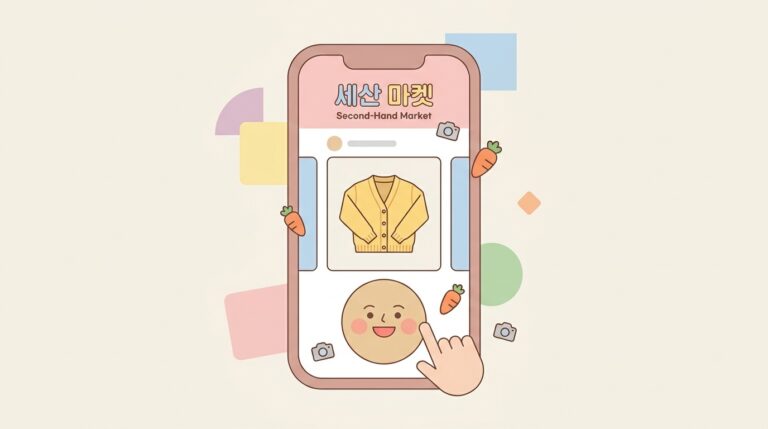
Phase 1: Empathy (스토리 몰입형 오프닝)
안녕하세요! (An-nyeong-ha-se-yo!) Hello, my lovely K-culture and Korean language lovers! It’s your favorite Korean bestie and Daily Hangul Editor here.
Have you ever looked at your closet, saw that beautiful jacket you barely wore, and thought, “I should sell this on Karrot Market (당근마켓 – Dang-geun-ma-ket)!”? But then, the anxiety kicks in. You need to take photos of the item and describe them in Korean. You might worry, “What if they ask for more pictures because my photos are blurry?” or “How do I tell them the lighting made the color look different?”
Don’t worry! Today, we are going to master the art of taking and describing photos for second-hand trading in Korea. Whether you want to clear out your room or make some extra pocket money, this guide will give you the exact A2-level Korean phrases you need to sound like a local seller. Let’s snap some perfect photos and make your first sale! 📸
Phase 2: 핵심 표현 3선 심층 분석 (Deep Dive into Key Expressions)
1. 사진 좀 더 보여주세요 (Sa-jin jom deo bo-yeo-ju-se-yo)
- Pronunciation: “Sah-jin jom duh bo-yuh-joo-seh-yo” (Sounds like: Sah-jean (like denim) jom duh boy-yo-joo-say-yo)
- Meaning: Please show me more photos. (Directly: “Photos a little more show please.”)
- K-Culture Moment: You will see this phrase in almost every second-hand trading app chat screen! Buyers want to make sure there are no hidden stains before they meet you at the subway station.
- Editor’s Insight: The word ‘좀 (jom)’ means ‘a little,’ but Koreans use it as a magic softener to make requests sound polite and friendly. Without ‘좀’, it can sound a bit demanding!
- Situation Spectrum: Casual: 🚫 | Semi-formal: ✅ (Perfect for app chat!) | Formal: ⚠️
- 🤔 Think About It: In your culture, do buyers ask for many detailed photos before meeting up, or do they trust the initial post?
2. 실물하고 색상이 비슷해요 (Sil-mul-ha-go saek-sang-i bi-seut-hae-yo)
- Pronunciation: “Sheel-mool-hah-go saek-sahng-ee bee-seut-hae-yo” (Sounds like: Sheel-mool hah-go sack-sang-ee bee-soot-hay-yo)
- Meaning: The color is similar to the real item.
- K-Culture Moment: Korean buyers are very sensitive to color differences caused by yellow indoor lighting or filters. Writing this in your description builds instant trust!
- Editor’s Insight: ‘실물 (sil-mul)’ means ‘real object’ or ‘in-person appearance’. You might hear K-pop fans say “실물 깡패 (sil-mul kkang-pae)” which means someone looks incredibly beautiful in real life!
- Situation Spectrum: Casual: ⚠️ | Semi-formal: ✅ | Formal: ✅
- 🤔 Think About It: Why is matching the photo color to the real object so important in online shopping and trading?
3. 여기 하자 있어요 (Yeo-gi ha-ja is-seo-yo)
- Pronunciation: “Yuh-ghee hah-jah ees-suh-yo” (Sounds like: Yuh-ghee hah-jah ees-suh-yo)
- Meaning: There is a flaw/defect here.
- K-Culture Moment: Honesty is the golden rule of Korean second-hand trading (당근 매너 – Dang-geun manner). Pointing out a tiny scratch with a close-up photo prevents any awkward arguments during the meetup.
- Editor’s Insight: ‘하자 (ha-ja)’ specifically refers to a defect, flaw, or scratch in an item. Showing this upfront makes you a high-rated, trustworthy seller!
- Situation Spectrum: Casual: ⚠️ | Semi-formal: ✅ | Formal: ✅
- 🤔 Think About It: Does pointing out flaws actually help you sell items faster in your country? In Korea, honesty builds fast sales!
Phase 3: 교과서 한국어 vs 진짜 한국어 (Textbook vs. Real Korean)
Situation 1: Explaining that you took a photo of the defect
- 📖 Textbook Korean: “결함 부분을 촬영했습니다.” (Gyeol-ham bu-bun-eul chwal-yeong-haet-seub-ni-da. – I have filmed the defective part.)
- 🗣️ 진짜 한국어: “하자 부분 사진 올렸어요!” (Ha-ja bu-bun sa-jin ol-lyeot-seo-yo! – I uploaded a picture of the flaw!)
- 💡 Why the difference?: The textbook uses highly formal words like ‘결함’ (defect) and ‘촬영’ (filming/shooting). Real people on apps use ‘하자’ (flaw) and ‘사진 올렸어요’ (uploaded photos) to sound friendly and approachable.
Situation 2: Asking if they want more photos
- 📖 Textbook Korean: “추가 사진을 원하십니까?” (Chu-ga sa-jin-eul won-ha-sib-ni-ka? – Do you desire additional photos?)
- 🗣️ 진짜 한국어: “사진 더 필요하세요?” (Sa-jin deo pi-ryo-ha-se-yo? – Do you need more photos?)
- 💡 Why the difference?: Asking “원하십니까?” sounds like a cold, automated customer service bot. “~필요하세요?” is warm, natural, and highly polite for daily life.
Phase 4: K-Culture 딥다이브 & 비언어적 매너 (K-Culture & Manners)
4-1. The “Manner Temperature” (매너온도)
In Korea’s top second-hand app, Karrot Market, every user starts with a “Manner Temperature” of 36.5°C (matching human body temperature). If you are polite, upload clear photos of scratches, and respond quickly, your temperature rises! If you hide flaws, it drops.
* The Gesture Tip: When taking photos of flaws, use your index finger to point gently at the scratch in the photo. It shows extreme care and honesty!
4-2. The Aesthetic: “감성 사진” (Sensibility Photos)
Koreans love aesthetics! When taking photos of clothes or items to sell, try to take them in natural sunlight (햇빛 – haet-bit) rather than under fluorescent lights. A neat background (like a clean floor or plain wall) makes your item sell 10 times faster!
Phase 5: 실전 롤플레이 시나리오 (Roleplay Scenario)
Setting: You (Minji) are selling a cute yellow cardigan on Karrot Market. A buyer (Ji-a) messages you because they want to check the color and condition before meeting up at Hapjeong Station (합정역).
- Ji-a (Buyer): 안녕하세요! 카디건 관심 있어서 메시지 드려요. (Hello! I’m interested in the cardigan, so I’m messaging you.)
- Minji (Seller/You): 🎭 (Smiling warmly) 안녕하세요! 관심 가져주셔서 감사해요. (Hello! Thank you for your interest.)
- Ji-a (Buyer): 사진 필터가 있는 것 같은데, 실물 색상이랑 비슷한가요? (The photo seems to have a filter, is the color similar to the real item?)
- Minji (Seller/You): 🎭 (Typing carefully) 아, 자연광에서 다시 찍은 사진 보내드릴게요! 잠시만요. (Ah, let me send you a photo taken again in natural light! Just a moment.)
- Minji (Seller/You): 🎭 (Sends picture) 이 사진이 실물하고 색상이 제일 비슷해요. (This photo is the most similar to the real color.)
- Ji-a (Buyer): 아, 예쁘네요! 혹시 하자가 있나요? (Ah, it’s pretty! By any chance, are there any flaws?)
- Minji (Seller/You): 🎭 (Zooming in on a tiny button thread) 여기 소매 쪽에 미세한 실밥이 있어요. 사진 확인해 보세요! (There is a tiny loose thread on the sleeve here. Please check the photo!)
- Ji-a (Buyer): 와, 친절한 설명 감사해요! 내일 거래하고 싶어요. (Wow, thank you for the kind explanation! I’d love to trade tomorrow.)
🔀 Interactive Choice:
How do you reply to lock in the deal?
* A) “네, 내일 거래해요.” (Yeah, let’s trade tomorrow.)
* B) “좋습니다. 합정역 2번 출구 어떠세요?” (Sounds good. How about Hapjeong Station Exit 2?)
* C) “네! 내일 시간과 장소 조율해요.” (Yes! Let’s coordinate the time and place tomorrow.)
Feedback:
- Best Choice: B — It immediately suggests a specific, safe public location (Subway Station Exit), which is the gold standard for safe trading in Korea!
- Bad Choice: A — A bit too short and passive. It might make the coordination drag on.
- Risk Choice: C — Good, but leaving everything until tomorrow might cause the buyer to change their mind. Deciding the spot now is better!
Phase 6: 10초 감정 섀도잉 드릴 (10-Second Shadowing Drill)
Read these out loud with feeling! Follow the pause markers (/) and emotional cues.
- [😊 Friendly and reassuring]
- “이 사진이 / 실물하고 / 색상이 비슷해요!”
- ee sa-jin-i / sil-mul-ha-go / saek-sang-i bi-seut-hae-yo!
- (This photo / is similar / to the real color!)
- [🥺 Honest and polite]
- “여기 / 미세한 / 하자가 있어요 / 확인해 보세요.”
- yeo-gi / mi-se-han / ha-ja-ga is-seo-yo / hwa-gin-hae bo-se-yo.
- (Here / a tiny / flaw exists / please check it.)
Phase 7: K-Culture 미니 사전 (K-Culture Mini Dictionary)
- 당근마켓 (Dang-geun-ma-ket) | Karrot Market
- Korea’s biggest neighborhood-based second-hand marketplace app. “당근” also means carrot!
- 네고 (Ne-go) | Negotiation
- Short for “negotiation.” Buyers often ask “네고 가능한가요?” (Is negotiation/discount possible?).
- 쿨거래 (Kul-geo-rae) | Cool/Fast Trade
- A quick, clean transaction without asking too many questions or asking for discounts. Sellers love “쿨거래 원해요” (I want a fast, hassle-free trade).
- 직거래 (Jik-geo-rae) | Direct/In-person Trade
- Meeting face-to-face to trade items, usually near subway exits, to save on shipping costs.
Phase 8: 여행자를 위한 생존 키트 (Traveler’s Survival Kit)
Survival Expressions TOP 3
- 사진 좀 더 보내주실 수 있나요? (Sa-jin jom deo bo-nae-ju-sil su in-na-yo?)
- Pro Tip: Use this when you are the buyer and want to see the item from different angles.
- 택배 거래 가능한가요? (Taek-bae geo-rae ga-neung-han-ga-yo?)
- Pro Tip: Use this if the seller lives too far away and you want them to ship it to you.
- 실제 사진인가요? (Sil-je sa-jin-in-ga-yo?)
- Pro Tip: Ask this if the seller used an official internet graphic/model image instead of their own photo.
💡 Editor’s Travel Note: To start trading, search for the Karrot Market app (당근마켓) on your phone’s app store. You will need a Korean phone number to verify your local neighborhood, making it incredibly safe!
Phase 9: “한 발 더 깊이” (Deep Thought)
In Korea, second-hand trading is not just about saving money; it’s a culture of trust and shared community values. People often give away items for free (나눔 – na-num) or leave cute little sweet treats inside the shopping bags for the buyers. By taking clean, honest photos and pointing out every tiny scratch, you are participating in “K-manners” (한국의 배려 문화). It is about respecting the next owner of your beloved item.
💬 Your Turn: Have you ever used a second-hand trading app in your country? What is the most important manner in your culture when selling used items? Let me know in the comments below! 👇
Phase 10: FAQ & 오해 방지 (FAQ & Common Mistakes)
Q: Can I use studio/filtered lighting to make my clothes look prettier?
A: While aesthetic photos (감성 사진) are popular, over-filtering that changes the original tone of the item will lead to complaints. Always state “실물 색감과 다를 수 있습니다” (Color may differ from real life) or upload a daylight photo!
Q: What should I do if my Korean is still basic during the face-to-face meet-up?
A: Don’t worry! Most trades take less than 1 minute. Just smile, hand over the bag, say “감사합니다! (Thank you!)”, and you are good to go!
Q: Do I have to accept requests to lower the price (네고)?
A: No! If you don’t want to lower the price, write “네고 사절입니다” (No negotiations allowed) or “에누리 불가” (No discounts) in your item description.
🚨 흔한 실수 (Common Mistakes) 경고판
- Mistake 1: Posting only stock/internet photos.
- Correct Action: Always upload at least one real-life photo of the actual item in your room.
- Mistake 2: Hiding stains to sell faster.
- Correct Action: Take a close-up photo and say “여기 오염이 있어요” (There is a stain here).
- Mistake 3: Not mentioning the size.
- Correct Action: Put a ruler next to the item or write the size (e.g., “M 사이즈입니다”).
Phase 11: 액션 미션 & 참여 유도 (Action Mission)
- Bronze Mission: Take a photo of an item in your room and write a caption using: “실물하고 색상이 비슷해요.”
- Silver Mission: Post the photo on your SNS or Instagram Story, tag
@DailyHangul, and use the hashtag#KarrotManners! - Gold Mission: Write a mock description for an item you want to sell with the phrase: “여기 하자 있어요. 사진 확인해 주세요!”
🎮 K-Culture Mission: Watch a modern Korean slice-of-life drama (like Our Blues or Run On). Listen closely for the word “당근” (carrot) used not as a vegetable, but as a verb: “너 그거 당근했어?” (Did you ‘Karrot’ that?).
Phase 12: 인터랙티브 퀴즈 챌린지 (Quiz Challenge)
1. Match the Phrase to its Meaning!
- A) 사진 좀 더 보여주세요
- B) 여기 하자 있어요
- C) 실물하고 색상이 비슷해요
Check Answer & Explanation
- A -> Please show me more photos.
- B -> There is a flaw/defect here.
- C -> The color is similar to the real item.
Great job! Remembering these three will make you an expert seller! 🎉
2. True or False?
- “당근마켓 (Dang-geun-ma-ket) is only used for buying carrots in Korea.”
Check Answer & Explanation
- Answer: False!
- Explanation: While “당근” means carrot, “당근마켓” is the number one neighborhood second-hand trading app in South Korea! 🥕







