

Hello, My Friend! Welcome to Daily Hangul! 👋
Phase 1: Empathy (Your Korean Bestie’s Seoul Subway Story) 🚇
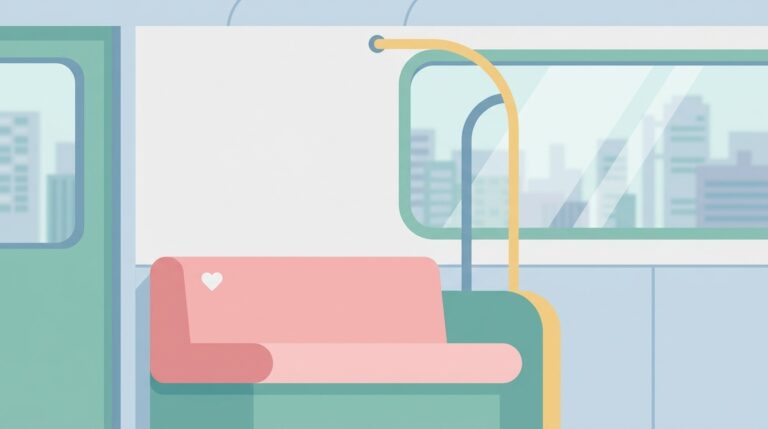
Picture this: You’ve had an amazing day exploring Hongdae, your legs are sore, and you finally step into the Seoul subway. You’re dreaming of sitting down and resting your feet. But as the doors open… gasp! It’s a sea of people. Every single seat is taken. You look around, feeling a bit lost, and want to whisper to your friend, “There are no seats!”
Many of my foreign students tell me that riding the Seoul subway during rush hour (affectionately called “Hell-subway” or Jiok-cheol 지하철) is their first real “Welcome to Korea” reality check! Don’t worry, sweet friend. Today, we are going to learn how to naturally express that there are no seats, understand the unspoken etiquette of Seoul subways, and navigate this like a true local. Let’s dive in!
Phase 2: Top 3 Must-Know Expressions 💡
Let’s learn three simple but super-useful ways to say “There are no seats” or “It’s crowded.”
1. 자리가 없어요 (Ja-ri-ga eops-eo-yo)
- Pronunciation: Jah-ree-gah up-suh-yo (Sounds like “Jah-ree” + “up” with a soft “suh-yo”)
- Meaning: There are no seats. / There is no space.
- K-Culture Moment: You will hear this constantly in K-Dramas when two characters board a bus or subway together, look around, and sigh while holding onto the straps.
- Editor’s Insight: Jari (자리) means “seat” or “space,” and eops-eo-yo (없어요) means “does not exist” or “don’t have.” It’s the most standard, polite, and perfect way to state the situation to anyone!
- Situation Spectrum: Casual (⚠️ – Use jari eopseo to close friends) / Semi-formal (✅) / Formal (✅)
- 🤔 Think About It: In your country, do you usually search for a seat till the end, or do you quickly give up and stand? In Korea, people scan the cabin instantly as they board!
2. 사람이 진짜 많아요 (Sa-ram-i jin-jja manh-a-yo)
- Pronunciation: Sah-rahm-ee jeen-jjah mahn-ah-yo (Rhymes with “Sah-ram” + “Jean-jah” + “mahn-ah-yo”)
- Meaning: There are really so many people.
- K-Culture Moment: In reality TV shows like Run BTS! or travel vlogs, stars say this when they enter a crowded market or a busy subway station.
- Editor’s Insight: Instead of just saying “no seats,” Koreans often describe the crowd. Jin-jja (진짜) means “really/honestly,” which adds a very natural, conversational flavor to your Korean!
- Situation Spectrum: Casual (⚠️) / Semi-formal (✅) / Formal (✅)
- 🤔 Think About It: Korean culture values shared feelings. Saying “There are so many people” is a warm way to share your tired feelings with your companion.
3. 서서 가야 해요 (Seo-seo ga-ya hae-yo)
- Pronunciation: Suh-suh gah-yah hae-yo (Sounds like “Suh-suh” + “gah-yah” + “heh-yo”)
- Meaning: We have to stand all the way. (Literally: “Stand and go”)
- K-Culture Moment: Used by tired office workers heading home after a long day in K-Dramas like My Liberation Notes.
- Editor’s Insight: Seo-seo (서서) means “standing,” and ga-ya hae-yo (가야 해요) means “must go.” It’s a very practical way to accept your fate with a cute, light sigh.
- Situation Spectrum: Casual (⚠️) / Semi-formal (✅) / Formal (✅)
- 🤔 Think About It: Korean verbs often stack up to describe actions in sequence (standing + going). Isn’t it fascinating how the language pictures the physical movement?
Phase 3: Textbook Korean vs. Real-Life Korean 🗣️
Let’s look at how textbooks teach this versus how your Korean bestie actually talks on the subway!
Situation A: Telling your friend there’s no seat
- 📖 Textbook: 좌석이 존재하지 않습니다. (Jwa-seok-i jon-jae-ha-ji ans-seup-ni-da. – “Seats do not exist.”) -> Too robotic! Sounds like a train computer speaking.
- 🗣️ Real Korean: 아, 자리 없다! (Ah, jari eop-da! – “Ah, no seats!”)
- 💡 Why? Close friends use casual, shortened endings (Ban-mal 반말) to express immediate feelings. Adding “Ah” at the beginning makes it sound incredibly natural!
Situation B: Commenting on the crowd
- 📖 Textbook: 지하철에 승객이 가득합니다. (Ji-ha-cheol-e seung-gaek-i ga-deuk-ham-ni-da. – “The subway is full of passengers.”) -> Too formal! Sounds like a news reporter.
- 🗣️ Real Korean: 와, 사람 대박 많아요! (Wa, saram dae-bak manh-a-yo! – “Wow, there are super many people!”)
- 💡 Why? Daebak (대박) is an awesome slang word meaning “awesome/huge/super.” Combining it with manh-a-yo (many) shows genuine surprise.
Phase 4: K-Culture Deep Dive & Non-Verbal Manners 🚇🇰🇷
4-1. Subway Eye Contact & “Nunchi” (눈치)
When the subway is packed and there are no seats, Nunchi (the Korean art of reading the room) is your best friend.
* The Golden Rule: Avoid staring directly at people who are sitting down. It might make them feel uncomfortable or pressured to stand up! Instead, look slightly above their heads at the station map or look at your phone.
* The Gesture: If someone kindly offers you their seat, bow your head slightly (about 15 degrees) and say “Gamsahabnida” (Thank you) with a warm smile.
4-2. The “Pink Seats” Mystery 🌸
If you ride the Seoul subway, you’ll notice bright pink seats at the end of some rows. These are Pregnancy Priority Seats (Im-san-bu ba-ryeo-seok 임산부 배려석). Even if the subway is completely packed and there are absolutely no other seats, Koreans usually leave these pink seats empty for expectant mothers. Keeping these seats open is a beautiful sign of community care in Korea!
Phase 5: Real-Life Roleplay Scenario 🎭
Meet Ji-won, your kind Korean classmate. You both just finished class and are boarding a crowded subway train at Sinchon Station.
- Setting: A busy Line 2 subway train heading towards Gangnam.
- Characters: You (Tired student) & Ji-won (Your Korean friend).
Ji-won: 와, 오늘 지하철에 사람이 진짜 많네요!
        (Wa, o-neul ji-ha-cheol-e sa-ram-i jin-jja manh-ne-yo!)
        "Wow, there are really so many people in the subway today!"

You: 🎭 (Sighing gently, looking around)
     진짜요. 자리가 하나도 없어요.
     (Jin-jja-yo. Ja-ri-ga ha-na-do eops-eo-yo.)
     "Really. There isn't even a single seat."

Ji-won: 우리 서서 가야 해요. 힘들죠?
        (U-ri seo-seo ga-ya hae-yo. Him-deul-jyo?)
        "We have to stand. It's tiring, right?"

You: 괜찮아요! 지하철이 빨라서 좋아요.
     (Gwen-chan-a-yo! Ji-ha-cheol-i ppal-la-seo jo-a-yo.)
     "It's okay! I like the subway because it's fast."

Ji-won: 맞아요. 다음 역에서 사람이 많이 내릴 거예요. 조금만 참아요!
        (Ma-ja-yo. Da-eum yeok-e-seo sa-ram-i manh-i nae-ril geo-ye-yo. Jo-geum-man cham-a-yo!)
        "That's true. A lot of people will get off at the next station. Hang in there a bit!"

You: 네, 고마워요. 다음 역이 어디예요?
     (Ne, go-ma-wo-yo. Da-eum yeok-i eo-di-ye-yo?)
     "Yes, thank you. What is the next station?"

Ji-won: 다음은 홍대입구역이에요.
        (Da-eum-eun Hong-dae-ip-gu-yeok-i-e-yo.)
        "Next is Hongik University Station."

You: 아, 그렇군요! 그럼 사람이 많이 내리겠네요.
     (Ah, geu-reok-gun-yo! Geu-reom sa-ram-i manh-i nae-ri-get-ne-yo.)
     "Ah, I see! Then many people will indeed get off."
🔀 Interactive Choice Point
Now, a seat opens up right in front of you, but an elderly grandmother (Hal-meo-ni 할머니) is walking towards it. What do you do?
* A) Sit down quickly! First come, first served!
* B) Step back, gesture toward the seat, and say “여기 앉으세요” (Yeo-gi an-jeu-se-yo – Please sit here).
* C) Pretend you didn’t see the grandmother and look at your phone.
Feedback:
- If you chose A (Bad): Oh no! In Korea, giving up seats to the elderly is deeply rooted in Confucian culture. Sitting down in front of a senior might get you some harsh stares!
- If you chose B (Best! ⭐): Perfect! Offering your seat to an elder is highly respected. You will definitely receive a warm, blessing-filled smile from the grandmother!
- If you chose C (Risk): While common during busy times, it’s always better to use your Nunchi and show kindness if you notice someone who needs the seat more.
Phase 6: 10-Second Emotion Shadowing Drill 🗣️⚡
Let’s practice speaking with real emotions! Pause at the / marks.
- [🥺 Exhausted & Disappointed]
아… / 자리 / 진짜 / 없네요…
(Ah… / ja-ri / jin-jja / eop-ne-yo…)
“Ah… there are really no seats…” -
[😊 Bright & Positive]
괜찮아요! / 서서 / 가도 / 돼요!
(Gwen-chan-a-yo! / seo-seo / ga-do / dwae-yo!)
“It’s okay! I can go standing up!”
Phase 7: K-Culture Mini Dictionary 📖
- 지옥철 (Ji-ok-cheol) | “Hell-subway” | A combination of Ji-ok (hell) and Ji-ha-cheol (subway). Used to describe crowded rush hour trains.
- 임산부 배려석 (Im-san-bu ba-ryeo-seok) | “Pregnancy Priority Seat” | Pink-colored seats designated for pregnant women on public transport.
- 노약자석 (No-yak-ja-seok) | “Priority Seats for Elderly/Disabled” | Seats located at the very ends of each carriage. Usually kept empty for the elderly, injured, or pregnant, even if the train is packed.
- 환승 (Hwan-seung) | “Transfer” | Transferring between subway lines or between a subway and a bus for free (within a certain time limit!).
Phase 8: Survival Kit for Travelers 🎒
Survival Phrases TOP 3
- 내릴게요! (Nae-ril-ge-yo!)
- Meaning: “I’m getting off!” (Say this loudly and politely when the train is packed and you need to squeeze through to the exit door).
- 지나갈게요. (Ji-na-gal-ge-yo.)
- Meaning: “Passing through.” (Use this when gently moving past people in a crowded aisle).
- 죄송합니다. (Joe-song-hap-ni-da.)
- Meaning: “I am sorry.” (Say this if you accidentally bump into someone on a bumpy train ride).
🗺️ Editor’s Travel Note
When traveling in Korea, Google Maps won’t show you the best real-time walking and transit paths. Instead, make sure to search and download the [KakaoMetro App] or the [Naver Map App] before you land! They show exactly which subway car door is closest to your transfer point.
(Note: App layouts and subway fares are subject to change, so check current guides before traveling!)
Phase 9:
Frequently Asked Questions (FAQ)
Q: What does "자리가 없어요 (Ja-ri-ga eops-eo-yo)" mean in Korean and how do you pronounce it?
A: In Korean, "자리가 없어요 (Ja-ri-ga eops-eo-yo)" is pronounced [Jah-ree-gah up-suh-yo (Sounds like "Jah-ree" + "up" with a soft "suh-yo"] and means: There are no seats. / There is no space.
Q: What does "사람이 진짜 많아요 (Sa-ram-i jin-jja manh-a-yo)" mean in Korean and how do you pronounce it?
A: In Korean, "사람이 진짜 많아요 (Sa-ram-i jin-jja manh-a-yo)" is pronounced [Sah-rahm-ee jeen-jjah mahn-ah-yo (Rhymes with "Sah-ram" + "Jean-jah" + "mahn-ah-yo"] and means: There are really so many people.
Q: What does "서서 가야 해요 (Seo-seo ga-ya hae-yo)" mean in Korean and how do you pronounce it?
A: In Korean, "서서 가야 해요 (Seo-seo ga-ya hae-yo)" is pronounced [Suh-suh gah-yah hae-yo (Sounds like "Suh-suh" + "gah-yah" + "heh-yo"] and means: We have to stand all the way. (Literally: "Stand and go")






