

안녕하세요! Welcome to Daily Hangul!
안녕하세요! (Annyeonghaseyo!) I’m your friendly Daily Hangul Senior Editor and local culture navigator. If you are planning to hit the snowy slopes of Korea this winter, you’ve probably realized that while Korean ski resorts are world-class, the price tags on those lift passes can sometimes make your jaw drop!
Many of our intermediate learners have shared their pain point: “I know there are discounts available, but I’m too intimidated to ask for them in Korean at the ticket booth!” Don’t worry. Today, we are going to master the exact, natural phrases you need to score those sweet discounts like a true local. Grab your winter gear, and let’s slide right in!
Phase 2: Deep-Dive into 3 Essential Expressions
1. 혹시 할인되는 카드 있어요? (Hoksi hal-in-doeneun kadeu isseoyo?)
- Pronunciation: Hoke-shee hal-een-doe-neun kah-deu eet-suh-yo? (Sounds like “hope” without the ‘p’ + “she” + “hal-in” + “do-eh-noon” + “card” + “is-suh-yo”)
- Meaning: “By any chance, is there a card that gets a discount?”
- K-Culture Moment: This is the ultimate golden phrase in Korea. Whether you’re buying a theme park ticket or a ski lift pass, asking for “card discounts” (카드 할인) is extremely common.
- Editor’s Insight: Korean credit card companies partner extensively with resorts. Even if you are a foreigner, some international cards or specific check cards qualify. Starting with “혹시” (by any chance) instantly softens your request, making you sound incredibly polite and natural.
- Situation Spectrum: Casual: ⚠️ | Semi-formal: ✅ | Formal: ✅
- 🤔 Think About It: In your home country, do you usually ask for credit card partnerships at the ticket booth, or is everything done online beforehand?
2. 동반 할인도 적용돼요? (Dongban hal-in-do jog-yong-dwaeyo?)
- Pronunciation: Dong-bahn hal-een-doh johg-yong-dwae-yo? (Sounds like “dong” + “bahn” + “hal-een” + “doh” + “juck-yong” + “gway-yo”)
- Meaning: “Does the companion discount apply as well?”
- K-Culture Moment: Skiing is a social event in Korea. Often, if one person has a specific membership or credit card, their companions (동반자) can get a 20-30% discount too!
- Editor’s Insight: “동반” means “accompanying/companion.” Asking this ensures you don’t pay full price for your friends or family who might not have the specific discount card.
- Situation Spectrum: Casual: ⚠️ | Semi-formal: ✅ | Formal: ✅
- 🤔 Think About It: How does the concept of collective or group discounts reflect Korea’s highly social “we” (우리) culture?
3. 장비 렌탈이랑 패키지로 하면 더 저렴해요? (Jangbi rental-irang paekiji-ro hamyeon deo jeoryeom-haeyo?)
- Pronunciation: Jahng-bee ren-tal-ee-rahng pack-ee-jee-roh ha-myuhn duh juh-ryum-hae-yo? (Sounds like “jahng-bee” + “rental” + “ee-rahng” + “package” + “roh” + “ha-myun” + “duh” + “juh-ryum-hae-yo”)
- Meaning: “Is it cheaper if I bundle it as a package with equipment rental?”
- K-Culture Moment: Almost all Korean ski resorts offer “Lift + Rental” packages (리프트+렌탈 패키지). Buying them separately is a rookie mistake!
- Editor’s Insight: “저렴하다” is a sophisticated, polite intermediate (B2) synonym for “싸다” (to be cheap). Using “저렴해요?” makes you sound highly educated and respectful.
- Situation Spectrum: Casual: 🚫 | Semi-formal: ✅ | Formal: ✅
- 🤔 Think About It: Why do you think Korean businesses prefer using Hanja-based terms like “저렴하다” over native Korean terms like “싸다” in customer service contexts?
Phase 3: Textbook Korean vs. Real-Life Korean
Situation 1: Asking for discounts at the booth
- 📖 Textbook Korean: “할인을 해 주십시오.” (Hal-in-eul hae jusipsio. – Please give me a discount.)
- 🗣️ Real-Life Korean: “혹시 추가 할인받을 수 있는 방법이 있을까요?” (Hoksi chuga hal-in-badeul su inneun bangbeobi isseulkkayo? – By any chance, is there a way I can get an additional discount?)
- 💡 Why the difference? The textbook version sounds demanding and robotic. The real-life version uses “혹시” (by any chance) and the soft questioning ending “-을까요?” which politely invites the staff to find a deal for you.
Situation 2: Asking if a promotion is still valid
- 📖 Textbook Korean: “이 프로모션은 아직 합니까?” (I peuromosyeoneun ajik hamnikka? – Is this promotion still active?)
- 🗣️ Real-Life Korean: “이 이벤트 지금도 진행 중이에요?” (I ibenteu jigeumdo jinhaeng jung-ieyo? – Is this event still running right now?)
- 💡 Why the difference? Koreans use “이벤트” (event) more frequently than “프로모션” (promotion) in daily speech, and “진행 중” (in progress) is the natural business-to-customer phrasing.
Phase 4: K-Culture Deep Dive & Non-Verbal Etiquette
4-1. Nunchi (눈치) & Body Language
When asking for discounts in Korea, a warm smile and a slight tilt of the head go a long way. Do not approach the ticket counter aggressively. Hand your credit cards or discount coupons over with both hands as a sign of respect. This subtle gesture instantly builds a friendly rapport with the staff, making them much more willing to look up the best available deals for you.
4-2. The Korean Ski Resort Culture
Korean ski resorts (like those in Gangwon-do) are famous for night skiing (야간 스키) and the post-skiing culinary culture. After using your discounted lift pass, Koreans head straight to eat warm Eomuk-tang (fish cake soup) or Samgyeopsal (pork belly). The lift ticket itself is often called “리프트권” (ripeuteu-gwon), and getting a discount on this is considered a badge of honor among budget-conscious local skiers!
Phase 5: Real-Life Roleplay Scenario
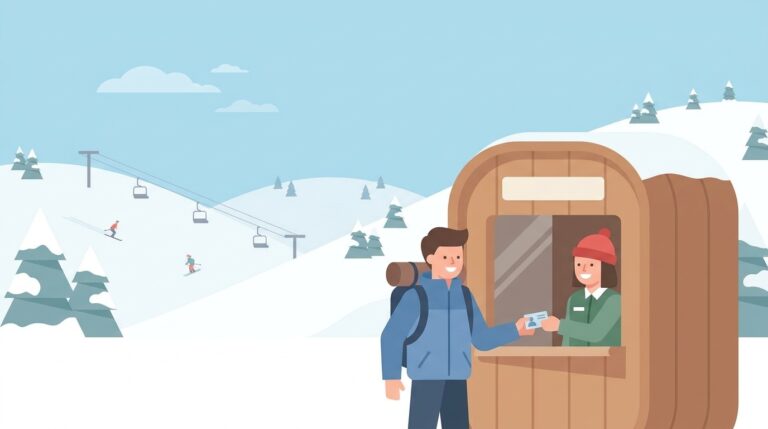
Setting: You are at the ticket box of a beautiful ski resort in Pyeongchang, covered in fresh snow. The ticket agent, Minji, is friendly but very busy.
- Minji (Staff): 어서 오세요! 리프트권 구매 도와드리겠습니다.
(Welcome! I can help you purchase your lift tickets.) - You (Intermediate Learner): 안녕하세요! 혹시 외국인 할인이나 카드 할인되는 거 있어요?
(Hello! By any chance, are there any foreign tourist discounts or card discounts?) - Minji (Staff): 아, 외국인 관광객이시면 여권 보여주실 때 20% 할인 가능해요. 혹시 어떤 카드로 결제하시나요?
(Ah, if you are a foreign tourist, you can get a 20% discount when you show your passport. Which card are you paying with?) - You (Intermediate Learner): 🎭 (Handing over your passport and card) 신한카드로 하려고요. 동반 할인도 적용돼요?
(I plan to use Shinhan Card. Does the companion discount apply as well?) - Minji (Staff): 네, 신한카드는 동반 1인까지 30% 할인 가능합니다! 여권 할인보다 이게 더 저렴해요.
(Yes, with Shinhan Card, one companion can get up to 30% off! This is cheaper than the passport discount.) - You (Intermediate Learner): 와, 다행이네요! 장비 렌탈이랑 패키지로 묶으면 더 저렴해지나요?
(Wow, what a relief! Is it cheaper if we bundle it with equipment rental?) - Minji (Staff): 네, 패키지로 하시면 인당 만 원씩 더 할인해 드릴 수 있어요. 그렇게 도와드릴까요?
(Yes, if you do the package, we can discount another 10,000 KRW per person. Shall I help you with that?) - You (Intermediate Learner): 네, 그렇게 해주세요! 정말 감사합니다.
(Yes, please do it that way! Thank you so much.)
🔀 Interactive Choice Point
What will you say next to finalize the rental process?
* **A.
Frequently Asked Questions (FAQ)
Q: What does "혹시 할인되는 카드 있어요? (Hoksi hal-in-doeneun kadeu isseoyo?)" mean in Korean and how do you pronounce it?
A: In Korean, "혹시 할인되는 카드 있어요? (Hoksi hal-in-doeneun kadeu isseoyo?)" is pronounced [Hoke-shee hal-een-doe-neun kah-deu eet-suh-yo? (Sounds like "hope" without the 'p' + "she" + "hal-in" + "do-eh-noon" + "card" + "is-suh-yo"] and means: "By any chance, is there a card that gets a discount?"
Q: What does "동반 할인도 적용돼요? (Dongban hal-in-do jog-yong-dwaeyo?)" mean in Korean and how do you pronounce it?
A: In Korean, "동반 할인도 적용돼요? (Dongban hal-in-do jog-yong-dwaeyo?)" is pronounced [Dong-bahn hal-een-doh johg-yong-dwae-yo? (Sounds like "dong" + "bahn" + "hal-een" + "doh" + "juck-yong" + "gway-yo"] and means: "Does the companion discount apply as well?"
Q: What does "장비 렌탈이랑 패키지로 하면 더 저렴해요? (Jangbi rental-irang paekiji-ro hamyeon deo jeoryeom-haeyo?)" mean in Korean and how do you pronounce it?
A: In Korean, "장비 렌탈이랑 패키지로 하면 더 저렴해요? (Jangbi rental-irang paekiji-ro hamyeon deo jeoryeom-haeyo?)" is pronounced [Jahng-bee ren-tal-ee-rahng pack-ee-jee-roh ha-myuhn duh juh-ryum-hae-yo? (Sounds like "jahng-bee" + "rental" + "ee-rahng" + "package" + "roh" + "ha-myun" + "duh" + "juh-ryum-hae-yo"] and means: "Is it cheaper if I bundle it as a package with equipment rental?"







