

C1 Korean Masterclass: Finding Your Inner Peace in the Hustle of Seoul
Phase 1: Empathy (스토리 몰입형 오프닝)
안녕하세요! Daily Hangul Editor Min-ji here, your trusty Korean bestie and cultural navigator! 🌿
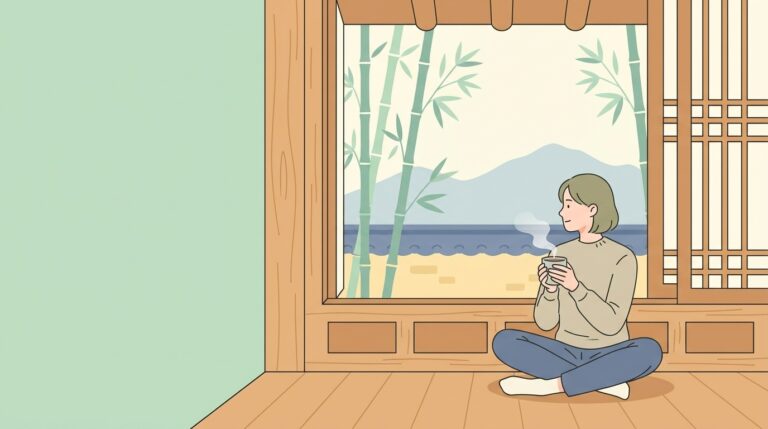
Imagine this: You’ve just finished a grueling 9-to-5 shift in the heart of Gangnam. Neon lights are blinding, cars are honking, and your KakaoTalk is buzzing relentlessly with work messages. Your mind feels like a browser with 50 tabs open. You desperately need to unplug. You step into a secluded da-won (다원 – traditional tea house) tucked away in a quiet alley of Insadong, or perhaps you find yourself at a serene temple stay in Bukhansan. The master pours warm lotus tea, looks at you, and asks how your mind is holding up.
At a C1 level, you aren’t just ordering food anymore; you want to talk about your soul, your mental health, and how you cope with modern-day anxiety (hyeondaeein-ui seutreseu). Many advanced learners tell me, “Min-ji, I want to discuss mindfulness in Korean, but I only know basic words like ‘행복해요’ (I’m happy) or ‘스트레스 받아요’ (I’m stressed).”
Don’t worry! Today, we are going deep into the linguistic nuances of 현대인의 명상과 마음 챙김 (Modern Meditation and Mindfulness). This guide is built from real-life conversations I’ve had with advanced learners who wanted to join Korean meditation circles and tea ceremonies. Let’s elevate your Korean to a spiritual, deeply reflective level!
Phase 2: Deep Dive into 3 Essential Expressions (핵심 표현 3선 심층 분석)
Let’s unpack three high-level expressions that will make you sound incredibly native and thoughtful when discussing mental health.
1. 마음을 비우다 (Ma-eum-eul bi-u-da)
- Pronunciation: Mah-eum-eul bee-oo-dah (Rhymes with “Ma” as in mama, and “bi-u-da” sounds like “bee-ooh-dah”)
- Meaning: Literally “to empty one’s mind/heart.” It means letting go of greed, worries, and obsessive thoughts.
- K-Culture Moment: You will hear this constantly in healing K-Dramas like Our Blues or Forest of Secrets. When a character is obsessing over a promotion or a breakup, an older, wiser mentor will gently tap their shoulder and say, “이제 그만 마음을 비워라” (Let it go now/Empty your mind).
- Editor’s Insight: Unlike the English “clear your head,” 마음을 비우다 carries a deeply Buddhist undertone. It implies that suffering comes from holding onto attachment (jip-chaek), so emptying the heart (마음) is the ultimate key to peace.
- Situation Spectrum: Casual ✅ | Semi-formal ✅ | Formal ✅
- 🤔 Think About It: Is it easy to “empty your mind” in your culture, or is active problem-solving preferred? How does the concept of emptying differ from Western mindfulness?
2. 멍(을) 때리다 (Myeong-eul ttae-ri-da)
- Pronunciation: Myeong-eul ttae-ree-dah (“Myeong” sounds like “young” with an M; “ttae-ri-da” uses a tense double ‘t’ sound, like the ‘t’ in “stop”)
- Meaning: Literally “to hit a daze.” It means zones out, spacing out, or entering a state of absolute brain rest.
- K-Culture Moment: Korea actually hosts an annual “Space-out Competition” (멍때리기 대회) by the Han River! The goal is to maintain the lowest, most stable heart rate without falling asleep or checking your phone. It’s a literal cultural phenomenon celebrating doing absolutely nothing.
- Editor’s Insight: While once considered a lazy habit, 멍때리기 is now celebrated as essential mental hygiene for overworked Koreans. You can do 불멍 (spacing out looking at a campfire), 물멍 (looking at water/the ocean), or 풀멍 (looking at plants).
- Situation Spectrum: Casual ✅ | Semi-formal ✅ | Formal 🚫 (Too slangy for corporate presentations, but perfectly fine in talk shows or casual interviews)
- 🤔 Think About It: What is your favorite way to space out? 불멍 (campfire), 물멍 (water), or 숲멍 (forest)?
3. 마음을 다잡다 (Ma-eum-eul da-jap-da)
- Pronunciation: Mah-eum-eul dah-jahp-dah (“da” as in doctor, “jap” sounds like “jahp” with a sharp stop at the end)
- Meaning: Literally “to grab hold of one’s mind/heart.” It means to compose oneself, regain emotional control, or steel one’s resolve.
- K-Culture Moment: In K-Pop documentaries (like those of BTS or BLACKPINK), when members face immense pressure before going on stage or after a setback, they often talk about how they 마음을 다잡고 (composed themselves/steeled their resolve) to push forward.
- Editor’s Insight: This is the opposite of 마음을 비우다. While 비우다 is about letting go, 다잡다 is about actively gathering your scattered, anxious emotions and pulling them back into a focused center.
- Situation Spectrum: Casual ✅ | Semi-formal ✅ | Formal ✅
- 🤔 Think About It: When was the last time you had to 마음을 다잡다 after receiving stressful news?
Phase 3: Textbook Korean vs. Real Korean (교과서 한국어 vs. 진짜 한국어)
Let’s compare textbook phrases with what advanced native speakers actually say when talking about mental states.
Scenario A: When you are incredibly stressed and need a break
- 📖 Textbook Style: “스트레스가 심해서 휴식이 필요합니다.” (seut-re-seu-ga sim-hae-seo hyu-sig-i pil-yo-hap-ni-da)
- Translation: “My stress is severe, so I need rest.”
- 🗣️ Real Korean: “머리가 터질 것 같아서 뇌 정지 왔어요. 잠시 쉬어 가야겠어요.” (meo-ri-ga teo-jil geot gat-ah-seo noe jeong-ji wat-eo-yo. jam-si swi-eo ga-ya-get-eo-yo)
- Translation: “My head feels like it’s going to explode; my brain has literally stopped working. I need to take a breather.”
- 💡 Why the difference? C1 speakers use metaphors like 뇌 정지 (brain freeze/stop) and 머리가 터질 것 같다 to vividly express cognitive overload instead of dry medical terms.
Scenario B: Describing a state of perfect peace
- 📖 Textbook Style: “마음이 아주 평안하고 조용합니다.” (ma-eum-i a-ju pyeong-an-ha-go jo-yong-hap-ni-da)
- Translation: “My mind is very peaceful and quiet.”
- 🗣️ Real Korean: “마음이 한결 차분해지고 비워진 기분이에요.” (ma-eum-i han-gyeol cha-bun-hae-ji-go bi-wo-jin gi-bun-i-e-yo)
- Translation: “My mind feels significantly calmer and beautifully emptied out.”
- 💡 Why the difference? 한결 (significantly/so much more) and 비워지다 (to be emptied) add a poetic, self-aware depth to your spiritual state.
Phase 4: K-Culture Deep Dive & Non-Verbal Manners (비언어적 매너)
4-1. The Body Language of Mindfulness in Korea
When attending a temple stay (템플스테이) or a formal tea ceremony (다도 – Dado), non-verbal cues are everything:
* 공수 (Gong-su) Hand Position: When standing in a temple or speaking to a monk, place your right hand over your left hand (for women) or left over right (for men) gently over your lower abdomen. This shows humility and internal focus.
* The Scented Sigh: When drinking traditional tea, do not gulp. Hold the cup with both hands, bring it close to your face to inhale the steam, take a small sip, and let out a silent, slow breath through your nose. It is a sign of respect for the tea and the space.
4-2. The Rise of “힐링 (Healing)” Culture
In Western cultures, wellness often focuses on self-improvement and high performance (e.g., biohacking, cold plunges). In Korea, the buzzword is 힐링 (Healing). It is a soft, therapeutic approach. It’s about returning to a state of natural comfort. This is why cozy, low-stakes variety shows like 삼시세끼 (Three Meals a Day) or healing cafes where you can just sit and look at trees (숲뷰 카페) are massive trends. It’s an antidote to the high-pressure, hyper-competitive 빨리빨리 (hurry-hurry) culture.
Phase 5: Real-Life Roleplay Scenario (실전 롤플레이 시나리오)
Setting: A quiet, beautifully minimalist tea house in Hanok-style near Anguk Station. You are speaking with Ji-woo, a local tea master and meditation facilitator who noticed you looking a bit overwhelmed.
Dialogue
- 지우 (Ji-woo): (따뜻한 연잎차를 건네며) “오늘 유독 지쳐 보이시네요. 요즘 마음속이 많이 복잡하신가 봐요?”
- (Hands you warm lotus tea) “You look exceptionally exhausted today. Is your mind feeling very cluttered lately?”
- You: “네, 맞아요. 요즘 업무가 너무 몰려서 머리가 터질 것 같았거든요. 아무 생각도 안 하고 싶었어요.”
- “Yes, that’s right. Work has piled up so much lately that my head feels like it’s going to explode. I didn’t want to think about anything.”
- 지우 (Ji-woo): (미소를 지으며) “그럴 때는 그냥 편하게 멍을 때리는 것도 아주 좋은 명상이에요. 차 향을 먼저 맡아보세요.”
- (Smiling) “In times like that, just comfortably spacing out is actually a great form of meditation. Try smelling the tea’s aroma first.”
- You: (눈을 감고 향을 맡으며) “아… 차 향을 맡으니까 온몸의 긴장이 풀리면서 마음이 한결 차분해지네요.”
- (Inhaling the scent with eyes closed) “Ah… smelling the tea releases all the tension in my body, and my mind feels significantly calmer.”
- 지우 (Ji-woo): “다행이네요. 차를 마시는 이 짧은 순간만큼은 모든 집착과 걱정을 내려놓고 마음을 비워보세요.”
- “I’m glad. For this short moment while drinking tea, try letting go of all attachments and worries, and empty your mind.”
- You: “마음을 비우는 게 생각보다 쉽지 않지만, 이 공간에 있으니 자연스럽게 그렇게 되는 것 같아요.”
- “Emptying the mind isn’t as easy as it sounds, but being in this space seems to make it happen naturally.”
- 지우 (Ji-woo): “맞아요. 자, 차가 식기 전에 한 모금 마셔보세요. 그리고 다시 시작할 힘을 얻는 거예요.”
- “Indeed. Here, take a sip before it gets cold. And then, you regain the strength to start anew.”
- You: “네, 차를 마시며 마음을 다잡고 내일부터는 다시 긍정적인 마음으로 시작해 볼게요. 고맙습니다.”
- “Yes, I will compose myself while drinking this tea and start tomorrow with a positive mindset again. Thank you.”
🔀 Interactive Choice Points (인터랙티브 선택지)
How would you respond to Ji-woo’s question in Turn 5, when she says: “모든 집착과 걱정을 내려놓고 마음을 비워보세요.”?
- Choice A: “네, 이제부터 아무 생각도 안 하고 그냥 바보처럼 있을래요.”
- (Yes, from now on I won’t think about anything and will just stay like an idiot.)
- Choice B: “생각이 꼬리에 꼬리를 물어서 마음을 비우는 게 쉽지 않은데, 좋은 방법이 있을까요?”
- (My thoughts keep spiraling, so emptying my mind isn’t easy. Do you have any good tips?)
- Choice C: “마음을 비우면 인생에서 도태될 것 같아 솔직히 두려워요.”
- (Honestly, I’m scared that if I empty my mind, I will fall behind in life.)
🕵️♀️ Feedback on Your Choice:
- Choice A (Risk ⚠️): While funny, calling yourself a 바보 (idiot) breaks the peaceful, meditative flow of a C1 conversation. It’s a bit too self-deprecating for this setting.
- Choice B (Best 👍): Excellent! The idiomatic expression 생각이 꼬리에 꼬리를 물다 (thoughts biting their own tails / thoughts spiraling) is a perfect C1 phrase that fits the context beautifully.
- Choice C (Good but intense ⚠️): Extremely deep! Reflects the high-pressure competitive nature of Korean society (도태되다 – to fall behind). Ji-woo would give you a 2-hour lecture on self-love!
Phase 6: 10-Second Emotion Shadowing Drill (10초 감정 섀도잉 드릴)
Practice these sentences out loud. Focus on the emotional markers and the pause points (/).
- [🥺 Exhausted and seeking relief]
- “요즘 / 업무가 너무 몰려서 / 머리가 터질 것 같아요. / 진짜 / 뇌 정지 온 것 같아니까요.”
- Yo-jeum / eom-mu-ga neo-mu mol-ryeo-seo / meo-ri-ga teo-jil geot gat-a-yo. / jin-jja / noe jeong-ji on geot gat-a-ni-kka-yo.
- [🧘♀️ Deeply peaceful and relaxed]
- “차 향을 맡으니까 / 복잡했던 마음이 / 한결 / 차분하게 / 가라앉는 기분이에요.”
- Cha hyang-eul mat-eu-ni-kka / bop-jap-haet-deon ma-eum-i / han-gyeol / cha-bun-ha-ge / ga-ra-an-neun gi-bun-i-e-yo.
- [💪 Determined but gentle]
- “여기서 / 에너지를 충전했으니 / 내일부터는 / 다시 마음을 다잡고 / 힘내 보려고요.”
- Yeo-gi-seo / e-neo-ji-reul chung-jeon-haet-eu-ni / nae-il-bu-teo-neun / da-si ma-eum-eul da-jap-go / him-nae bo-ryeo-go-yo.
Phase 7: K-Culture Mini-Dictionary (K-Culture 미니 사전)
- 번아웃 (Beon-a-ut) | Burnout | Loanword widely used in corporate and academic settings to describe extreme mental and physical exhaustion.
- 소확행 (So-hwak-haeng) | Small but Certain Happiness | A lifestyle trend prioritizing daily tiny comforts (like buying a warm latte) over grand life goals.
- 불빛 요가 (Bul-bit Yo-ga) / 싱잉볼 명상 (Sing-ing-bol Myeong-sang) | Ambient Yoga / Singing Bowl Meditation | Popular urban mindfulness trends in Seoul’s trendy neighborhoods like Mapo and Seongsu.
- 템플스테이 (Temple Stay) | Temple Stay | Experiencing Buddhist monastic life. A highly popular weekend getaway for stressed-out city dwellers.
Phase 8: Traveler’s Survival Kit (여행자를 위한 생존 키트)
Survival Expressions for Mindfulness Seekers
- “조용한 자리로 안내해 주실 수 있나요?”
- Jo-yong-han ja-ri-ro an-nae-hae ju-sil su in-na-yo?
- “Could you guide me to a quiet seat?” (Perfect for tea houses)
- “혹시 이 찻집, 예약제로 운영되나요?”
- Hok-si i chat-jip, ye-yak-je-ro un-yeong-doe-na-yo?
- “By any chance, is this tea house run on a reservation-only basis?”
- “초보자가 참여할 수 있는 명상 프로그램이 있을까요?”
- Cho-bo-ja-ga cham-yeo-hal su in-neun myeong-sang pro-geu-raem-i is-seul-kka-yo?
- “Is there a meditation program that beginners can join?”
🧭 Editor’s Travel Note: To book a gorgeous, authentic temple stay, download the official [Templestay Korea App] or visit their English portal. When navigating the winding alleys of Bukchon Hanok Village to find hidden tea rooms, use [KakaoMap] or [Naver Map] instead of Google Maps, which often glitches in old alleyways. (Note: Program details and operating hours may vary, so always check before visiting.)
Phase 9:
Frequently Asked Questions (FAQ)
Q: What does "마음을 비우다 (Ma-eum-eul bi-u-da)" mean in Korean and how do you pronounce it?
A: In Korean, "마음을 비우다 (Ma-eum-eul bi-u-da)" is pronounced [Mah-eum-eul bee-oo-dah (Rhymes with "Ma" as in mama, and "bi-u-da" sounds like "bee-ooh-dah"] and means: Literally "to empty one's mind/heart." It means letting go of greed, worries, and obsessive thoughts.
Q: What does "멍(을) 때리다 (Myeong-eul ttae-ri-da)" mean in Korean and how do you pronounce it?
A: In Korean, "멍(을) 때리다 (Myeong-eul ttae-ri-da)" is pronounced [Myeong-eul ttae-ree-dah ("Myeong" sounds like "young" with an M; "ttae-ri-da" uses a tense double 't' sound, like the 't' in "stop"] and means: Literally "to hit a daze." It means zones out, spacing out, or entering a state of absolute brain rest.
Q: What does "마음을 다잡다 (Ma-eum-eul da-jap-da)" mean in Korean and how do you pronounce it?
A: In Korean, "마음을 다잡다 (Ma-eum-eul da-jap-da)" is pronounced [Mah-eum-eul dah-jahp-dah ("da" as in doctor, "jap" sounds like "jahp" with a sharp stop at the end] and means: Literally "to grab hold of one's mind/heart." It means to compose oneself, regain emotional control, or steel one's resolve.







