

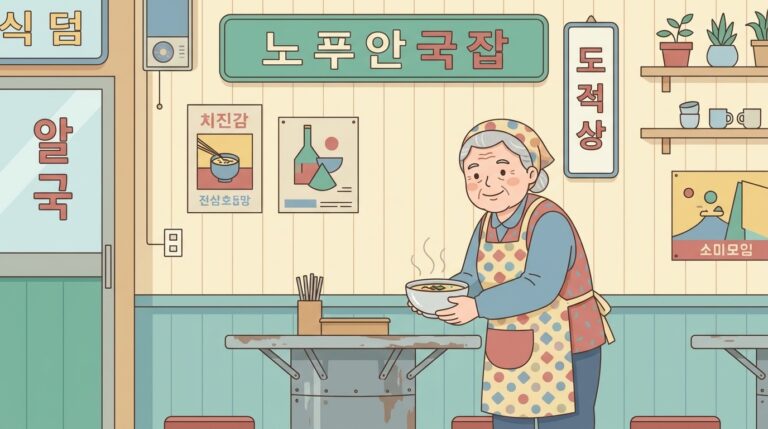
Step into the Past: Master the Hidden Language of Korea’s ‘Nopo’ (Heritage Restaurants)
Phase 1: Empathy (Welcome to the Warmth of a Korean Alleyway)
안녕하세요! It’s your Favorite Korean Navigator and Editor-in-Chief from Daily Hangul (매일한글)!
Imagine this: You’re walking through a narrow, dimly lit alleyway in Euljiro, Seoul. Modern skyscrapers loom behind you, but right here, the air smells of rich, simmering garlic broth and charcoal-grilled meat. You push open a squeaky sliding glass door. Inside, there are no sleek digital kiosks. Instead, you see dented aluminum pots, mismatched plastic chairs, and an elderly grandmother (이모님 – imonim) laughing loudly with a group of regulars.
Welcome to a Nopo (노포)—a historic, decades-old restaurant that has survived generations.
Many of our intermediate learners tell us, “I can order food at trendy restaurants in Gangnam, but when I step into a Nopo, I freeze! The menu is handwritten, the staff don’t use standard textbook Korean, and I feel like an intruder in a local secret society.”
Don’t worry! That feeling of intimidation is completely normal. Today, we’re going to unlock the unspoken rules, cultural nuances, and soulful slang of Korea’s heritage diners so you can order like a true local regular (단골 – dangol).
Phase 2: Deep Dive into 3 Essential “Nopo” Expressions
To navigate these culinary time machines, you need to move beyond standard textbook Korean. Let’s master three powerful expressions.
1. 이모, 여기 늘 먹던 걸로 주세요! (Imo, yeogi neul meokdeon geollo juseyo!)
- Pronunciation: Ee-mo, yeo-gi neul meok-deon geol-lo joo-seyo! (Think of “Imo” like the English “E-mail” but with an “o” sound, and “neul” like the “nul” in “null”.)
- Meaning: “Auntie, the usual here, please!”
- K-Culture Moment: You’ve probably seen this in K-Dramas like Reply 1988 or Work Later, Drink Now. A tired protagonist slides onto a plastic stool, makes eye contact with the owner, and utters this phrase. It immediately establishes a warm, familial connection.
- Editor’s Insight: 이모 (Imo) literally means maternal aunt, but in a Nopo, it is a magic word that melts icy boundaries. Using “늘 먹던 걸로” (what I always eat) is the ultimate badge of honor. Even if it’s only your second time visiting, saying this with a playful smile can charm the owner into giving you extra side dishes (서비스 – freebies).
- Situation Spectrum:
- Casual (반말): 이모, 하던 대로 줘! 🚫 (Too rude unless you are 60+ and actually family)
- Semi-formal (해요체): 이모, 여기 늘 먹던 걸로 주세요! ✅ (Perfect for Nopos)
- Formal (하십시오체): 어머니, 늘 식사하시던 메뉴로 부탁드립니다. ⚠️ (Too stiff; sounds like a business meeting)
- 🤔 Think About It: In many Western cultures, calling a restaurant server “Auntie” or “Uncle” might seem intrusive or overly familiar. Why do you think Korean culture embraces family titles (이모, 삼촌, 언니) for complete strangers in dining spaces?
2. 국물이 끝내줘요! (Gungmuri kkeutnae jwoyo!)
- Pronunciation: Goong-mool-ee kkeut-nae jwo-yo! (Make sure to assimilate the ‘k’ and ‘n’ sounds so kuk-mul naturally becomes gung-mul.)
- Meaning: “This broth/soup is absolute heaven!” (Lit. “The broth finishes it!”)
- K-Culture Moment: This is a legendary phrase from a famous 1990s Korean instant noodle commercial, but it is used daily in Nopos serving Gukbap (rice soup) or Jeongol (stew).
- Editor’s Insight: In Korea, the depth of a restaurant’s history is measured by its broth. When you say this, make a slight “Aah!” sound right after swallowing. It shows you appreciate the 48 hours of boiling that went into your meal.
- Situation Spectrum:
- Casual: 국물 끝장난다! ✅ (Great with friends)
- Semi-formal: 국물이 끝내줘요! ✅ (Perfect to show enthusiasm to the owner)
- Formal: 육수 맛이 아주 깊고 훌륭합니다. ⚠️ (Too academic for a noisy eatery)
- 🤔 Think About It: Why does Korean culture place such a high emotional value on “warm soup” (국물)? Think about how soup is shared from a single pot in Korea compared to individual plating in your country.
3. 여기 공기밥 하나 비벼 주세요! (Yeogi gonggibap hana bibyeo juseyo!)
- Pronunciation: Yeo-gi gong-gi-bap ha-na bee-byeo joo-seyo!
- Meaning: “Please mix a bowl of rice in here!”
- K-Culture Moment: The grand finale of almost any Nopo meal—whether it’s spicy stir-fried pork (Jeyuk) or pork backbone stew (Gamjatang)—is the legendary K-Dessert: Fried Rice (볶음밥) made using the leftover sauce right on your table grill.
- Editor’s Insight: Do not leave even a spoonful of sauce behind. Asking to “비벼 주세요” (mix it in) or “볶아 주세요” (fry it up) shows the chef you respect their base sauce.
- Situation Spectrum:
- Casual: 밥 좀 비벼줘. 🚫 (Don’t use with older staff)
- Semi-formal: 여기 밥 하나 볶아 주시겠어요? ✅ (Extremely polite and natural)
- Formal: 여기 공기밥 추가하여 비빔을 요청합니다. 🚫 (Robot speak)
Phase 3: Textbook Korean vs. Real-Life Nopo Korean
| Situation | 📖 Textbook Korean (Too formal/stiff) | 🗣️ Real-Life Nopo Korean (Natural & Soulful) |
|---|---|---|
| Asking for more side dishes | 반찬을 더 주실 수 있나요? (Banchan-eul deo jusil su innayo?) |
이모님, 여기 반찬 리필 좀 부탁드려요! (Imonim, yeogi banchan ripil jom butakdeuryeoyo!) |
| Checking if they are still open | 영업시간이 어떻게 되나요? (Yeogeop-sigani eotteoke doenayo?) |
혹시 아직 식사 되나요? (Hoksi ajik siksa doenayo? – “By any chance, is dining still possible?”) |
- 💡 Why the difference? Nopos are run on human affection (정 – Jeong). Textbook phrases sound like you are dealing with a corporate franchise. Real-Life Korean uses warmer, softer contractions and polite yet casual phrasing to make the staff feel valued as family.
Phase 4: K-Culture Deep Dive & Non-Verbal Manners
4-1. The “Nopo” Code of Non-Verbal Etiquette
- The Eye-Contact “Jeogiyo”: In modern restaurants, you press a call button on the table. In a Nopo, there are no buttons. Do not yell “Jeogiyo!” loudly across a crowded room. Instead, make eye contact with the Imo, raise your hand slightly to shoulder level, and give a warm, nodding smile.
- The Spoon Setter: It is a common courtesy in Korea to lay out the napkins and place chopsticks and spoons on top of them for everyone at the table. If you do this for your group first, the owner will instantly recognize you as someone who knows Korean dining culture.
4-2. The “Jeong” (정) Culture in Old Spaces
In a Nopo, space is tight. You might sit on a round plastic stool right next to a stranger, or have to step over someone’s shoes. This physical closeness is a reflection of Jeong (social attachment/affection). Embrace the noise, the steam, and the shared space! It is not a place for quiet privacy; it is a communal celebration of food.
Phase 5: Live Roleplay Scenario
Setting: “Eulji-Oden,” a 40-year-old street-side indoor cart (Pojangmacha) famous for its fishcake soup and spicy stir-fried octopus. The steam is thick, and the walls are covered in scribbled memories of customers from the 1990s.
Characters:
- 민우 (Minwoo): An intermediate Korean learner who wants to show his friend the real Seoul.
- 이모님 (Imonim): The owner. Gruff on the outside, but has a heart of pure gold.
🎭 The 8-Turn Script
- 민우: (Bowing slightly as he enters) 안녕하세요! 이모님, 두 명인데 안쪽에 자리 있을까요?
- (An-nyeong-ha-se-yo! I-mo-nim, doo myeong-in-de an-jjok-e ja-ri is-seul-kka-yo?)
- “Hello! Auntie, we are two people, is there a seat inside?”
- 이모님: (Wiping a plastic table with a wet rag) 어, 들어와! 저기 구석 자리 앉아. 오늘 바람 많이 부네.
- (Eo, deul-eo-wa! Jeo-gi goo-seok ja-ri an-ja. Oh-neul ba-ram ma-ni boo-ne.)
- “Oh, come on in! Sit in that corner spot. It’s really windy today.”
- 민우: (Sitting down and rubbing hands) 네, 진짜 춥네요. 이모, 여기 뜨끈한 어묵탕 하나랑 처음처럼 한 병 주세요!
- (Ne, jin-jja choop-ne-yo. I-mo, yeo-gi tteu-keun-han eo-muk-tang ha-na-rang cheo-eum-cheo-reom han byeong joo-seyo!)
- “Yeah, it’s really cold. Auntie, please give us one steaming hot fishcake soup and a bottle of Chumchurum (Soju)!”
- 이모님: (Bringing the soju first with a wink) 자, 추우니까 목부터 축이고 있어. 어묵탕 금방 나온다!
- (Ja, choo-oo-ni-kka mok-bu-teo chuk-i-go is-seo. Eo-muk-tang geum-bang na-on-da!)
- “Here, it’s cold so wet your throat first. The fishcake soup will be out in a jiffy!”
- 민우: (Taking a sip of the soup after it arrives) 와… 이모, 국물이 진짜 끝내주네요! 속이 확 풀려요.
- (Wa… I-mo, goong-mool-ee jin-jja kkeut-nae-joo-ne-yo! Sok-ee hwak pool-lyeo-yo.)
- “Wow… Auntie, this broth is truly incredible! It completely warms me up inside.”
- 이모님: (Grinning proudly, setting down a small plate of seasoned chives) 그렇지? 우리 육수만 30년째야. 이거 부추무침인데 같이 먹어봐.
- (Geu-reot-ji? Oo-ri yuk-su-man sam-sip-nyeon-jjae-ya. Ee-geo boo-choo-moo-chim-in-de ga-chi meok-eo-bwa.)
- “Right? We’ve been making this broth for 30 years. Here are some seasoned chives, try it together.”
- 민우: (Clapping hand over mouth in delight) 서비스 감사합시다! 이모님, 나중에 여기 밥도 볶을 수 있죠?
- (Seo-bee-seu gam-sa-hap-ni-da! I-mo-nim, na-jung-e yeo-gi bap-do bok-eul soo it-jyo?)
- “Thank you for the service (freebie)! Auntie, we can fry some rice in this later, right?”
- 이모님: (Laughing loudly) 당연하지! 먹고 남은 소스만 남겨둬. 내가 기가 막히게 볶아줄 테니까.
- (Dang-yeon-ha-ji! Meok-go nam-eun so-seu-man nam-gyeoh-dwo. Nae-ga gi-ga mak-hi-ge bok-a-jool te-ni-kka.)
- “Of course! Just leave the leftover sauce. I’ll fry it up so good it’ll blow your mind.”
🔀 Interactive Choice Points
Now it’s your turn! The soup was amazing, and now you want to pay. How do you approach the counter?
- Option A: You walk up and say loudly: “저기요, 계산서 좀 주시겠습니까?” (Excuse me, could I get the bill?)
- Option B: You catch her eye and say warmly: “이모님, 너무 잘 먹었습니다! 얼마예요?” (Auntie, we ate so well! How much is it?)
- Option C: You leave the money on the table silently and walk out because she looks busy.
Feedback:
- Best Selection: Option B! Asking “너무 잘 먹었습니다” (We ate so well) before asking for the price is the ultimate compliment in a Nopo. It treats the owner like an artisan, not just a cashier.
- Risk Selection: Option A. While grammatically correct, 계산서 (bill) sounds too clinical. In small Nopos, they often calculate based on the empty plates and bottles at your table, not an electronic printed bill.
- Bad Selection: Option C. Leaving cash without saying goodbye is considered incredibly rude in Korea’s high-context social culture, even if they are busy.
Phase 6: 10-Second Emotion Shadowing Drill
Let’s practice speaking with the exact rhythm, emotion, and pauses of a native speaker. Use the slash / to pause and breathe.
- [🥺 Relieved and cozy – after drinking hot soup on a freezing day]
- 와… / 국물이 / 진짜 / 끝내줘요! / 속이 / 확 / 풀려요!
- (Wa… / gung-muri / jin-jja / kkeutnae-jwoyo! / sog-i / hwak / pullyeoyo!)
- [😊 Courteous and hungry – ordering fried rice]
- 이모님! / 여기 / 밥 / 하나만 / 기가 막히게 / 볶아주세요!
- (Imonim! / yeogi / bap / hanaman / giga makhige / bokkaju-seyo!)
Phase 7: K-Culture Mini-Dictionary
- 노포 (Nopo | No-po): Heritage restaurants or shops that have been passed down for generations. They usually have a rustic atmosphere and a limited but highly perfected menu.
- 이모님 (Imonim | Ee-mo-nim): Literally “Aunt.” Used affectionately to address middle-aged or elderly female staff in casual eateries.
- 서비스 (Seobiseu | Seo-bee-seu): Free food or drinks given by the owner as a gesture of kindness or hospitality. Never demand it; let it happen naturally!
- 단골 (Dangol | Dan-gol): A regular customer. Being recognized as a dangol at a Nopo is a high social status among Korean foodies.
Phase 8: Survivor Kit for Travelers
Survival Phrases TOP 3:
- “여기 뭐가 제일 잘 나가요?” (Yeogi mwo-ga je-il jal na-ga-yo?)
- Pro Tip: Use this when there is no English menu. It means “What sells the best here?” and lets the owner pick their signature dish for you.
- “덜 맵게 해주실 수 있어요?” (Deol maep-ge hae-jusil su isseo-yo?)
- Pro Tip: Essential if you can’t handle high spice levels. It means “Can you make it less spicy?”
- “카드 결제 되나요?” (Kadeu gyeol-je doenayo?)
- Pro Tip: While most Nopos now accept cards, some very old places prefer bank transfers or cash. It’s always polite to ask “Is card payment okay?”
🗺️ Editor’s Travel Note: To find authentic Nopos in Seoul, skip Google Maps. Instead, download the Naver Map App and search for the keyword “노포 맛집” (Nopo gourmet). Look for places with 4.5+ stars that have been active since before 1990. (Note: Restaurant operational hours can change without notice, so always check Naver Map before making the trip!)
Phase 9: “A Step Deeper” (Thinking Points)
In Western dining, the service is often transactional—you pay for a service, and the server maintains a professional distance. In a Korean Nopo, the boundaries of professionalism are blurred by Jeong (정). The owner might scold you for not eating your vegetables, or pour you a drink without asking. This reflects Korea’s collective, family-centric historical mindset where everyone in the community is connected.
- 💬 Your Turn: Have you ever experienced this kind of “rough but warm” hospitality in your own country? Let us know in the comments below!
Phase 10: FAQ & Common Mistakes
Q: Can I go to a Nopo alone? Many places seem to only serve double portions.
A: Excellent observation! Many Nopo dishes like Jeongol (stews) or Samgyeopsal (pork belly) are designed for minimum 2 people. However, if you go during off-peak hours (between 2 PM and 5 PM) and ask politely, “1인분도 식사 가능한가요?” (Is a 1-person portion available for dining?), many warm-hearted owners will accommodate you.
Q: Is it rude to ask for a receipt at an old, cash-only place?
A: Not at all. However, instead of asking for a paper receipt, it is much more common to do a simple mobile bank transfer (계좌이체 – gyejwa-iche) on the spot. They will have their bank account details written on a cardboard sign near the kitchen.
Q: Why do the owners sometimes speak in banmal (informal language) to me?
A: This is not a sign of disrespect! In Korean culture, when an elderly person uses warm banmal with you, it means they view you affectionately as their own grandchild or niece/nephew. Embrace it as a sign of true hospitality!
🚨 Common Mistakes Alert:
- Using “Jeogiyo” like a siren: Do not wave frantically or snap your fingers. It’s incredibly disrespectful to older workers.
- Leaving food behind: If you leave a bowl half-full, the Imo might genuinely worry that her food didn’t taste good. If you are full, say, “너무 배불러서 조금 남겼어요, 진짜 맛있었어요!” (I’m too full so I left a little, it was truly delicious!).
Phase 11: Action Mission
- 🥉 Bronze Medal: Read the Phase 6 Shadowing Drill aloud 3 times while imagining the smell of steaming broth.
- 🥈 Silver Medal: Share this post on Instagram or X with the Korean word you found most interesting (#DailyHangul #NopoExperience).
- 🥇 Gold Medal: The next time you visit a Korean restaurant (even in your hometown), instead of saying “Thank you,” look the server in the eye and say: “너무 잘 먹었습니다!”
Phase 12: Interactive Quiz Challenge
1. Situation Quiz
You are at a busy pig trotters (Jokbal) Nopo. You want to ask for more lettuce leaves. What is the most natural way to say this?
* A) 저기요, 상추를 더 주십시오.
* B) 이모님, 상추 조금만 더 리필해 주실 수 있어요?
* C) 야! 상추 더 줘.
View Answer & Explanation
Correct Answer: B
Using ‘이모님’ (Imonim) and asking with a polite ‘수 있어요?’ (Can you?) is the perfect blend of warmth and politeness for a Nopo. ‘A’ is too robotic, and ‘C’ is extremely rude banmal!
2. True or False?
In a Korean Nopo, it is customary to wait for the server to put down your chopsticks and napkins for you.
View Answer & Explanation
Correct Answer: False
In casual dining and Nopos, customers almost always set up their own chopsticks, spoons, and napkins. Doing this for your tablemates shows great manners!







