

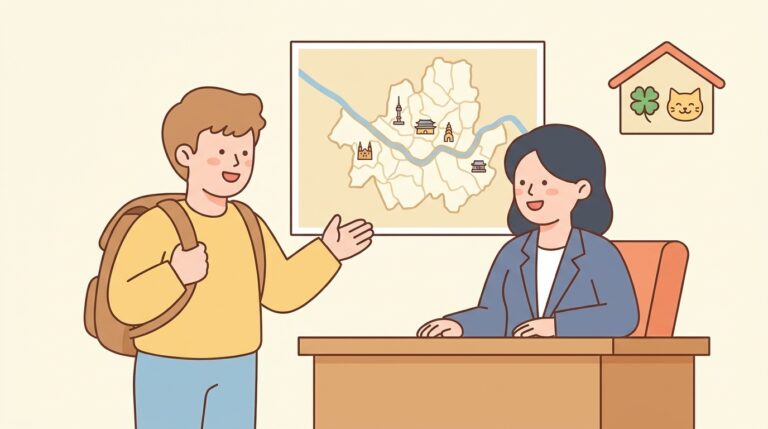
Finding Your Cozy Spot in Seoul: How to Schedule a Viewing with a Korean Realtor like a Native!
Phase 1: Empathy (Welcome, My Friend!)
안녕하세요! Welcome back to Daily Hangul, your premium Korean learning companion and neighborhood navigator. I’m your senior editor, and today we are tackling one of the most exciting—yet incredibly nerve-wracking—milestones of living in South Korea: finding your own place (집 구하기)!
Imagine this: You’ve been scrolling through housing apps like Dabang (다방) or Zigbang (직방). You’ve found a beautiful one-room (원룸) with a sunny window and a cozy kitchen. You want to see it in person before someone else snatches it up. You need to call or text the real estate agent—known in Korea as 공인중개사 (gong-in-jung-gae-sa) or simply 부동산 (bu-dong-san).
Suddenly, your palms sweat. “How do I sound polite but confident? What if they speak too fast? What if I make a mistake?”
Take a deep breath! You are not alone. Many of our intermediate (B1) learners tell us that making that first appointment is the hardest hurdle. Today, we’re going to turn that anxiety into excitement. By the end of this guide, you’ll have the exact scripts, cultural hacks, and conversational confidence to book your viewing like a seasoned Seoulite. Let’s dive in!
Phase 2: Deep Dive into 3 Essential Expressions
To navigate the Korean housing market, you need expressions that show you are polite, serious, and ready. Here are your top three power phrases.
1. 방 좀 볼 수 있을까요? (Can I take a look at the room/house?)
- Pronunciation: Bang jom bol su isseul-kka-yo? (Sounds like: bahng jom bol soo ee-seul-kah-yo?)
- Meaning: “Can I see the room?” (Direct: “Can I please look at the room a little?”)
- K-Culture Moment: In K-Dramas like Because This Is My First Life, you often see characters wandering into a local real estate office on a rainy afternoon, politely uttering this exact phrase to break the ice.
- Editor’s Insight: The word ‘좀’ (jom) is a magic word in Korean. It literally means “a little,” but culturally, it softens your request, making you sound extremely natural, polite, and less demanding.
- Situation Spectrum:
- Casual: 방 좀 볼 수 있을까? (🚫 – Too informal for realtors)
- Semi-formal: 방 좀 볼 수 있을까요? (✅ – Perfect! Polite and friendly)
- Formal: 방을 볼 수 있겠습니까? (⚠️ – A bit too stiff for a casual house hunt)
- 🤔 Think About It: In your native language, do you use softening words like “just” or “a bit” when making requests to strangers? How does it compare to the Korean use of ‘좀’?
2. 혹시 오늘 방문 예약 가능할까요? (Would it be possible to schedule a visit today?)
- Pronunciation: Hoksi oneul bang-mun ye-yak ga-neung-hal-kka-yo? (Sounds like: hok-shee oh-neul bahng-moon yeh-yahk gah-neung-hahl-kah-yo?)
- Meaning: “Could I potentially make a viewing appointment for today?”
- K-Culture Moment: If you’ve watched Our Beloved Summer, characters often have to make quick appointments. In Korea’s fast-paced housing market, good rooms go fast. This phrase is your golden ticket to speed.
- Editor’s Insight: ‘혹시’ (hoksi) means “by any chance” or “perhaps.” Starting your question with 혹시 shows that you respect the realtor’s busy schedule, making them much more willing to squeeze you in.
- Situation Spectrum:
- Casual: 오늘 갈 수 있어? (🚫 – Impolite)
- Semi-formal: 혹시 오늘 방문 예약 가능할까요? (✅ – Highly recommended)
- Formal: 금일 방문 예약이 가능하겠습니까? (⚠️ – Overly formal, sounds like a corporate email)
- 🤔 Think About It: Koreans value indirectness as a form of politeness. How does adding “by any chance” change the pressure on the person receiving the question?
3. 직방에서 매물 보고 연락드렸어요. (I’m calling/texting after seeing your listing on Zigbang.)
- Pronunciation: Zigbang-eseo mae-mul bogo yeon-rak-deuryeosseo-yo. (Sounds like: Jeeg-bahng-eh-suh mae-mool bo-go yuhn-rahk-deu-ryuh-suh-yo.)
- Meaning: “I saw the property listing on Zigbang and am reaching out to you.”
- K-Culture Moment: Modern Koreans rarely walk blindly into real estate offices anymore. They browse apps like Zigbang or Dabang first, find a specific listing, and then contact the designated agent using this line.
- Editor’s Insight: ‘매물’ (mae-mul) is a real estate term meaning “property for sale/rent.” Using this specific vocabulary immediately signals to the agent that you are an informed seeker who knows what they want.
- Situation Spectrum:
- Casual: 직방 보고 연락했어. (🚫 – Rude to a professional)
- Semi-formal: 직방에서 보고 연락드렸어요. (✅ – Perfect for text or call)
- Formal: 직방 앱에서 매물을 확인하고 연락을 취하였습니다. (⚠️ – Sounds robotic)
- 🤔 Think About It: Why is referencing a specific source (like an app) helpful in a fast-paced business culture like Korea’s?
Phase 3: Textbook Korean vs. Real-World Korean
Let’s compare the stiff textbook phrases with the warm, practical language real estate agents actually use and expect.
Situation 1: Expressing your budget
- 📖 Textbook: “제 예산은 보증금 천만 원에 월세 오십만 원입니다.” (My budget is a 10 million won deposit and 500,000 won monthly rent.)
- 🗣️ Real-World: “천에 오십(1000/50) 정도로 보고 있어요.” (I’m looking at around 1000/50.)
- 💡 Why the difference? Koreans heavily abbreviate rental prices. “1000/50” (천에 오십) refers to deposit/monthly rent. Dropping the units (won, man-won) shows you understand the local rental system and makes you sound like a local!
Situation 2: Asking if a property is still available
- 📖 Textbook: “그 방은 아직 계약할 수 있습니까?” (Is that room still available for contract?)
- 🗣️ Real-World: “혹시 그 방 아직 나갔나요?” (By any chance, is that room already gone?)
- 💡 Why the difference? In the fast-moving Korean market, rooms are said to “go out” (나가다 – nagada). Asking if it “went out” is the most natural way to check availability.
Phase 4: K-Culture Deep Dive & Non-Verbal Manners
4-1. The Art of “Nunchi” (눈치) in Korean Real Estate
When meeting a realtor, 눈치 (Nunchi – situational quick-wittedness) is your best friend.
* The Head Bow: When you walk into the real estate office (부동산), do a slight 15-degree bow while saying “안녕하세요!”.
* Accepting Tea/Coffee: Realtors will almost always offer you a paper cup of instant mix coffee (Maxim Gold!) or green tea. Even if you aren’t thirsty, accept it with two hands as a sign of respect and gratitude. It builds immediate rapport (정 – Jeong)!
4-2. The “Bang-Gu-Hagi” (방 구하기) Culture
In Korea, house hunting is practically a sport. Unlike some Western countries where viewings are scheduled days or weeks in advance, Korean viewings often happen on the same day you contact the agent. If you see a place you like, you might hop into the realtor’s car right then and there to tour 3 or 4 different properties. Be prepared to move fast!
Phase 5: Real-Life Roleplay Scenario
Let’s practice! You are texting Mr. Kim, a friendly but busy realtor from “Lucky Real Estate” (대박 부동산).
Characters:
- Realtor Kim (김 중개사): Professional, prompt, and uses polite business-Korean.
- You (학습자): A polite foreigner looking for a sunny one-room near the subway.
[Scene: You are sending a KakaoTalk message to Realtor Kim about a room you saw online.]

1. You: 안녕하세요! 직방에서 매물 보고 연락드렸어요.
   (An-nyeong-ha-se-yo! Zigbang-eseo mae-mul bogo yeon-rak-deuryeosseo-yo.)
   "Hello! I'm contacting you after seeing your listing on Zigbang."

2. Realtor Kim: 아, 네! 안녕하세요. 어떤 매물 말씀이신가요?
   (Ah, ne! An-nyeong-ha-se-yo. Eotteon mae-mul mal-sseum-i-sin-ga-yo?)
   "Ah, yes! Hello. Which listing are you referring to?"

3. You: [📸 Sends screenshot] 이 원룸이요. 혹시 이 방 아직 안 나갔나요?
   ([Sends screenshot] I won-rum-i-yo. Hok-si i bang a-jik an na-gat-na-yo?)
   "[Sends screenshot] This one-room. By any chance, is this room still available (not gone yet)?"

4. Realtor Kim: 네, 다행히 아직 집 볼 수 있어요! 오늘 보러 오실래요?
   (Ne, da-haeng-hi a-jik jip bol su isseo-yo! Oneul bo-reo o-sil-lae-yo?)
   "Yes, luckily you can still see the house! Would you like to come see it today?"

5. You: 네, 좋아요! 혹시 오늘 오후 3시에 방문 예약 가능할까요?
   (Ne, jo-a-yo! Hok-si oneul o-hu se-si-e bang-mun ye-yak ga-neung-hal-kka-yo?)
   "Yes, great! By any chance, would it be possible to schedule a visit today at 3 PM?"

6. Realtor Kim: 아, 3시에는 다른 손님이 있어서요. 4시는 어떠세요?
   (Ah, se-si-e-neun da-reun son-nim-i isseo-seo-yo. Ne-si-neun eo-tteo-se-yo?)
   "Ah, I have another client at 3:00. How about 4:00?"

7. You: 4시도 괜찮습니다! 주소 알려주시면 거기로 갈게요.
   (Ne-si-do gwaen-chan-seub-ni-da! Ju-so al-ryeo-ju-si-myeon geo-ri-ro gal-gae-yo.)
   "4:00 is also fine! If you let me know the address, I will go there."

8. Realtor Kim: 네, 저희 부동산 주소 문자로 보내드릴게요. 4시에 뵙겠습니다!
   (Ne, jeo-hui bu-dong-san ju-so mun-ja-ro bo-nae-deu-ril-ge-yo. Ne-si-e boep-get-seub-ni-da!)
   "Yes, I will text you our office address. See you at 4:00!"
🔀 Choose Your Path!
How would you reply to Realtor Kim’s address text to show your excitement and confirm?
- A) “네, 알겠습니다. 그때 봐요!” (Ne, al-get-seub-ni-da. Geu-ttae bwa-yo!)
- B) “네, 확인했습니다! 감사합니다. 조금 있다가 뵙겠습니다!” (Ne, hwa-gin-haet-seub-ni-da! Gam-sa-ham-ni-da. Jo-geum it-da-ga boep-get-seub-ni-da!)
- C) “오케이! 4시에 갈게.” (Okay! Ne-si-e gal-ge.)
💡 Feedback on Your Choice:
- If you chose A (Risk): While grammatically okay, “그때 봐요” (See you then) is a bit too casual for a business relationship. It might feel slightly abrupt to a realtor.
- If you chose B (Best!): Perfect! “확인했습니다” (Confirmed/Checked) and “조금 있다가 뵙겠습니다” (See you in a bit – polite formal) show high level of politeness and excitement. Realtors will love your manners!
- If you chose C (Bad): Yikes! “갈게” is banmal (informal/casual language). Using this with someone older or in a business setting is considered quite rude.
Phase 6: 10-Second Emotion Shadowing Drill
Let’s practice speaking with real Korean feelings. Pay attention to the pauses (/) and the emotional cues!
- [😊 Politely & Hopefully]
- 혹시 / 오늘 / 방문 예약 / 가능할까요?
- Hok-si / o-neul / bang-mun ye-yak / ga-neung-hal-kka-yo?
- [🙌 Brightly & Confirming]
- 네, / 주소 / 보내주시면 / 거기로 갈게요!
- Ne, / ju-so / bo-nae-ju-si-myeon / geo-ri-ro gal-ge-yo!
- [🥺 Slightly disappointed but adapting]
- 아, / 3시는 안 되는군요. / 그럼 / 4시는 괜찮으세요?
- Ah, / se-si-neun an doe-neun-gun-yo. / Geu-reom / ne-si-neun gwaen-chan-eu-se-yo?
Phase 7: K-Culture Mini Dictionary
- 원룸 (Won-rum) | Studio Apartment
- The most common housing type for students and young professionals in Korea. It combines the bedroom, kitchen, and living space into one room.
- 보증금 (Bo-jeung-geum) | Key Money / Deposit
- A large sum of money given to the landlord at the beginning of the lease, which is returned fully when you move out.
- 월세 (Wol-se) | Monthly Rent
- The monthly fee paid to the landlord. Usually, higher deposits result in lower monthly rent.
- 직방 / 다방 (Zigbang / Dabang) | Housing Apps
- The two giant mobile applications that revolutionized house-hunting in Korea. You can filter by price, location, and room type.
Phase 8: Survivor Kit for Travelers & Expats
Survival Expressions TOP 3
- “지하철역에서 가까운 방 있나요?” (Ji-ha-cheol-yeok-e-seo ga-kka-un bang it-na-yo?)
- Pro Tip: “Are there rooms close to the subway station?” Crucial for Seoul life!
- “관리비는 얼마예요?” (Gwan-ri-bi-neun eol-ma-ye-yo?)
- Pro Tip: “How much is the maintenance fee?” Always ask this, as utilities and building fees are often separate from rent.
- “융자 없는 안전한 집인가요?” (Yung-ja eop-neun an-jeon-han jip-in-ga-yo?)
- Pro Tip: “Is this a safe house with no mortgages/loans?” Highly useful for protecting your deposit.
Editor’s Travel Note 🗺️
Before you go house hunting, make sure to download the Naver Map App to find your way to real estate offices. Google Maps is not very accurate in Korea! Also, remember that real estate fees (복비 – Bokbi) are legally regulated, so check the official calculator online so you don’t get overcharged.
Note: Real estate regulations and market prices fluctuate yearly. Always consult official sources for the latest deposit safety laws.
Phase 9: “A Step Deeper” (Thoughtful Reflection)
In many Western countries, renting is a straightforward transaction: you sign a lease, pay a small deposit, and pay monthly rent. In Korea, however, the system of Jeonse (전세 – massive deposit, zero rent) and Wolse (월세 – high deposit, monthly rent) reflects a unique economic history based on mutual trust and high-interest savings. The relationship with your realtor is not just corporate; it’s highly personal. A good realtor will advocate for you, negotiate with the landlord (임대인), and even help you resolve issues after you move in. Politeness and building good rapport are not just manners—they are practical tools for a better life in Korea.
💬 Your Turn: Have you ever experienced a unique housing system in another country? How does the Korean deposit system sound to you? Share your thoughts in the comments below!
Phase 10: FAQ & Common Mistakes
Q: Can foreigners sign a rental contract in Korea?
A: Absolutely! You just need a valid passport, visa, and eventually your Alien Registration Card (ARC) to secure your deposit rights (확정일자) at the local community center (주민센터).
Q: What should I do if the realtor speaks too fast?
A: Don’t panic! Simply say: “죄송하지만 조금만 천천히 말씀해 주세요” (I am sorry, but could you please speak just a little slower?). Korean realtors are generally very patient with foreigners who try their best.
Q: Is the price on Zigbang always real?
A: Sometimes, agents post fake listings (허위매물) to lure clients. If a room looks too good to be true, it probably is. Always verify by asking, “이 방 실매물 맞나요?” (Is this a real listing?).
🚨 Common Mistakes Alert!
- Mistake: Using “너” (you) or “그쪽” when talking to the agent.
- Correct Action: Refer to them as 사장님 (Sajangnim – President/Boss) or 중개사님 (Junggaesanim – Realtor).
- Mistake: Forgetting to ask about the direction of the windows.
- Correct Action: Always ask: “남향인가요?” (Is it south-facing?). South-facing rooms get the best sunlight and save heating bills!
- Mistake: Rushing into a contract on the first day without checking water pressure.
- Correct Action: Go to the bathroom, turn on the sink faucet, and flush the toilet at the same time to check the pressure!
Phase 11: Action Mission
- Bronze Medal 🥉: Read the Roleplay in Phase 5 out loud three times to practice your flow.
- Silver Medal 🥈: Share this post on your social media with the hashtag #DailyHangul and write down your favorite new word!
- Gold Medal 🥇: Open a Korean housing app, find a room, and draft a simulated text message to the agent using the phrases learned today!
Phase 12: Interactive Quiz Challenge
Test your skills before you head out to Seoul!
Q1. What is the most natural way to ask if a listing is still available?
a) 이 방 아직 살아있나요?
b) 이 방 아직 안 나갔나요?
c) 이 방 아직 계약합니까?
Q2. Translate into abbreviated Korean: “Deposit of 5 million won and monthly rent of 400,000 won.”
🔍 Click to reveal answers and explanations!
- A1: Correct Answer is b) 이 방 아직 안 나갔나요?
- Explanation: As we learned, “나가다” (to go out) is the natural colloquial verb used for available rooms. “살아있나요” sounds like you’re asking if the room is literally alive!
- A2: Correct Answer is “오백에 사십” (500/40)
- Explanation: 5 million is 오백만 (abbreviated to 오백) and 400,000 is 사십만 (abbreviated to 사십). Linked by “에” (to/at), it becomes 오백에 사십!







