

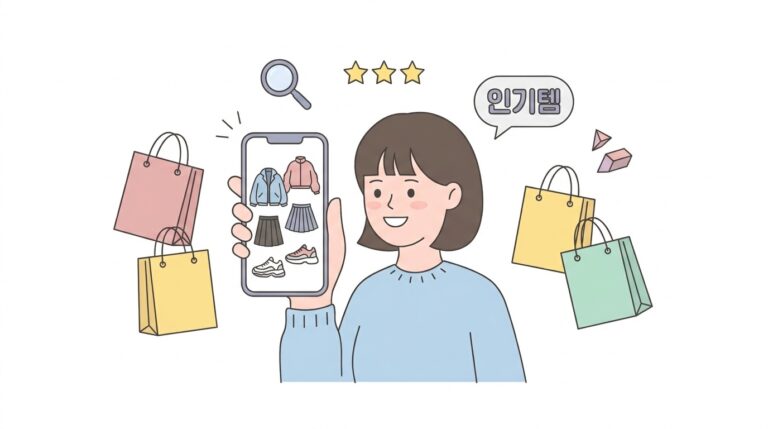
Master Online Shopping in Korea: How to Search for Your Perfect K-Items Like a Local!
Phase 1: Empathy (Your Korean Shopping Journey Starts Here!)
안녕하세요! (An-nyeong-ha-se-yo!) I’m your Daily Hangul editor and your personal Korean culture navigator!
Imagine this: You are watching your favorite K-drama, and the lead actress is wearing the most stunning pastel-pink cardigan. Or maybe you’re scrolling through TikTok and spot a K-beauty skincare product that promises the ultimate “glass skin.” You immediately open a Korean shopping app like Coupang, Gmarket, or Musinsa, ready to buy it. But then… boom. You are greeted by a wall of Korean characters. You try typing “pink cardigan” in English, but the results are either empty or completely off.
We’ve all been there! Many of our learners tell us, “I know what I want, but I don’t know the right Korean words to search for it!”
Don’t worry! Today, we are going to unlock the secret search terms that real Koreans use daily. By the end of this guide, you’ll be finding your favorite items on Korean shopping sites in seconds. Let’s dive in! 🛍️
Phase 2: Deep Dive into 3 Essential Search Expressions
1. [이거] 있어요? (I-geo is-syeo-yo?)
- Pronunciation: “Ee-geo eet-suh-yo?” (Rhymes with “go” + “it-saw-yo”)
- Meaning: “Do you have this?”
- K-Culture Moment: You see this in K-dramas all the time when a character walks into a trendy boutique in Hongdae, points to a mannequin’s outfit, and asks the shop assistant for their size.
- Editor’s Insight: While online shopping uses search bars, this is the fundamental phrase for finding items. If you are chatting with an online seller or using a customer service channel (like KakaoTalk Channel), sending a screenshot of the item with “이거 있어요?” is the fastest way to get help!
- Situation Spectrum:
- Casual (with close friends): 이거 있어? (I-geo is-seo?) ⚠️
- Semi-formal (to store owners/sellers): 이거 있어요? (I-geo is-syeo-yo?) ✅
- Formal (official inquiry): 혹시 이 제품 재고가 있나요? (Hok-si i je-pum jae-go-ga in-na-yo?) 🚫 (Too formal for quick searches!)
- 🤔 Think About It: In Korean, we often omit the subject (like “you” or “I”) because the context makes it obvious. How does this compare to your native language where you always have to say “Do you have this?”
2. [검색창]에 쳐봐 (Geom-saek-chang-e chyeo-bwa)
- Pronunciation: “Gum-saek-chang-eh chuh-bwah” (Sounds like “Gum” + “sack” + “chang” + “eh” + “chuh” + “boy” without the ‘y’)
- Meaning: “Type it in the search bar.”
- K-Culture Moment: Picture a YouTube vlog where a K-beauty creator says, “Just search ‘glass skin cushion’ in the search bar!”
- Editor’s Insight: 검색창 (Geom-saek-chang) means “search bar/box” and 쳐봐 (chyeo-bwa) comes from the verb 치다 (chi-da), which means “to hit” or “to type.” It’s the ultimate digital-native phrase.
- Situation Spectrum:
- Casual: 검색창에 쳐봐. (Geom-saek-chang-e chyeo-bwa.) ✅
- Semi-formal: 검색창에 쳐보세요. (Geom-saek-chang-e chyeo-bo-se-yo.) ✅
- Formal: 검색창에 입력해 주시기 바랍니다. (Geom-saek-chang-e im-ryeok-hae ju-si-gi ba-ram-ni-da.) 🚫
- 🤔 Think About It: Why do you think Koreans use the verb “to hit” (치다) for typing on a keyboard or phone screen? Think about the physical action!
3. 요즘 [유행하는] 스타일 (Yo-jeum yu-haeng-ha-neun seu-ta-il)
- Pronunciation: “Yo-jeum yoo-hang-ha-noon-suh-tah-il”
- Meaning: “The style that is trending these days / Trendy style.”
- K-Culture Moment: Scrolling through Musinsa (Korea’s top fashion app) and looking at the daily top 10 rankings to see what university students in Seoul are wearing.
- Editor’s Insight: Koreans are highly trend-sensitive. If you want to look fashionable in Korea, typing 요즘 유행하는 (yo-jeum yu-haeng-ha-neun) before your item (e.g., 요즘 유행하는 바지 – trendy pants) will filter your search to show the most popular items right now.
- Situation Spectrum:
- Casual: 요즘 유행하는 스타일 (Yo-jeum yu-haeng-ha-neun seu-ta-il) ✅
- Semi-formal: 요즘 유행하는 스타일이에요. (Yo-jeum yu-haeng-ha-neun seu-ta-il-i-e-yo.) ✅
- Formal: 최근 트렌디한 디자인입니다. (Choe-geun teu-ren-di-han di-ja-in-im-ni-da.) 🚫
- 🤔 Think About It: Trend-sensitivity is a big part of Korean “Ppalli-Ppalli” (fast-paced) culture. Do trends change as quickly in your country?
Phase 3: Textbook Korean vs. Real-Life Korean
Let’s compare what boring textbooks teach you versus how cool, young Koreans actually search online!
Scenario 1: Searching for popular products
- 📖 Textbook Korean: 인기 있는 상품을 찾고 있습니다. (In-gi in-neun sang-pum-eul chat-go it-seom-ni-da.) – “I am looking for popular products.”
- 🗣️ Real-Life Korean: 요즘 인기템 뭐예요? (Yo-jeum in-gi-tem mwo-yeo-yo?) – “What are the popular items/must-haves these days?”
- 💡 Why the difference? Koreans love shortening words! 인기 (In-gi – popular) + 아이템 (A-i-tem – item) becomes 인기템 (In-gi-tem). It’s snappy and used constantly in shopping reviews!
Scenario 2: Looking for cheap but high-quality items
- 📖 Textbook Korean: 가격이 저렴하고 질이 좋은 물건 (Ga-gyeok-i jeo-ryeom-ha-go jil-i jo-eun mul-geon) – “An item that is low in price and good in quality.”
- 🗣️ Real-Life Korean: 가성비 좋은 거 (Ga-seong-bi jo-eun geo) – “Something with great cost-effectiveness (value for money).”
- 💡 Why the difference? 가성비 (Ga-seong-bi) is a legendary Korean word combining “Price” (가격), “Performance” (성능), and “Ratio” (비율). If a product is cheap but amazing, it is always described as “가성비 갑” (King of cost-effectiveness).
Phase 4: K-Culture Deep Dive & Non-verbal Manners
4-1. The Digital Gesture: “Cap-cheo” (캡처)
When shopping online with Korean friends, don’t just send links. The culture of sharing screenshots—캡처 (Kaep-cheo)—is huge. Koreans love taking a screenshot, drawing a circle around the specific detail they like (like a collar or a color), and sending it via KakaoTalk with the phrase: “이거 어때?” (How about this?).
4-2. The “Naver Shopping” Culture
While Amazon rules the West, Naver Shopping and Coupang rule Korea. When searching, Koreans don’t just look at official brand malls. They use Naver Smart Store (네이버 스마트스토어). This is where small, trendy independent designers sell their clothes. Searching on Naver with terms like “내돈내산” (Nae-don-nae-san)—which means “Bought with my own money” (not a sponsored ad)—helps you find honest reviews of products!
Phase 5: Real-Life Roleplay Scenario
Setting: You are shopping for a jacket online. You are texting your trendy Korean friend, Minji (민지), to get help searching for the right style.
- Minji (민지): Trendsetter, loves online shopping on Musinsa.
- You: A2-level Korean learner trying to find a cool oversized jacket.
The 8-Turn Chat:
- You: 민지야, 나 재킷 사고 싶어! 🧥
(Min-ji-ya, na jae-kit sa-go si-po!)
「 Minji, I want to buy a jacket! 」 - Minji (🎭 Smiling, typing fast): 오! 어떤 스타일 찾는데?
(Oh! Eo-tteon seu-ta-il chan-neun-de?)
「 Oh! What kind of style are you looking for? 」 - You: 음, 요즘 유행하는 스타일로!
(Eum, yo-jeum yu-haeng-ha-neun seu-ta-il-lo!)
「 Um, the style that is trending these days! 」 - Minji (🎭 Nodding): 그러면 무신사 앱에서 검색해 봐.
(Geu-reo-myeon Mu-sin-sa aep-e-seo geom-saek-hae bwa.)
「 Then try searching on the Musinsa app. 」 - You: 검색창에 뭐라고 쳐야 돼?
(Geom-saek-chang-e mwo-ra-go chyeo-ya dwae?)
「 What should I type in the search bar? 」 - Minji (🎭 Sending a link): ‘오버핏 재킷’이라고 쳐봐. 요즘 이게 인기템이야!
(‘O-beo-pit jae-kit’-i-ra-go chyeo-bwa. Yo-jeum i-ge in-gi-tem-i-ya!)
「 Type ‘Overfit (Oversized) jacket’. This is the popular item these days! 」 - You (🎭 Excitedly screenshots a product): 이거 예쁘다! 이거 요즘 많이 입어?
(I-geo ye-ppeu-da! I-geo yo-jeum ma-ni i-beo?)
「 This is pretty! Do people wear this a lot these days? 」 - Minji (🎭 Sending a thumbs-up emoji): 응! 가성비도 진짜 좋아. 그거 사!
(Eung! Ga-seong-bi-do jin-짜 jo-a. Geu-geo sa!)
「 Yes! The cost-effectiveness is really good too. Buy that one! 」
🔀 Interactive Choice Point!
What will you say to Minji now?
* Option A: “이거 어디서 사?” (Where do I buy this?)
* Option B: “고마워! 당장 검색창에 칠게!” (Thanks! I’ll type it in the search bar right away!)
* Option C: “너무 비싸, 가성비 안 좋아.” (Too expensive, not good value.)
Feedback:
- Option A (Risk): Good, but a bit blunt. Since Minji already told you to use Musinsa, she might say “I just told you, on Musinsa!”
- Option B (Best!): Perfect! It uses the key vocabulary (검색창, 치다) naturally and shows great enthusiasm.
- Option C (Bad): A bit too negative after Minji spent time helping you. Better to say “조금 비싸네” (It’s a bit expensive) instead.
Phase 6: 10-Second Emotion Shadowing Drill
Practice speaking like a native! Pay attention to the pauses (/) and the emotional cues.
- [😊 Excitedly & happily]
- 요즘 / 인기템 / 뭐야? / 나도 살래!
- Yo-jeum / in-gi-tem / mwo-ya? / Na-do sal-rae!
- “What’s the / popular item / these days? / I want to buy it too!”
- [🤔 Curiously & thinking]
- 검색창에 / 뭐라고 / 쳐야 되지?
- Geom-saek-chang-e / mwo-ra-go / chyeo-ya doe-ji?
- “In the search bar… / what / should I type?”
- [🤩 Amazed by the cheap price]
- 우와, / 이거 진짜 / 가성비 좋다!
- U-wa, / i-geo jin-ja / ga-seong-bi jo-ta!
- “Wow, / this is really / good value for money!”
Phase 7: K-Culture Mini-Dictionary
- 내돈내산 (Nae-don-nae-san)
- Translation: “My money, my purchase.”
- Real-life Use: Used in blogs and YouTube titles to prove the review is 100% genuine and not a paid advertisement.
- 인기템 (In-gi-tem)
- Translation: Hot item / Best seller.
- Real-life Use: Highlighting trendy clothing, cosmetics, or gadgets that everyone is buying right now.
- 품절대란 (Pum-jeol-dae-ran)
- Translation: Out-of-stock crisis.
- Real-life Use: When a product becomes so popular (like Honey Butter Chips in the past) that it sells out everywhere instantly.
- 지름신 (Ji-reum-sin)
- Translation: “The God of Urge-Buying” (Shopping Spirit).
- Real-life Use: You say “지름신 오셨다” (The shopping god has arrived) when you suddenly feel the unstoppable urge to buy lots of things online.
Phase 8: Survival Kit for Travelers & Online Shoppers
Survival Phrases TOP 3
- “무료 배송이에요?” (Mu-ryo bae-song-i-e-yo?)
- Meaning: Is it free shipping?
- Pro Tip: Look for the green badge 무료배송 on Naver Shopping to save money!
- “배송 얼마나 걸려요?” (Bae-song ol-ma-na geol-ryeo-yo?)
- Meaning: How long does delivery take?
- Pro Tip: Coupang offers “Rocket Delivery” (로켓배송) which arrives the next morning!
- “리뷰 좋은 거 추천해 주세요.” (Ri-byu jo-eun geo chu-cheon-hae ju-se-yo.)
- Meaning: Please recommend something with good reviews.
Editor’s Travel Note 📝
If you are visiting Korea and want to experience the legendary next-day delivery, download the Coupang App. You will need a Korean phone number to sign up, but if you don’t have one, you can easily use Gmarket Global which supports foreign credit cards and English search interfaces! (Note: App terms and payment methods are subject to change according to service provider policies.)
Phase 9: “Going One Step Deeper” (Reflective Thought)
In Korea, online shopping is more than just buying things; it is a shared social activity. Koreans constantly ask each other, “How is this style?” or “Is this brand cool?” to fit in with the group aesthetic while expressing their individuality. This is closely related to “Nunchi” (눈치)—the art of sensing other people’s feelings and trends. When you search for “trendy” items, you aren’t just buying clothes; you are joining a collective cultural conversation.
💬 Your Turn: What is one fashion item from your country that you think would be an “인기템” (hot item) in Korea? Tell us in the comments below!
Phase 10: FAQ & Avoiding Common Mistakes
Q: Can I use English on Korean shopping sites?
A: Yes, but the results are limited. Many products are listed with Koreanized English words (Konglish). For example, search for “맨투맨” (Maen-tu-maen) instead of “sweatshirt,” or “원피스” (Won-pi-seu) instead of “dress.”
Q: What is the difference between ‘검색하다’ and ‘치다’?
A: 검색하다 (Geom-saek-ha-da) is the official verb “to search.” 치다 (Chi-da) is the colloquial term for “to type into a search bar.” On chat apps, always use “~라고 쳐봐” (type ~).
Q: Why does my payment keep failing on Korean apps?
A: Most Korean apps require domestic authentication. If you are a foreigner without a resident card, look for “Global” versions of Gmarket or use K-beauty global sites like Olive Young Global which accept international visas.
🚨 Common Mistakes Warning Board
- Mistake: Searching for “Oversized sweater” in English.
❌ Correct Action: Search for 오버핏 니트 (O-beo-pit ni-teu) instead! - Mistake: Using “싸구려” (Ssa-gu-ryeo – cheap/trashy) to find cheap items.
❌ Correct Action: Use 가성비 좋은 (Ga-seong-bi jo-eun – cost-effective) to avoid sounding rude or low-class. - Mistake: Saying “서치해봐” (Seo-chi-hae-bwa) to a friend.
❌ Correct Action: Say 검색해봐 (Geom-saek-hae-bwa) or 쳐봐 (Chyeo-bwa).
Phase 11: Action Mission & Engagement
Complete these missions to become a Korean shopping pro!
- 🥉 Bronze Mission: Open your Instagram or a search engine, go to the search bar, and type “요즘 유행하는 패션” (Fashion that is trending these days). Screenshot one outfit you like!
- 🥈 Silver Mission: Write a comment below this post using the word “가성비” to describe your favorite budget-friendly item.
- 🥇 Gold Mission: Go to Gmarket Global, search for “인기템”, and find one item you actually want to add to your wishlist!
🎮 K-Culture Mission:
Watch the next episode of a K-drama. When a character is on their phone, look closely—are they browsing online shopping apps? See if you can spot them taking a “캡처” (screenshot)!
Phase 12: Interactive Quiz Challenge
Test your skills! Can you pass the Daily Hangul Shopping Quiz?
1. Situational Judgment
You want to ask your Korean friend what is currently hot in Korean makeup. Which phrase is best?
* A) 요즘 인기템이 뭐예요? (Yo-jeum in-gi-tem-i mwo-yeo-yo?)
* B) 비싼 화장품 어디 있어요? (Bi-ssan hwa-jang-pum eo-di is-seo-yo?)
🔍 Click here for the Answer & Explanation
Correct Answer: A
Explanation: 인기템 (In-gi-tem) means popular/hot item, which is perfect for asking about trends. Option B asks “Where is the expensive makeup?” which is unnatural!
2. Fill-in-the-Blank
“Type ‘Musinsa’ in the search bar!”
👉 _______에 ‘무신사’라고 쳐봐!
🔍 Click here for the Answer & Explanation
Correct Answer: 검색창 (Geom-saek-chang)
Explanation: 검색창 means “search bar.”
3. True/False Culture Quiz
In Korea, the term “내돈내산” (Nae-don-nae-san) means that the reviewer was paid by the company to promote the product. (True / False)
🔍 Click here for the Answer & Explanation
Correct Answer: False
Explanation: It means “My money, my purchase,” indicating it is a genuine, unsponsored review!







