

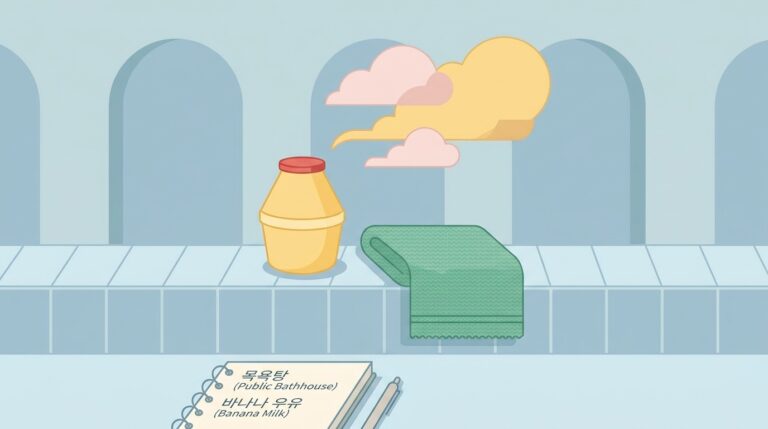
Warm Baths and Cold Sips: Navigating a Sunday Morning Korean Bathhouse (목욕탕)
안녕하세요! It’s your K-culture companion and editor from Daily Hangul (매일한글)!
Have you ever watched a K-drama where characters sit in a steamy room with sheep-head towels on their heads, sipping sweet rice juice? If so, you’ve witnessed the magic of the Korean bathhouse culture! But for many of our intermediate (B1) learners, stepping into a neighborhood bathhouse (목욕탕 – mogyoktang) or a massive 24-hour sauna complex (찜질방 – jjimjilbang) for the first time can feel incredibly intimidating.
“Where do I put my shoes?” “Do I really have to go completely naked?” “What do I say when I want an exfoliating scrub?”
Don’t worry! Today, we are diving deep into the warm, steamy, and wonderfully rejuvenating world of a Sunday morning in a Korean bathhouse. By the end of this guide, you’ll feel like a local regular, ready to wash away your weekend fatigue with absolute confidence. Let’s jump in!
Phase 2: Deep Dive into 3 Essential Bathhouse Expressions
To sound like a true local, you need to master the expressions that carry the unique warmth and sensory experiences of the Korean bathhouse. Here are three must-know phrases:
1. 시원하다! (Si-won-ha-da!)
- Pronunciation: She-won-ha-da (Sounds like “She wants hot air” but said quickly!)
- Meaning: Literally “It is cool/refreshing,” but in a bathhouse, it actually means “Ah, this hot water feels amazing and relieves my tension!”
- K-Culture Moment: You will hear older Korean uncles or aunts sink into a scalding 42°C (107°F) hot tub, let out a deep sigh, and say, “어우, 시원하다!” It confuses foreigners because the water is hot, but to Koreans, the feeling of muscle relaxation is incredibly “cool” and refreshing.
- Editor’s Insight: This word bridges physical temperature and emotional relief. Use it when sipping hot soup (해장국) or soaking in a hot tub.
- Situation Spectrum: Casual ✅ | Semi-formal ✅ | Formal ⚠️
- 🤔 Think About It: Is there a word in your native language that describes a hot sensation as “refreshing” or “cool”? How does your culture express physical relief?
2. 때 밀러 왔어요. (Ttae mil-leo wass-eo-yo.)
- Pronunciation: Ttae meel-luh wah-ssuh-yo (Like “tay” in Taylor Swift + “meel-luh”)
- Meaning: “I came to get a body scrub (skin exfoliation).”
- K-Culture Moment: If you want the ultimate Korean spa experience, you hire a professional scrub master (세신사 – sesinsa or affectionately called 이모 – imo for women / 삼촌 – samchon for men). You lay on a vinyl table, and they scrub off dead skin cells using a textured Italian towel.
- Editor’s Insight: 때 (ttae) means dirt or dead skin, and 밀다 (milda) means to push/scrub. Saying this at the counter lets the staff know you want to book a session immediately.
- Situation Spectrum: Casual ✅ | Semi-formal ✅ | Formal 🚫
- 🤔 Think About It: Exfoliation is deeply personal. Why do you think sharing this physical space and getting scrubbed by a professional is considered a healthy, bonding activity in Korea?
3. 개운하다! (Gae-un-ha-da!)
- Pronunciation: Gae-oon-ha-da (Like “get” without the ‘t’ + “oon-ha-da”)
- Meaning: “To feel refreshed, light, and clean (after a wash, shower, or sleep).”
- K-Culture Moment: When you finally step out of the bathhouse, clean from head to toe, holding a cold banana milk, you look at your friend and say, “아, 진짜 개운하다!“
- Editor’s Insight: Unlike 시원하다 (which can describe the temperature or immediate sensation), 개운하다 is the ultimate state of purity and lightweight bliss after finishing a refreshing task.
- Situation Spectrum: Casual ✅ | Semi-formal ✅ | Formal ⚠️
- 🤔 Think About It: How does your body feel different after a simple shower versus a deep, hours-long bathhouse session?
Phase 3: Textbook Korean vs. Real-Life Korean
Let’s compare the stiff textbook phrases with what Koreans actually say in the bathhouse.
Scenario 1: Ordering a drink inside the bathhouse
- 📖 Textbook: “식혜 한 잔 주세요.” (Sikhye han jan juseyo. – Please give me a glass of Sikhye.)
- 🗣️ Real-Life: “이모, 시원한 식혜 하나 주세요!” (Imo, siwonhan sikhye hana juseyo! – Auntie, one cold Sikhye, please!)
- 💡 Why the difference? Inside the neighborhood bathhouse, the staff are affectionately called 이모 (auntie). Adding “시원한” (cold/refreshing) emphasizes how much you crave that icy drink in the hot steamy room.
Scenario 2: Asking if a tub is too hot
- 📖 Textbook: “이 물은 뜨겁습니까?” (I mureun tteugeopseumnikka? – Is this water hot?)
- 🗣️ Real-Life: “여기 좀 많이 뜨거워요?” (Yeogi jom mani tteugeowoyo? – Is it super hot in here/in this tub?)
- 💡 Why the difference? B1 speakers should avoid overly formal bookish questions (~습니까). Using “여기 좀~” (Here, a bit…) makes your question sound softer, natural, and friendly to the person already soaking in the tub.
Phase 4: K-Culture Deep Dive & Non-Verbal Manners
4-1. Nunchi (눈치) & Bathhouse Etiquette
To survive your first bathhouse trip without getting side-eyes, you need high Nunchi (situational awareness).
* Wash BEFORE you soak: Never step into a communal hot tub without thoroughly washing your body at the sit-down washing stations first.
* Hair Up: If you have long hair, tie it up. Letting your hair float in the communal hot tub is a major etiquette violation.
* The Towel Rule: You are given small hand towels. Do not let your towels touch the bathwater; keep them on your head or on the side of the tub.
4-2. The Sunday Morning Cultural Code
For Koreans, Sunday morning is the prime bathhouse time. Families go together; grandmothers, mothers, and daughters scrub each other’s backs (a profound bonding ritual called 등 밀어주기 – deung mireojugi). Afterwards, the reward is always a bottle of sweet, ice-cold Banana Milk (바나나맛 우유) or Sikhye (식혜 – sweet rice punch) mixed with ice. It’s not just about hygiene; it is a ritual of starting the week fresh.
Phase 5: Interactive Roleplay Scenario
Setting: You are at a local neighborhood bathhouse (용산목욕탕) on a Sunday morning. You want to pay for entry and request a body scrub (세신). You meet the friendly receptionist/scrub master, Mrs. Kim (김 이모).
[Characters]
- You: A tired expat/traveler looking to experience a real Korean scrub.
- 김 이모 (Mrs. Kim): The neighborhood veteran who runs the bathhouse with tough love.
- 김 이모: 어서 와요! 오늘 일찍 왔네?
(Eoseo wayo! Oneul iljjik wanne?)
(🎭 Smiling warmly, handing you a key) “Welcome! You’re here early today!” -
You: 안녕하세요, 이모! 목욕하러 왔어요. 성인 한 명이요.
(Annyeonghaseyo, imo! Mogyokhareo wass-eo-yo. Seong-in han myeong-i-yo.)
“Hello, Auntie! I’m here to bathe. One adult, please.” -
김 이모: 그래요. 수건 두 장 주고, 신발장 열쇠는 85번 써요.
(Geuraeyo. Sugeon du jang jugo, sinbaljang yeolsoe-neun palsip-o-beon sseoyo.)
“Sure. Here are two towels, and use shoe locker number 85.” -
You: 저… 오늘 때도 좀 밀고 싶은데요. 세신사 이모 계세요?
(Jeo… oneul ttae-do jom milgo sipeundeyo. Sesinsa imo gyeseyo?)
(🎭 Asking slightly shyly) “Um… I’d like to get a body scrub today too. Is the scrub master auntie here?” -
김 이모: 아, 정 이모 지금 비어 있어! 들어가서 옷 벗고 탕에 한 15분 들어가서 몸 불리고 있어. 내가 말해둘게.
(Ah, Jeong imo jigeum bieo isseo! Deureogaseo ot beotgo tang-e han sibo-bun deureogaseo mom bulligo isseo. Naega malhaedulge.)
“Ah, Auntie Jeong is free right now! Go inside, undress, soak in the tub for about 15 minutes to soften your skin. I’ll let her know.” -
You: 네, 알겠습니다! 몸 불리고 있을게요. 얼마예요?
(Ne, algetseumnida! Mom bulligo isseulgeyo. Eolma-yeyo?)
“Got it! I will soften my skin in the water. How much is it?” -
김 이모: 목욕탕 삼만 원에 세신 삼만 원, 총 육만 원이에요.
(Mogyoktang sam-man won-e sesin sam-man won, chong yung-man won-i-eyo.)
“30,000 won for entry, 30,000 won for the scrub. Total is 60,000 won.” -
You: 여기 카드로 계산해 주세요. 감사합니다!
(Yeogi kadeu-ro gyesanhae juseyo. Gamsahamnida!)
(🎭 Handing over the card) “Please charge it to this card. Thank you!”
🔀 Your Turn: What will you do next?
- Choice A: You head straight to the scrub table naked as soon as you walk in.
- Choice B: You shower first, soak in the hot tub for 15 minutes, and wait for your name to be called.
- Choice C: You go directly into the hot tub without showering to save time.
Feedback:
- Best Choice – B: Perfect! You followed the etiquette. Showering first is mandatory, and soaking for 15 minutes softens your skin (몸을 불리다), making the scrub highly effective and less painful!
- Risk Choice – A: If you go straight to the table, the scrub master will scold you! Your skin needs to be soft and wet for the scrub to work.
- Bad Choice – C: Danger! Other bathers will stare at you with heavy disapproval (눈치). Going into a communal tub without washing your body first is the ultimate bathhouse sin.
Phase 6: 10-Second Emotional Shadowing Drill
Practice speaking with the real emotions of a tired Korean enjoying a Sunday bathhouse ritual. Pause at the slashes (/).
- [😊 Expressing deep physical relief while soaking in hot water]
- “어우 / 진짜 / 시~원하다!”
- (Eou / jinjja / she-won-ha-da!)
- “Ah… seriously… this is so refreshing!”
- [🥺 Squeaky-clean and happy, walking out of the bathhouse]
- “때 밀고 나니까 / 몸이 너무 / 개운해요!”
- (Ttae milgo nanikka / mom-i neomu / gae-un-haeyo!)
- “Since I got a scrub, my body feels so wonderfully light and clean!”
Phase 7: K-Culture Mini-Dictionary
- 바나나맛 우유 (Banana-mat Uyu) | Banana Flavored Milk
- The legendary sweet drink packaged in a jar-shaped bottle. Drinking this cold after a hot bath is an absolute law of Korean bathhouse culture.
- 이태리 타올 (I-tae-ri Ta-ol) | Italy Towel
- Despite the name, it was invented in Korea! It is a coarse, usually green or yellow textured glove/towel used specifically for exfoliating skin.
- 몸을 불리다 (Mom-eul bullida) | To soften/soak the body
- Literally “to swell the body.” It refers to soaking in hot water so that dead skin cells loosen up and scrub off easily.
- 세신사 (Se-sin-sa) | Professional Scrub Master
- Highly skilled practitioners who use specialized techniques to exfoliate your entire body quickly and painlessly.
Phase 8: Survivor Kit for Travelers
Top 3 Survival Phrases
- 수건 한 장 더 주실 수 있나요? (Sugeon han jang deo jusil su innayo?)
- “Can I have one more towel, please?”
- Pro Tip: Female bathhouses usually limit towels at the counter, so keep this phrase handy if you need an extra!
- 이거 어떻게 사용해요? (Igeo eotteoke sayonghaeyo?)
- “How do I use this?”
- Pro Tip: Use this if you are confused by the electronic locker keys or water temperature levers.
- 식혜 물 많이 타지 말고 진하게 해주세요. (Sikhye mul mani taji malgo jinhage haejuseyo.)
- “Please make the Sikhye strong, don’t water it down with too much ice.”
Editor’s Travel Note
Before visiting local bathhouses, search for them on Naver Map App (네이버 지도) by typing “사우나” (Sauna) or “목욕탕” (Bathhouse). Disclaimer: Operating hours and prices may change post-pandemic, so check recent Naver reviews before visiting!
Phase 9: Deep Thoughts (한 발 더 깊이)
In many Western cultures, being naked around strangers is highly uncomfortable and avoided. In Korea, however, communal nudity at a mogyoktang represents an environment of equalizing humility. Inside the tub, everyone—regardless of their social class, wealth, or profession—is identical. There is a term, “목욕탕 친근감” (bathhouse intimacy), meaning that once you have scrubbed and soaked naked together, there are no secrets left, and you become instantly closer.
💬 Your Turn: Would you be willing to try a full-body scrub by a sesinsa, or does the nakedness make you nervous? Let us know in the comments below!
Phase 10: FAQ & Avoiding Common Mistakes
Q: Can I wear a swimsuit in the hot springs/tubs?
A: Absolutely not. Swimsuits are strictly forbidden in traditional Korean bathhouses (목욕탕). You must go completely naked. However, in the unisex social areas of larger 찜질방 (saunas), you must wear the t-shirt and shorts provided at the entrance.
Q: I have tattoos. Can I enter a Korean bathhouse?
A: Historically, tattoos were frowned upon. Today, modern saunas and large Jjimjilbangs in Seoul are quite relaxed. However, very traditional neighborhood bathhouses might still turn away clients with massive, intimidating tattoos. If you have small tattoos, you will have no issues.
Q: How much tip should I give to the scrub master (세신사)?
A: Tipping is not customary in Korea. You only pay the exact fee listed on the menu. You can pay at the front desk or, sometimes, directly to the scrub master inside the bathhouse using your locker key/card.
🚨 Common Mistakes Warning Board
- Mistake 1: Standing and showering while splashing water everywhere.
- Correct Action: Sit down at the low plastic stools to wash, and keep your shower head close to your body.
- Mistake 2: Diving or swimming in the cold tub.
- Correct Action: The cold tub (냉탕) is for quiet cooling down, not a swimming pool.
- Mistake 3: Dropping your small towel into the hot tub water.
- Correct Action: Fold it and place it on top of your head like a crown!
Phase 11: Action Missions
- 🥉 Bronze Mission: Go to a Korean supermarket (or Asian mart) and buy a green Italy Towel (이태리 타올) and a Banana Milk. Try exfoliating your arms at home!
- 🥈 Silver Mission: Screenshot this guide, go to your social media, and tag @DailyHangul with the phrase: “이번 주말에 목욕탕 가고 싶어요!” (I want to go to a bathhouse this weekend!)
- 🥇 Gold Mission: Find a local Korean bathhouse or Jjimjilbang in your city, walk in confidently, and order a cup of sweet Sikhye using: “이모, 시원한 식혜 하나 주세요!”
Phase 12: Interactive Quiz Challenge
Test your knowledge before you pack your bathhouse bag!
1. Situational Judgment
When you enter the hot tub and feel the scalding water instantly relaxing your muscles, what do you exclaim?
* A) 차갑다! (Chagapda!)
* B) 시원하다! (Siwonhada!)
* C) 뜨겁다! (Tteugeopda!) – Note: While physically correct, it’s not what locals say for relief.
👉 Click to see the Answer & Explanation
Correct Answer: B
Even though the water is physically hot, Koreans use 시원하다 (refreshing/cool) to express physical and mental relief!
2. Fill-in-the-Blank
To get a satisfying skin exfoliation, you tell the receptionist: “오늘 ____ 밀러 왔어요.”
👉 Click to see the Answer & Explanation
Correct Answer: 때 (Ttae)
“오늘 때 밀러 왔어요” means “I came to scrub off dead skin today.”
3. True or False Culture Quiz
True or False: It is perfectly fine to walk straight into a hot tub at a Korean bathhouse without showering first, as long as you look clean.
👉 Click to see the Answer & Explanation
Correct Answer: FALSE
This is a major social taboo in Korea. You must always soap up and rinse your entire body thoroughly at the showers before entering any communal tubs!
See you next time with more exciting local tips! 안녕! 👋







