

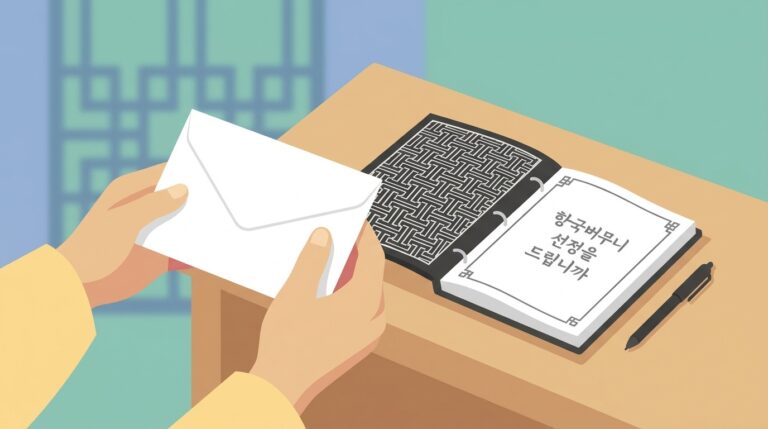
Navigating Condolence Money at a Korean Funeral: A Gentle Guide for Beginners
Phase 1: Empathy (Welcome, My Friend!)
안녕하세요! (An-nyeong-ha-se-yo!) Hello, I’m your lead editor at Daily Hangul, your trusty cultural navigator.
Imagine this: You are watching a deeply emotional K-Drama. The lead character is standing in a quiet funeral hall, wearing black, and gently sliding a clean white envelope into a wooden box. You might wonder: What is inside that envelope? What do they say when they hand it over?
If you ever find yourself attending a Korean funeral (장례식장 – jang-rye-sik-jang), the concept of 조의금 (jo-ui-geum)—condolence money—can feel incredibly overwhelming. You might worry: Is my envelope correct? Am I going to say the wrong thing?
Don’t worry! Today, we are going to learn the absolute basics of condolence money. By the end of this post, you will know exactly what to do and say with confidence and heart. Let’s walk through this together, step-by-step.
Phase 2: Top 3 Essential Expressions for Beginners
1. 조의금 (Jo-ui-geum)
- Pronunciation: Jo-ee-geum (Sounds like “Joy” + “geum” without the ‘y’ sound)
- Meaning: Condolence money
- K-Culture Moment: In K-Dramas, you will see a sign near the entrance of a funeral hall that says 부의금 (bu-ui-geum) or 조의금. Both mean condolence money. Visitors slide a white envelope into a box right next to the guest registry.
- Editor’s Insight: This money is a practical way of helping the grieving family cover the costs of the funeral. It is a beautiful community tradition of mutual aid.
- Situation Spectrum: Casual 🚫 / Semi-formal ⚠️ / Formal ✅
- 🤔 Think About It: Does your culture use cash to express condolences, or do you send flowers/food instead? How do you feel about this practical way of supporting a grieving friend?
2. 봉투 (Bong-tu)
- Pronunciation: Bong-too (Sounds like “Bong” + “too”)
- Meaning: Envelope
- K-Culture Moment: At a Korean funeral hall, you don’t need to bring your own envelope! There is almost always a small desk near the entrance with free white envelopes and black pens.
- Editor’s Insight: Never use a colorful or decorated envelope. It must be plain white. Write your name vertically on the back-left side of the envelope.
- Situation Spectrum: Casual ⚠️ / Semi-formal ✅ / Formal ✅
- 🤔 Think About It: Why do you think white is the mandatory color for funerals in Korea, whereas bright colors are strictly avoided?
3. 삼가 고인의 명복을 빕니다 (Sam-ga go-in-ui myeong-bok-eul bim-ni-da)
- Pronunciation: Sam-ga go-in-ui myeong-bo-geul bim-ni-da
- Meaning: “I pray for the deceased’s happiness in the afterlife.”
- K-Culture Moment: This is the most standard, respectful phrase to say to the family or write on the back of your envelope.
- Editor’s Insight: For absolute beginners (A1), this sentence is quite long! If it feels too difficult to speak, it is perfectly okay to just bow deeply and say a simple “죄송합니다” (joe-song-ham-ni-da – I am sorry) or write the text on the envelope instead.
- Situation Spectrum: Casual 🚫 / Semi-formal ⚠️ / Formal ✅
- 🤔 Think About It: This phrase has Buddhist roots but is used by almost everyone in Korea today. It shows how deeply language and ancient traditions are connected!
Phase 3: Textbook Korean vs. Real-Life Korean
Scenario 1: Handing over the envelope
- 📖 Textbook Korean: “조의금을 드리겠습니다.” (Jo-ui-geum-eul deu-ri-get-seum-ni-da. – “I will give you the condolence money.”)
- 🗣️ Real-Life Korean: “받아주세요.” (Ba-da-ju-se-yo. – “Please accept this.”) or simply bowing in silence.
- 💡 Why the difference? Directly mentioning “money” while handing it over can feel slightly too transactional in Korea. It is much more polite to say “Please accept this” with a gentle bow.
Scenario 2: Expressing sorrow to a close friend
- 📖 Textbook Korean: “삼가 고인의 명복을 빕니다.” (Sam-ga go-in-ui myeong-bok-eul bim-ni-da.)
- 🗣️ Real-Life Korean: “마음 잘 추슬러.” (Ma-eum jal chu-seul-leo. – “Take care of your heart/mind.”)
- 💡 Why the difference? While the textbook phrase is perfect for formal settings, if the grieving person is your close friend, using such a formal phrase can feel distant. Instead, warmly tell them to take care of their heart.
Phase 4: K-Culture Deep Dive & Non-Verbal Manners
4-1. Nunchi (눈치) & Bowing Etiquette
When you hand over the envelope, use two hands. Handing something over with one hand is considered disrespectful in formal Korean culture. Hold the envelope with both hands, bow your head slightly, and place it in the collection box or hand it to the receptionist.
4-2. The Golden Rules of Condolence Money
- Odd Numbers Only: The amount of money you give should start with an odd number (30,000 KRW, 50,000 KRW, or 70,000 KRW). Odd numbers symbolize good fortune and yin/yang balance in Korean tradition. Exception: 100,000 KRW is also acceptable because 10 is considered a complete, full number.
- Clean Bills, but Not Brand New: In some cultures, brand new crisp bills are preferred. In Korea, extremely crisp new bills are for weddings or New Year’s gifts. For funerals, normal, used bills are preferred as they don’t look like they were “prepared in anticipation” of a death.
Phase 5: Real-Life Roleplay Scenario
Setting: You arrive at the entrance of your Korean coworker’s father’s funeral hall. A receptionist (Min-su) is sitting next to the guest registry book.
- Min-su (Receptionist): 어서 오세요. 성함을 적어주세요.
(Eo-seo o-se-yo. Seong-ham-eul jeo-geo-ju-se-yo.)
“Welcome. Please write your name here.” - You: 네, 여기 있습니다.
(Ne, yeo-gi it-seum-ni-da.)
“Yes, here it is.” 🎭 [You write your name in the guest book] - Min-su: 감사합니다.
(Gam-sa-ham-ni-da.)
“Thank you.” - You: 봉투는 어디에 있나요?
(Bong-tu-neun eo-di-e in-na-yo?)
“Where are the envelopes?” - Min-su (Pointing to the side table): 저기 오른쪽에 준비되어 있습니다.
(Jeo-gi o-reun-jjo-ge jun-bi-deo-eo it-seum-ni-da.)
“They are prepared over there on the right.” - You: 아, 네. 감사합니다.
(Ah, ne. Gam-sa-ham-ni-da.)
“Ah, yes. Thank you.” - You (After putting the cash in the envelope, you hand it over): 여기… 받아주세요.
(Yeo-gi… ba-da-ju-se-yo.)
“Here… please accept this.” 🎭 [You hand the envelope with both hands and bow] - Min-su (Bowing back): 위로해 주셔서 감사합니다.
(Wi-ro-hae ju-shyeo-seo gam-sa-ham-ni-da.)
“Thank you for your condolences.”
🔀 Interactive Choice Point
How do you respond to Min-su to show respect?
- Option A: “감사합니다!” (Gam-sa-ham-ni-da!) with a big smile.
- 🚫 Risk: Smiling and saying “Thank you!” enthusiastically is highly inappropriate at a funeral. Keep your tone soft and low.
- Option B: Say nothing, just bow deeply with a solemn expression.
- 🏆 Best: Silence is often the most polite and respectful response at a Korean funeral if you are not fluent in Korean.
- Option C: “축하합니다!” (Chuk-ha-ham-ni-da!).
- 🚨 Bad: This means “Congratulations!” Saying this at a funeral would be a massive social mistake.
Phase 6: 10-Second Shadowing Drill
Let’s practice saying the most important polite phrase. Pay attention to the pauses (/) and the soft, respectful emotion.
- Sentence: “삼가 / 고인의 / 명복을 / 빕니다.”
- Pronunciation: Sam-ga / go-in-ui / myeong-bo-geul / bim-ni-da.
- Emotion Guide:
[🥺 Softly, speaking quietly with deep respect]“I pray for the deceased’s happiness in the afterlife.”
Phase 7: K-Culture Mini Dictionary
- 조의금 (Jo-ui-geum) | Condolence money given to support the family.
- 부조금 (Bu-jo-geum) | A general term for money given at both happy and sad events (weddings, funerals, first birthdays).
- 상주 (Sang-ju) | The chief mourner (usually the eldest son or spouse) who hosts the guests.
- 절 (Jeol) | The traditional deep bow on the floor. At funerals, you bow to the photo of the deceased twice.
Phase 8: Survivor Kit for Travelers
Survival Phrases TOP 3
- 봉투 있어요? (Bong-tu it-seo-yo?)
- Meaning: Do you have an envelope?
- Pro Tip: Use this if you cannot find the envelopes at the entrance table.
- 죄송합니다 (Joe-song-ham-ni-da)
- Meaning: I am sorry / My condolences.
- Pro Tip: A safe, easy word to use if the formal expressions are too hard to remember.
- 어디로 가요? (Eo-di-ro ga-yo?)
- Meaning: Where do I go?
- Pro Tip: Useful when finding the specific funeral hall inside a large hospital basement.
📌 Editor’s Travel Note
Most Korean funerals take place in funeral halls located in the basement of major hospitals. If you need to find a funeral hall quickly, download the Naver Map App to navigate hospital complexes easily. Note: Hospital layouts and funeral hall directions may change, so always check the digital information board at the hospital lobby entrance.
Phase 9: “A Step Deeper” (Thoughtful Reflection)
In many Western cultures, sending flowers or cards is the standard way to show condolences. In Korea, giving cash (조의금) is preferred because Korean culture values practical community support. Historically, Korean villages pooled resources to help families afford big life events. Giving cash is not seen as cold; rather, it is a warm, tangible way of saying, “I am here to carry this heavy burden with you.”
💬 Your Turn: Have you ever experienced a similar cash-giving tradition in your country? Let us know in the comments below!
Phase 10: FAQ & Common Mistakes
Q: How much money should I put in the envelope as an A1 beginner/student?
A: If you are a student or a casual coworker, 50,000 KRW is the most standard and safe amount. If you are very close to the person, you can give 100,000 KRW or more.
Q: Can I wear bright colors if I don’t have black clothes?
A: If possible, avoid bright colors entirely. If you don’t have black, wear navy, dark grey, or beige. Avoid bright white tops or red/yellow colors.
Q: Do I hand the envelope directly to the grieving friend?
A: No, do not hand it to them directly. Put it in the collection box at the entrance reception desk before you enter the main room to meet your friend.
🚨 Common Mistakes Alert!
- Mistake 1: Writing your name in red ink on the envelope. (Red ink is traditionally associated with death or bad luck in Korea. Always use black ink.)
- Mistake 2: Giving an even amount of money, like 40,000 KRW. (Number 4 sounds like the word for “death” in Korean. Stick to 30,000, 50,000, or 70,000 KRW.)
- Mistake 3: Saying “Cheers!” (건배 – geon-bae) when drinking with others in the funeral dining hall. (Even if you are catching up with friends, never clink glasses at a funeral.)
Phase 11: Action Mission
- Bronze Mission: Practice saying “받아주세요” (Ba-da-ju-se-yo) three times out loud using both hands to gesture.
- Silver Mission: Grab a blank white envelope and practice writing your name vertically on the back-left side in black ink.
- Gold Mission: Next time you watch a K-Drama with a funeral scene, look closely at how they hold the envelope and bow. Share your findings on social media and tag #DailyHangul!
Phase 12: Interactive Quiz Challenge
1. Which of the following is an appropriate amount for condolence money?
a) 40,000 KRW
b) 50,000 KRW
c) 80,000 KRW
2. True or False: You should write your name in red ink on the funeral envelope.
🔍 Click here to reveal the Answers & Explanations!
- Correct Answer: b) 50,000 KRW
- Explanation: 50,000 starts with an odd number (5), which is considered auspicious. 40,000 and 80,000 start with even numbers, which are avoided.
- Correct Answer: False
- Explanation: Never write names in red ink in Korea; always use black ink, especially at funerals!







