

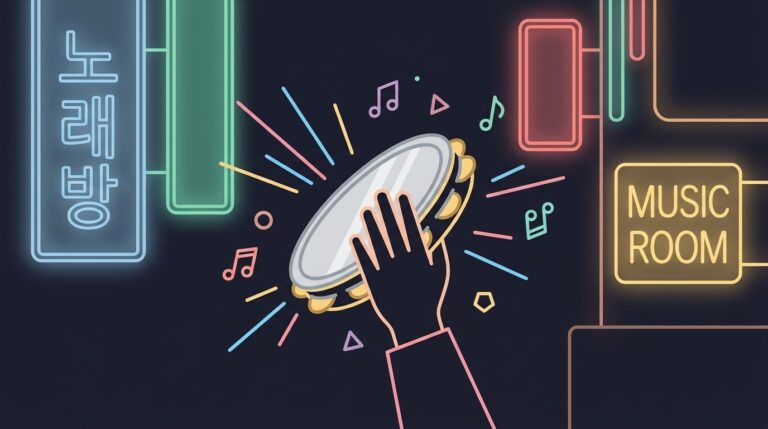
Master the Art of the Noraebang Tambourine: How to Hyped Up the Room Like a Korean Pro
Phase 1: Empathy (스토리 몰입형 오프닝)
안녕하세요! I’m your Daily Hangul editor and local culture navigator!
Picture this: You are in a neon-lit, private room at a Seoul Noraebang (노래방 – karaoke) with your Korean friends or coworkers. The first song starts playing—a high-energy K-Pop hit or a classic trot anthem. Suddenly, someone slides a glittering, metallic tambourine across the table to you. Everyone looks at you, smiling.
Do you just sit there and gently tap it against your leg? Oh, no! In Korea, the tambourine is not just an instrument; it is a sacred tool of high energy, or 흥 (heung – infectious joy/excitement).
If you’ve ever felt awkward holding a tambourine, worrying about ruining the rhythm, or not knowing what to shout to keep the vibe high, you are in the right place. Today, we are going to learn how to shake that tambourine like a true local and master the exact phrases to get the whole room chanting with you. Let’s turn you into the ultimate hype master!
Phase 2: Deep Dive into 3 Essential Expressions (핵심 표현 3선 심층 분석)
Let’s master the three magic phrases that will instantly elevate the room’s energy.
1. 분위기 살리고! (Bun-wi-gi sal-li-go!)
- Pronunciation: Boon-wee-gi sahl-lee-go! (Think of “boon-weary” combined with “sal-lee-go” where “go” sounds like the English verb go)
- Meaning: “Let’s liven up the mood!” / “Keep the vibe alive!”
- K-Culture Moment: You will often hear this in trot songs or party anthems. It’s usually followed by “~살리고, 살리고, 살리고 살리고 살리고!” while shaking the tambourine vigorously at chest level.
- Editor’s Insight: 분위기 means atmosphere/mood, and 살리다 means to revive or bring to life. By adding -고 (and), you are implying a continuous rise in excitement. It’s active, social, and immediately shows you are ready to party.
- Situation Spectrum: Casual ✅ | Semi-formal ⚠️ (Great for company dinners!) | Formal 🚫
- 🤔 Think About It: In many Western cultures, karaoke is about solo performance. In Korea, it is a team sport. Why do you think keeping the “collective vibe” alive is so important in Korean social gatherings?
2. 달리자! (Dal-li-ja!)
- Pronunciation: Dahl-lee-jah! (Sounds like “dahl” + “lee” + “jah”)
- Meaning: “Let’s run!” (Figurative: “Let’s go all out!” / “Let’s drink/party hard!”)
- K-Culture Moment: Usually shouted right before the chorus of an fast-tempo song drops. You shake the tambourine above your head, making eye contact with everyone.
- Editor’s Insight: While 달리다 literally means to run, in nightlife and social gatherings, it means to push the energy to the absolute limit. It signals that you are letting go of all stress.
- Situation Spectrum: Casual ✅ | Semi-formal ⚠️ | Formal 🚫
- 🤔 Think About It: How does comparing “having fun” to “running a race” reflect the fast-paced, high-energy nature of Korean Pali-Pali (hurry-hurry) culture?
3. 텐션 올려~! (Tension ol-려~!)
- Pronunciation: Ten-shyeon ohl-ryeo~! (The “ten-shyeon” is the Koreanized English word “tension”, and “ohl-ryeo” sounds like “all-yuh”)
- Meaning: “Raise your energy!” / “Get hyped!”
- K-Culture Moment: Often shouted by K-Pop idols on variety shows to boost the crowd’s energy. It goes perfectly with a rapid, continuous tambourine roll.
- Editor’s Insight: In English, “tension” usually has a negative, stressful connotation. But in Korea, “텐션” (tension) refers to positive energy and hype. High tension (하이 텐션) means being super energetic and enthusiastic.
- Situation Spectrum: Casual ✅ | Semi-formal ✅ | Formal 🚫
Phase 3: Textbook Korean vs. Real Korean (교과서 한국어 vs. 진짜 한국어)
At the B2 level, it’s time to move past rigid, textbook sentences and embrace the lively colloquialisms used in real-life social settings.
Situation 1: Encouraging someone to sing energetically
- 📖 Textbook Korean: 열심히 노래해 주세요. (Yeol-sim-hi no-rae-hae ju-se-yo.) – “Please sing passionately.”
- 🗣️ 진짜 한국어: 무대 찢어버려! (Mu-dae jji-jeo-beo-ryeo!) – “Tear up the stage!”
- 💡 Why the difference? Koreans love dramatic metaphors for high-energy performances. Telling someone to “rip the stage” (찢다) is the ultimate compliment and hype phrase.
Situation 2: Reacting to someone’s great song
- 📖 Textbook Korean: 노래를 정말 잘 부르시네요. (No-rae-reul jeong-mal jal bu-reu-si-ne-yo.) – “You sing really well.”
- 🗣️ 진짜 한국어: 역시 우리 [이름]이, 가창력 폭발했다! (Yeok-si u-ri [Name]-i, ga-chang-ryeok pok-bal-haet-da!) – “As expected of our [Name], your vocal power exploded!”
- 💡 Why the difference? Highlighting group belonging (우리 – our) and using explosive words like 폭발 (explosion) builds intense rapport and makes the singer feel like a superstar.
Phase 4: K-Culture Deep Dive & Non-Verbal Manners
4-1. Nunchi & Tambourine Gestures
To survive and thrive in a Korean Noraebang, you need 눈치 (Nunchi – situational quick-wittedness).
* The “Trot Tap”: When a trot song plays, hit the tambourine on your palm, then your elbow, then your hip. (Palm-Elbow-Hip rhythm). It is the classic Korean aunt/uncle technique that always wins laughs.
* The Eye-Contact Shake: Don’t just stare at the screen. Turn to the person singing, shake the tambourine near them (but not too close to their face!), and nod aggressively to show you are listening.
* Volume Control: If someone is singing a quiet, emotional ballad (발라드), put the tambourine down! Shaking it during a sad song is a major Nunchi fail.
4-2. The Noraebang Hype Code
In Korean corporate and social life, the Noraebang serves as a pressure valve. Shaking the tambourine isn’t just about rhythm; it is about showing your peers that you are willing to let your guard down and support the collective happiness of the group. If you are active with the tambourine, you will instantly be labeled as someone with 센스 (sense – social intelligence).
Phase 5: Real-Life Roleplay Scenario (실전 롤플레이)
Setting: You are at a Noraebang after a team dinner with your Korean colleagues. Min-ho, the life of the office, has just queued up a famous high-energy song, “Tears” by So Chan-whee.
Characters:
- 민호 (Min-ho): The passionate colleague who is already standing on a chair.
- 지영 (Ji-young): The manager who is watching to see who has the best team spirit.
- You: The rising star of the team, armed with a tambourine.
Dialogue:
- 민호: 아, 이 노래 키 높은데! 같이 불러줘요! (🎭 Waving his arm to invite you)
(Ah, i no-rae ki nop-eun-de! Gat-i bul-reo-jwo-yo! / Ah, this song is high-pitched! Sing with me!) - You: 걱정 마요, 민호 씨! 제가 뒤에서 템버린으로 백업할게요! (🎭 Grabbing the tambourine with a grin)
(Geok-jeong ma-yo, Min-ho ssi! Je-ga dwi-e-seo tem-beo-rin-eu-ro baek-eop-hal-ge-yo! / Don’t worry, Min-ho! I’ll back you up with the tambourine from behind!) - 지영: 오~ 역시 센스 넘쳐! 시작한다!
(Oh~ yeok-si sen-seu neom-chyeo! Si-jak-han-da! / Oh~ as expected, so much sense! It’s starting!) - You: (🎭 Shaking the tambourine to the beat) 자, 분위기 살리고~!
(Ja, bun-wi-gi sal-li-go~! / Now, keep the vibe alive~!) - 민호: (🎭 Singing the high note passionately) ~잔인한~!
(~Jan-in-han~! / ~Cruel~!) - You: (🎭 Tapping tambourine against elbow rapidly) 가창력 폭발한다! 달리자!!
(Ga-chang-ryeok pok-bal-han-da! Dal-li-ja!! / Vocal power exploding! Let’s go all out!!) - 지영: 꺄~! 템버린 장인인데?! 오늘 밤 끝까지 가는 거야!
(Kya~! Tem-beo-rin jang-in-in-de?! O-neul bam kkeut-kka-ji ga-neun geo-ya! / Kya~! You’re a tambourine master?! We are going till the end tonight!) - You: 텐션 끝까지 올려~! 아자!
(Ten-shyeon kkeut-kka-ji ohl-ryeo~! A-ja! / Raise the tension to the limit~! Let’s go!)
🔀 Interactive Choice Points
How will you react when Min-ho hands you the microphone for the rap part?
- A. “저는 랩 못해요…” (I can’t rap…) and hand it back timidly.
- B. Take the mic and passionately scream-mumble the rhythm while shaking the tambourine.
- C. Politely decline but start a synchronized dance with Ji-young to keep the focus on her.
Feedback:
- Choice A (Bad 🚫): Destroys the built-up energy. Even if you can’t rap, attempting it bad-temperedly is better than shutting it down.
- Choice B (Best ✅): Absolute gold! In a Noraebang, energy and enthusiasm trump skill. The crowd will erupt in cheers!
- Choice C (Risk ⚠️): Safe and polite, but might lose some of the momentum if Ji-young doesn’t want to dance. Use only if Ji-young is already standing up.
Phase 6: 10-Second Emotion Shadowing Drill (감정 섀도잉 드릴)
Read these aloud while matching the emotion and the rhythmic pauses (/ marks the pause).
- [🔥 Extreme Hype & Loud]
자! / 분위기 살리고, / 살리고! / 오늘 끝까지 / 달리자!!
(Ja! / Bun-wi-gi sal-li-go, / sal-li-go! / O-neul kkeut-kka-ji / dal-li-ja!!) -
[🤩 Amazed & Encouraging]
우와, / 대박! / 목소리 미쳤다! / 무대 완전히 / 찢어버렸어!
(U-wa, / dae-bak! / Mok-so-ri mi-chyeot-da! / Mu-dae wan-jeon-hi / jji-jeo-beo-ryeot-seo!)
Phase 7: K-Culture Mini-Dictionary (미니 사전)
- 흥 (Heung) | Infectious joy/excitement | The unique Korean emotional state of spontaneous joy and high spirits that makes you want to dance and sing.
- 템버린 요정 (Tem-beo-rin Yo-jeong) | Tambourine Fairy | A nickname given to the person who keeps the room incredibly hyped using only the tambourine.
- 칼군무 (Kal-gun-mu) | Razor-sharp synchronized dance | Usually used for K-Pop idols, but in a Noraebang, it’s when everyone does the exact same tambourine movement together.
- 막곡 (Mak-gok) | The final song | The last song of the session, usually a legendary high-energy track where everyone holds hands or jumps together.
Phase 8: Survivor Kit for Travelers
Survival Phrases TOP 3
- 서비스 주세요! (Seo-bi-seu ju-se-yo!)
- Meaning: “Please give us free extra time!” (Always ask the front desk politely after your hour is up!)
- 마이크 볼륨 좀 올려주세요. (Ma-i-keu bol-ryum jom ol-려-ju-se-yo.)
- Meaning: “Please turn up the microphone volume.”
- 취소 버튼 어디 있어요? (Chwi-so beot-eun eo-di is-seo-yo?)
- Meaning: “Where is the cancel button?” (Crucial when someone enters the wrong song!)
Editor’s Travel Note
When looking for a place to sing, you have two choices. If you want a quick, cheap session by yourself or with one friend, look for a 코인노래방 (Coin Noraebang, often called Ko-No). If you are with a large group wanting to shake tambourines and drink, go to a traditional family Noraebang.
To find the highest-rated spots near you, download the Naver Map App and search for “노래연습장” (Norae-yeon-seup-jang—the official legal name for Noraebang).
Phase 9: “Go One Step Deeper” (생각 질문)
In Western cultures, karaoke is often a performance where individuals show off their vocal talent. In Korea, however, Noraebang is a collective therapy session. It is where hierarchical walls of Korean society melt away. For a few hours, a strict boss and an entry-level worker become equal partners in shaking the tambourine. It highlights the Korean cultural value of 정 (Jeong)—deep, collective affection and bonding.
💬 Your Turn: How does your culture handle group stress relief? Do you have an equivalent of the Noraebang? Let us know in the comments below!
Phase 10: FAQ & Avoiding Misunderstandings (자주 묻는 질문)
Q: Can I shake the tambourine during slow ballads?
A: Absolutely not! Ballads in Korea are sacred moments of emotional release. Shaking a tambourine during a sad song ruins the atmosphere. Instead, turn on your smartphone flashlight and wave it slowly from side to side.
Q: Is it rude to reserve a song while someone else is singing?
A: It is standard practice to reserve songs ahead of time, but never press the “Play Now (시작)” button if it cuts off the current singer’s song. Always use the “Reserve (예약)” button.
Q: What if I really can’t sing?
A: No one cares about your vocal pitch in a Korean Noraebang. They care about your participation. Shaking the tambourine energetically, clapping, and reacting well to others (리액션) is actually more appreciated than someone who sings perfectly but sits quietly the rest of the night.
🚨 Common Mistakes Warning Board
- Mistake 1: Hoarding the microphone and singing 4 songs in a row.
- Correct Action: Keep a 1:1 ratio. Let others sing before you reserve your next one.
- Mistake 2: Keeping the tambourine to yourself all night.
- Correct Action: Pass it around! Sharing the role of the “Hype Master” builds great team dynamic.
Phase 11: Action Missions (액션 미션)
- Bronze Mission 🥉: Practice the Trot Tap (Palm-Elbow-Hip) in your room using a random household object (a book or paper plate) to a fast song.
- Silver Mission 🥈: Record a short video of you saying “분위기 살리고~!” with high energy and share it with a friend.
- Gold Mission 🥇: Next time you go to a Noraebang, secure the tambourine first, do not sit down during the first song, and lead the crowd with “달리자!”
Phase 12: Interactive Quiz Challenge (퀴즈 챌린지)
1. Which gesture is appropriate during a sad ballad?
- A) Vigorous tambourine shaking above the head
- B) Waving a smartphone flashlight slowly
- C) Performing the trot tap on your elbow
2. Fill in the blank: If you want to say “Let’s go all out / run!”, you shout “_______!”
3. True or False: “텐션” (Tension) in Korean nightlife has a negative meaning.
🔍 Click here to check the Answers & Explanations!
- Answer: B
- Explanation: Slow songs require emotional space. Flashlights are acceptable; noisy tambourines are a big no-no!
- Answer: 달리자 (Dal-li-ja)
- Explanation: This literally means “Let’s run,” but is used to hype up the crowd to party hard.
- Answer: False
- Explanation: In Korea, “high tension” (하이 텐션) means high positive energy and excitement!







