

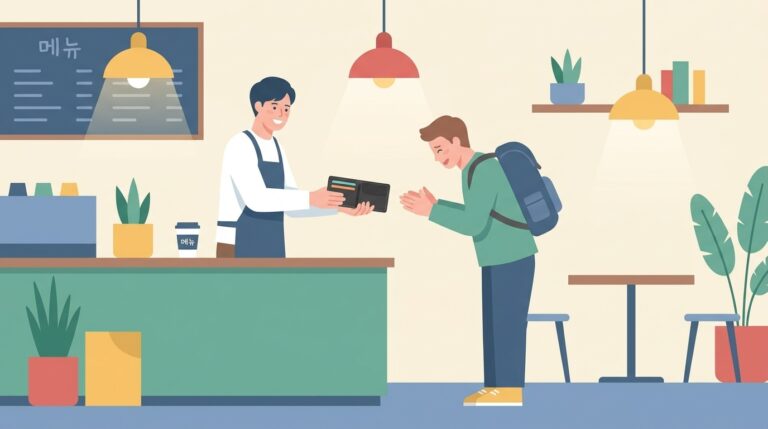
Finding My Lost Wallet in Seoul: A Heartwarming K-Drama Moment in Real Life!
Hello, my lovely Daily Hangul friends! (안녕하세요! 매일한글 에디터입니다.) Have you ever felt that sudden, icy wave of panic wash over you when you reach into your pocket or bag, only to find… nothing? Yes, the ultimate traveler’s nightmare: losing your wallet.
In many parts of the world, losing a wallet containing your ID, cash, and credit cards means saying goodbye to them forever. But in Korea, you might actually experience what foreigners often call the “Korean Wallet Miracle.” Today, we are going to dive into how to talk about your past experiences in Korean—specifically that emotional roller coaster of losing your wallet and miraculously getting it back! Ready? Let’s get started!
Phase 2: Deep Dive into 3 Essential Expressions
1. 지갑을 잃어버렸어요 (Jigabeul ireobeoryeosseoyo)
- Pronunciation: Jee-gap-eul ee-reo-beo-ryeot-eo-yo (Sounds like “Jee-gapool ear-oh-buh-ryuts-uh-yo”)
- Meaning: I lost my wallet.
- K-Culture Moment: You often see this in K-Dramas when the main character frantically pats down their pockets at a subway turnstile, realizing their transit card is gone.
- Editor’s Insight:
잃어버리다(to lose) is a combination of잃다(to lose) and버리다(to throw away/completely do). Adding~어 버리다emphasizes the feeling of regret and completeness of the loss—like “I lost it completely and I feel so bad about it.” - Situation Spectrum: Casual: 잃어버렸어 (✅) | Semi-formal: 잃어버렸어요 (✅) | Formal: 잃어버렸습니다 (✅)
- 🤔 Think About It: How does your native language express regret when losing something? In Korean, the grammar itself physically carries the weight of that regret!
2. 다행히 찾았어요 (Dahaenghi chajasseoyo)
- Pronunciation: Da-haeng-hee cha-jat-eo-yo (Sounds like “Dah-hang-hee chah-jaht-suh-yo”)
- Meaning: Fortunately, I found it.
- K-Culture Moment: The moment of relief when a kind stranger runs up to you in a cafe holding your lost item, or when the police station calls you.
- Editor’s Insight:
다행히comes from다행(luck/good fortune). Using this adverb at the beginning of your sentence instantly shifts the mood of your story from tragic to happy! - Situation Spectrum: Casual: 다행히 찾았어 (✅) | Semi-formal: 다행히 찾았어요 (✅) | Formal: 다행히 찾았습니다 (✅)
- 🤔 Think About It: Koreans heavily emphasize collective relief. Saying “다행이다” (Thank goodness) is almost a reflex when hearing someone else’s good news.
3. 가슴이 철렁했어요 (Gaseumi cheolleonghaesseoyo)
- Pronunciation: Ga-seumi cheol-leong-haes-seo-yo (Sounds like “Gah-seum-ee chul-lung-hat-suh-yo”)
- Meaning: My heart sank. / My heart skipped a beat.
- K-Culture Moment: The exact microsecond you realize your back pocket is empty. Your stomach drops, and you freeze.
- Editor’s Insight:
철렁is an onomatopoeia describing a sudden, heavy sinking feeling (often associated with water splashing or a heavy object dropping). It’s incredibly natural and native-like to use this when telling dramatic stories! - Situation Spectrum: Casual: 가슴이 철렁했어 (✅) | Semi-formal: 가슴이 철렁했어요 (✅) | Formal: 가슴이 철렁했습니다 (⚠️ – slightly too emotional for strict formal reports, but great in casual-formal speeches)
- 🤔 Think About It: Why does Korean have so many physical body-related words for emotions (e.g., “chest/heart sinking”)? It shows how deeply emotional expression is tied to physical sensations in Korean culture.
Phase 3: Textbook Korean vs. Real-Life Korean
Situation 1: Explaining that you lost your wallet
- 📖 Textbook Korean: 저는 길에서 지갑을 분실했습니다. (Jeonun gileseo jigabeul bunsilhaessseumnida. – I misplaced my wallet on the street.)
- 🗣️ Real-Life Korean: 길에서 지갑을 소맷자락에 넣다가 흘렸나 봐요. 아니면 어디 두고 왔나 봐요. (Gileseo jigabeul… eodi dugo wanna bwayo. – I think I dropped it while putting it in my sleeve/pocket… or maybe I left it somewhere.)
- 💡 Why the difference?
분실하다(to misplace/lose) is a very cold, official hanja (Sino-Korean) word used in police reports. In real conversations, Koreans use speculation patterns like~었나 봐요(I guess I did…) to recreate their hazy memory.
Situation 2: Expressing relief
- 📖 Textbook Korean: 지갑을 다시 찾아서 기쁩니다. (Jigabeul dasi chajaseo gippeumnida. – I am glad to find my wallet again.)
- 🗣️ Real-Life Korean: 진짜 살았어요! 한국 사람들 진짜 양심적이네요. (Jinjja sarasseoyo! Hanguk saramdeul jinjja yangsimjeogineyo. – I’m literally saved! Koreans are so honest.)
- 💡 Why the difference? Saying “기쁩니다” sounds like a written speech. Real Koreans use dramatic exaggerations like “살았다!” (I survived/I’m saved!) and praise the “양심” (conscience/honesty) of the finder.
Phase 4: K-Culture Deep Dive & Non-Verbal Manners
4-1. Nunchi & Gestures
When reporting or asking about a lost item in Korea:
* The Two-Handed bow of gratitude: When someone returns your wallet, accept it with both hands (두 손), bowing your head slightly. It shows deep respect and sincerity.
* Eye Contact (Nunchi): Keep your eyes wide and apologetic if asking for help. It signals that you are genuinely troubled, triggering the “Jeong” (정 – warm affection/bond) of the locals.
4-2. The “Korean Wallet Miracle” Culture
Korea is world-famous for its safety. People leave laptops on cafe tables to go to the restroom, and lost wallets often sit untouched on bus stops or are handed over to the nearest police station. This stems from a strong sense of community trust and the widespread presence of CCTV. If you lose something, don’t give up! It’s highly likely sitting safely at a lost and found center.
Phase 5: Real-Life Roleplay Scenario
The Scene: You left your wallet at a trendy cafe in Hongdae. You frantically run back to the cafe and speak to the staff member (Min-su).
Characters:
* You (민우/Min-woo): Panicked but trying to be polite.
* 민수 (Min-su): Helpful and calm cafe barista.
Dialogue
- You: 저기요… 죄송한데요, 제가 아까 여기서 지갑을 잃어버린 것 같아서요.
(Jeogiyo… joesonghandeyo, jega akka yeogiseo jigabeul ireoberin geot gataseoyo.)
Translation: “Excuse me… sorry to bother you, but I think I lost my wallet here earlier.”
(🎭 Hands trembling slightly, looking around the table) -
민수: 아, 정말요? 언제쯤 방문하셨어요?
(Ah, jeongmalyo? Eonje-jjeum bangmunhasyeosseoyo?)
Translation: “Oh, really? Around what time did you visit?” -
You: 한 시간 전쯤에요. 창가 자리에 앉았었어요.
(Han sigan jeon-jjeume-yo. Chang-ga jarie anjasseosseoyo.)
Translation: “About an hour ago. I sat at the window seat.” -
민수: 어떤 지갑이었나요? 색상이나 브랜드를 말씀해 주시겠어요?
(Eotteon jigabieonnayo? Saeksang-ina beuraendeureul malsseumhae jusigesseoyo?)
Translation: “What kind of wallet was it? Could you tell me the color or brand?” -
You: 검은색 가죽 지갑이고, 안에 제 학생증이 들어있어요.
(Geomeunsaek gajuk jigabigo, ane je haksaengjeung-i deureoisseoyo.)
Translation: “It’s a black leather wallet, and my student ID is inside.” -
민수: 아! 혹시 이 지갑 맞나요? 어떤 손님분이 테이블에 있는 걸 맡겨두고 가셨어요.
(Ah! Hoksi i jigap mannayo? Eotteon sonnimbuni teibeure inneun geol matgyeodugo gasyeosseoyo.)
Translation: “Ah! Is this by chance the one? Another customer handed it in after finding it on the table.”
(🎭 Pulls out a black wallet from under the counter) -
You: 맞아요! 와, 진짜 다행이다… 가슴이 철렁했거든요. 정말 감사합니다!
(Majayo! Wa, jinjja dahaengida… gaseumi cheolleonghaetgeodeunyo. Jeongmal gamsahabnida!)
Translation: “That’s it! Wow, thank goodness… my heart had completely sunk. Thank you so much!”
(🎭 Bowing deeply with both hands holding the wallet) -
민수: 찾으셔서 다행이에요! 좋은 하루 보내세요.
(Chajeusyeoseo dahaengieoyo! Joeun haru bonaeseyo.)
Translation: “I’m glad you found it! Have a great day.”
🔀 Interactive Choice Point
What will you say to the customer who handed in your wallet if they are still in the cafe?
* A: “아싸! 지갑 찾았다!” (Assa! Jigap chajatta!)
* B: “정말 감사합니다. 은혜를 평생 잊지 않을게요.” (Jeongmal gamsahabnida. Eunhyereul pyeongsaeng ijji aneulgeyo.)
* C: “찾아주셔서 정말 감사합니다. 덕분에 살았어요!” (Chajajusyeoseo jeongmal gamsahabnida. Deokbune sarasseoyo!)
Feedback:
- A (Bad): Too informal! This means “Yay! I found my wallet!” which you can say to yourself, but not directly as a thank you to someone.
- B (Risk): Too dramatic! “I will never forget your grace for the rest of my life” sounds like a historical drama (사극) hero. It might make the local feel a bit awkward!
- C (Best): Perfect balance! Friendly, polite, and expresses just how relieved you are.
Phase 6: 10-Second Emotion Shadowing Drill
Practice saying these like a native by following the dramatic pauses (/) and emotional cues!
[🥺 Desperate & Worried]
어떡하죠? / 지갑을 / 잃어버린 것 같아요…
(Eotteokhajyo? / Jigabeul / ireobeoryeon geot gatayo…)
“What should I do? I think I lost my wallet…”-
[😊 Immense Relief]
와, / 진짜 다행이다! / 가슴이 / 철렁했잖아요!
(Wa, / jinjja dahaengida! / Gaseumi / cheolleonghaetjanayo!)
“Wow, thank goodness! My heart literally sank!”
Phase 7: K-Culture Mini Dictionary
- 분실물 (Bunsilmul) | Lost Property / Lost Items | Used widely in public places (e.g., “분실물 센터” – Lost and Found Center).
- 양심 (Yangsim) | Conscience | Often used to praise someone’s honesty (e.g., “양심 냉장고”, “양심적인 사람”).
- CCTV (Sisi-tibi) | Security Camera | Korea’s high density of CCTV is the unsung hero behind the safe retrieval of lost goods.
- 파출소 (Pachulso) | Local Police Substation | The friendly neighborhood police box where people turn in lost items.
Phase 8: Traveler’s Survival Kit
Survival Phrases TOP 3:
- 지갑을 두고 왔어요. (Jigabeul dugo wasseoyo.) – I left my wallet behind.
- 여기에 지갑 있었나요? (Yeogie jigap isseonnayo?) – Was there a wallet here?
- 경찰서가 어디예요? (Gyeongchalseoga eodiyeoyo?) – Where is the police station?
💡 Editor’s Travel Note
If you lose something in public transit, don’t panic! Open the LOST112 Portal (integrated lost and found system run by the Korean Police) or check with the station office. Note: Information and procedures on LOST112 may vary slightly depending on your location, but it remains the most reliable nationwide service.
Phase 9: “Going One Step Deeper” (Thinking Corner)
In many countries, individual responsibility is the golden rule—if you lose it, it’s your fault. However, Korean society is deeply rooted in “Jeong” (정) and collective safety. Returning a lost item is not just about being lawful; it’s about putting oneself in the other person’s shoes.
💬 Your Turn: Have you ever lost something valuable while traveling? How would you react if you found someone else’s wallet on a cafe table in Seoul? Share your stories in the comments below!
Phase 10: FAQ & Common Mistakes
Q: Can I use “잃어버리다” for losing a game or weight?
A: No! 잃어버리다 is only for losing physical objects (like keys, phones, or wallets). To lose a game, use 지다 (jida). To lose weight, use 살을 빼다 (sareul ppaeda).
Q: What is the difference between “잃다” and “잃어버리다”?
A: 잃다 is a general term for losing something (often abstract things like confidence, consciousness, or friends). 잃어버리다 emphasizes the complete, physical, and regretful loss of an object.
Q: What should I do first if I lose my wallet on a Seoul subway?
A: Remember your exact train number and car number (usually written on the platform doors), then immediately report it to the station office (역무실).
🚨 Common Mistakes Alert!
- Bad: 지갑을 졌어요 (Jigabeul jyeosseoyo) ❌
- Correction: 지갑을 잃어버렸어요 (Jigabeul ireobeoryeosseoyo) – “졌어요” means you lost a match or game!
- Bad: 가슴이 떨어졌어요 (Gaseumi tteoreojyeosseoyo) ❌
- Correction: 가슴이 철렁했어요 (Gaseumi cheolleonghaesseoyo) – While “dropped” makes sense in English, in Korean, your heart “splashes/sinks” (철렁하다).
Phase 11: Action Mission
- 🥉 Bronze: Say “지갑을 잃어버렸어요” out loud 5 times with a sad expression.
- 🥈 Silver: Write a small journal entry in the comments using:
지갑,다행히, and찾았어요. - 🥇 Gold: Next time you watch a K-Drama, actively listen for characters saying “다행이다” or “철렁했다” and post the timestamp or drama name on your Instagram stories, tagging
@DailyHangul!
Phase 12: Interactive Quiz Challenge
Q1. Which of the following words means “Fortunately”?
- 갑자기 (Gapjagi)
- 다행히 (Dahaenghi)
- 솔직히 (Soljikki)
Reveal Answer & Explanation
Correct Answer: 2. 다행히
* Explanation:
* 1. 갑자기 means “Suddenly”
* 2. 다행히 means “Fortunately/Thank goodness”
* 3. 솔직히 means “Honestly”
Q2. Fill in the blank: 지갑을 _____ (I lost my wallet).
- 찾았어요 (chajasseoyo)
- 잃어버렸어요 (ireobeoryeosseoyo)
- 버렸어요 (beoryeosseoyo)
Reveal Answer & Explanation
Correct Answer: 2. 잃어버렸어요
* Explanation:
* 1. 찾았어요 means “found”
* 2. 잃어버렸어요 means “lost”
* 3. 버렸어요 means “threw away”







