

Escape Room K-Adventure: How to Choose Your Theme Like a K-Drama Pro!
안녕하세요! (Annyeonghaseyo!) It’s your Korean bestie and Daily Hangul Editor here!
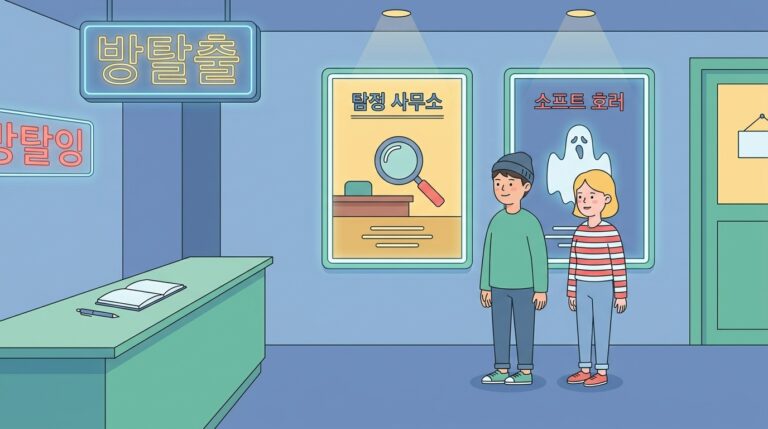
Imagine this: You are standing in the neon-lit hallway of a trendy escape room cafe in Hongdae, Seoul. Your Korean friends are excitedly pointing at posters of blood-curdling ghost houses and dark detective offices. They turn to you and ask: “What do you want to play?”
Suddenly, your mind goes blank. You want to say, “I hate scary things, let’s do a detective one!” but your textbook only taught you “저는 추리를 좋아합니다” (which sounds like a formal robot).
Don’t worry! Today, we are mastering the art of choosing an escape room theme in Korean, A2-style. No scary grammar, just pure, practical fun that will make your Korean friends go, “Wow, your Korean is so natural!”
Phase 2: Key Expressions for Picking Themes
1. 무서운 건 못 해요 (Museoun geon mot haeyo)
- Pronunciation: Moo-suh-oon guhn moht hae-yo (Sounds like “Moo-seon gun mote hey-yo”)
- Meaning: “I can’t do scary things.”
- K-Culture Moment: You will hear K-Pop idols say this in reality shows right before they are forced to enter a haunted house theme!
- Editor’s Insight: Instead of the textbook “저는 공포를 싫어합니다” (I dislike horror), Koreans naturally use “못 해요” (I can’t do [it]) to politely but clearly express their limits.
- Situation Spectrum: Casual (무서운 건 못 해 ⚠️) | Semi-formal (무서운 건 못 해요 ✅) | Formal (무서운 것은 어렵습니다 🚫)
- 🤔 Think About It: Why do you think Koreans use “I can’t do” instead of “I hate” to express preferences? (Hint: It sounds softer and less confrontational!)
2. 추리 테마가 당겨요 (Churi temaga dang-gyeoyo)
- Pronunciation: Choo-ree teh-mah-gah dahng-gyuh-yo (Sounds like “Choo-ree tay-ma-ga dang-gyuh-yo”)
- Meaning: “I’m craving a mystery/detective theme.”
- K-Culture Moment: Like craving spicy Tteokbokki, Koreans use “당기다” (to pull/crave) for activities they are in the mood for!
- Editor’s Insight: “당기다” literally means “to pull.” Saying a theme “pulls” you means you are highly interested in it right now.
- Situation Spectrum: Casual (추리 당긴다 ✅) | Semi-formal (추리 테마가 당겨요 ✅) | Formal (추리 테마를 선호합니다 🚫)
- 🤔 Think About It: Do you have a similar expression in your language where a physical action (like “pulling”) means “craving”?
3. 난이도 어때요? (Nanido eottaeyo?)
- Pronunciation: Nah-nee-doh uh-tteh-yo? (Sounds like “Nah-nee-do uh-day-yo?”)
- Meaning: “How is the difficulty level?”
- K-Culture Moment: Essential question when booking escape rooms in Seoul, as some themes have a 99% failure rate!
- Editor’s Insight: “난이도” (Difficulty) is a key word in Korean gaming and escape room culture. Always ask this to avoid being locked in a room forever!
- Situation Spectrum: Casual (난이도 어때? ✅) | Semi-formal (난이도 어때요? ✅) | Formal (난이도가 어떻게 됩니까? 🚫)
- 🤔 Think About It: Why is it practical to ask about difficulty before booking in Korea’s fast-paced gaming culture?
Phase 3: Textbook Korean vs. Real Korean
Situation 1: Saying you don’t want horror
- 📖 Textbook: “저는 공포 영화나 공포 게임을 좋아하지 않습니다.” (I do not like horror movies or horror games.)
- 🗣️ Real Korean: “저 진짜 쫄보라 공포는 절대 안 돼요!” (I am a total coward, so horror is an absolute no!)
- 💡 Why the difference? “쫄보” (Jjol-bo) is a super friendly, cute slang for “coward” or “scaredy-cat.” Using this instantly breaks the ice and makes everyone laugh!
Situation 2: Asking for a mystery/detective theme
- 📖 Textbook: “추리 소설 같은 테마를 선택합시다.” (Let us choose a theme like a detective novel.)
- 🗣️ Real Korean: “우리 머리 쓰는 추리 테마 해요!” (Let’s do a brain-using detective theme!)
- 💡 Why the difference? Koreans love the phrase “머리 쓰다” (to use one’s brain) for puzzles, quizzes, and mystery escape rooms.
Phase 4: K-Culture Deep Dive & Non-Verbal Manners
4-1. The “No-Spoiler” Pinky Promise (쉿! Secret Gesture)
In Korean escape room cafes, confidentiality is highly respected. Before entering, you will sign a waiver promising not to reveal the puzzles. When talking about themes in the lobby, keep your voice low, place your index finger over your lips (“쉿!” – Shh!), and respect other players who are coming out of the rooms.
4-2. The Escape Room Cafe (방탈출 카페) Craze
In Korea, escape rooms are not just games; they are immersive cafes! Located in major youth districts like Hongdae, Sinchon, and Gangnam, these cafes offer high-tech sensors, movie-like sets, and detailed storylines. Some horror themes even feature live actors! Knowing how to express your limits is crucial for your safety (and heart rate!).
Phase 5: Real-Life Roleplay Scenario
Setting: A trendy escape room cafe in Hongdae. You are with your Korean friend, Minjun.
- 민준 (Minjun): 공포 테마 할래요, 아니면 추리 테마 할래요?
(Do you want to do a horror theme, or a mystery theme?) - 나 (You): 🎭 (With trembling hands) 저는 진짜… 무서운 건 못 해요.
(I really… can’t do scary things.) - 민준 (Minjun): 아, 진짜요? 공포 테마 엄청 재밌는데! 안 무서운 것도 있어요.
(Oh, really? Horror themes are so fun! There are some that aren’t scary.) - 나 (You): 🎭 (Shaking your head vigorously) 아니요, 저 완전 쫄보예요! 공포는 절대 안 돼요.
(No, I’m a total coward! Horror is an absolute no.) - 민준 (Minjun): 하하, 알겠어요. 그럼 머리 쓰는 추리 테마로 볼까요?
(Haha, okay. Then shall we look at a brain-using mystery theme?) - 나 (You): 🎭 (Smiling with relief) 네, 좋아요! 추리 테마가 당겨요.
(Yes, great! I’m craving a mystery theme.) - 민준 (Minjun): 이 테마 어때요? ‘홍대 탐정’인데 인기가 많아요.
(How about this theme? It’s ‘Hongdae Detective’ and it’s very popular.) - 나 (You): 🎭 (Pointing at the star ratings on the poster) 그거 난이도 어때요? 너무 어려우면 탈출 못 해요!
(How is the difficulty level of that one? If it’s too hard, we can’t escape!)
🔀 Interactive Choice Point!
How would you respond if Minjun asks, “How about a semi-horror detective theme?”
* A) “네, 조금은 괜찮아요!” (Yes, a little bit is okay!)
* B) “싫어합니다.” (I dislike it. – Too cold!)
* C) “절대 안 돼요! 저 울 거예요!” (Absolute no! I will cry! – Cute and clear!)
Feedback:
- Best Choice – C: Super cute and natural! It clearly sets your boundary while keeping the mood fun and friendly.
- Good Choice – A: Great if you want to challenge yourself.
- Risky Choice – B: A bit too textbook and blunt. It might make the mood awkward.
Phase 6: 10-Second Emotion Shadowing Drill
Practice saying these lines with the exact emotion to sound like a native!
[🥺 Scared & Pleading]무서운 건 / 못 해요… (Moo-suh-oon guhn / moht hae-yo…)[😎 Confident & Hungry for Puzzles]추리 테마가 / 당겨요! (Choo-ree teh-mah-gah / dahng-gyuh-yo!)[😱 Panicked & Dramatic]저 진짜 / 쫄보예요! (Juh jin-jja / jjol-bo-yeh-yo!)
Phase 7: K-Culture Mini Dictionary
- 방탈출 (Bang-tal-chul) | Escape Room (Literally: “Room Escape”)
- 쫄보 (Jjol-bo) | Coward / Scaredy-cat (Highly used among friends)
- 난이도 (Nan-i-do) | Difficulty level
- 힌트 (Hint-teu) | Clue / Hint (Most Korean escape rooms give you 3-4 hints via a smartphone or tablet!)
Phase 8: Survivor Kit for Travelers
Survival Phrases TOP 3
- 힌트 어떻게 써요? (Hint-teu eo-tteo-ke sseo-yo?) – How do we use hints?
- 탈출 성공했어요! (Tal-chul seong-gong-haet-seo-yo!) – We successfully escaped!
- 사진 찍어 주세요. (Sa-jin jjik-eo ju-seyeo.) – Please take a photo for us. (They usually print a photo for you if you escape!)
🗺️ Editor’s Travel Note:
To book the best escape rooms in Seoul, do not search on English sites. Download the Naver Map App and search “방탈출 카페” (Bangtalchul Cafe) near you. You can see ratings, read Korean reviews, and book directly!
Phase 9: “Going Deeper” (Cultural Insight)
In Korea, escape rooms are a staple of “Nori Munhwa” (Play Culture). Unlike in some Western countries where escape rooms are mostly corporate team-building events, in Korea, they are a primary dating and hangout activity. This explains why they are so heavily stylized, story-focused, and emotional. Knowing your preferences and negotiating them with your friends is part of building close relationships (정 – Jeong) in Korea!
💬 Your Turn: Would you choose a horror theme or a mystery theme? Tell me in the comments below using today’s Korean expressions!
Phase 10: FAQ & Avoiding Common Mistakes
Q: Can I play Korean escape rooms even if my Korean is only A2 level?
A: Yes! Many popular cafes in Hongdae and Gangnam offer English-friendly themes where the text and puzzle clues are translated. Just ask the staff: “영어 테마 있어요?” (Yeong-eo tema is-seo-yo? – Is there an English theme?)
Q: How do we get hints in Korean escape rooms?
A: Usually, they will hand you a smartphone or tablet. You enter a code found near the puzzle to receive the hint. Sometimes, you have to talk through a walkie-talkie, which is a great chance to practice your Korean speaking skills!
🚨 Common Mistakes Alert!
- Mistake: Saying “저는 무서운 사람입니다” (I am a scary person) instead of “무서운 건 못 해요” (I can’t do scary things).
- Correction: Saying “무서운 사람” means you are scary/frightening! Always use “무서운 것” (scary things) or “공포 테마” (horror theme).
Phase 11: Action Mission!
- 🥉 Bronze: Say “무서운 건 못 해요” out loud 3 times in front of your mirror with a scared face.
- 🥈 Silver: Share this post on your SNS with the hashtag #DailyHangul and tell us if you are a “쫄보” (scaredy-cat) or a “정대세” (brave expert)!
- 🥇 Gold: Next time you watch a K-Drama or Variety show, spot the word “쫄보” or “공포” and write down the context!
Phase 12: Interactive Quiz Challenge!
Test your skills! Click to reveal the answers.
1. What does “쫄보” mean?
Click to reveal the answer
Answer: Coward / Scaredy-cat. Use this cute slang to explain why you don’t want to do horror themes!
2. How do you say “I’m craving a mystery theme” in semi-formal Korean?
Click to reveal the answer
Answer: “추리 테마가 당겨요.” (Churi temaga dang-gyeoyo.)
3. True or False: “난이도” refers to the number of people allowed in the room.
Click to reveal the answer
Answer: False. “난이도” (Nan-i-do) means “difficulty level.” If it has 5 stars, prepare your brain!







