

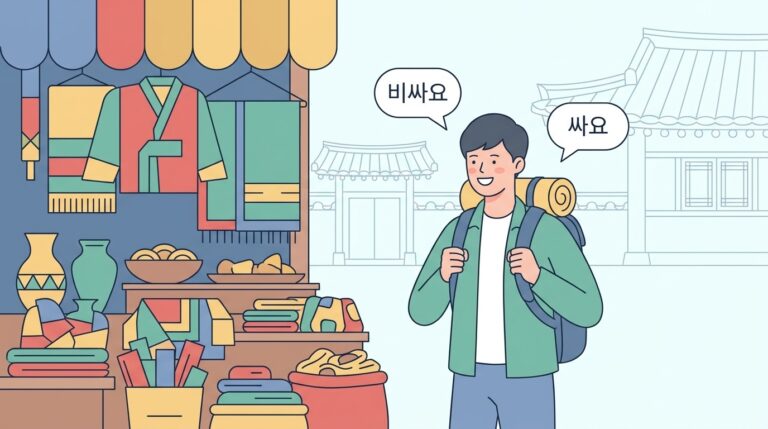
Master Shopping in Korea: How to Say ‘It’s Expensive’ and ‘It’s Cheap’ (비싸요/싸요)
Phase 1: Empathy (Your Korean BFF’s Guide to Shopping)
안녕하세요! (An-nyeong-ha-se-yo!) Your favorite Daily Hangul editor and cultural navigator is here! ✨
Picture this: You are wandering through the dazzling, neon-lit streets of Hongdae or the trendy alleys of Myeongdong. You spot a gorgeous, hand-crafted K-beauty set or a stylish jacket like the one your favorite K-drama lead wore. You check the price tag. Your heart either leaps because it’s a steal, or your jaw drops because it costs more than your plane ticket!
You want to express this feeling to your shopping buddy or even haggle politely with the friendly shop owner (이모님 – I-mo-nim). But how do you say “It’s expensive” or “It’s cheap” without sounding like a robotic dictionary?
Don’t worry! Today, we are going to master the ultimate shopping survival words: 비싸요 (Bi-ssa-yo) and 싸요 (Ssa-yo). Let’s make sure you never overpay and always shop like a local!
Phase 2: Core Expressions Deep-Dive
1. 비싸요 (Bi-ssa-yo)
- Pronunciation: Bee-sah-yo (Think of the “ssa” as a strong, tense “S” sound, like the hissing of a tea kettle.)
- Meaning: It’s expensive. / Costly.
- K-Culture Moment: You will hear this in almost every K-drama when characters go shopping in luxury department stores in Gangnam. A character looks at a bag, gasps secretly, and whispers to their friend: “너무 비싸요!” (It’s too expensive!)
- Editor’s Insight: The root verb is 비싸다 (bi-ssa-da). Adding “요 (yo)” at the end makes it perfectly polite for A1 learners to use with shopkeepers.
- Situation Spectrum: Casual (✅ with friends as ‘비싸’) | Semi-formal (✅ ‘비싸요’) | Formal (☑ ’비쌉니다’)
- ᄉ Think About It: In Korea, discussing prices openly with a vendor is a normal part of street-market culture. How does this compare to your country?
2. 싸요 (Ssa-yo)
- Pronunciation: Sah-yo (Make sure to tense your tongue for the double “SS” sound!)
- Meaning: It’s cheap. / It’s inexpensive.
- K-Culture Moment: Think of those legendary K-pop thrift shopping videos. When idols find a cool vintage shirt for only 5,000 KRW ($4 USD), they happily yell: “대박, 진짜 싸요!” (Awesome, it’s so cheap!)
- Editor’s Insight: Be careful with pronunciation! If you pronounce “싸요” too softly, it might sound like “사요” (sa-yo), which means “I buy it.” Double the ‘S’ energy to mean “cheap”!
- Situation Spectrum: Casual (✅ ‘싸’) | Semi-formal (✅ ‘싸요’) | Formal (☑ ’쌉니다’)
- ᄉ Think About It: “Cheap” can sometimes mean “low quality” in English, but in Korean, “싸요” is mostly positive, meaning “great value for money.”
3. 진짜 싸요 (Jin-jja Ssa-yo)
- Pronunciation: Jeen-jah Sah-yo
- Meaning: It is really cheap! / What a bargain!
- K-Culture Moment: When buying street food like Tteokbokki (spicy rice cakes) or Eomuk (fish cakes) at a traditional market where a huge portion costs almost nothing.
- Editor’s Insight: “진짜” (jin-jja) means “really” or “real.” It adds natural, friendly emotion to your sentence!
- Situation Spectrum: Casual (✅ ‘진짜 싸’) | Semi-formal (✅ ‘진짜 싸요’) | Formal (☐ ‘진짜 쌉니다’ – rarely used, sounds unnatural)
- ᄉ Think About It: Adding intensifiers like “진짜” shows your genuine reaction, making you sound more like a human and less like a textbook.
Phase 3: Textbook Korean vs. Real Korean
Let’s compare what dry textbooks teach you versus how cool, real-life Koreans actually talk!
Situation 1: Reacting to a very high price
- ᄒ extbf{Textbook Korean:} “가격이 매우 고가입니다.” (Ga-gyeok-i mae-u go-ga-im-ni-da. – “The price is highly expensive.”)
- ᅴ extbf{Real Korean:} “우와, 너무 비싸요!” (U-wa, neo-mu bi-ssa-yo! – “Whoa, it’s too expensive!”)
- ᄂ extbf{Why the difference?} Textbook Korean uses dry, Hanja-based (Chinese character) formal vocabulary. Real Koreans use emotional exclamations like “우와” (wow) and the friendly modifier “너무” (too/very) to express shock.
Situation 2: Finding a great deal
- ᄒ extbf{Textbook Korean:} “이 물건은 저렴합니다.” (I mul-geon-eun jeo-ryeom-ham-ni-da. – “This item is low-priced.”)
- ᅴ extbf{Real Korean:} “대박, 이거 진짜 싸요!” (Dae-bak, i-geo jin-jja ssa-yo! – “Awesome, this is so cheap!”)
- ᄂ extbf{Why the difference?} “저렴하다” (to be inexpensive) is used in advertisements or formal writing. In real conversations, younger Koreans love using “대박” (awesome/jackpot) combined with “진짜 싸요.”
Phase 4: K-Culture Deep-Dive & Non-Verbal Manners
4-1. The “Aigu” Hand and Head Tilt (Nunchi & Gestures)
When saying “비싸요” (It’s expensive), never point aggressively at the item. Instead, do this:
1. Tilt your head slightly to the side.
2. Gently touch your cheek or place one hand near your heart.
3. Make a soft sighing sound (“아이구~” – Ai-gu~).
This non-verbal sign shows the shopkeeper that you love the item but your wallet is just a bit too light, prompting them to give you a discount or throw in freebies (서비스 – seo-bi-se)!
4-2. Traditional Market Culture (시장 – Si-jang)
In Korean traditional markets like Mangwon Market or Gwangjang Market, haggling is an art. If you smile warmly and say, “이모, 조금만 깎아주세요~ 너무 비싸요!” (Auntie, please give me a tiny discount~ It’s too expensive!), she might laugh and slash the price. Remember, this works best in traditional markets, never in department stores or convenience stores!
Phase 5: Real-Life Roleplay Scenario
Setting: A trendy vintage clothing shop in Hongdae.
Characters:
* You: A budget-conscious traveler looking for a cool jacket.
* Min-su (민수): The cool shop owner who loves to chat.
- Min-su: 어서오세요! 이 자켓 어때요? 진짜 예뻐요.
(Eo-seo-o-se-yo! I ja-ket eo-ttae-yo? Jin-jja yeo-bpeo-yo.)
“Welcome! How about this jacket? It’s really pretty.” -
You: ᄑ [Admiring the jacket] 와, 진짜 예뻐요! 얼마예요?
(Wa, jin-jja yeo-bpeo-yo! Eol-ma-ye-yo?)
“Wow, it’s really pretty! How much is it?” -
Min-su: 이거 15만 원(150,000 KRW)이에요.
(I-geo sip-o-man won-i-e-yo.)
“This is 150,000 Korean Won (approx. $110 USD).” -
You: ᄑ [Surprised, touching your chest] 헉, 너무 비싸요!
(Heok, neo-mu bi-ssa-yo!)
“Gasp, it’s too expensive!” -
Min-su: 음… 그러면 이 티셔츠는 어때요? 세일해요!
(Eum… geu-reo-myeon i ti-syeo-tsu-neun eo-ttae-yo? Se-il-hae-yo!)
“Hmm… then how about this T-shirt? It’s on sale!” -
You: 오! 이건 얼마예요?
(O! I-geon eol-ma-ye-yo?)
“Oh! How much is this one?” -
Min-su: 만 원(10,000 KRW)이에요!
(Man won-i-e-yo!)
“It’s 10,000 Korean Won (approx. $7 USD)!” -
You: ᄑ [Smiling brightly] 와! 진짜 싸요! 이거 주세요!
(Wa! Jin-jja ssa-yo! I-geo ju-se-yo!)
“Wow! That’s really cheap! Please give me this one!”
ᄒ Interactive Choice Point!
What will you say next to Min-su?
* A. “깎아주세요!” (Kka-kka-ju-se-yo!) – “Give me a discount!”
* B. “카드 돼요?” (Ka-deu dwae-yo?) – “Do you accept cards?”
* C. “너무 비싸요, 안 사요.” (Neo-mu bi-ssa-yo, an sa-yo.) – “Too expensive, I won’t buy it.”
ᄑ Feedback on Your Choice:
- Choice A (Risk ☑ ): It is okay to ask for a discount in street markets, but asking for a discount on a cheap 10,000 KRW shirt might make the owner sweat! Use it for expensive items.
- Choice B (Best ✅): Perfect! Most shops in Korea accept cards, even for small amounts. Very practical.
- Choice C (Bad ❃): Ouch! Saying “I won’t buy it” directly sounds a bit rude in Korean culture. It’s better to just say “감사합니다” (Thank you) and walk away politely.
Phase 6: 10-Second Emotion Shadowing Drill
Let’s practice speaking with real Korean feelings! Pay attention to the pauses (/) and the emotional cues.
- [🥺 Disappointed & shocked]
- “헉! / 너무 / 비싸요…”
- Heok! / neo-mu / bi-ssa-yo…
- (Gasp! It’s too expensive…)
- [ᄑ Excited & pleasantly surprised]
- “대박! / 이거 / 진짜 / 싸요!”
- Dae-bak! / i-geo / jin-jja / ssa-yo!
- (Awesome! This is so cheap!)
Phase 7: K-Culture Mini-Dictionary
- 이모 (I-mo) | Auntie | Used to friendly address female shop owners or restaurant servers in their 40s-60s.
- 대박 (Dae-bak) | Awesome / Jackpot | Expresses extreme amazement or disbelief.
- 세일 (Se-il) | Sale | Korea’s borrowed word from English “Sale.” You will see this written everywhere in shopping districts!
- 서비스 (Seo-bi-se) | Service / Freebie | Refers to free gifts or extra food items given by kind shopkeepers as a friendly gesture.
Phase 8: Survivor Kit for Travelers
Survival Expressions TOP 3
- 이거 얼마예요? (I-geo eol-ma-ye-yo?) – How much is this?
- Pro Tip: Point to any item and say this. It works 100% of the time!
- 조금만 깎아주세요. (Jo-geum-man kka-kka-ju-se-yo.) – Please give me a little discount.
- Pro Tip: Say this with a cute smile in street markets!
- 봉투 필요해요? (Bong-tu pil-yo-hae-yo?) – Do you need a plastic bag?
- Pro Tip: This is what the cashier will ask you. You can reply with “네” (Yes) or “아니요” (No).
ᄑ Editor’s Travel Note: To navigate Korean shopping alleys easily, make sure to download the Naver Map App which provides incredibly precise walking directions in English. Cash is great for traditional markets, but cards are accepted almost everywhere else!
Phase 9: “Going One Step Deeper” (Cultural Essay)
In Western cultures, price tags are usually fixed and final. However, in Korea, shopping is not just a transaction; it is a form of social connection. The act of saying “비싸요” (it’s expensive) with a playful whine, and the shopkeeper replying with “에이, 진짜 안 비싸요~” (Oh come on, it’s really not expensive!) is a bonding game. It utilizes the Korean concept of Jeong (정)—the feeling of warm attachment. By learning these simple words, you aren’t just buying an object; you are participating in a delightful, centuries-old cultural dance.
ᄑ Your Turn: Have you ever negotiated a price in a foreign country? Let us know in the comments below!
Phase 10: FAQ & Avoiding Mistakes (FAQ Schema)
Q: Can I say “비싸요” in a luxury department store like Shinsegae?
A: You can say it quietly to your friend as an observation (“와, 진짜 비싸다…”), but do not say it directly to the clerk to ask for a discount. Department stores have strictly fixed prices!
Q: What is the difference between “싸요” and “저렴해요”?
A: “싸요” (ssa-yo) is casual and used everyday with friends or shop owners. “저렴해요” (jeo-ryeom-hae-yo) is more formal and polite, often used in professional or business contexts.
Q: How do I say “It is extremely cheap”?
A: You can say “대박 싸요” (Dae-bak ssa-yo) or “진짜 너무 싸요” (Jin-jja neo-mu ssa-yo)!
ᄑ Common Mistakes Warning Sign
- Mistake 1: Saying “사요” (sa-yo) instead of “싸요” (ssa-yo).
- Result: You will accidentally say “I buy it” instead of “It is cheap.”
- Correct Action: Put pressure on your tongue to make a strong “S” sound.
- Mistake 2: Screaming “비싸요!!” loudly at an older shopkeeper.
- Result: It can sound aggressive.
- Correct Action: Always say it with a gentle, soft tone and a smile.
Phase 11: Action Mission & Engagement
- ᄆ Bronze Mission: Speak “비싸요” and “싸요” aloud 5 times in front of the mirror using our Shadowing Drill!
- ᄉ Silver Mission: Share this post on your Instagram Story and tag @DailyHangul with your favorite shopping item in Korea!
- ᄀ Gold Mission: Next time you visit a Korean market (or a Korean grocery store in your city), look at the prices and whisper to yourself: “우와, 진짜 싸요!” or “너무 비싸요!”
ᄒ K-Culture Mission: Watch a clip of any K-drama shopping scene and try to spot if the characters say “비싸요”! Write the drama name in the comments!
Phase 12: Interactive Quiz Challenge
Q1. How do you say “It’s too expensive!” politely in Korean?
- A) 비싸
- B) 진짜 싸요
- C) 너무 비싸요
ᄑ Click here for the Answer & Explanation
Correct Answer: C) 너무 비싸요
Explanation: “너무” means “too” and “비싸요” means “expensive (polite).” “비싸” (A) is too casual for strangers, and “진짜 싸요” (B) means “it’s really cheap.”
Q2. True or False: You should haggle and say “비싸요, 깎아주세요” at a convenience store (CU or GS25).
- A) True
- B) False
ᄑ Click here for the Answer & Explanation
Correct Answer: B) False
Explanation: Convenience stores have computerized, fixed pricing. Haggling there will make the cashier very confused! Save your haggling skills for traditional street markets.







